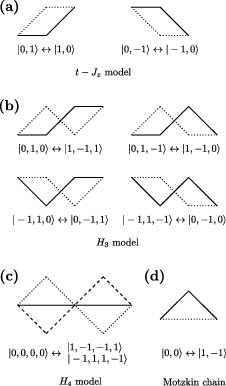
- The paper presents the peak-valley mechanism that imposes local invariant rules, leading to exponential Hilbert space fragmentation in spin systems.
- It employs a duality mapping of spin states to bosonic charge configurations to provide a geometric approach to unifying known fragmentation models.
- The results demonstrate that emergent invariants enforce nonergodic dynamics and enable systematic construction of disorder-free, localized Hamiltonians.
Peak-Valley Mechanism for Hilbert Space Fragmentation: A Technical Analysis
Introduction and Context
The study of ergodicity breaking, delocalization, and thermalization in many-body quantum systems has sharpened, especially with developments in quantifying and constructing models exhibiting Hilbert space fragmentation (HSF). While the eigenstate thermalization hypothesis (ETH) predicts the thermalization of generic many-body systems, growing evidence shows robust nonthermal, disorder-free HSF, where the many-body Hilbert space splits into exponentially many dynamically disconnected Krylov sectors. Typical analyses of HSF are model-specific and lack general organizing principles. In "Peak-valley mechanism for Hilbert space fragmentation" (2604.23659), Fu and Po present a unifying physical mechanism—peak-valley (PV) fragmentation—by leveraging a geometric mapping of spin states to charge configurations and product-state paths. This approach organizes known HSF models, formalizes criteria for fragmentation, and enables systematic construction of new strongly-fragmented Hamiltonians.
Duality: Domain-wall Particle and Bosonic Charge
The formalism begins with a one-dimensional spin-F chain, where local spin-z projections are interpreted as domain-wall particle (DP) variables marking boundaries between different bosonic bond charges (Figure 1). This mapping leads to an auxiliary U(1) boson system living on the lattice bonds, with spin operators dual to fluctuations in bond charge occupation. The Hilbert space of the DP system is only a subspace of the unconstrained bosonic Fock space, with local constraints derived from the finite-range of spin projection, ∣nk+21−nk−21∣≤F.
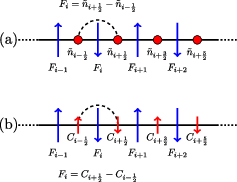
Figure 1: Schematic depiction of a 1D spin-F chain with domain-wall particles mapped onto bond-centered bosonic charges.
Operators in the DP representation are constructed so as to obey these constraints. The mapping preserves critical features such as total DP dipole moment, which is proportional to the total charge fluctuation of the dual system. Consequently, local physical dynamics in the DP system translate to local deformations in path representations of charge distributions.
Geometrical Representation and Operator Structure
The duality naturally supports a geometric—path-based—representation of DP states and operators (Figure 2). Each product state is visualized as a discrete path, with vertical steps encoding local fluctuations in the bond charge. Local DP operators correspond to deformations or local moves on these paths, analogous to step-wise transitions in lattice path enumeration problems (e.g., Motzkin or Fredkin paths). This geometric perspective is critical for formulating the PV fragmentation principle.
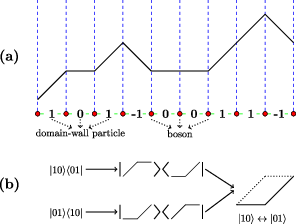
Figure 2: (a) Product-state path representation of DP configurations; (b) local operator-induced path deformations corresponding to off-diagonal transitions.
Peak-Valley Fragmentation Principle
Definition: PV fragmentation occurs when a set of local Hamiltonian terms ensures that the heights of alternating regional peaks and valleys in the geometrical path representation are individually preserved under dynamics. In technical terms, for every q-body local operator, both the local maximum and minimum values of charge along any q-site segment are conserved. As a result, collections of emergent quantum numbers—the heights of regional peaks and depths of valleys—become strict dynamical invariants. The Hilbert space thus fragments into sectors with fixed regional peak/valley values.
These emergent invariants are not associated with standard conserved quantities (e.g., Noether charges), but do correspond to an exponentially large set of disconnected Krylov subspaces, leading to strong, disorder-free HSF.
Core Subspace and Operator Construction
For each spin-F system, the "core subspace" Hc is defined as configurations that strictly preserve certain bounds in cumulative local spin sums, often dual to much simpler models (e.g., spin-S chains with S=F/2). Operators that induce PV fragmentation necessarily preserve z0, and their matrix elements vanish between core and non-core states. This principle underpins a systematic construction:
- Operators are projected onto subspaces where cumulative local spin (or charge) remains within prescribed bounds.
- Allowed off-diagonal processes are those that do not alter the maxima or minima of local path segments. Violation of this condition permits transitions out of the core and destroys fragmentation.
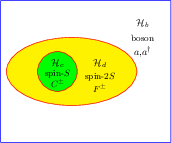
Figure 3: Hierarchical relation among bosonic charge, DP, and core subspaces, as well as schematic flow induced by PV fragmentation.
Examples: Existing and Novel Fragmented Models
PV fragmentation provides a natural organizing principle for known models:
Numerical Evidence: Entanglement and Fragmentation
The sector structure of PV-fragmented models is reflected in the real-space entanglement dynamics (Figures 6, 7). After initializing in a product state within a fixed Krylov sector:
- Entanglement entropy growth fails to become symmetric or thermal even at long times.
- Profiles of z9 vs. cut position exhibit asymmetry and plateau structure directly associated with the underlying peak/valley structure and core invariants.
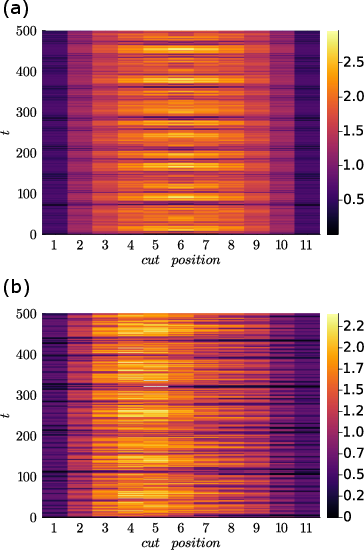
Figure 5: Entanglement entropy versus time and cut position for larger Krylov subspaces, highlighting asymmetry and non-thermalization characteristic of fragmented dynamics.
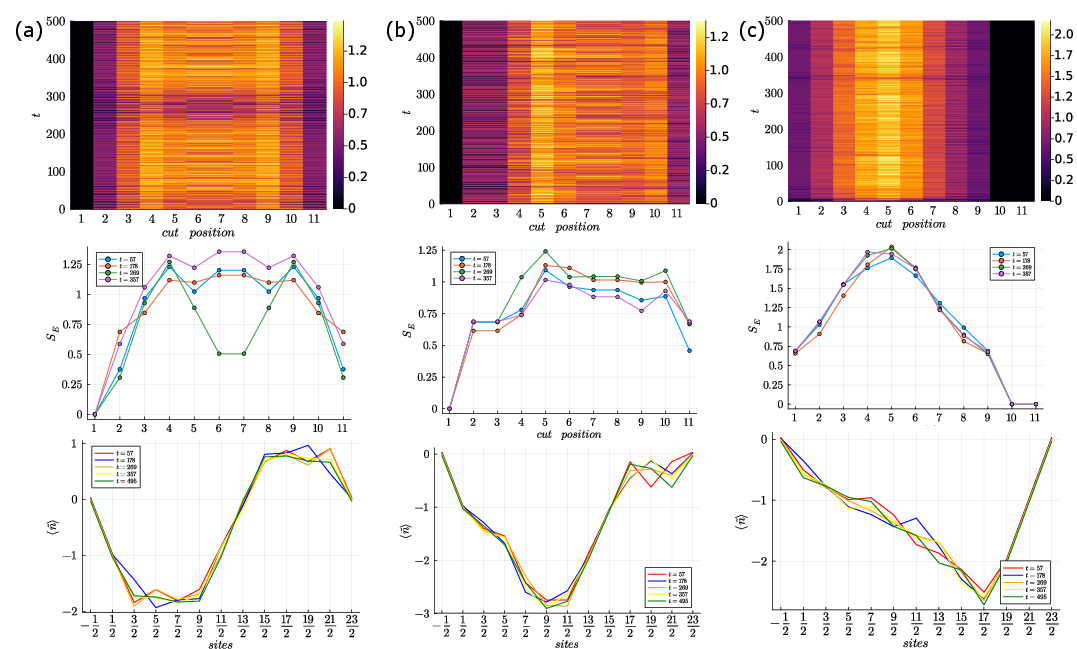
Figure 6: Entanglement entropy and charge expectation for small Krylov sectors, with entanglement plateaus tracking regional geometric features.
Generalization: Higher Spin and Higher-Order Fragmentation
The PV mechanism enables the systematic design of fragmented models for arbitrary spin-∣nk+21−nk−21∣≤F0 chains. For instance:
- Spin-2 ∣nk+21−nk−21∣≤F1-∣nk+21−nk−21∣≤F2 and ∣nk+21−nk−21∣≤F3 analogs: Operators are constructed with suitable projectors such that only transitions within bounded cumulative spin subspaces are permitted (see construction in the text).
- Higher-order fragmentation: Embedding fragmented models (e.g., Fredkin spin-∣nk+21−nk−21∣≤F4) within the core subspaces of PV-fragmented spin-1 models generates a hierarchical HSF, leading to higher-order fragmentation where core subspaces themselves further fragment (Figure 7).
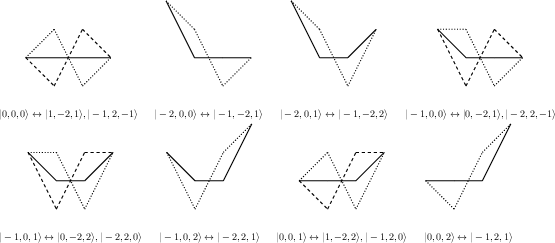
Figure 8: Transitions violating PV fragmentation in the construction of spin-2 ∣nk+21−nk−21∣≤F5 model, illustrating necessary projectors and constraints.
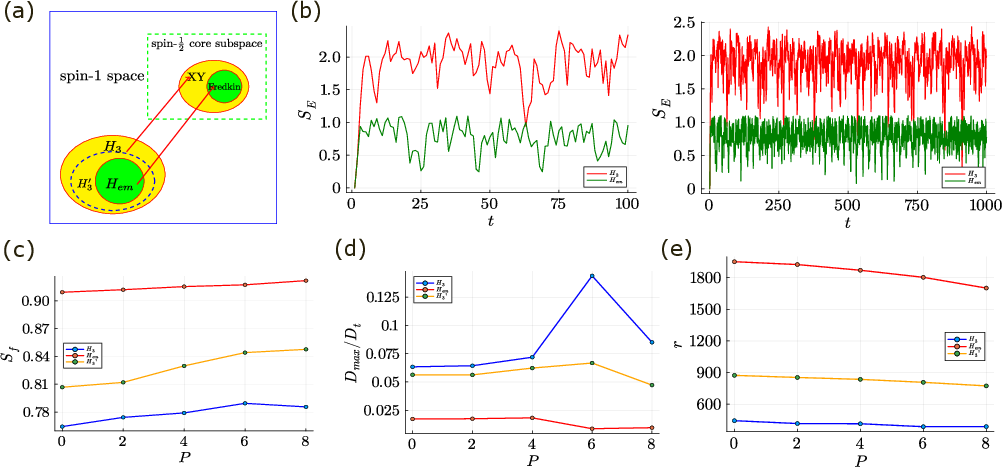
Figure 7: Schematic and numerics (fragmentation entropy, entanglement, sector count) for embedded Fredkin models demonstrating higher-order fragmentation.
Generalizations and Theoretical Implications
The geometric, duality-driven construction can be generalized beyond one dimension, to higher spatial dimensions and to systems with related—but distinct—symmetry constraints. For example, the formalism extends to classical domain-wall particle systems and to higher dimensions via suitably defined plaquette and bond degrees of freedom (Figures 10, 11).
Pragmatically, PV fragmentation provides a robust mechanism for constructing strongly nonergodic, dynamically disconnected subspaces even in clean, translation-invariant models, opening avenues for the investigation of new types of disorder-free localization, memory, and slow relaxation.
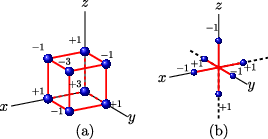
Figure 9: Classical point DP configuration illustrating fractal structures arising in dual descriptions.
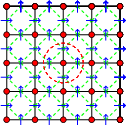
Figure 10: Two-dimensional DP-charge lattice, with DP-charge duality manifesting as plaquette-based transformations.
Conclusion
The peak-valley mechanism organizes and extends the landscape of Hilbert space fragmentation in quantum many-body systems. By enforcing strict local dynamical invariance rules rooted in a geometric charge duality, it produces emergent, sector-defining invariants that guarantee strong, exponentially scaling fragmentation. The framework is both diagnostic—clarifying why known models fragment or not—and generative, enabling construction of new models (including higher-spin or higher-order fragmented systems) with prescribed ergodicity-breaking features. The implications are broad, potentially informing the design of robust quantum memories, slow-thermalization protocols in cold-atom platforms, and the study of localization phenomena in quantum statistical mechanics.