- The paper demonstrates that generalized symmetries induce exponential Hilbert space fragmentation, challenging traditional ergodicity assumptions.
- It unifies subsystem, higher-form, and non-invertible symmetries under a common framework, with models like the PXP and U(1) quantum link illustrating the effects.
- The findings imply that thermalization can occur within isolated Krylov sectors, opening new avenues for quantum simulation and disorder-free localization.
Hilbert Space Fragmentation via Generalized and Non-Invertible Symmetries
Introduction and Motivation
The extensive body of research into quantum ergodicity breaking has identified Hilbert space fragmentation (HSF) as a robust mechanism underpinning anomalous thermalization and slow dynamics in a broad range of quantum many-body systems. In conventional settings, ergodicity breaking is tightly associated with conservation laws arising from global symmetries, which yield a polynomial number of symmetry sectors. However, the presence of exponentially many dynamically disconnected Krylov sectors—core to HSF—has often been regarded as incontrovertible evidence of non-ergodic behavior. The paper "Hilbert Space Fragmentation from Generalized Symmetries" (2604.12907) systematically challenges and restructures this paradigm by demonstrating that generalized symmetries—especially subsystem, higher-form, and non-invertible symmetries—can induce HSF even in absence of conventional ergodicity breaking.
Fragmentation Induced by Generalized Symmetries
The authors formalize sufficient conditions for HSF within translation-invariant tensor product Hilbert spaces. They show that when a local conserved operator possesses extensively many disjoint translations and is diagonal in the product basis, the system splits into exponentially many Krylov sectors. Beyond global symmetries, gauge symmetries and higher-form symmetries (where symmetry operators act on lower-dimensional submanifolds) naturally fulfill these requirements, with the entailed symmetry algebra producing fragmentation scaling as exp(cLf) for system size L and spatial dimensionality f.

Figure 1: The geometry of higher-form (red) and gauge (blue) symmetry operators enables disjoint translations, underpinning Hilbert space fragmentation in lattice systems.
Subsystem and fractal symmetries, whose generators are not necessarily classified by standard group cohomology or p-form structure but instead act on rigid or fractal submanifolds, can manifest similar fragmentation when their support structure permits extensive independence. Crucially, this unified architecture reveals that many emblematic models (including quantum dimer models, quantum link models, and cases with fracton physics) owe their strong fragmentation not to accidental constraints or fine tuning, but to their underlying subsystem or higher-form symmetry content.
Non-Invertible and Partial-Isometric Symmetries
Moving beyond invertible operator symmetries, the work rigorously generalizes fragmentation to non-invertible symmetries, formalized as partial isometries. Here, symmetry operators commute with the Hamiltonian only within constrained sectors and are non-invertible on the global Hilbert space. The symmetry algebra then acts as D=UP, with U unitary and P a projector onto a tensor-factorizing subspace. These non-invertible symmetries, arising for example from dualities (Kramers-Wannier, lattice gauge dualities, etc.), fragment not only the entire Hilbert space but also individual symmetry sectors, yielding a layered architecture of disconnected dynamics.
The 3D U(1) quantum link model provides a concrete realization: apart from strong fragmentation owing to local gauge invariance and higher-form symmetries, the sector specified by maximal planar winding number further fragments due to a family of non-invertible partial isometries supported on 2D slices. The construction Dxy (see Eq. (18) in the paper) projects onto sectors where planar winding is conserved, explaining exponential fragmentation in subsystems that were previously believed to be non-ergodic purely due to microscopic constraints.
Case Studies: PXP Model and Gauge Theories
As a paradigmatic example, the PXP model (constrained spin-1/2 chain describing Rydberg blockade physics) features a simple local conserved operator: the 2-local projector onto neighboring excitations, Gn. This operator commutes with the projected Hamiltonian and, by the general theory above, guarantees fragmentation. Thus, the model's fragmented structure does not necessarily require emergent non-ergodic physics, but is an immediate consequence of its local constraint algebra, interpretable as a L0 gauge structure in disguise.
Krylov-Restricted Thermalization and Disorder-Free Localization
The paper emphasizes that the presence of exponential HSF does not a priori preclude thermalization. Krylov-restricted thermalization describes a dynamical regime where each sector evolves independently and potentially thermalizes internally, but the ensemble does not relax to a global translation-invariant Gibbs state. This mechanism underpins "disorder-free localization" seen in lattice gauge theories: sector-wise initial conditions with spatial inhomogeneity remain dynamically locked even in the large system limit, without invoking disorder or explicit ergodicity breaking.
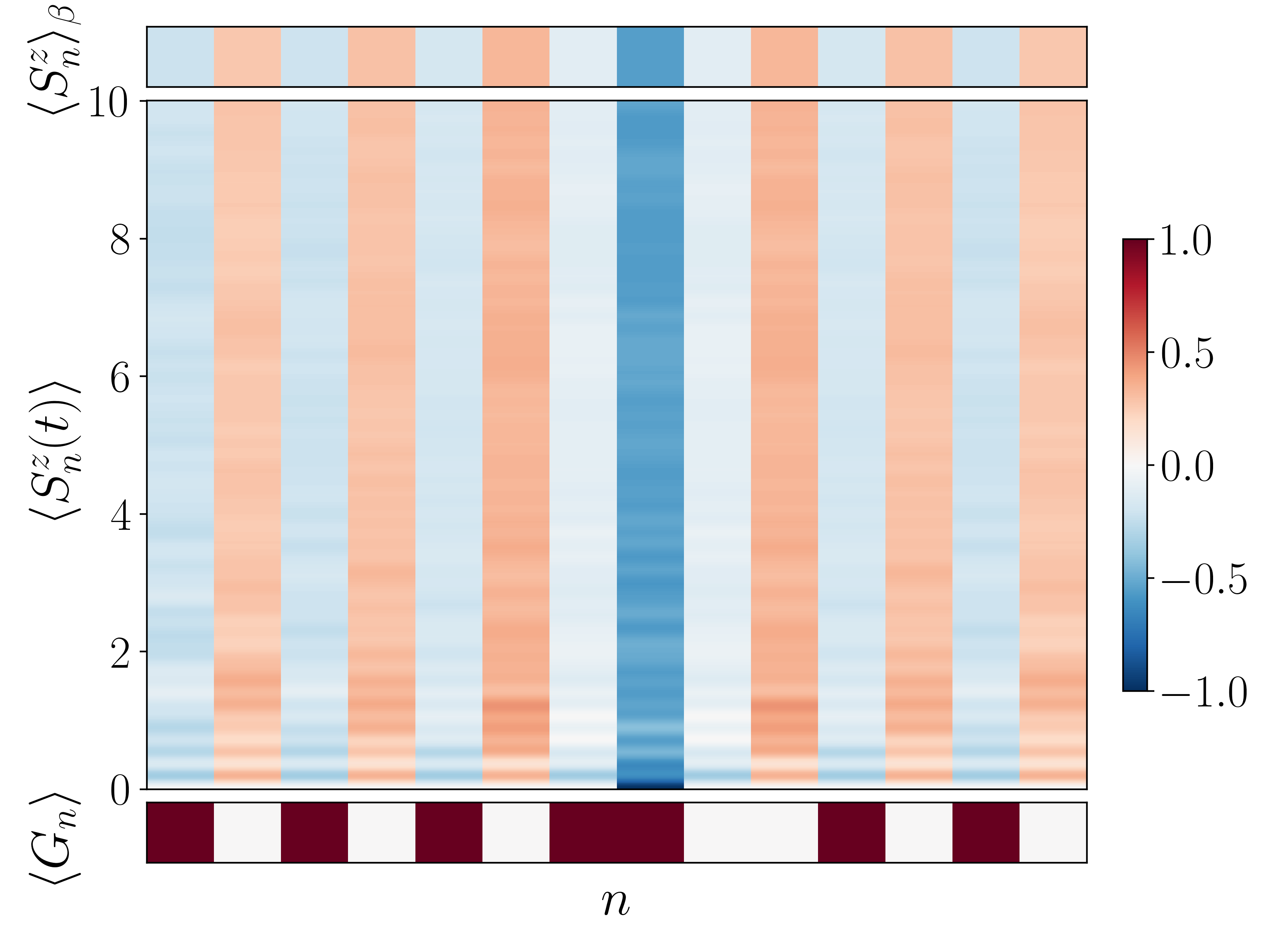
Figure 2: Local magnetization dynamics in a 1D L1 quantum link model initialized in an inhomogeneous sector; relaxation within the Krylov sector preserves non-translation-invariant features at long times.
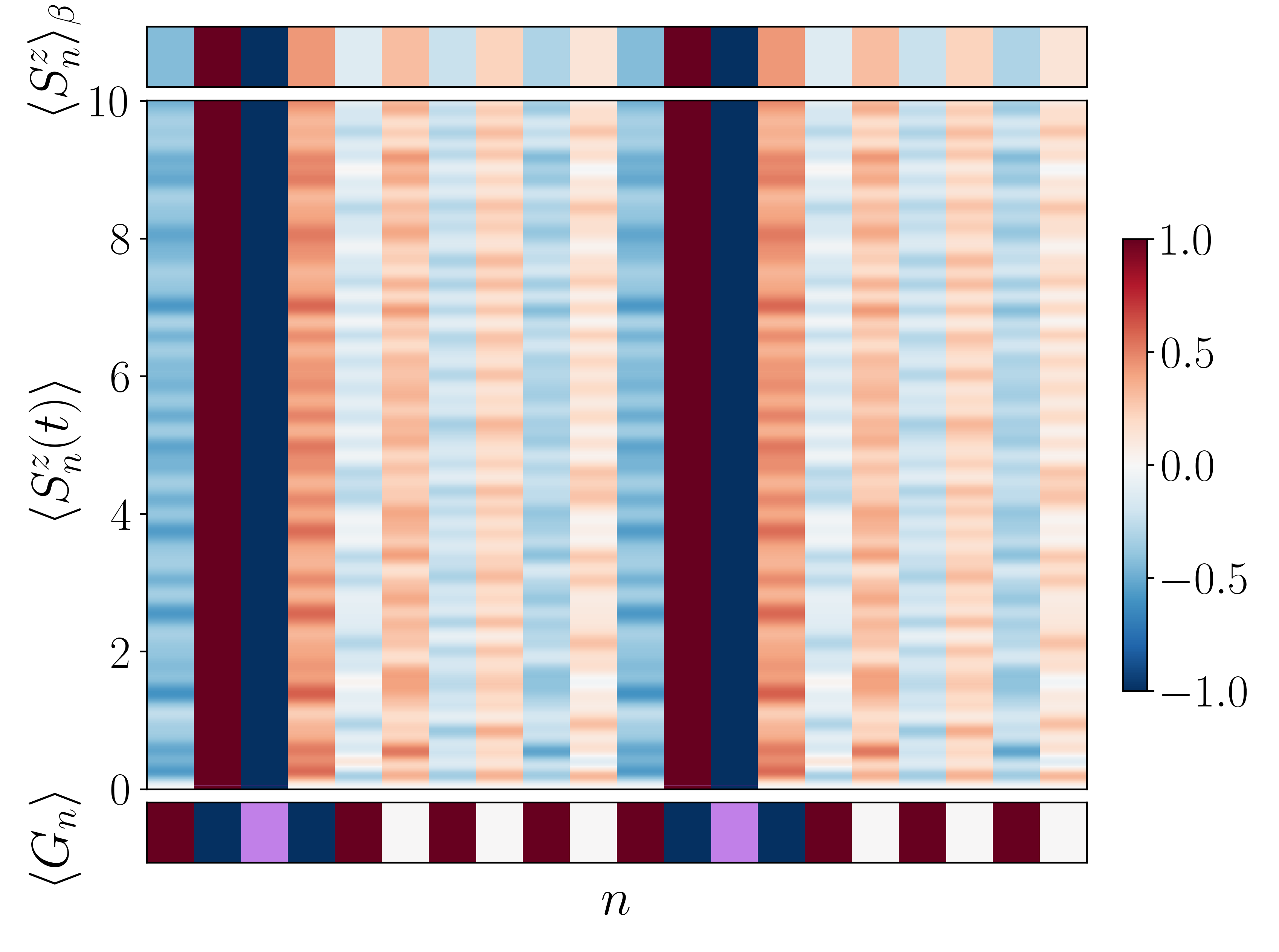
Figure 3: Selected Krylov sectors decouple spatially, fully inhibiting transport and entanglement between frozen subsystems, a hallmark of HSF enforced by local symmetries.
Implications, Theoretical Extensions, and Outlook
This framework exposes the redundancy of the standard association between HSF and ergodicity breaking. The exponential proliferation of Krylov sectors is recast as a symmetry phenomenon, not an exclusively dynamical pathology. If the commutant algebra (the set of all operators commuting with the Hamiltonian) can be generated by generalized symmetries, all instances of fragmentation can be classified within this powerful symmetry-based taxonomy [(2604.12907), Moudgalya_2022].
The identification of non-invertible, subsystem, and higher-form symmetries as responsible for fragmented dynamics suggests new directions in both condensed matter and quantum information theory. These insights inform the design of quantum simulators, the characterization of dynamical quantum memories, and the exploration of robust non-equilibrium phases. The tractability of the symmetry-resolved fragmentation picture enables systematic identification of whether any observed ergodicity breaking is genuinely dynamical (scars, weak fragmentation) or of purely symmetry origin.
Conclusion
"Hilbert Space Fragmentation from Generalized Symmetries" (2604.12907) provides a robust, symmetry-centric classification of fragmentation phenomena in quantum many-body systems. By unifying subsystem, higher-form, and non-invertible symmetries within a dynamical framework, it elucidates when HSF signals true ergodicity breaking and when it is a manifestation of an enriched symmetry algebra. The theoretical apparatus developed allows for both the prediction and control of fragmentation-induced anomalous dynamics, with substantial implications for the study of thermalization, localization without disorder, and quantum simulation architectures. Future work focusing on the algebraic generation of commutants and exploring unresolved non-invertible structures will further refine the understanding of ergodicity and fragmentation in strongly correlated quantum systems.