- The paper introduces a quantum Ising model with side coupling that fragments the Hilbert space into exponentially many invariant sectors under resonance conditions.
- It employs analytical and numerical methods to show reduced entanglement entropy and robust quantum many-body scar revivals at resonance.
- The model’s tunability and geometric flexibility offer new avenues for exploring ergodicity breaking and protecting quantum information.
Hilbert Space Fragmentation in Quantum Ising Systems Induced by Side Coupling
Introduction and Theoretical Framework
This work introduces a generalized quantum Ising model with side couplings designed to induce Hilbert space fragmentation (HSF) and realize quantum many-body scars (QMBS). The system comprises two sets of spins, labeled A (hosting a conventional transverse-field Ising model on an arbitrary lattice) and B (free spins serving as an auxiliary manifold). Each spin in B couples to its A counterpart through a tunable side-interaction. Under specific resonance conditions—when the transverse field strength and the side coupling are equal—the composite Hilbert space fragments into exponentially many dynamically disconnected sectors.
This construction harnesses intrinsic kinetic constraints arising from such coupling-induced resonances, presenting a compelling alternative to canonical models like PXP, MBL, or systems with explicitly imposed conserved quantities. The fragmentation mechanism is not simply attributable to symmetry, but crucially depends on the resonance between the local transverse field and the side-coupling. This framework enables both analytical progress and efficient numerical exploration across various geometries.
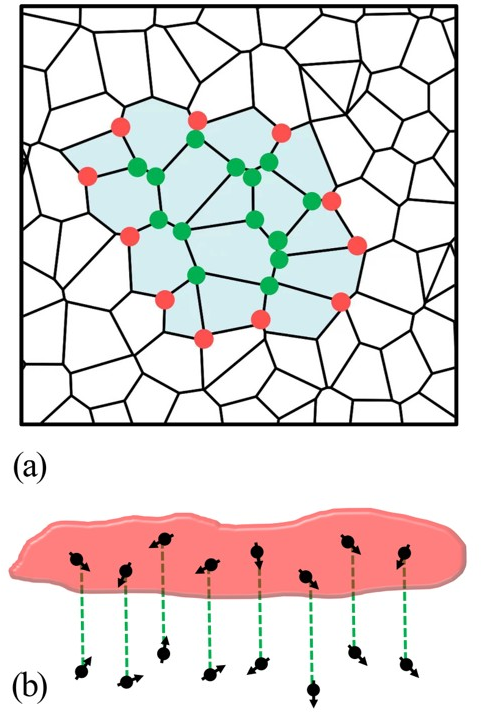
Figure 1: (a) Hilbert space fragmentation arises in a transverse-field Ising model when pinned spins (red dots) at resonance induce kinetic constraints on domain wall motion, fragmenting the Hilbert space; (b) The dual-spin structure with side couplings between A (interacting) and B (free) spins.
The model Hamiltonian is defined as
H=H0+j=1∑Nκjσa,jxσb,jx
with
H0=⟨i,j⟩∑Jijσa,izσa,jz+j=1∑Ngjσa,jx
Here, σa,jα and σb,jα (α=x,y,z) are Pauli operators for A and B spins. The key feature is the commuting set of σb,jx observables, resulting in a large number of mutually independent local integrals of motion.
At resonance (gj=κj for all j), each B spin that is an eigenvector of σb,jx with eigenvalue −1 effectively pins its corresponding A spin by canceling the transverse field, introducing hard dynamical constraints. Every configuration of B spins thus defines an Ising Hamiltonian for A with transverse fields selectively switched off, fragmenting the global Hilbert space into invariant subspaces labeled by the H0=⟨i,j⟩∑Jijσa,izσa,jz+j=1∑Ngjσa,jx0 B-spin sectors. When multiple B spins are pinned, this can spatially disconnect regions of the A lattice, further fragmenting the Hilbert space into exponentially many dynamically isolated sectors.
The fragmentation is highly sensitive to the geometry of A and the distribution of H0=⟨i,j⟩∑Jijσa,izσa,jz+j=1∑Ngjσa,jx1, offering flexibility over the structure and counting of fragmented sectors.
Entanglement Structure and Numerical Findings
The impact of fragmentation is further quantified via the entanglement entropy of eigenstates. Monte Carlo simulations were performed for finite-size chains and two-dimensional square and triangular lattices, focusing on the distribution of the entanglement entropy H0=⟨i,j⟩∑Jijσa,izσa,jz+j=1∑Ngjσa,jx2 between odd and even sites. These reveal:
- At resonance (H0=⟨i,j⟩∑Jijσa,izσa,jz+j=1∑Ngjσa,jx3), a large fraction of eigenstates displays vanishing or strongly reduced entropy, a hallmark of strong HSF.
- Off-resonance, this effect disappears, and entropy distributions revert towards thermal (ETH) predictions.
- The geometry of the underlying lattice materially affects the detailed statistics of H0=⟨i,j⟩∑Jijσa,izσa,jz+j=1∑Ngjσa,jx4, evidencing geometry-dependent fragmentation patterns.
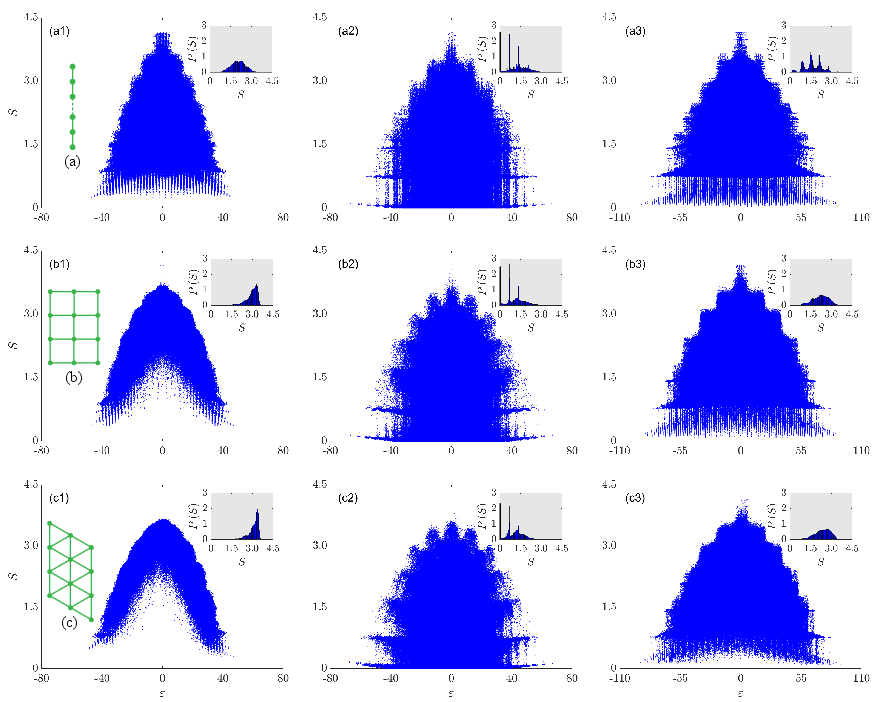
Figure 2: Entanglement entropy distributions for eigenstates in chain, square, and triangular lattices at, above, and below resonance, demonstrating the sharp increase in zero-entropy states at resonance.
Quantum Many-Body Scars and Dynamical Study
The work verifies the presence of non-thermal QMBS by examining the dynamical evolution and fidelity of special initial product states, corresponding to subspaces supporting exact scarred eigenstates. For bipartite lattices at resonance, the dynamics under quantum quenches display:
- Perfect periodic revivals in fidelity, indicating non-ergodic dynamics.
- Zero entanglement entropy throughout time evolution, confirming localization within a (fragmented) subspace.
- For off-resonance parameters, the periodicity is destroyed, and entanglement grows, demonstrating the strict necessity of the resonance for robust QMBS.
This analytical and numerical evidence for QMBS is valid in arbitrary lattice geometries, not restricted to chains.
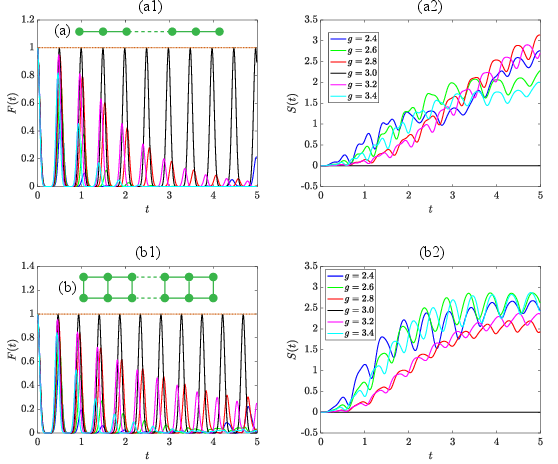
Figure 3: (a1, b1) Dynamical fidelity and (a2, b2) bipartite entanglement entropy for bipartite lattices; perfect revivals and zero entropy manifest QMBS at resonance, with amplitude decay off-resonance.
Comparison with PXP and Scar Models
The scheme is conceptually related to the PXP model, which also realizes QMBS via kinetic constraints. However, key distinctions are:
- Blockade mechanisms involve two coupled species in the present model, versus constrained single-spin flips in PXP.
- Arbitrary lattice geometry is permissible here; PXP is restricted to chains.
- The fragmentation mechanism here arises from dynamically imposed kinetic constraints at resonance, not from integrability or simple symmetry sectors.
This positions the model as a versatile and tractable platform for exploring HSF and scarring in a much broader range of settings.
Conclusion
This work presents a formal and computational study of Hilbert space fragmentation and QMBS in quantum Ising systems with side coupling. The resonance between the transverse field and side interaction induces a vast proliferation of dynamically invariant sectors, mathematically akin to a fragmentation of the Hilbert space into exponentially many isolated components. The existence and geometry of fragmentation is reflected in the entanglement structure and dynamical properties, including QMBS revivals, and is robust across varied lattice types.
Theoretically, this expands the classification of mechanisms capable of violating ETH and hosting non-thermal memory-retaining dynamics, independently of disorder or explicit integrability. Practically, the system's tunability and geometric generality suggest applications in protecting quantum information and engineering ergodicity-breaking dynamics on programmable quantum simulators. Further developments may include detailed scaling analyses of sector dimension statistics, explorations of the interplay with weak disorder, and proposals for experimental realization using synthetic quantum matter platforms.

