Oracle Noise: Faster Semantic Spherical Alignment for Interpretable Latent Optimization
Published 26 Apr 2026 in cs.CV | (2604.23540v1)
Abstract: Text-to-image diffusion models have achieved remarkable generative capabilities, yet accurately aligning complex textual prompts with synthesized layouts remains an ongoing challenge. In these models, the initial Gaussian noise acts as a critical structural seed dictating the macroscopic layout. Recent online optimization and search methods attempt to refine this noise to enhance text-image alignment. However, relying on unconstrained Euclidean gradient ascent mathematically inflates the latent norm and destroys the standard Gaussian prior, causing severe visual artifacts like color over-saturation. Furthermore, these methods suffer from inefficient semantic routing and easily fall into the ``reward hacking'' trap of external proxy models. To address these intertwined bottlenecks, we propose Oracle Noise, a zero-shot framework reframing noise initialization as semantic-driven optimization strictly confined to a Riemannian hypersphere. Instead of relying on complex external parsers, we directly identify the most impactful structural words in the prompt to efficiently route optimization energy. By updating the noise strictly along a spherical path, we mathematically preserve the original Gaussian distribution. This geometric constraint eliminates norm inflation and unlocks aggressive step sizes for rapid convergence. Extensive experiments demonstrate that Oracle Noise significantly accelerates semantic alignment and achieves superior aesthetics without black-box models. It completely mitigates Euclidean-induced degradation, establishing state-of-the-art performance across human preference metrics (e.g., HPSv2, ImageReward), semantic alignment (CLIP Score), and sample diversity, all within a strict 2-second optimization budget.
The paper shows that enforcing hyperspherical constraints on noise vectors preserves the Gaussian prior and avoids norm inflation during optimization.
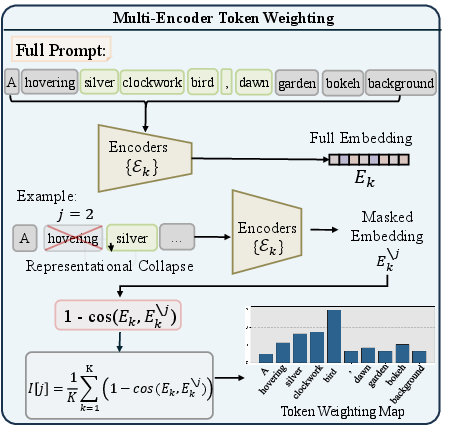
It introduces a novel multi-encoder token weighting strategy that assigns semantic importance without relying on external parsers.
Experiments demonstrate superior compositional alignment, efficiency, and robust performance compared to traditional Euclidean-based approaches.
Oracle Noise: Semantic Spherical Alignment for Interpretable Latent Optimization
Introduction
The Oracle Noise framework establishes a new paradigm for inference-time noise optimization in text-to-image diffusion models, addressing fundamental flaws encountered by previous methods that operate in unconstrained Euclidean space. This work rigorously formalizes the initialization of diffusion latents as a Riemannian hyperspherical optimization problem, ensuring strict preservation of the Gaussian prior, rapid convergence, and mitigation of semantic misallocation—all within a zero-shot, reward-model-free pipeline. Oracle Noise leverages a parser-free, multi-encoder token weighting strategy based on representational collapse and advances a strict spherical geodesic optimization mechanism that aligns macroscopic layout and semantic structure with the compositional intricacy of target prompts.
Theoretical Rationale and Methodological Contributions
High-dimensional Geometry and Failure of Euclidean Approaches
In the latent diffusion regime, high-dimensional Gaussian noise vectors (z∼N(0,I)) naturally concentrate on a thin annulus at radius D, forming a Riemannian hypersphere in high dimensions. Prior work, typically exploiting online Euclidean gradient ascent for conditional alignment, suffers two principal failures: (a) systematic norm inflation that drives the noise distribution off-manifold, producing color over-saturation and geometric artifacts; (b) unstructured allocation of optimization capacity across prompt tokens, leading to poor sample quality and susceptibility to reward hacking when external human preference models are used.
Spherical Geodesic Optimization
Oracle Noise eliminates norm inflation by enforcing all optimization trajectories to remain on the hypersphere, utilizing the exponential map for prior-preserving manifold updates. The method computes gradients of a CFG-aware cross-attention objective, orthogonally projects to the tangent space, and applies a geodesic step parameterized by angular increment η:
zT←zTcosη+∥zT∥∥g⊥∥g⊥sinη
where g⊥ is the projection of the (Euclidean) gradient onto the hyperspherical tangent plane. This guarantees invariance to ℓ2-norm and distributional equivalence to the standard Gaussian prior, as formally characterized by the vanishing Wasserstein-2 distance between the corresponding distributions in high-dimensional spaces.
Multi-Encoder Token Weighting
A critical innovation is Oracle Noise's unsupervised token importance quantification. By iteratively masking each token in the prompt and measuring mean cosine shift in the joint embedding space (across pre-trained encoders such as CLIP-L/G), the approach assigns optimization weights that focus alignment energy on semantically essential tokens ("load-bearing" words):
This advances beyond syntactic parsing: token impact is a function of its effect on the global prompt embedding under cross-modal encoders, supporting prompt-agnostic and model-agnostic token routing.
CFG-Aware Objective and Attention-Level Routing
Oracle Noise computes optimization objectives using CFG-extrapolated pre-softmax attention logits from the frozen generative backbone at maximal noise scale. Layer-aware weights are incorporated, targeting shallow (context) and deep (semantic layout) blocks in direct proportion to their interpretive structure. Failure to account for the guidance dynamics at inference leads to suboptimal update directions incompatible with the final generation, a shortcoming confirmed both theoretically and empirically.
Experimental Results
Qualitative Superiority and Semantic Control
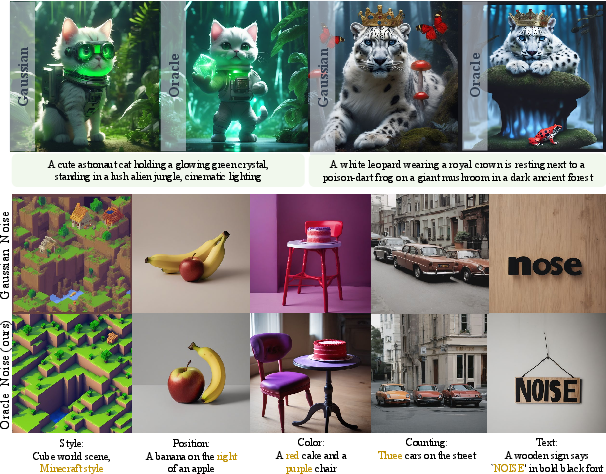
Relative to Gaussian and prior reward-guided baselines, Oracle Noise demonstrates marked improvements in prompt adherence, fine control over compositionality, and explicit rendering of complex compositions. The qualitative evaluation directly showcases its efficacy:
Figure 2: Oracle Noise achieves superior compositional alignment, counting, style control, and explicit text rendering versus Gaussian Noise.
Quantitative Benchmarks
Empirical analysis across MS-COCO, DrawBench, Pick-a-Pic, GenEval, and model variants (SDXL, SD3.5-M, SDXL-Turbo) reveals the following:
Alignment and Fidelity: Oracle Noise decisively outperforms Gaussian and reward-based alternatives in HPSv2, ImageReward, PickScore, Aesthetics, Vendi, and CLIP scores, both in standard and CFG-guided settings.
Sample Diversity: Sample diversity (Vendi Score) and FID improve, indicating both better mode coverage and photorealism.
Efficiency: All alignment and quality gains are achieved within an aggressive 2-second inference budget, contrasting with 35–600s latencies in reward-hacking and Euclidean baselines.
Figure 3: Oracle Noise materially reduces FID and improves CLIP alignment compared to Gaussian initialization, with effective ablation showing all components are essential for peak performance.
Robustness and Ablation
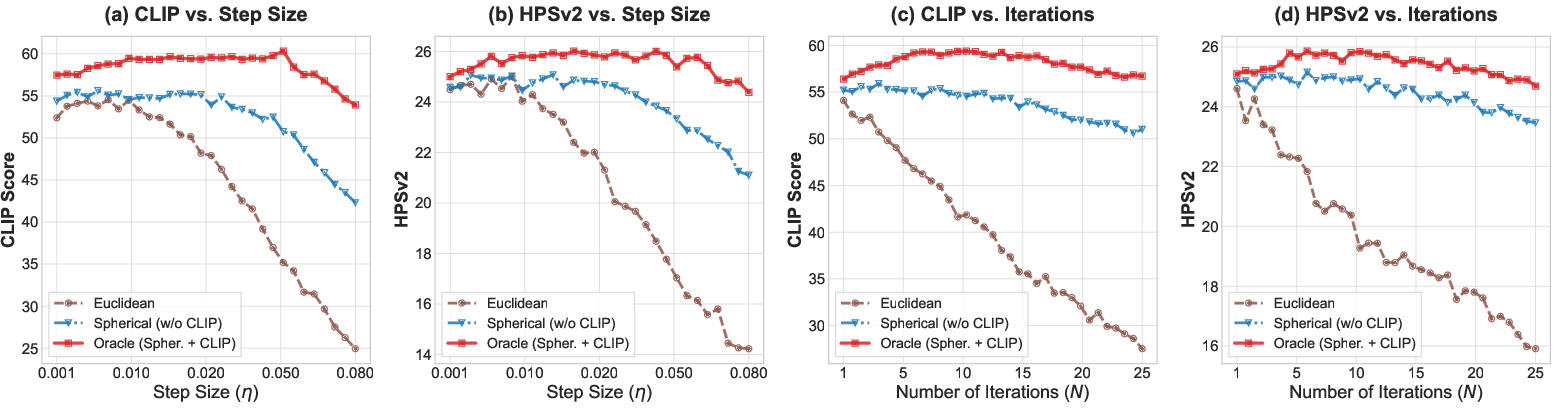
Ablation confirms that each ingredient—multi-step geodesic optimization, token weighting, and spherical constraint—contributes uniquely to final performance. Notably, unconstrained Euclidean updates cause optimization collapse at moderate-to-large step sizes; geometric preservation via Oracle Noise allows for larger, robust steps and fast convergence.
Figure 4: Hyperparameter study showing that unconstrained Euclidean steps cause instability, pure Spherical constrains geometry but lacks semantic focus, and full Oracle Noise overcomes both, achieving rapid and stable fidelity gains.
Failure Modes and Limitations
While Oracle Noise resolves geometric and semantic routing bottlenecks, edge cases remain, especially with antagonistic prompt structure (semantic suppression or attention sinks), or with inherently ambiguous token-embedding interactions. Over-optimization ("geodesic overshoot") can destabilize alignment for simple prompts if hyperparameters are not adaptively tuned. These nuances suggest the need for prompt-aware dynamic step sizing and adaptive early stopping, as well as further exploration into extending these principles to video and 3D generative models.
Theoretical and Practical Implications
This work shows that latent initialization for LDMs is geometry-constrained, not merely a sampling concern. Correctly aligning generations with user intent cannot ignore the high-dimensional topology of the noise manifold, and semantic routing is best optimized by direct measurement of information content in learned embedding spaces rather than heuristics or external black-box proxies.
Practically, this enables interpretable, efficient, and robust semantic alignment at inference without training overhead or risk of reward hacking, fully preserving model prior integrity. These advances can generalize beyond text-to-image, potentially benefiting any generative process seeded by high-dimensional noise—extending to video, 3D, and conditional multimodal synthesis.
Conclusion
Oracle Noise reframes inference-time latent optimization in diffusion models as a strictly Riemannian problem, introducing a mathematically founded, zero-shot method that achieves rapid, robust, and interpretable text-to-image alignment. Its core innovations—semantic token weighting and spherical geodesic updates—resolve the intertwined challenges of geometric degradation, semantic scattering, and reward-model susceptibility, setting a new state-of-the-art on zero-shot metrics across models and datasets. Future progress will likely arise from prompt-adaptive control of optimization hyperparameters and cross-modal generalization.
“Emergent Mind helps me see which AI papers have caught fire online.”
Philip
Creator, AI Explained on YouTube
Sign up for free to explore the frontiers of research
Discover trending papers, chat with arXiv, and track the latest research shaping the future of science and technology.Discover trending papers, chat with arXiv, and more.