- The paper introduces the Nambu-GTEMPO method, extending GTEMPO to simulate fermionic impurities in superconducting baths using Grassmann MPS.
- It benchmarks the method against ED and CTQMC, confirming convergence and accuracy in both equilibrium and non-equilibrium simulations.
- The approach provides a scalable, sign-problem-free alternative for DMFT and real-time evolution studies in superconducting systems.
Grassmann Time-Evolving Matrix Product Operators for Fermionic Impurities Coupled to a Superconducting Bath
Introduction
The study of quantum impurity models (QIPs) is central in condensed matter physics, particularly when the impurity is embedded in a structured bath such as a superconductor. Existing numerical approaches for QIPs include continuous-time quantum Monte Carlo (CTQMC), numerical renormalization group (NRG), exact diagonalization (ED), and tensor-network-based methods such as time-evolving matrix product states (MPS). CTQMC is limited to imaginary-time axes and suffers from the sign problem in real-time calculations, while other real-time techniques either introduce bath discretization errors or are inefficient at finite temperatures.
The Grassmann time-evolving matrix product operator (GTEMPO) framework addresses these challenges by representing path integrals as matrix product states in the temporal dimension, tailored for fermionic systems through Grassmann algebra. However, prior implementations of GTEMPO have restricted the bath to normal (non-superconducting) fermionic environments. This paper extends GTEMPO to the Nambu formalism, enabling the simulation of impurity systems coupled to s-wave superconducting baths—a scenario crucial for phenomena such as Andreev reflection, Yu-Shiba-Rusinov states, Majorana zero modes, and unconventional superconductivity.
Theoretical Framework
Superconducting Anderson Impurity Model and Nambu-GTEMPO
The superconducting Anderson impurity model (SAIM) Hamiltonian includes an impurity with onsite energy εd and interaction U, hybridized with a superconducting bath described by BCS theory:
H=Himp+Hhyb+Hbath
GTEMPO is recast in the Nambu formalism, leveraging the Bogoliubov transformation to convert the superconducting bath into an effective normal bath representation. The influence functional (IF), previously unavailable analytically for superconducting baths, is derived and shown to retain core quadratic structure. This enables straightforward adaptation of GTEMPO's matrix product construction algorithms.
Construction of Influence Functional as a Grassmann MPS
GTEMPO essentially discretizes the path integral in time and encodes the resulting augmented density tensor as a Grassmann MPS (GMPS). The central advance is the partial IF algorithm, which efficiently builds the tensor network representing the IF by regrouping temporal terms sharing common Grassmann variables (GVs). For SAIM, the IF couples both spin species, necessitating a block structure in the tensor network construction.
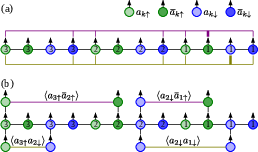
Figure 1: Diagram of the partial IF algorithm, illustrating Grassmann variables, partial influence functional grouping, and GMPS network assembly for SAIM.
Benchmarks and validation of the method are performed through comparison with ED and CTQMC across both imaginary and real-time axes. Observables such as single-particle Green functions and state population probabilities are constructed from the GMPS using rigorous contraction schemes.
Numerical Results
Toy Model and Non-Interacting Benchmarks
The method is rigorously benchmarked against ED for:
- A single-orbital bath (toy model)
- Non-interacting cases with semicircular bath spectral functions
Strong numerical agreement—mean errors decreasing linearly with time step size—demonstrates that for finite baths, MPS bond truncation errors vanish, leaving only discretization artifacts.
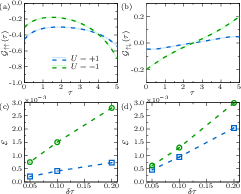
Figure 2: Imaginary-time correlation functions G↑↑(τ) and G↑↓(τ) for the toy model, validating Nambu-GTEMPO against ED.
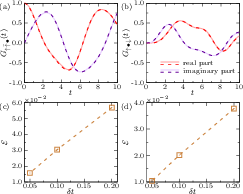
Figure 3: Real-time correlation functions, showing precise agreement between Nambu-GTEMPO and ED for non-interacting QIPs.
For continuous baths, systematic study of the effect of bond dimension (χ) and time step size (δt or δτ) confirms that proper choices yield convergent results.
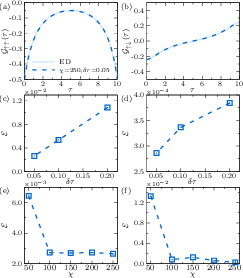
Figure 4: Imaginary-time correlation errors as functions of δτ and χ, illustrating convergence properties in the non-interacting case.
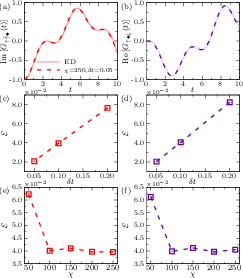
Figure 5: Real-time correlation errors as functions of U0 and U1, showing accuracy scaling in continuous baths.
The method is applied to DMFT simulations on the Bethe lattice, employing typical interaction strengths (U2, half-filling) at both moderate and low temperatures (U3, U4). CTQMC is used as a reference on the imaginary contour. Nambu-GTEMPO exhibits step-by-step numerical correspondence to CTQMC in iterative DMFT, with errors controlled by bond dimension and time step.
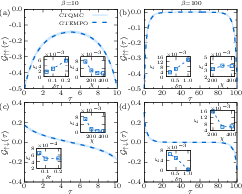
Figure 6: Imaginary-time correlation functions U5, U6 for SAIM, comparing Nambu-GTEMPO to CTQMC and showing hyperparameter influence.
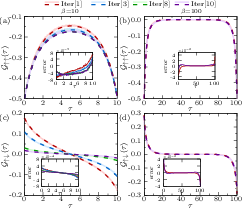
Figure 7: DMFT iteration progression—Nambu-GTEMPO results converge to CTQMC, validating the method as an impurity solver for superconducting states.
Real-Time Evolution: Non-Equilibrium Dynamics
Nambu-GTEMPO advances beyond CTQMC limitations, handling real-time dynamics without sign problem. Time evolution of impurity state populations is computed for SAIM post-quench initialization. Convergence analysis confirms that sufficiently large bond dimension and small time step yield accurate results.
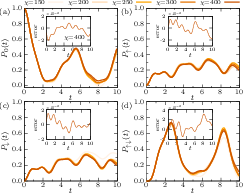
Figure 8: Time evolution of impurity state probabilities for SAIM, demonstrating real-time capabilities and convergence against hyperparameters.
Implications and Future Directions
Nambu-GTEMPO presents a robust, controlled, and flexible tensor network solver for fermionic QIPs in superconducting environments, applicable to equilibrium, non-equilibrium, and DMFT contexts. Its immunity to sampling noise and absence of a sign problem in path integral evaluations make it a strong candidate for impurity solvers in both conventional and cluster extensions of DMFT, especially for superconducting phases and non-equilibrium situations where Monte Carlo methods fail.
Practically, the method is parallelizable in time (subject to tensor network constraints) and amenable to GPU acceleration. The theoretical underpinning of the Bogoliubov transformation's reduction of the bath structure could generalize to other pairing symmetries (triplet, multiband, multisite). Further developments may focus on optimization of GMPS contractions, improved scaling in multi-impurity setups, and integration with algorithmic advances in tensor networks (e.g., temporal entanglement renormalization, block-sparse algebra).
Conclusion
The extension of GTEMPO to the Nambu formalism constitutes a significant step in the numerical simulation of fermionic impurities coupled to superconducting baths (2604.23301). Analytical derivation of the Feynman-Vernon IF, combined with efficient exploitation of the partial IF algorithm, enables high-fidelity simulation across equilibrium and non-equilibrium regimes. Benchmarking against ED and CTQMC confirms accuracy and control of numerical errors. The method's applicability to DMFT and flexibility regarding pairing types underline its broad relevance in correlated electron systems and superconductivity theory. Continued improvement in algorithmic efficiency and parallel hardware integration will further strengthen its practical utility in large-scale quantum many-body simulations.