- The paper introduces a scalable approach that robustly reconstructs 3D models from sparse, uneven Internet photos using advanced sampling strategies.
- It presents the MegaDepth-X dataset with 440,000 images and rigorous dynamic filtering to ensure cleaner data and enhanced depth map quality.
- The study demonstrates significant gains in pose accuracy and global geometry recovery over classical methods by emulating long-tail image distributions.
Long-Tail Internet Photo Reconstruction: Towards Robust 3D Models from Sparse Online Imagery
Background and Motivation
The proliferation of user-contributed photographic content on the Internet offers a potentially vast supervisory signal for 3D vision models. However, the distribution of images across scenes exhibits a highly skewed "long-tail": a minority of landmarks are densely photographed and amenable to classic SfM and modern feed-forward 3D models, while the majority—comprising hundreds of thousands of scenes—are only sparsely, unevenly, and noisily captured. Prior methods, both classical and learning-based, are limited in their ability to reconstruct geometry in these long-tail regimes due to insufficient visual overlap, viewpoint diversity, and the presence of ambiguous or dynamic content (Figure 1).
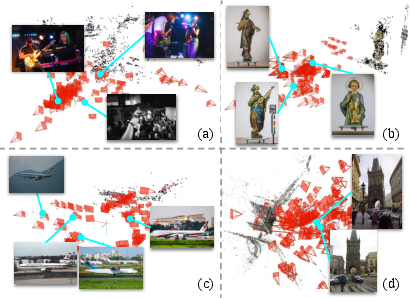
Figure 1: Unreliable reconstructions in MegaScenes, with failure modes arising from dynamic content and doppelganger ambiguity.
Conventional approaches to 3D foundation model training rely on heavily curated and well-conditioned datasets, which fail to represent the true sparsity and heterogeneity observed in the wild. As a result, current models generalize poorly to the sparse, ambiguous, and uneven Internet collections that dominate the data landscape.
The MegaDepth-X Dataset: Large-Scale, Clean 3D Supervision
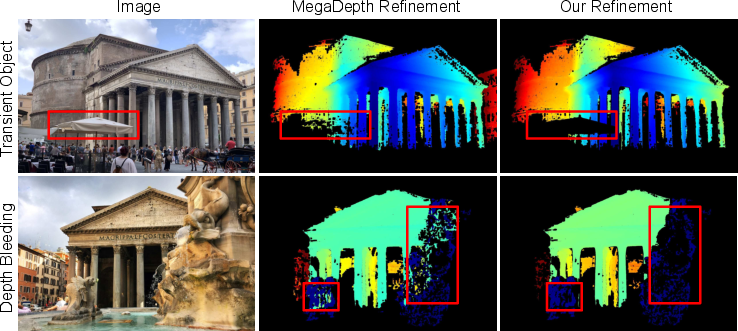
To enable robust training in the long-tail regime, the paper introduces the MegaDepth-X (MD-X) dataset, a significant extension of previous Internet-photo-based depth datasets, which is both 7× larger and substantially cleaner due to a rigorous construction pipeline.
Key steps in MD-X construction include:
MD-X comprises 1,865 landmark-scale reconstructions with over 440,000 images, offering broad viewpoint and scene-type coverage and significantly improving the availability of accurate 3D supervision for real-world Internet scenes.
Emulating Long-Tail Regimes: Sparsity-Aware Sampling
Realistic emulation of Internet photo long-tail characteristics during training is essential for model generalization. The authors focus on three core properties that typify challenging online scenes: their camera-view graphs exhibit low registration rates, sparse and weakly connected clusters, and minimal overlap, leading to failures in classic and learned methods.
To address this, a sparsity-aware sampling strategy is formulated as follows:
- Community Detection: Using the Louvain algorithm, the view graph is partitioned into connected communities reflecting dominant scene regions.
- Approximate Steiner Tree Construction: For target sparsity, a terminal from each community is selected, and a minimal subgraph spanning these terminals is found.
- Greedy View Selection: Views are iteratively sampled to maximize spatial and community coverage, balancing sparsity and local reconstructability (Figure 3).
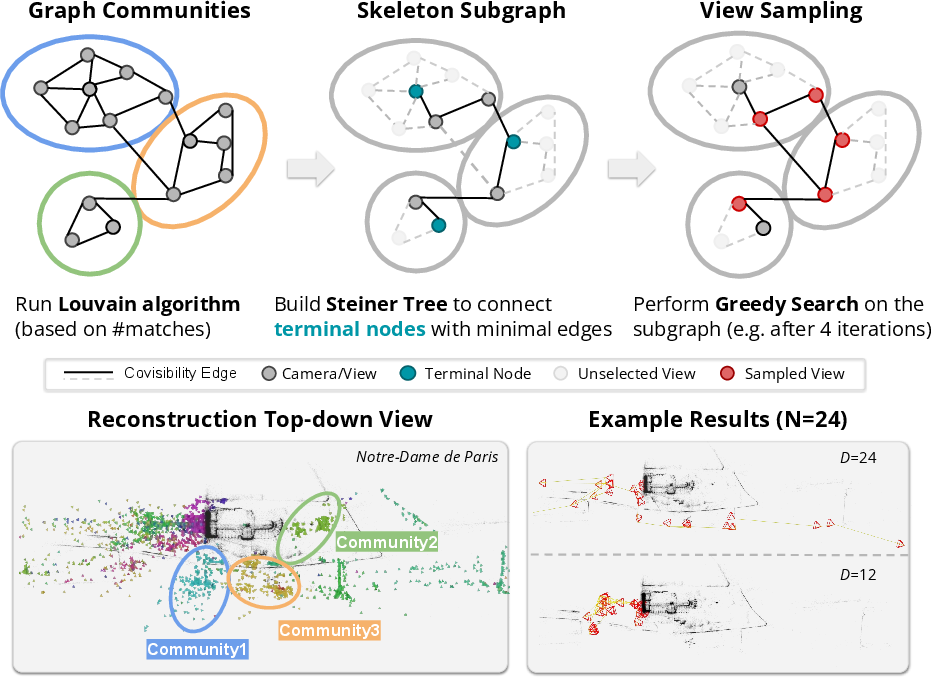
Figure 3: The sparsity-aware multi-stage sampling process enables the creation of training batches that mimic the camera distributions of real long-tail Internet collections.
Adjustable search parameters (e.g., number of connected components, search depth) allow systematic control over sparsity and coverage, directly shaping the difficulty level of synthetic training subsets.
Finetuning 3D Foundation Models for Long-Tail Robustness
The authors systematically finetune two leading feed-forward 3D models, π3 and VGGT, on the MD-X dataset using their long-tail-oriented sampling. Only the Alternating-Attention modules are updated, maintaining the geometric priors from pretraining. Multiple sampling strategies (dense, sparse, mixed, random) are evaluated for their impact on pose and geometry reconstruction under various degrees of sparsity and ambiguity.
Notably, the models fine-tuned with their mixed dense-sparse sampling show dramatic improvements on both synthetic (MD-X hard level) and real long-tail Internet test sets, as compared to both vanilla pretraining and naive sampling protocols.
Experimental Results
Robustness to Internet Long-Tail Scenes
On the MD-X test set and in-the-wild Internet scenes with extreme sparsity, the fine-tuned models display large improvements in pose accuracy, geometric consistency, and global layout recovery. Representative results (Figure 4) show the superiority of the approach under increasing levels of scene difficulty:
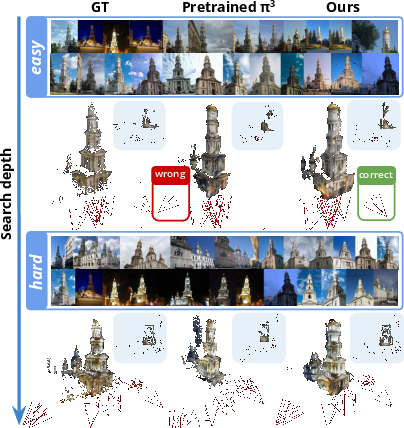
Figure 4: Improvement in reconstruction accuracy and completeness observed for the fine-tuned model on both easy and hard MD-X test cases.
For real long-tail scenes (Figure 5), classical COLMAP often fails entirely, registering few or zero images, and pretrained models generate fragmented or uncertain geometry. In contrast, finetuned models can reconstruct dense, globally coherent point clouds, recover structures from very few input images, and disambiguate doppelganger scene elements, sometimes even outperforming classical methods where zero images are registered.
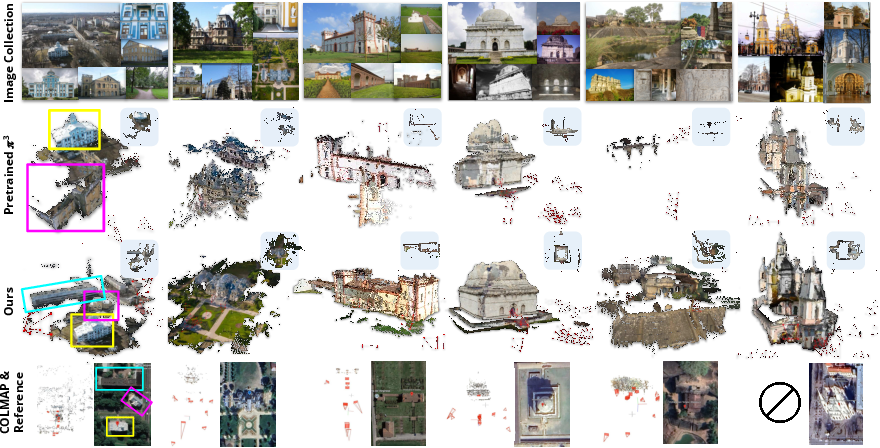
Figure 5: On practical Internet long-tail scenes, the fine-tuned model recovers dense and correct reconstructions where prior art fails or outputs incomplete/fractured results.
Disambiguation of Doppelganger Scenes
A pronounced challenge in Internet-scale 3D reconstruction is the disambiguation of symmetric or repetitive structures (doppelganger problem). The proposed data curation and sampling pipeline, combined with fine-tuning, leads to robust separation of visually similar structures, as evidenced by qualitative comparisons against both COLMAP and pretrained π3 (Figure 6).
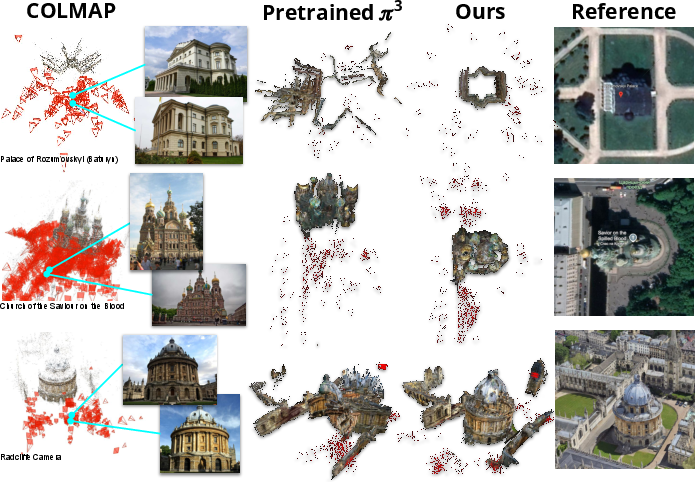
Figure 6: The finetuned model resolves visual ambiguities in doppelganger scenarios, consistently reconstructing distinct but symmetric/repetitive scene elements.
Ablation studies show that dense-view or randomly sampled batches yield less robust models, corroborating the need for explicit long-tail-mimicking supervision (Figure 7).
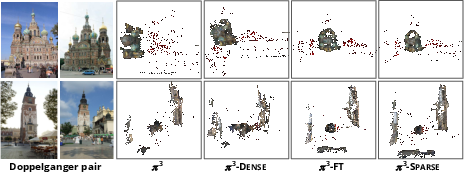
Figure 7: Models trained with sparsity-aware sampling are consistently more robust to doppelganger ambiguity.
Cross-Benchmark Generalization and Limitations
Finetuned models evaluated on standard curated benchmarks (RealEstate-10K, CO3Dv2, DTU, ETH3D, 7-Scenes, NRGBD) maintain comparable performance to their pretrained counterparts. Degradation is mainly observed for ETH3D, attributed to domain mismatch with controlled laboratory scenes. Quantitative and qualitative analyses (Figure 8) show that long-tail robustness does not come at the cost of overfitting or loss of generalization to controlled domains.
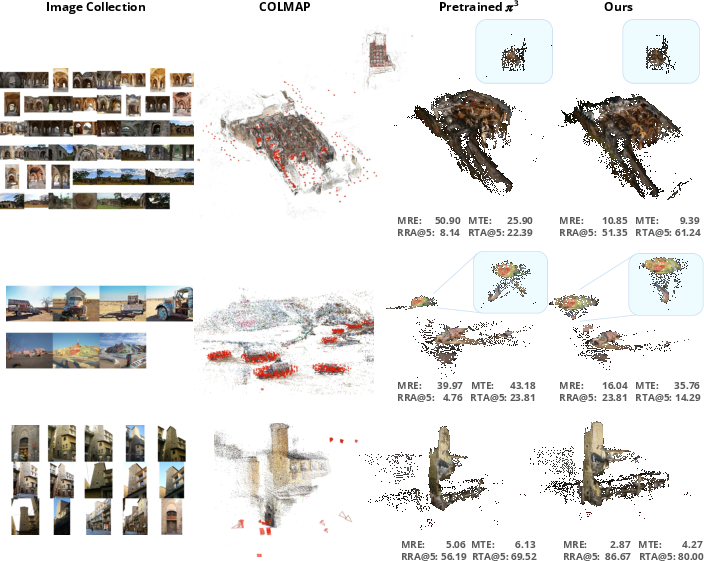
Figure 8: Quantitative gains in pose accuracy and completeness are observed on challenging long-tail benchmarks, with robust global geometry even under minimal input overlap.
One persisting limitation involves disjoint-view clusters: in scenarios where input images originate from entirely disconnected spatial regions (e.g., indoor versus outdoor), the model may still fuse them into a single global frame rather than separating them (Figure 9). Improving disconnected-scene reasoning is identified as an open issue.

Figure 9: Both pretrained and fine-tuned models struggle to segment and separate disconnected areas, such as mixed indoor-outdoor image sets.
Implications and Future Directions
This work advances the state of Internet-scale 3D vision by formalizing and demonstrably addressing the long-tail regime, where real-world sparsity and ambiguity are most challenging. By uniting stringent dataset curation, dense-depth refinement, and a principled sparsity emulation for training, the proposed pipeline establishes new robustness standards for foundation models in 3D.
The practical implications are significant: robust 3D reconstruction from sparse, noisy Internet imagery is essential for automated culture heritage digitization, online mapping, and universal 3D scene understanding without the need for laboriously curated multi-view captures.
Theoretically, the results support the assertion that data distribution emulation—rather than merely scaling model size or supervision—remains a bottleneck for foundation model generalization. Specifically, the explicit focus on the observation graph structure (beyond naïve sparsification) is shown to be critical for learning priors applicable to the Internet's long tail.
Future research may address the expansion of such datasets and techniques to smaller-scale (single-object), indoor, or everyday scenes, advancing toward universal 3D vision systems capable of open-world geometric reasoning.
Conclusion
This paper introduces a scalable strategy to tackle the long-tail problem in Internet photo 3D reconstruction, with strong empirical gains over existing methods in terms of robustness, ambiguity resolution, and generalization. MegaDepth-X and sparsity-aware sampling together provide a blueprint for building future 3D foundation models that can learn from, and operate robustly on, the vast and diverse spectrum of Internet visual data (2604.22714).