Emergent Extreme-View Geometry in 3D Foundation Models
Abstract: 3D foundation models (3DFMs) have recently transformed 3D vision, enabling joint prediction of depths, poses, and point maps directly from images. Yet their ability to reason under extreme, non-overlapping views remains largely unexplored. In this work, we study their internal representations and find that 3DFMs exhibit an emergent understanding of extreme-view geometry, despite never being trained for such conditions. To further enhance these capabilities, we introduce a lightweight alignment scheme that refines their internal 3D representation by tuning only a small subset of backbone bias terms, leaving all decoder heads frozen. This targeted adaptation substantially improves relative pose estimation under extreme viewpoints without degrading per-image depth or point quality. Additionally, we contribute MegaUnScene, a new benchmark of Internet scenes unseen by existing 3DFMs, with dedicated test splits for both relative pose estimation and dense 3D reconstruction. All code and data will be released.

Paper Prompts
Sign up for free to create and run prompts on this paper using GPT-5.
Top Community Prompts
Explain it Like I'm 14
Emergent Extreme-View Geometry in 3D Foundation Models — Explained Simply
What is this paper about?
This paper explores whether new, powerful 3D AI models can understand 3D scenes from pairs of photos that don’t even look at the same part of the scene (for example, two photos taken from opposite sides of a building). The authors find that these models already have a hidden, emergent understanding of 3D geometry in such “extreme views.” They then show a simple way to make that understanding even better without breaking the models’ other skills. They also release a new test collection, called MegaUnScene, to fairly measure how well these models work on real, messy Internet photos.
1) Main idea and purpose
- Today’s 3D “foundation models” can predict things like camera positions (poses), depth, and 3D points directly from images.
- But they’re mostly trained on photos that overlap a lot, making the task easier.
- This paper asks: Can these models still figure out the 3D relationship between cameras when the two images have little or no overlap? And if not perfectly, can we lightly fine-tune them to be much better at it—without ruining their other abilities?
- The authors also build a new benchmark (MegaUnScene) to test models on real-world, previously unseen Internet scenes.
2) Key questions (in plain terms)
- Do 3D foundation models secretly “get” extreme viewpoints even if they weren’t trained for them?
- Can we improve their ability on these tough cases by tweaking just a tiny part of the model?
- Can we do this while keeping their original strengths—like good depth maps and 3D reconstructions—unchanged?
- How do we fairly test these skills on real photos the models haven’t seen before?
3) What did they do? (Methods explained simply)
Think of a 3D foundation model as having:
- A shared “brain” (the backbone) that processes all images together and forms an internal 3D understanding.
- Several “readers” (decoder heads) that translate that internal understanding into specific outputs: camera pose, depth maps, and 3D point maps.
Here’s the approach:
- First, they “peeked inside the brain” by visualizing attention patterns. Attention patterns show which parts of one image the model looks at when processing another image.
- When two images overlap, the model attends to matching areas (as expected).
- When they don’t overlap, the model still attends to meaningful spots—like places that would be nearby in 3D or share structure (e.g., corners, curves). This hints at an internal 3D “language” the model uses.
- Then, they tried a tiny, careful fine-tuning:
- They froze all the “reader” heads (so depth and pose outputs don’t drift apart).
- They updated only the bias terms (small adjustable numbers) in a few chosen layers of the backbone—the shared “brain.”
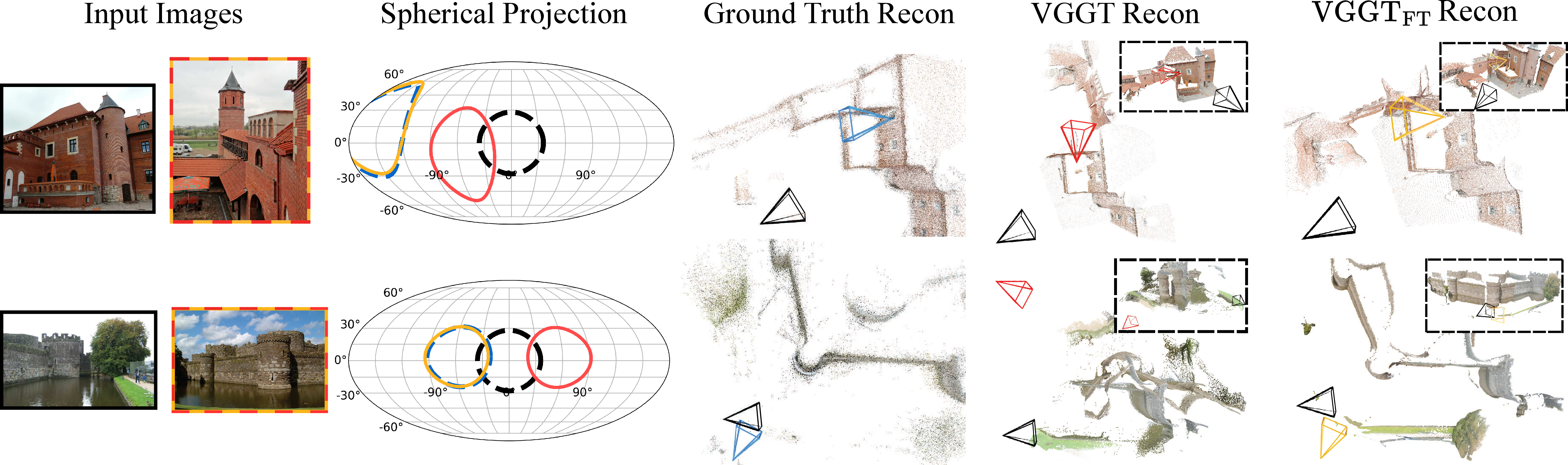
- They trained this tiny part to be better at predicting how two cameras are rotated relative to each other (“relative rotation”), using a simple rotation loss. No dense (pixel-by-pixel) supervision needed.
- They used around 65,000 image pairs for just 2 epochs (very light training) and changed ~80,000 parameters in models that have billions of parameters.
- They also created a new benchmark:
- MegaUnScene: 476 real Internet scenes that the models have not seen before.
- Two test sets for relative pose (UnScenePairs and UnScenePairs-t) and one for dense 3D reconstruction (UnSceneRecon, with 100 scenes and real-world scale).
- This lets them measure performance on tough, real, non-overlapping or widely spaced views.
Analogy: Instead of retraining the entire brain or changing how the “readers” work, they gently adjust a few “knobs” in the brain so it speaks its internal 3D language more clearly for extreme views, while keeping everything else stable.
Key terms in everyday language:
- Camera pose: Where the camera is and which way it’s pointing.
- Relative rotation: How much you’d rotate one camera to match the direction of the other.
- Depth map: For each pixel in an image, how far that point is from the camera.
- Point map: A dense set of 3D points that represent the scene.
- Attention map: A heat map showing which parts of one input the model focuses on while analyzing another.
4) Main findings and why they matter
- Emergent understanding: Even before fine-tuning, the models show signs of grasping 3D relationships in non-overlapping views. They don’t just match pixels—they infer structure.
- Big boost with tiny changes: By tuning only small bias terms in specific backbone layers (and freezing all heads), the models’ estimates of relative rotation improve a lot on extreme-view image pairs.
- Example improvements (median rotation error, lower is better):
- On a tough “single-camera” test (sELP), error drops from about 13.2° to 9.7°.
- On in-the-wild Internet pairs (with and without translations), errors drop from roughly 42.4° → 13.1° and 28.4° → 11.7°.
- No trade-off with other tasks: Depth and 3D point predictions stay strong; in some cases, they even improve. That’s because the heads are frozen and the updates are tiny and targeted.
- Works across different 3D models: They tested several recent 3D foundation models and saw consistent gains.
- New benchmark: MegaUnScene gives the community a fair way to measure performance on real, unseen scenes that aren’t part of the models’ training data.
Why it matters:
- Real photos (like tourist albums or historical archives) often don’t have nice, overlapping image sets. Models that handle extreme viewpoints are more useful in the real world.
- The fact that small updates unlock big improvements suggests these models already “know” more than we thought—they just need a nudge to use it.
5) What’s the impact? (So what?)
- Smarter 3D from messy photos: This work helps 3D models handle everyday, imperfect image collections—great for apps in virtual tours, archaeology, mapping, and more.
- Efficient fine-tuning: Instead of expensive retraining, small, careful tweaks can adapt huge models to tough scenarios quickly.
- Better evaluation: MegaUnScene gives researchers a realistic, unseen testbed to drive future progress.
- Future directions: Rotation got much better; translation (how far cameras moved) improved less. Next steps include finding equally light ways to sharpen translation estimates under extreme conditions.
In short: 3D foundation models already carry a hidden 3D sense that goes beyond matching overlapping pixels. With a tiny, smart adjustment, they become much better at understanding extreme viewpoints—without losing what they already do well.
Knowledge Gaps
Knowledge gaps, limitations, and open questions
Below is a single, focused list of what remains missing, uncertain, or unexplored, framed to guide future research.
- Quantitative characterization of the “internal 3D language”: Beyond a few attention-map visualizations, there is no systematic measurement linking specific backbone heads/layers to pose/depth performance or attention patterns to geometric reasoning across large datasets.
- Automatic selection of backbone layers to tune: The paper hints at a small subset of impactful layers, but lacks an explicit, general procedure (e.g., based on Fisher information, sensitivity, or representational change metrics) to identify which layers to adapt in different architectures and data regimes.
- Theoretical explanation of why bias-only updates work: There is no formal analysis of why selective bias tuning aligns internal geometry without degrading dense outputs, nor conditions under which this strategy might fail.
- Failure-mode analysis: The paper does not catalog where alignment fails (e.g., strong lens distortion, rolling shutter, extreme intrinsics mismatch, severe occlusion, textureless surfaces, specularities, night scenes), making it hard to target robustness improvements.
- Translation estimation under extreme baselines: Improvements in translation are modest; it remains unclear how to significantly boost translation accuracy for large-baseline, low-overlap pairs (e.g., with losses enforcing epipolar/parallax constraints, scene priors, or generative bridging).
- Multi-task consistency strategies: Freezing the camera head preserves reconstruction, but the paper does not explore alternatives that could improve pose while maintaining depth/point consistency (e.g., joint losses enforcing pose–depth consistency, cross-head distillation, or consistency regularizers).
- Comparison to other parameter-efficient tuning methods: The study omits direct comparisons with LoRA/adapters, prefix tuning, or low-rank updates in attention/MLP projections, leaving open whether bias-only is optimal across models and tasks.
- Generality across architectures lacking camera tokens: For architectures without dedicated camera tokens (e.g., permutation-invariant designs), the reasons for degradation and how to redesign tokens/heads to retain multi-task alignment are not investigated.
- Training signal quality: Rotation supervision relies on COLMAP-derived poses which may be noisy for extreme pairs; there is no uncertainty modeling or robustness analysis to label errors and their effect on alignment.
- Pair sampling strategy: The effects of sampling distributions (overlap categories, baseline magnitudes, scene types) and the minimal number of pairs required for effective adaptation are not studied, limiting guidance on data-efficient tuning.
- Anchoring term behavior: The optional anchoring for fixed reference frames is under-specified; its impact on different datasets, intrinsics, and architectures (including permutation-invariant ones) is not analyzed.
- Dense reconstruction metrics: ACC/CMP after Umeyama alignment and ICP can mask scale/intrinsic inconsistencies; there is no evaluation of absolute scale accuracy (especially for metric-scale 3DFMs), Chamfer distance, per-scene breakdowns, or sensitivity to registration.
- Impact on intrinsics and calibration: The method assumes known intrinsics and does not measure robustness to intrinsics errors (e.g., focal length mismatches) or perform self-calibration in extreme-view settings.
- Domain generalization: Evaluation focuses on internet landmarks plus ETH3D/RE10K; there is no assessment on significantly different domains (e.g., indoor clutter with occlusions, aerial/underwater, egocentric videos, non-rigid/dynamic scenes).
- Overlap labeling reliability: UnScenePairs-t overlap categories are partly verified via match filtering, yet residual mislabeling is possible; the paper does not quantify labeling accuracy or its effect on reported metrics.
- Dataset curation biases: MegaUnScene uses Doppelgangers++ and MASt3R-SfM in the pipeline; potential biases from these tools (e.g., match filtering, reconstruction failure cases) and their downstream effects on evaluation are not assessed.
- Metric scale annotations: UnSceneRecon scale factors are derived via Google Maps and manual inspection; the uncertainty of these annotations and their impact on reconstruction metrics are not quantified.
- Scaling to multi-view extreme settings: The alignment is trained on pairs and evaluated on multi-view datasets with typical overlap; there is no test on long sequences where many adjacent pairs lack overlap or contain large parallax.
- Computational aspects: The paper does not report fine-tuning/inference time, memory footprint, or the scalability of alignment to larger backbones/datasets, which are critical for practical deployment.
- Causality between attention and geometry: It remains unproven whether observed cross-view attention patterns causally drive pose accuracy; interventions (e.g., head ablations or attention modulation) could establish causal links but are not attempted.
- Symmetry and scene priors: The approach likely benefits from structural symmetries (e.g., facades, landmarks); performance on asymmetric or highly unique scenes is not isolated and analyzed.
- Alternative supervision signals: The effectiveness of adding weak geometric constraints (epipolar consistency, silhouette/semantic priors), photometric consistency, or synthetic bridging (e.g., generative video priors) to improve extreme-view pose remains unexplored.
- Robustness to sensor artifacts: No evaluation is provided for motion blur, HDR/exposure variation, compression artifacts, or sensor noise typical in mobile/wearable captures.
- Release and reproducibility specifics: While code/data will be released, the paper does not detail how to reproduce layer selection, training pair construction, and anchoring settings to ensure consistent third-party alignment results.
- Broader task impact: The effect of alignment on related tasks (e.g., novel view synthesis, dense optical flow, semantic 3D understanding) is not assessed; whether improved extreme-view geometry benefits these tasks is unknown.
Practical Applications
Overview
Below are practical applications that follow directly from the paper’s findings and innovations—namely, the emergent extreme-view geometry in 3D foundation models (3DFMs), the lightweight bias-only backbone alignment for rotation accuracy under non-overlapping views, and the MegaUnScene benchmark for evaluation on unseen, in-the-wild scenes.
Immediate Applications
- 3DFM “Extreme-View Pose Adapter” for existing photogrammetry and 3D reconstruction pipelines (software; mapping/GIS; digital heritage)
- Integrate the paper’s bias-only backbone alignment into workflows built on VGGT, WorldMirror, or similar 3DFMs to improve relative pose estimation when photos have little/no overlap (e.g., tourist collections, historical archives), while preserving dense depth/point outputs.
- Potential tools/products/workflows: a plug-in or PEFT-style adapter for DUSt3R/VGGT-like toolchains; CLI to run rotation-only fine-tuning on customer image-pair sets; SDK for commercial photogrammetry packages.
- Dependencies/assumptions: access to model weights and the alternating-attention backbone; small rotation-supervision dataset (can be bootstrapped via COLMAP reconstructions); camera head remains frozen to avoid depth–pose drift.
- Robust “Sparse-Photo” 3D capture for cultural heritage and museums (culture; nonprofit; public sector)
- Use the aligned 3DFMs to reconstruct landmarks from user-submitted or archival photos with wide baselines and minimal overlap; reduce curation burden and failure rates in public digitization campaigns.
- Dependencies/assumptions: Internet photo permissions; sufficient geometric structure in scenes; basic calibration metadata or EXIF focal lengths; benchmark and validate on MegaUnScene.
- Disaster response and situational awareness from crowd-sourced imagery (public safety; emergency management)
- Quickly assemble 3D situational models from heterogeneous, non-overlapping photos collected by responders and the public; improves pose robustness under chaotic capture conditions.
- Dependencies/assumptions: legal/privacy frameworks for using public images; time-limited fine-tuning with rotation-only supervision; downstream validation for translation estimates (improvements are modest).
- Insurance claims and forensics scene reconstruction (finance; legal)
- Reconstruct accidents or damage sites from disparate smartphone photos with extreme viewpoints to support evidence review and claims adjudication.
- Dependencies/assumptions: access to raw images; rotation ground-truth can be approximated or bootstrapped; translation estimation may require complementary methods.
- Mobile AR capture stabilization and world-anchoring from minimal sweeps (consumer software; mobile)
- Improve anchor stability and camera pose estimates when casual captures produce sparse or poorly overlapping frames; reduce capture constraints for users.
- Dependencies/assumptions: integration into mobile 3DFMs; lightweight on-device adapters or server-side fine-tuning; careful handling of translation accuracy.
- Real estate and construction progress documentation from sparse photos (proptech; AEC)
- Build reliable 3D models from occasional, non-systematic photo uploads; align extreme-view pairs for consistent site models without strict capture protocols.
- Dependencies/assumptions: varying camera intrinsics; occasional re-calibration; quantify quality with UnSceneRecon-like metrics.
- Drone mapping with limited flight time (robotics; geospatial)
- Use the aligned 3DFMs to robustly relate images with large baselines caused by sparse flight paths; reduce mission duration while keeping 3D outputs usable.
- Dependencies/assumptions: sufficient texture and structure; potentially augment with traditional SfM for translation refinement; careful evaluation under parallax.
- Multi-camera vehicle systems with wide baselines (autonomous systems; automotive)
- Improve relative orientation across cameras that have minimal field-of-view overlap (e.g., front vs. side), strengthening 3D consistency in perception stacks.
- Dependencies/assumptions: domain adaptation from landmark-centric pretraining; calibration priors; translation and scale handling in downstream modules.
- Academic evaluation and reproducibility using MegaUnScene (academia; standards)
- Adopt MegaUnScene as an independent benchmark to evaluate generalization to unseen Internet scenes for relative pose and dense reconstruction tasks.
- Dependencies/assumptions: dataset access and licensing; standardized metrics (MRE, RA/TA, ACC/CMP); familiarity with SfM/MVS baselines for cross-checks.
- Green ML and cost-efficient model adaptation (policy; sustainability)
- Use bias-only fine-tuning (~80k parameters, ~2 epochs) for significant rotation gains, reducing compute and energy footprints relative to full fine-tuning.
- Dependencies/assumptions: access to partial-parameter training setup; organizational adoption of PEFT best practices.
Long-Term Applications
- End-to-end “Non-Overlap SfM” pipelines for real-world capture (software; robotics; mapping)
- Build reconstruction systems that explicitly support zero/near-zero overlap by combining aligned 3DFMs with robust translation inference, semantic priors, and generative video cues for motion completion.
- Dependencies/assumptions: further research on translation and scale estimation; integration with generative trajectory priors; standardized evaluation suites.
- On-device personal adapters for casual 3D capture (consumer software; mobile)
- Ship PEFT-style adapters that tune a user’s phone to their typical capture style and camera model, improving 3D stabilization without cloud training.
- Dependencies/assumptions: efficient on-device training; privacy-preserving storage; robust fallback when data is scarce or ambiguous.
- Extreme-view loop closure in SLAM and VIO (robotics)
- Use the emergent cross-view geometry “language” to bridge loops in navigation sequences even when frames share no visual overlap, reducing drift.
- Dependencies/assumptions: robust fusion of 3DFM pose predictions with inertial/odometry; extended training on motion datasets; safety validation.
- Multi-modal priors for extreme views (software; research)
- Combine 3DFMs with text or scene databases (e.g., landmark metadata) to guide pose reasoning under ambiguity; enrich the backbone’s internal language with semantic constraints.
- Dependencies/assumptions: curated priors; scalable multi-modal training; bias-only alignment generalized beyond rotation.
- Standardization of extreme-view benchmarks and capture protocols (policy; standards)
- Establish best practices for collecting and reporting non-overlapping view datasets across sectors (heritage, robotics, public safety), including privacy and consent frameworks for Internet photos.
- Dependencies/assumptions: cross-industry collaboration; legal review; governance for dataset updates and audit trails.
- Digital twin generation from sparse archives (energy; industrial operations)
- Create plant or facility twins from historical, sparse archives; periodically update with limited new captures; support maintenance planning and safety audits.
- Dependencies/assumptions: scene-specific priors; integration with CAD/BIM; validation against ground-truth measurements.
- Crowd-sourced city-scale mapping from heterogeneous media (smart cities; public sector)
- Fuse sparse photos from citizens, social media, and municipal sources to maintain living 3D maps; handle large baselines and non-overlapping views gracefully.
- Dependencies/assumptions: data governance and quality controls; scalable inference; mechanisms for detecting and mitigating spurious reconstructions.
- Forensic-grade translation estimation and metric scale (legal; insurance; public safety)
- Extend the alignment to improve translation accuracy and scale recovery, delivering reconstructions that meet evidentiary standards.
- Dependencies/assumptions: new loss terms and calibration routines; uncertainty quantification; expert review protocols.
- Educational tools for “3D language” introspection (education; research)
- Build interactive visualizers around cross-view attention maps to teach geometric reasoning beyond correspondence, informing new curricula in computer vision and graphics.
- Dependencies/assumptions: accessible tooling; curated examples; generalization across architectures.
- General-purpose PEFT for 3DFMs across domains (software; MLOps)
- Standardize bias-only/layer-selective adapters for different 3DFMs (VGGT, WorldMirror, pi3 variants), enabling rapid domain adaptation (indoor, aerial, underwater, medical).
- Dependencies/assumptions: broad architecture support; reproducible training recipes; monitoring for multi-task degradation (keep camera head frozen or isolated).
Notes on Feasibility and Assumptions Across Applications
- The alignment primarily improves rotations; translation gains are modest and may need complementary methods (e.g., additional losses, priors, or classical SfM).
- Freezing the camera head during adaptation is critical to preserve dense prediction quality; unfreezing it can degrade depth–pose consistency.
- Rotation-only supervision can be bootstrapped from existing reconstructions (e.g., COLMAP) and does not require dense labels, but noisy pose estimates will affect tuning quality.
- Scenes must contain sufficient geometric structure; extremely textureless or dynamic scenes remain challenging.
- Access to model internals (weights, backbone architecture) is necessary; closed 3DFM services may require vendor cooperation for PEFT adapters.
- Ethical and legal considerations apply when using Internet images (consent, attribution, privacy); policy frameworks should accompany deployments.
Glossary
- Alternating attention backbone (AA): A shared transformer backbone that alternates between per-frame and global attention blocks to fuse cross-view information. "we only update the bias terms of a sparse set of layers in the shared alternating attention (AA) backbone."
- Bundle adjustment: A nonlinear optimization that jointly refines camera poses and 3D points to minimize reprojection error across images. "Classical 3D reconstruction methods such as Structure-from-Motion (SfM)~\cite{agarwal2011building,hartley2003multiple,schonberger2016structure,snavely2006photo} and Multi-View Stereo (MVS)~\cite{schoenberger2016mvs,furukawa2015multi} recover camera poses and 3D structure by matching local features and jointly optimizing via bundle adjustment."
- Camera extrinsics: The rotation and translation that place the camera in the world coordinate frame. "Fused VGGT predicted pointmaps from unprojecting depth and applying camera extrinsics on UnSceneRecon's Wat Yai Chai Mongkhon scene."
- Camera head: The task-specific output head that predicts camera pose parameters from backbone features. "task-specific heads, such as the camera head and the dense prediction head visualized in Figure \ref{fig:architectural_design}."
- COLMAP: An open-source Structure-from-Motion pipeline used to reconstruct scenes and estimate camera poses. "construct a training set of image pairs from scene-level COLMAP reconstructions from MegaScenes~\cite{tung2024megascenes}."
- Cross-view attention maps: Visualizations of attention linking tokens across different input images to reveal learned geometric relationships. "We illustrate the cross-view attention maps in Figure \ref{fig:attention_viz}, as exemplified by VGGT~\cite{wang2025vggt} and three image pairs with varying levels of overlap."
- Dense prediction head: The task-specific output head that produces per-image dense geometry such as depth and point maps. "task-specific heads, such as the camera head and the dense prediction head visualized in Figure \ref{fig:architectural_design}."
- Doppelgangers++: A method to disambiguate visually ambiguous internet photos, improving matching and reconstruction. "Doppelgangers++~\cite{xiangli2025doppelgangersimprovedvisualdisambiguation} disambiguates challenging internet photos depicting ambiguous views, while dense MASt3R~\cite{leyor2024mast3r} matches yield more robust pairwise poses for incremental SfM."
- Geodesic error: The angular discrepancy between two rotation matrices measured on the rotation manifold. "We compute the geodesic error, defined as % "
- Geodesic loss: A loss function measuring minimal angular distance between rotation matrices on the rotation manifold. "and $\mathcal{L}_{\mathrm{geo}$ denotes the geodesic loss which measures the minimal angular distance between rotation matrices on the manifold."
- Global attention block: A transformer block that concatenates tokens from all images to allow self-attention across views. "By contrast, the global attention block concatenates tokens from both images:"
- Iterative closest point: An algorithm that aligns point clouds by iteratively matching and minimizing distances between closest points. "align the predicted points to the ground truth using the Umeyama algorithm, followed by iterative closest point."
- MASt3R-SfM: A pipeline integrating dense matching (MASt3R) with Structure-from-Motion for robust scene reconstruction. "using Doppelgangers++~\cite{xiangli2025doppelgangersimprovedvisualdisambiguation} integrated with MASt3R-SfM~\cite{duisterhof2025mastrsfm}."
- MegaUnScene: A benchmark of 476 unseen internet scenes for evaluating 3D foundation models under unconstrained conditions. "To evaluate our system, we contribute a new dataset named MegaUnScene."
- Multi-View Stereo (MVS): A technique that computes dense 3D structure by aggregating correspondences across multiple calibrated views. "Classical 3D reconstruction methods such as Structure-from-Motion (SfM)~\cite{agarwal2011building,hartley2003multiple,schonberger2016structure,snavely2006photo} and Multi-View Stereo (MVS)~\cite{schoenberger2016mvs,furukawa2015multi} recover camera poses and 3D structure by matching local features and jointly optimizing via bundle adjustment."
- Parallax: Apparent motion of scene points induced by camera translation, affecting correspondence and overlap classification. "the increased translation baseline introduces parallax challenges where the classification algorithm may classify image pairs with some overlap into the None category."
- Patch tokens: Tokenized image patch embeddings fed into the transformer backbone. "These patch tokens and then fed into a shared transformer-based backbone, which alternates between frame attention blocks and global attention blocks."
- Permutation-equivariant reasoning: Model behavior where outputs consistently reflect permutations of inputs (not invariant), useful for multi-view processing. "further generalized this paradigm with permutation-equivariant reasoning and metric-scale reconstruction for large-scale scenes."
- Permutation-invariant architectures: Architectures whose outputs do not depend on the order of input images. "For permutation-invariant architectures (e.g., \mathbb{1}_{\text{a} = 0$, and the loss reduces to the symmetric relative-rotation term."</li> <li><strong>Point map</strong>: A dense mapping from image pixels to 3D points, enabling reconstruction from images. "predict camera poses, depths, and point maps in a single feedforward pass"</li> <li><strong>RANSAC</strong>: A robust estimation method used to verify geometric matches by rejecting outliers. "Classical pipelines employ handcrafted descriptors~\cite{lowe2004distinctive,rublee2011orb} and RANSAC-based matches~\cite{fischler1981random}."</li> <li><strong>Relative pose estimation</strong>: The task of predicting rotation (and often translation) between two camera views. "Traditional relative pose estimation relies on local feature matching and geometric verification, typically assuming sufficient visual overlap between input views."</li> <li><strong>sELP</strong>: A test set of extreme landmark image pairs focusing on non-overlapping rotational motion. "reduces median rotation error on sELP~\cite{bezalel2025extreme} (a single camera setting) from $13.2^\circ{\to}9.7^\circ$"</li> <li><strong>SO(3) manifold</strong>: The mathematical space of 3D rotations used to measure angular distances between rotation matrices. "on the $\mathrm{SO}(3)$ manifold."
- Structure-from-Motion (SfM): A pipeline that recovers camera poses and sparse 3D geometry from multiple overlapping images. "Classical 3D reconstruction methods such as Structure-from-Motion (SfM)~\cite{agarwal2011building,hartley2003multiple,schonberger2016structure,snavely2006photo} and Multi-View Stereo (MVS)~\cite{schoenberger2016mvs,furukawa2015multi} recover camera poses and 3D structure by matching local features and jointly optimizing via bundle adjustment."
- Umeyama algorithm: A closed-form method for estimating a similarity transform (scale, rotation, translation) aligning two point sets. "align the predicted points to the ground truth using the Umeyama algorithm, followed by iterative closest point."
- Wide baselines: Large viewpoint changes between images that reduce overlap and challenge correspondence-based methods. "these overlap-dependent methods degrade under wide baselines or non-overlapping settings."
Collections
Sign up for free to add this paper to one or more collections.

