- The paper demonstrates that the adapted Wasserstein barycenter for Gaussian processes exists uniquely and retains Gaussianity via Cholesky decomposition.
- It reformulates the barycenter problem as a tractable finite-dimensional minimization using an iterative Procrustes alignment algorithm.
- Numerical experiments reveal that the adapted barycenter maintains lower marginal variances and preserves temporal structure compared to classical methods.
Adapted Wasserstein Barycenters of Gaussian Processes: An Expert Review
Introduction and Problem Statement
The paper "Adapted Wasserstein Barycenters of Gaussian Processes" (2604.22453) presents a comprehensive theoretical investigation of barycenters in the adapted Wasserstein space restricted to laws of Gaussian processes. The central innovation is leveraging the adapted Wasserstein distance, which incorporates filtration constraints and temporal asymmetry, making it fundamentally suitable for path-dependent settings such as stochastic control, mathematical finance, and sequential decision problems. In contrast to classical optimal transport frameworks, which disregard temporal and filtration constraints, the adapted theory penalizes transportation schemes that violate information flow.
The authors' principal objective is the existence, uniqueness, and characterization of weighted Fréchet means—adapted Wasserstein barycenters—among the laws of Gaussian processes in discrete time. Of particular interest is the explicit reduction of this barycenter problem to a tractable optimization over Gaussian measures, linking adapted optimal transport, Bures–Wasserstein geometry, and dynamic programming in multicausal transport.
Theoretical Framework and Main Results
The analysis is grounded in the adapted Wasserstein space (FP2,AW2), where FP2 denotes filtered processes on a discrete time horizon T with finite second moment. The adapted Wasserstein metric AW2 is defined via minimization over bicausal couplings compatible with the natural filtration. For Gaussian processes, this metric admits an explicit Cholesky-factor-based formulation, and the barycenter problem is recast as an adapted Bures--Wasserstein minimization in the quotient space of block-lower-triangular matrices modulo block-diagonal orthogonal transformations.
The main theoretical results are:
- Existence and Gaussianity: For any finite set of Gaussian processes, the barycenter in adapted Wasserstein space exists and is necessarily Gaussian. The barycenter problem thus reduces to a finite-dimensional minimization over the space of Gaussian processes' means and Cholesky (block-lower-triangular) factors.
- Uniqueness: The minimizer—the adapted barycenter—is unique up to orthogonal transformations. This is achieved via a structural decomposition: the adapted Bures–Wasserstein distance admits an isometry with a direct product of standard Bures–Wasserstein distances, one for each column in the Cholesky factorization.
- First-Order Characterization: The barycenter is characterized by a fixed-point equation involving iterative Procrustes alignment of Cholesky factors from the input processes. This formulation directly yields an efficient alternating minimization algorithm for computation.
- Regularity: If all input processes are regular (having nondegenerate conditional variances at every time), the barycenter inherits regularity.
Explicitly, the barycenter problem for input Gaussian processes Xi=ai+LiG, convex weights λi, seeks the Gaussian law with mean a∗=∑λiai and Cholesky factor (up to orthogonal equivalence) minimizing
i=1∑NλidABW2([L],[Li]),
where dABW denotes the adapted Bures–Wasserstein distance.
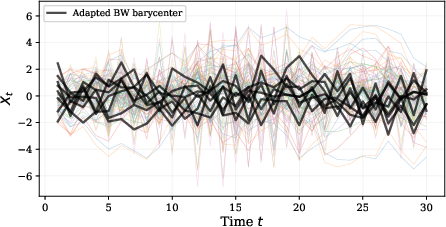
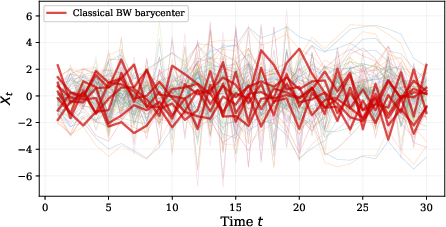
Figure 1: Adapted barycenter illustrating the Cholesky-factor structure imposed by the temporal filtration constraints.
A crucial technical insight is the column-wise decomposition: for block-lower-triangular L,M, the adapted Bures–Wasserstein distance splits across columns
FP20
where FP21 is the "future-propagated" covariance from noise injected at time FP22. Thus, barycenter computation decouples into FP23 independent Bures–Wasserstein barycenter problems.
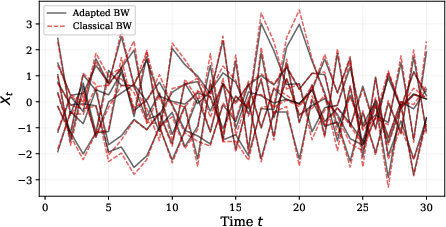
Figure 2: Comparison of sample paths for barycenters driven by identical noise. Solid black: adapted barycenter; dashed red: classical (non-adapted) barycenter.
Numerical Results and Distinctions from Classical Barycenters
The authors illustrate striking differences between adapted and classical (static) Wasserstein barycenters of Gaussian processes via detailed numerical experiments. Utilizing symmetric pairs of AR(1) processes with positive and negative autoregressive parameters, they show that:
- Marginal variances of the adapted barycenter remain consistently smaller than those of the classical barycenter throughout time, due to cancellation of noise propagation effects visible only in the path-wise (adapted) setting.
- Temporal structure: Both barycenters yield nearly uncorrelated processes in the presence of symmetric input, but the adapted barycenter achieves this by canceling contributions at the Cholesky level (i.e., at the pathwise evolution), not merely at the covariance level.
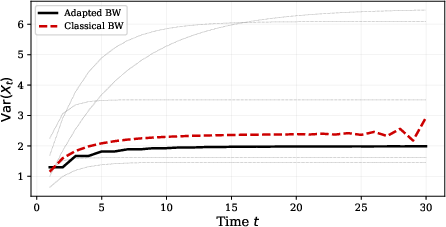
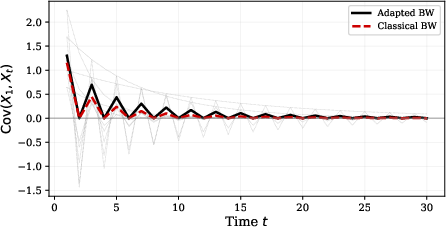
Figure 3: Marginal variance FP24 across time. The adapted barycenter (black) exhibits lower variance than the classical barycenter (red).
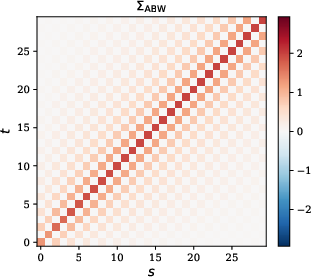
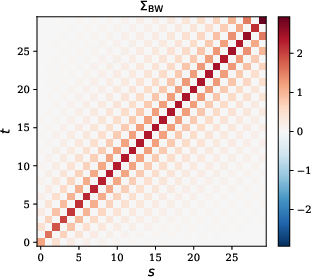
Figure 4: Covariance matrices of the adapted barycenter, showing the temporal structure induced by the pathwise constraint.
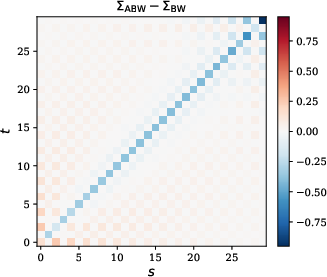
Figure 5: Difference between covariance matrices of adapted and classical barycenters, highlighting variance discrepancies manifesting on the diagonal.
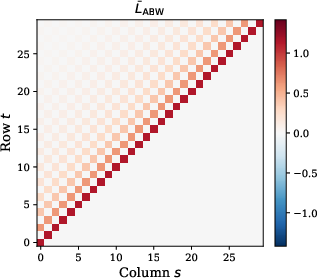
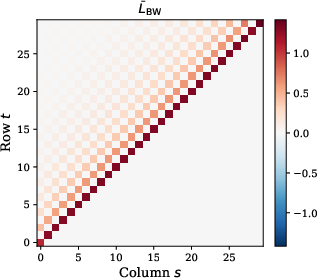
Figure 6: Cholesky factors of the adapted barycenter, indicating the structural origin of variance behaviors.
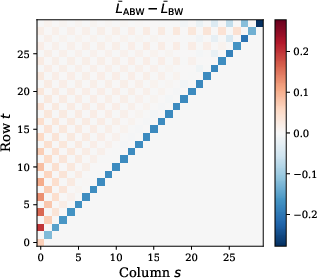
Figure 7: Difference in Cholesky factors between adapted and classical barycenters, demonstrating how adapted barycenters achieve variance reduction via cancellation at the factor level.
Implications and Theoretical Impact
This paper advances the mathematical theory of optimal transport for stochastic processes by isolating a tractable, geometrically rich subclass—Gaussian processes under adapted Wasserstein metrics—and elucidating their barycenter structure. Practical implications span robust scenario generation and model aggregation in stochastic optimization and mathematical finance, where temporally consistent averaging is essential. The authors present the adapted barycenter as a canonical object for stress testing and robust aggregation of competing dynamic models; its definition enforces information flow constraints which are critical in sequential applications.
The isometry between adapted and classical Bures–Wasserstein geometry per time slice enables direct import of well-established results on uniqueness, convexity, and barycenter algorithms from the latter. The algorithmic formulation and the precise fixed-point equations provided facilitate scalable barycenter computation in high-dimensional and long-horizon time series settings.
Open Questions and Future Directions
Key open questions raised include:
- Extension beyond Gaussians: While existence holds for more general filtered processes, the structure, uniqueness, and computability of non-Gaussian adapted barycenters remain open. The Markov case and continuous time (e.g., diffusion processes) are particularly promising future directions.
- Entropic Regularization: Analogs of entropic regularization for adapted Wasserstein barycenters may yield improved smoothness and computational benefits.
- Geometric Finer Structures: The isometric product structure yields non-negative curvature and explicit tangent cone information but leaves open whether geodesics and logarithmic maps in adapted spaces are fully determined by their classical counterparts.
- Practical deployment in robust finance: Model uncertainty quantification and scenario aggregation, especially for stress testing, could directly leverage the explicit computational algorithms developed herein.
Conclusion
The authors provide a rigorous, explicit, and practical characterization of adapted Wasserstein barycenters for Gaussian processes. By bridging dynamic optimal transport, stochastic control, and quantum information geometry, they establish a foundation for path-consistent model averaging with strong uniqueness and regularity guarantees. The decoupling via column-wise Bures–Wasserstein geometry yields analytical insight and computational tractability, positioning this work as a cornerstone for further advances in dynamic optimal transport theory and its myriad applications in sequential statistical modeling.