- The paper introduces a generative formulation for monocular VO by modeling camera motion via an ODE-driven flow matching process.
- It employs dense optical flow guidance and a parameterized vector field to deliver both precise pose estimates and uncertainty quantification.
- Ablation studies demonstrate robust performance with significant ATE improvements across challenging datasets such as TartanAir, KITTI, and TUM-RGBD.
PoseFM: Flow Matching for Probabilistic Frame-to-Frame Visual Odometry
Introduction
PoseFM introduces a principled generative framework for monocular visual odometry (VO), reformulating camera motion estimation as a distribution-matching problem via Flow Matching (FM). Unlike prior approaches that perform deterministic regression between consecutive frames, PoseFM models camera motion as a learned probability flow parameterized by an ODE-driven neural vector field. Through this generative treatment, PoseFM provides not only point estimates but also uncertainty quantification over pose hypotheses. The method leverages dense optical flow as visual guidance, integrating it with a continuous-time transformation on the rigid-body motion manifold, SE(3), and its associated Lie algebra. Empirical evaluations on standard benchmarks demonstrate PoseFM’s robust predictive accuracy, uncertainty-awareness, and competitive performance vis-à-vis state-of-the-art frame-to-frame and optimization-based VO pipelines.
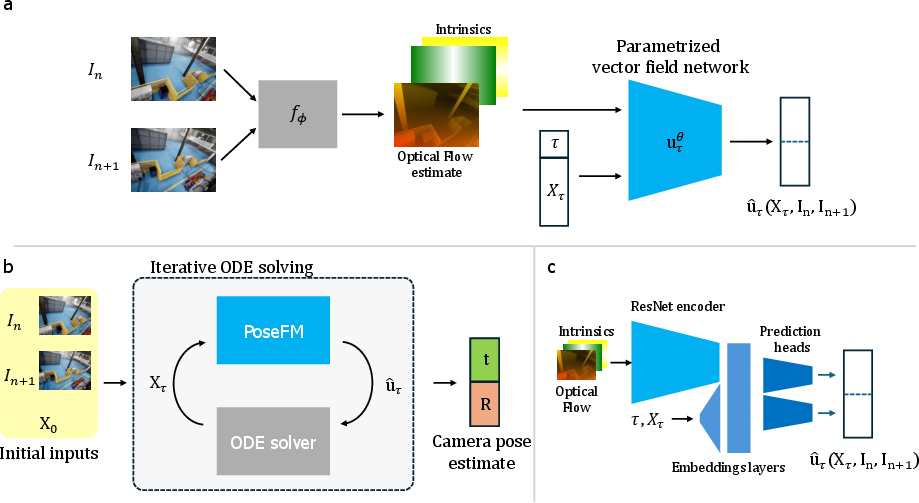
Figure 1: The PoseFM framework incorporates an optical flow estimator and a parameterized vector field network, producing pose distributions via integration in latent space.
Methodology
PoseFM models the conditional distribution p(T∣In,In+1) of camera motion T as a sample from a learned continuous-time flow conditioned on image pairs. FM’s key component is a parameterized vector field uτθ that dictates the direction and evolution of samples from an initial distribution in pose space towards the data-dependent target distribution at time τ=1. This ODE-driven approach allows for efficient, stable sampling and enables multiple plausible motion hypotheses to be retained through stochastic initialization and integration.
The pipeline operates as follows:
- Optical Flow Guidance: An optical flow backbone (PWCNet or WAFT) provides dense scene correspondence cues. The encoder is frozen during training for stable representation.
- Vector Field Estimation: Given visual guidance and a sampled pose from the base (prior) distribution, the main network, extending the TartanVO encoder, predicts the instantaneous velocity in pose space, separating translation and rotation components.
- Conditional Flow Matching Loss: PoseFM leverages the Conditional FM loss, minimizing discrepancy between the predicted and true flow fields in Lie algebra coordinates, with guidance conditioning through optical flow.
- Inference via ODE Integration: At test time, multiple initial poses are stochastically sampled, and the vector field is numerically integrated using an ODE solver, producing final pose predictions as well as their empirical variance for uncertainty estimation.
Key architectural modifications include dedicated embeddings for the temporal variable and pose state, fused with visual features, and a two-head output for translation and rotation parameterizations.
Empirical Evaluation
PoseFM is benchmarked on TartanAir, KITTI, and TUM-RGBD datasets, using Absolute Trajectory Error (ATE) with 7-DoF alignment as the main metric. A comprehensive ablation study quantifies the contribution of model components and hyperparameters.
TartanAir
PoseFM+PWC achieves an average ATE of 3.08, outperforming TartanVO (3.34), and shows trajectory-wise best results among frame-to-frame methods on several challenging scenes. Uncertainty quantification is directly enabled through pose sample variance, highlighting the advantage of generative over unimodal regression-based approaches.
KITTI
On KITTI, PoseFM+PWC demonstrates competitive generalization without fine-tuning, producing the best result on one sequence and second-best on two. Multi-frame optimization methods retain an overall edge, but the performance gap is much reduced in this setting, underscoring robust adaptation to diverse motion regimes.
TUM-RGBD
For indoor SLAM, PoseFM+PWC delivers strong results, closely approaching the best frame-to-frame methods, and substantially outperforming classical techniques on multiple sequences. This confirms the method’s domain generalization and resilience to scene distribution shift.
Ablation Studies
Ablations reveal the criticality of fine-tuning the vector field on predicted (rather than only ground-truth) optical flow—the performance gains are up to 20% lower ATE. The number of ODE steps for integration is shown to have only marginal impacts on accuracy beyond a moderate threshold (e.g., 5 steps), reflecting the stability of FM for pose evolution. Both PWCNet and WAFT serve as robust guidance modules, with similar pose estimation outcomes, indicating that final accuracy is governed by the generative model’s capacity, not solely the optical flow front-end.
Implications and Future Work
PoseFM’s generative formulation provides inherent, data-driven uncertainty quantification over camera motion, a marked departure from ad hoc or external noise models used in previous VO systems. As demonstrated, this ability to model and propagate pose ambiguity is critical for robust inference, particularly in environments characterized by perceptual aliasing or ambiguous visual cues.
From a practical viewpoint, frame-to-frame accuracy comparable to state-of-the-art methods is achieved without the complexity of global pose optimization across extended sequences. The approach generalizes well to novel domains and maintains resilience in the presence of optical flow noise, domain shift, and challenging geometric configurations.
Potential future directions include integrating multi-frame optimization atop the generative backbone, adopting more expressive visual encoders, and pursuing direct image-to-pose modeling that obviates the need for explicit optical flow estimation. Such extensions could further close the gap between frame-to-frame and globally optimized pipelines while providing real-time probabilistic state estimation.
Conclusion
PoseFM establishes flow matching as a viable and competitive paradigm for probabilistic monocular visual odometry. By learning distributions over camera motion directly from visual input and optical flow, PoseFM simultaneously achieves robust, accurate pose inference and principled uncertainty quantification. Its architectural and algorithmic developments mark a significant methodological advance in generative modeling for motion estimation, providing a foundation for future integration into autonomous navigation, AR/VR, and other perception-critical robotics applications.

