- The paper demonstrates that autonomous AI counterarguments (AIGC) improve group atmosphere and minority satisfaction, while AIMM increases participation at the cost of psychological safety.
- The study employs a 24-group, between-subjects design with simulated hierarchical settings to compare the effects of two AI-mediated dissent interventions.
- Findings challenge conventional design assumptions, urging a decoupling of anonymity and authenticity to ensure genuine inclusion and reflective group decision-making.
Introduction
The paper "Rethinking AI-Mediated Minority Support in Power-Imbalanced Group Decision-Making: From Anonymity To Authenticity" (2604.22319) interrogates the conventional assumption that anonymity provided by AI systems inherently protects minority voices and improves group decision outcomes in hierarchical contexts. Drawing on an empirical study in Korean corporate-like group dynamics, the authors contrast two LLM-powered mechanisms for introducing minority dissent: autonomous AI-generated counterarguments (AIGC) and anonymous paraphrased transmission of minority input (AIMM). The results highlight paradoxical impacts—especially that anonymity does not necessarily yield psychological safety or satisfaction for minority members in power-imbalanced settings.
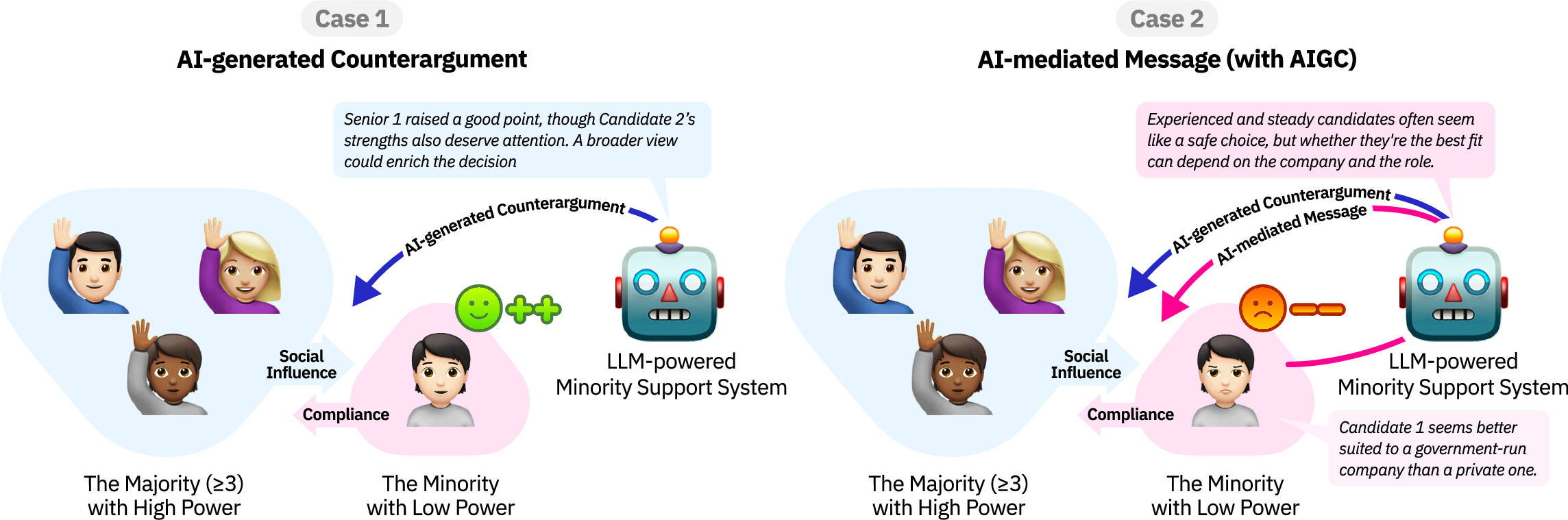
Figure 1: An LLM-powered minority support system mediates majority-minority dynamics through two designs: AIGC, which autonomously posts counterpoints to normalize dissent, and AIMM, which paraphrases privately submitted minority views blended with AIGC outputs to obscure authorship. AIGC improved group atmosphere and satisfaction, whereas AIMM increased participation but paradoxically undermined minority members' psychological safety and satisfaction.
Methodology and Intervention Designs
The study utilizes a 24-group, between-subjects mixed-methods design involving three seniors (majority, high-power) and one junior (minority, low-power) per group, assigned to a baseline, AIGC, or AIMM condition. Both interventions are implemented as real-time, LLM-powered agents embedded in a group chat for decision tasks.
- AIGC: An agent observes the group dialogue and posts counterpoints autonomously, mimicking the role of a devil's advocate without connecting dissent to any group member.
- AIMM: The agent accepts private minority input, paraphrases it to obscure authorship, and injects these anonymized dissenting perspectives into the group conversation, blending them with its own generated critical points.
Critically, in AIMM, the provenance of dissent is intentionally obfuscated, whereas in AIGC dissent is always agent-originated.

Figure 2: Four patterns of AI-mediated group communication: (A) human relays AI content, (B) human selectively discloses AI output, (C) AI reformulates and presents a human message, and (D) AI autonomously facilitates communication between participants.
Key Empirical Findings
Participation, Psychological Safety, and Satisfaction
Quantitative analyses revealed that the AIMM intervention increased the total volume of minority contributions but simultaneously produced a significant reduction in minority psychological safety and satisfaction. Majority members in AIMM conditions systematically discounted the value of AI-mediated dissent, perceiving it as non-human and thus delegitimized. Minority participants reported increased invisibility when their dissent was AI-paraphrased, describing a loss of recognition and expressive agency, despite the higher quantity of their views entering the discussion.
In contrast, AIGC led to reduced marginalization and heightened process satisfaction for minority members, as AI-generated counterpoints—recognized unambiguously as agentic—served to normalize dissent and foster a more open group climate. Importantly, neither approach produced changes in final group decisions, which continued to align with majority (senior) preferences in 80% of cases.
Authorship, Legitimacy, and Expressive Ownership
AIMM's attempt to anonymize and blend minority and AI-authored dissent produced the unintended consequence of erasing authorship and connection to the group's human members, leading to the devaluation of dissent by the majority and the psychological marginalization of the minority. This distinction underscores a disconnect: increased participation does not guarantee expressive ownership, perceived agency, or authentic inclusion.
Strong claims in the paper—contradicting prevailing design assumptions—are:
- Anonymous AI-mediated dissent may undermine, not support, minority psychological safety and satisfaction in hierarchies.
- Autonomous AI counterarguments (AIGC) can improve process satisfaction and atmosphere without compromising safety.
Theoretical and Practical Implications
The study advances three critical provocations for future design of AI-mediated communication (AIMC):
- Fundamental Trade-offs between Anonymity, Authenticity, Agency, and Accountability Complete anonymity via AIMC can eliminate social risk for dissenters but simultaneously strips them of agency, recognition, and accountability, which are central to expressive ownership and psychological safety. Thus, authenticity and anonymity must be explicitly decoupled in AIMC design.
- Power Asymmetry as a First-Order Design Variable Most AIMC interventions assume egalitarian group structure. The findings demonstrate that anonymity and AI-authorship are discounted by power-dominant members in hierarchical groups, potentially inverting the intended benefit for minorities and deepening marginalization. AIMC must explicitly engage with power asymmetry and attendant legitimacy regimes.
- AI as a Facilitator of Reflection, Not a Proxy for Human Responsibility Introducing AI to surface dissent must be situated in organizational practices that value psychological safety and reflection. Otherwise, AI can become a shield for dominant stakeholders to ignore or dismiss minority input under the guise of process neutrality.
The paper references a broader taxonomy of AIMC mechanisms with distinct implications for how expressive ownership, accountability, and group dynamics are mediated:
Figure 2: Four patterns of AI-mediated group communication—ranging from direct human relaying, selective disclosure, agent-led paraphrasing, to full autonomous facilitation—illustrate fundamentally different constructions of agency, authorship, and group legitimacy.
Broader Impact and Future Developments
This work raises foundational questions for the design of group-centered AI in real-world organizations. The research suggests that prevailing norms in the design of AI for group facilitation—including reliance on anonymization and proxying—may not transfer robustly to hierarchical and power-imbalanced settings. For practical deployment, AIMC must shift from maximizing the volume of minority speech to ensuring that dissent is meaningfully heard, attributed, and integrated with group relations.
On the theoretical level, these results problematize the assumed interchangeability of anonymity and authenticity in group support systems and require a recalibration of AI’s role—from surrogate to catalyst for collective reflection. Future work should investigate adaptive, context-aware mediation capable of dynamically balancing protective anonymity with the preservation of expressive ownership and accountability. There is also a critical need to incorporate organizational adoption constraints and stakeholder incentives.
Conclusion
The paper provides empirical evidence that anonymous AI-mediated support for minority dissent does not straightforwardly promote psychological safety or satisfaction in hierarchical groups. Instead, authentic, agentic dissent—preferably with transparent AI authorship—can cultivate more inclusive atmospheres without erasing minority agency. Effective AIMC design in power-imbalanced contexts must treat authenticity and anonymity as independent variables, foreground agency and attribution, and position AI as a facilitator of group reflection, not a substitute for organizational responsibility. This work refines the design principles for AI-supported group communication and signals critical design and research challenges for advancing equitable collective decision-making in complex organizational environments.

