- The paper introduces a novel design that integrates voice-based AI interviewing and interactive visualization to bolster process legitimacy.
- The paper employs a randomized factorial design across high-salience policy topics, revealing significant gains in trust, understanding, and social cohesion.
- The paper emphasizes that transparent and contestable processes are key to mitigating polarization and reinforcing democratic legitimacy.
AI and Collective Decisions: Strengthening Legitimacy and Losers’ Consent
Introduction
This paper, "AI and Collective Decisions: Strengthening Legitimacy and Losers' Consent" (2604.05368), analyzes the application of LLM-based systems to procedural legitimacy within collective decision-making contexts. While recent literature often centers on outcome quality and the technical affordances of LLMs in predicting preferences, aggregating opinions, and surfacing consensus (Small et al., 2023, Fish et al., 2023, Park et al., 2024), this study targets a more foundational theoretical concern: whether AI-augmented decision-making infrastructures can empirically foster legitimacy and losers’ consent—an indicator of democratic robustness whereby those whose preferred outcome is defeated nevertheless recall the process as fair and legitimate [losers_consent]. The paper operationalizes this problem through (1) system design prioritizing deliberative process cues, (2) a randomized factorial evaluation, and (3) multi-modal measurement of trust, social cohesion, and stance dynamics.
System Architecture
The proposed system constitutes two primary modules: a semi-structured voice-based AI interviewer and an interactive visualization pipeline.
The AI interviewer employs large-scale speech-to-text (OpenAI Whisper), LLM-driven question flow (GPT-4o), and TTS-1 for voice responses, enabling scalable elicitation of both beliefs and lived experiences across heterogeneous participant pools. Deterministic scripts and constraint-based prompts ensure process uniformity while minimizing interviewer bias, collecting data on factual stances as well as event-grounded rationales (see Implementation section for details).
The visualization module leverages LLM-extracted embeddings to plot each participant within a two-dimensional space: horizontal axis encodes predicted support (via LLM regression), and vertical axis encodes qualitative relevance (depth, story, and lived experience salience, as scored by human-calibrated LLM output). Interaction affordances include profile exploration (featured and self), audio transcript playback, and real-time correction ("Disagree with prediction?"). This apparatus was designed to maximize process transparency, facilitate perspective-taking, and operationalize procedural fairness in the deliberative experience.
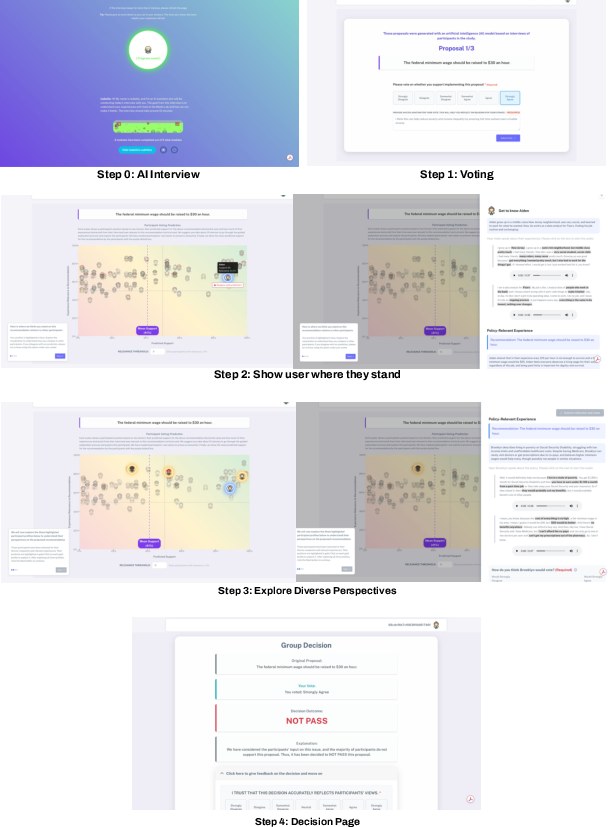
Figure 1: An overview of the different elements used in the study’s process, with AI interview, voting, multi-perspective exploration, and outcome feedback stages.
Experimental Design
The evaluation utilized a 2×2 randomized factorial design (n=181) on Prolific, stratifying for political diversity. Experimental factors were: AI interview (present/absent) and visualization (present/absent), producing four arms. Each participant engaged with three high-salience policy topics (minimum wage, DEI in hiring, local-vs-foreign hiring). To probe process scrutiny under maximal adversarial conditions, all participants encountered collective outcomes contrary to their stated stances.
A multi-layered measurement framework assessed (a) process legitimacy (trust, voice, adherence, understanding), (b) social cohesion (connection, respect, pluralism, perspective-taking), and (c) stance/learning (shifts, certainty, learning gain). Survey instruments were supplemented by 22 semi-structured qualitative interviews, enabling robust cross-modal triangulation.
Quantitative Findings
Statistical modeling employed regression with demographic and pre-treatment controls. The most significant main effects are summarized below.
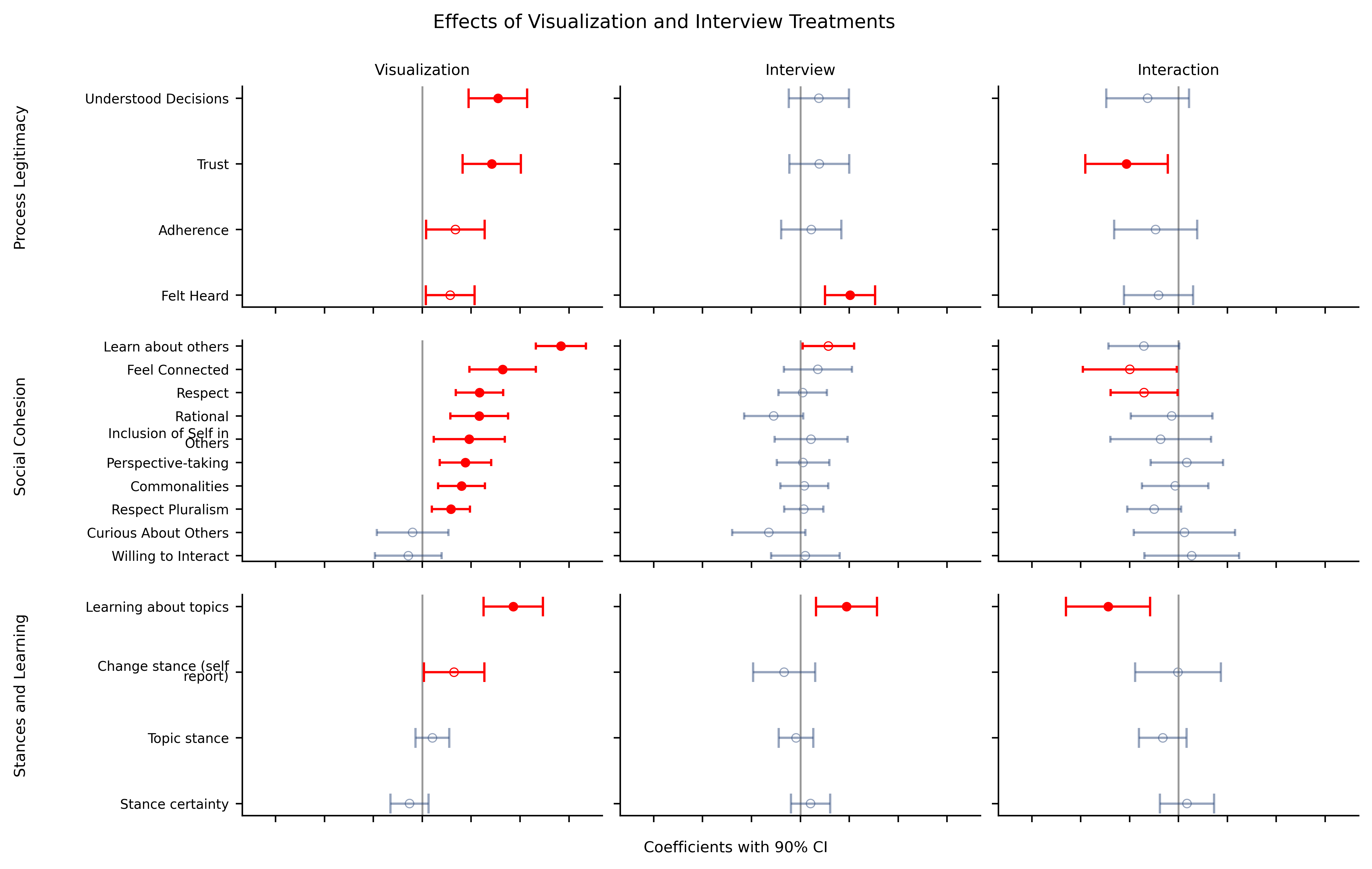
Figure 3: Estimated coefficients for visualization and AI interview treatments on key outcomes (90% CI), with markers for statistical significance.
- Visualization significantly increased perceived legitimacy (β=0.77, p<0.001 for understanding; β=0.71, p<0.001 for trust), adherence to outcomes (β=0.34, p=0.06), and sense of being heard (β=0.29, p=0.06).
- Social cohesion was strongly enhanced (connection β=0.82, respect β=0.58, pluralism β=0.29; all p<0.05) except for curiosity/willingness to interact, which showed no consistent effect or a slight decline.
- Topic learning (self-report) and stance change (self-report, not actual support) saw positive effects (learning β=0.93, p<0.001; stance change β=0.32, p=0.08). However, there was no main effect on actual policy support (Δstance) or increased certainty (stance certainty β=–0.13, p=0.27).
- The AI interview alone primarily increased participants' felt "voice" (β=0.51, p<0.001) and learning (β=0.47, p=0.01), likely a function of structured reflection, but weak effects on legitimacy/cohesion.
- Notably, the interaction term (visualization × AI interview) was negative for several metrics (e.g., trust, learning, respect, connection), indicating the visualization’s effect was attenuated for those who had already self-expressed via interview—likely an investment/expectation dynamic.
Qualitative Insights
Qualitative evidence validated and contextualized the quantitative findings, especially regarding the underlying mechanisms driving losers’ consent.
Participants exposed to voice-based, profile-rich visualizations reported stronger social connectedness, empathy, and rationalization of dissenters’ stances. Audio delivery was consistently viewed as more "real," emotionally nuanced, and credible than text alone. Conversely, conditions without visibility into peer perspectives or argument bases yielded "relationship-less" and "black box" experiences, frequently impeding trust and outcome acceptance.
Participants differentiated legitimacy not only through majority rule but via process explainability, visibility, and opportunity for input. When these criteria were unobservable or undermined (e.g., no avatar exposure, opaque process), compliance dropped and suspicions regarding manipulation increased. The presence of an AI interviewer, though generally accepted as nonjudgmental and efficient, aroused concerns about process opacity, potential bias, and possible distortion of nuanced or sensitive input—particularly for high-stakes applications.
Design Implications
The experimental evidence supports several implications for AI-enabled collective decision design:
- Grounding deliberative interfaces in personal experience, particularly through voice/audio, can substantially improve social evaluations, perceived rationality of dissent, and procedural legitimacy, even when outcomes are adverse.
- Transparency affordances—showing how participation is reflected, surfacing process logic and aggregative mechanisms, and enabling inspection and contestation of AI inference—are critical to mitigate trust deficits and perceptions of manipulation.
- For scalability, LLM-powered interviewers and rationalization extractors can effectively elicit nuanced, scalable evidence for collective reasoning (Park et al., 2024, Jarrett et al., 13 Feb 2025); but designers must harden these systems with audit and contestability tools to manage automation bias and agency erosion [green2019principles].
- Exposure to diverse, authentic rationales fosters understanding but does not guarantee increased willingness for deeper interaction or engagement with adversarial profiles, echoing established findings on affective polarization and deliberative backfire risk [boxell2024cross, bail_cross_cutting, frimer2017liberals].
- Standalone deliberative experiences focused exclusively on "losing" participants can reveal process deficiencies, whereas integrated, iterative or dialogic affordances may reduce backfire by enabling participants to revisit, reweigh, or propose alternative aggregative logics.
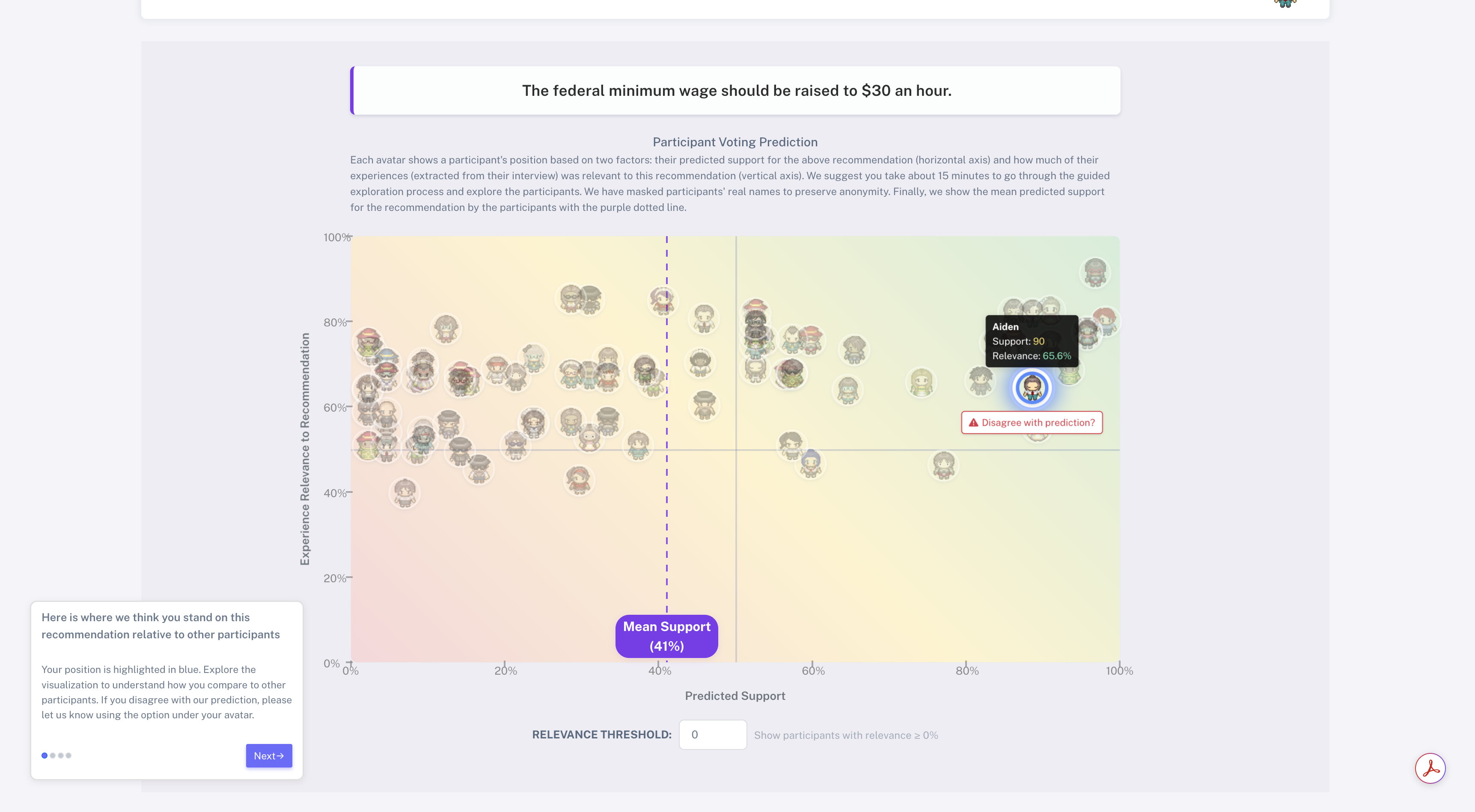
Figure 2: Visualization showing the user’s relative position among other participants, mapped along predicted support and experience relevance axes.
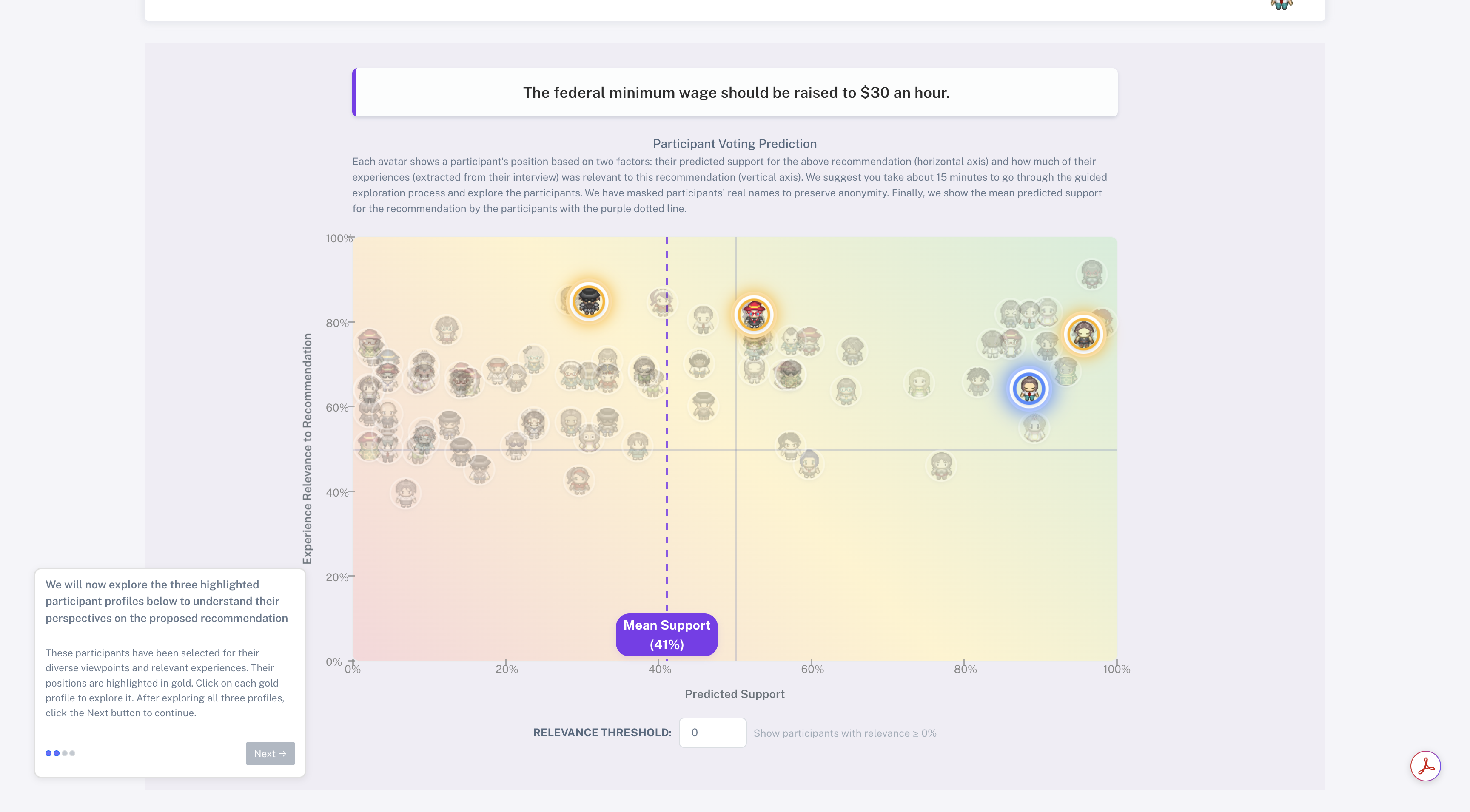
Figure 6: Visualization presenting diverse featured profiles across the spectrum of predicted support, highlighting experiential rationales.
Theoretical and Practical Impact
This work reinforces emerging theoretical consensus that process factors—specifically, the audibility of authentic, context-rich rationales and opportunities for contestation—are pivotal for robust losers’ consent and legitimacy [losers_consent, carman2010process]. LLM-based systems are uniquely positioned to operationalize these at scale, surpassing traditional survey or forum-based procedures in expressivity and human-likeness. However, the empirical results demonstrate that mere exposure to diversity is insufficient for overcoming downstream challenges in polarization, engagement, and compliance. Mechanism design must balance process contestability with efficient aggregation to preclude both disengagement (due to opacity) and performative polarization (due to engagement metrics focused on attention maximizing content [outgroup_polarizing]).
Practically, next-generation AI deliberative systems should:
- Integrate multi-turn dialogic scaffolds permitting feedback, correction, and contestation.
- Adopt robust, provenance-preserving pipelines for participant authentication and content verification.
- Combine reflective automation with iterative agenda setting to enable reform/repeal affordances, emulating participatory mini-publics but at digital scale.
- Account for variance in legitimation and engagement across sociopolitical and organizational domains; real-world deployment must accommodate context-specific norms and validation procedures.
Future Directions
Key technical research trajectories include: (1) developing richer, multi-dimensional embeddings of personal experience that permit nuanced spectrum visualization; (2) quantifying causal pathways between deliberative affordances, perception of procedural fairness, and long-term democratic engagement; (3) embedding LLM systems with explainability/contestability-by-design, leveraging social choice theory and HCI best practices [(Fish et al., 2023), considerit, yeo2025enhancing]; (4) examining cross-cultural and high-stakes deployment settings, with attention to privacy, bias, and regulatory constraints.
Conclusion
"AI and Collective Decisions: Strengthening Legitimacy and Losers’ Consent" (2604.05368) substantiates that carefully architected LLM-augmented systems can measurably enhance perceptions of procedural legitimacy and intergroup understanding in collective decision contexts, even when outcomes are counterpreferential. Audio-based, rationality-preserving interfaces, as implemented here, operationalize longstanding theoretical prescriptions from deliberative democracy and social psychology within computational institutional design. However, process transparency, contestability, and iterative engagement remain central challenges, motivating ongoing research into the intersection of AI, democracy, and collective rationality.

