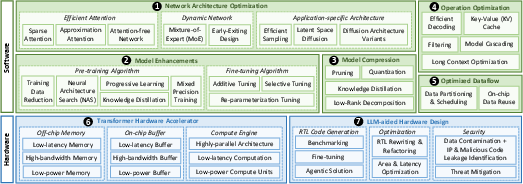
- The paper introduces a multi-layer methodology combining domain-specific adaptation, model compression, and LLM-aided hardware design to overcome resource constraints in MFMs.
- It demonstrates effective block-wise mixed-precision quantization and a custom transformer accelerator (SwiftTron) achieving over 3.5x speedup with minimal accuracy loss.
- The study validates its approach with real-world case studies in healthcare and robotics, highlighting energy-efficient adaptations and robust performance.
Hardware and Software Co-design Methodology for Accelerating Multimodal Foundation Models
Introduction and Challenges
Multimodal foundation models (MFMs), including LLMs, VLMs, and VLAs, have advanced the integration of multiple data modalities such as text, image, and audio, resulting in robust performance across diverse application domains. The tremendous scale and complexity of MFMs, however, impose significant computational, memory, bandwidth, and energy requirements, presenting obstacles to efficient training and deployment, particularly on resource-constrained platforms. The paper systematically enumerates four principal challenges: energy-efficient processing, cross-modal integration and alignment, domain-specific adaptation, and security and reliability.
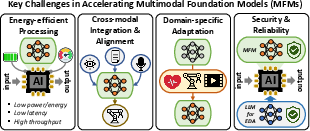
Figure 1: Key challenges in accelerating MFMs, including computational and memory bottlenecks, cross-modal alignment complexity, domain adaptation hurdles, and security requirements.
Multi-layered Methodology for MFM Acceleration
The authors propose a multi-layered methodology that integrates domain-specific model adaptation, hardware-aware software optimization, and tailored accelerator design. The workflow begins with network model development and fine-tuning for domain-specific tasks. The pipeline then applies compression techniques, operation-level optimizations (e.g., speculative decoding, model cascading), and dataflow scheduling aligned with hardware constraints. Hardware accelerators for transformers are designed either through expert-driven RTL flows or LLM-aided EDA, significantly shortening design cycles.
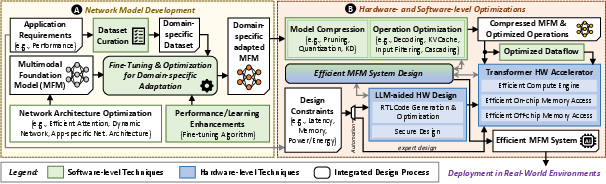
Figure 2: Systematic multi-layer methodology: fine-tuning, compression, operation optimizations, hardware co-design, deployment.
Hardware and Software Techniques Overview
The methodology encompasses a spectrum of hardware and software solutions:
Mixed-Precision Quantization and Compression Case Studies
Experimental results demonstrate the efficacy of block-wise mixed-precision quantization. For Llama3-8B, quantization sensitivity varies across transformer blocks, motivating adaptive allocation of bit-widths. Pareto-optimal configurations preserve accuracy (e.g., perplexity score degradation <0.3) while attaining up to 40.74% memory footprint reduction.
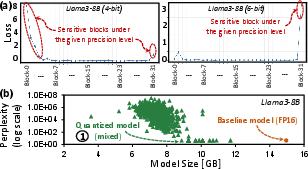
Figure 4: Block-wise quantization sensitivity in Llama3-8B; Pareto frontier for performance-memory tradeoff.
General-purpose processors/GPU implementations suffer inefficiencies for transformer primitives. The SwiftTron accelerator achieves end-to-end integer-only processing. Uniform quantization (8-bit for storage, 32-bit for computation, dynamic requantization) ensures both numerical stability and hardware efficiency. Specialized compute engines and memory buffers minimize area and power, while functional units handle multi-head attention, normalization, and nonlinear activation.
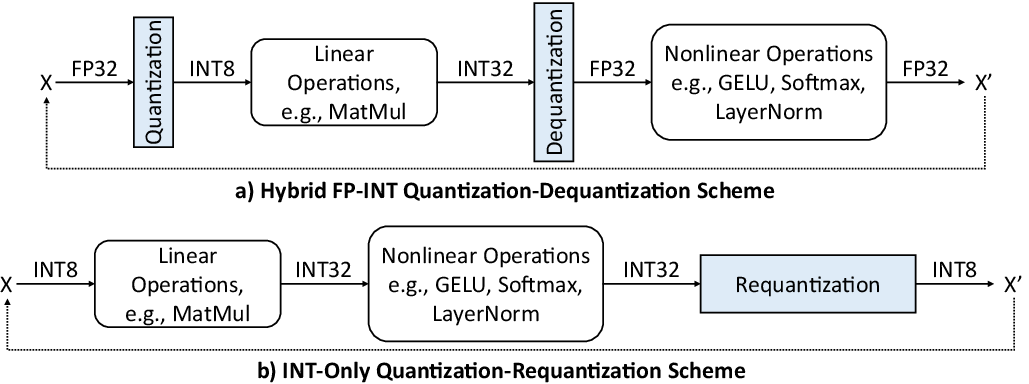
Figure 5: Comparison of quantization-dequantization schemes enabling integer-only transformer inference.
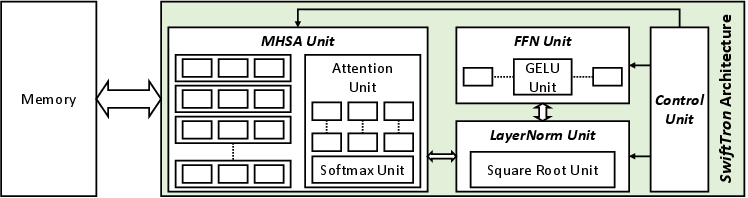
Figure 6: Functional block diagram of SwiftTron, highlighting tightly coupled, optimized units for transformer workloads.
SwiftTron delivers over 3.5x speedup versus GPU baselines with competitive accuracy across language and vision benchmarks. Matrix multiplication is identified as a primary optimization target in terms of area and power.
LLM-aided EDA: Security, IP, and Data Contamination
LLMs automate RTL code generation and verification, accelerating design and enabling rapid exploration. However, security concerns include potential IP leakage, hardware Trojan insertion, and benchmark contamination risks. Logic locking and machine unlearning are shown to mitigate leakage, while contamination metrics (e.g., pass rates, Min-K% probability) highlight data integrity issues.
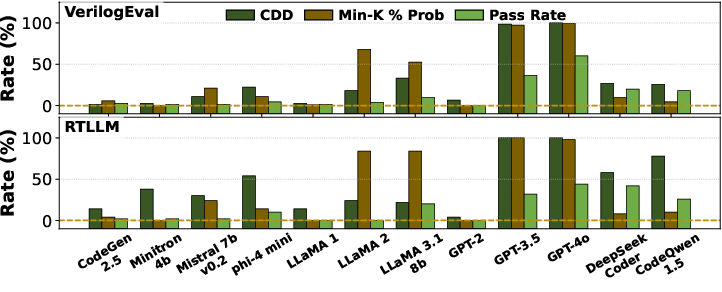
Figure 7: Contamination rates and functional correctness evaluation across LLMs for RTL generation.

Figure 8: Logic locking approaches effectively mitigate IP leakage risk from LLM-aided hardware design.
Healthcare and Robotics: Domain-specific Adaptation and Compression
Healthcare: A quantization-centric pipeline adapts TinyLLaVA-1.5B to medical imaging, achieving fine-tuned performance via domain alignment and instruction tuning. 8-bit and 4-bit post-training quantization effects are evaluated, revealing minimal regressions and substantial memory savings (up to 9x), enabling deployment on embedded devices without accuracy compromise.
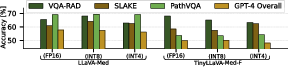
Figure 9: Closed-question accuracy under quantized medical MLLMs; minimal loss with aggressive compression.
Robotics: For open-vocabulary object detection (OVD), transformer-based VLMs are compressed via mixed-precision inference and block-level structural simplification. Key results demonstrate that moderate pruning and token drop achieve latency reductions and maintain semantic alignment, enhancing robotic navigation and perception responsiveness.

Figure 10: Modular overview of robotics perception stack integrating SLAM, OVD, and navigation.
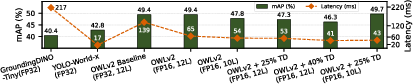
Figure 11: Accurate OVD performance with compressed transformer VLMs, illustrating trade-off between latency and detection F1.
Spiking-MFM Extensions: SNN-based Energy-efficient Approaches
SNNs introduce event-driven sparsity to MFMs for ultra-low-power deployment. Quantization sensitivity analysis in SLMs and SViTs shows that hierarchy-aware allocation of precision yields significant memory/power reduction with negligible accuracy/perplexity regression. QSLM achieves 85% memory savings in SpikeGPT-216M with ≤1.3% accuracy loss; QSViT reduces memory/power by >20% with maintained accuracy in vision SNNs.
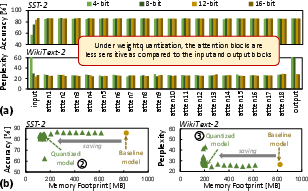
Figure 12: Block-wise quantization sensitivity in SpikeGPT; hierarchy-aware mixed precision preserves accuracy/memory savings.
Conclusion
The paper delineates a comprehensive, multi-layered methodology for accelerating MFMs via synergistic hardware and software co-design. Empirical results and domain-specific case studies validate the proposed strategies for energy-efficient, high-performance deployment of MFMs across healthcare, robotics, and neuromorphic contexts. The integration of LLM-aided hardware design, robust compression techniques, and tailored accelerator architectures is positioned to drive future development of scalable, domain-adapted AI systems under strict resource, security, and reliability constraints.
(2604.21952)