- The paper introduces D-QEO, which leverages quantum topographical preconditioning to significantly narrow the search volume in high-dimensional optimization.
- It employs register-based encoding to map each dimension onto independent quantum subspaces, enabling efficient parallelism and reducing classical iteration counts.
- Empirical results demonstrate exponential stability and reduced computational effort in benchmark tests compared to traditional classical optimization methods.
Distributed Quantum-Enhanced Optimization: A Topographical Preconditioning Approach for High-Dimensional Search
Introduction
The exponential growth of the search space with increasing dimensionality, commonly termed the "curse of dimensionality," poses a fundamental challenge for classical global optimization algorithms, particularly for highly non-convex, multi-modal functions. Efforts to mitigate this bottleneck using heavily parallelized classical algorithms such as Particle Swarm Optimization (PSO) combined with quasi-Newton methods (e.g., BFGS) have not prevented the empirical finding that, even with significant computational resources, the likelihood of locating the true global minimum in high-dimensional spaces decays exponentially. The core contribution of the discussed paper introduces Distributed Quantum-Enhanced Optimization (D-QEO), leveraging quantum processors as a topographical preconditioner rather than as high-precision optimizers. This framework integrates quantum and classical resources in a hybrid architecture, achieving exponential volume reduction and successful dimensional scaling in continuous global search.
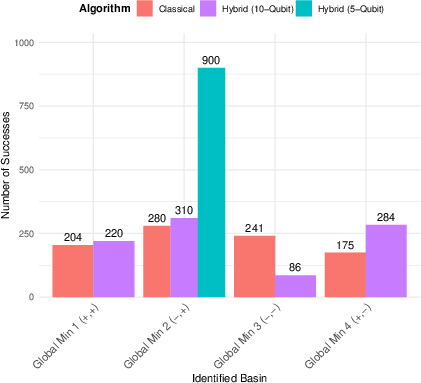
Figure 1: Box and whisker plot showing performance degrades drastically for a classical solver for the Rastrigin function as the dimensionality of the problem increases when using the same number of particles.
Topographical Preconditioning with Quantum Processors
Rather than delegating the task of attaining the global minimum to the QPU—which would inherit unmanageable discretization overhead and barren plateau issues—as in QAOA or VQE approaches, D-QEO exploits the ability of quantum circuits to rapidly map topographical features of the objective landscape, identifying the most promising basins of attraction. This quantum map provides highly localized, high-quality initialization points for GPU-accelerated classical solvers, drastically reducing the size of the search region that must be explored by the latter.
Dimensional Mapping and Discretization
Critical to the scalability of D-QEO is register-based encoding: each dimension of the d-dimensional problem is represented by a separate K-qubit register, mapping the continuous domain onto a discrete Hilbert space. The separability of benchmark functions (Rastrigin, separable Ackley) permits a one-level dimensional decomposition, so the total DK-qubit Hilbert space can be partitioned into d independent subspaces. This avoids the exponential scaling cost and memory bottleneck associated with particle-based mappings and monolithic entangled circuits, making utility-scale (50-qubit) experiments tractable on near-term hardware.
Figure 2: Motivation for cutting and knitting. Increasing from 5 to 10 qubits per dimension removes the grid-alignment bias and restores mathematical symmetry but incurs an exponential scaling cost in qubit requirements.
Quantum Measurement Distributions and Discretization Artifacts
Mapping continuous landscapes to low-dimensional quantum grids introduces resolution-induced artifacts; notably, the degeneracy of global minima in non-separable (e.g., Himmelblau) functions can be artificially broken by grid alignment, leading to pronounced bias toward particular minima. Fine-grained discretization (more qubits per register) restores mathematical symmetry but rapidly becomes infeasible for high dimensions, highlighting the necessity of focusing the D-QEO approach on separable topologies for current hardware regimes.
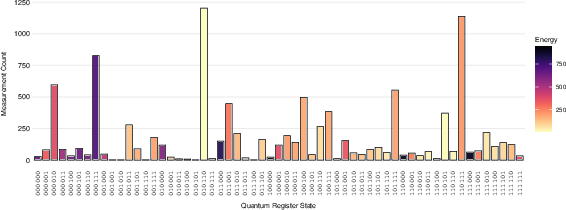
Figure 3: Quantum measurement distribution for the 2D Himmelblau function at low spatial resolution (K=3 qubits per dimension). The grid-induced degeneracy breaking causes the quantum optimizer to localize in a single basin, demonstrating the need for finer discretization to capture all global minima.
Core Methodology
Algorithmic Details
The D-QEO workflow comprises three phases:
- Quantum Topographical Preconditioning: Independent variational quantum circuits (hardware-efficient ansätze) are trained on each dimensional subspace, optimizing the tail energy (via Conditional Value-at-Risk, CVaR) to concentrate the probability distribution over the most promising minima.
- Seed Point Extraction and Bounding Box Formation: The post-optimization quantum measurement statistics are used to compute both the best discrete configuration and the centroid of the lowest-energy states, forming a seed and dynamic search box for the classical optimizer.
- Classical Refinement: GPU-accelerated classical solvers (PSO+BFGS for differentiable, PSO-only for non-differentiable landscapes) are tightly warm-started within the quantum-predefined subspace.
Notably, the dynamic adaptation of the search radius (δ) via the RMS spatial deviation of low-energy quantum samples mimics adaptive trust region/covariance strategies in evolutionary algorithms but is guided by quantum measurement statistics.
Distributed Circuit Execution
For separable target functions, each K-qubit circuit operates asynchronously, localized to a single computational register, enabling efficient parallel simulation/execution on heterogeneous quantum/classical hardware. This bypasses the classical tensor network knitting overhead required for general entangled circuits.
Empirical Results
Convergence and Scaling Behavior
D-QEO delivers a marked improvement in success rate (Ncorrect) relative to classical baselines as problem dimensionality increases, both for highly multi-modal (Rastrigin) and non-differentiable (Ackley) benchmarks. Where purely classical swarms display exponential decay in successful convergence beyond d>5, D-QEO maintains high success rates, including near-perfect performance at high quantum evaluation budgets (COBYLA iterations).
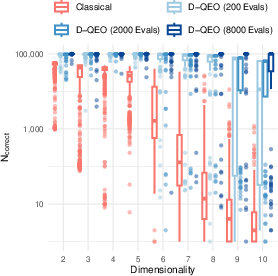
Figure 4: Number of correct solutions (Ncorrect) for the Rastrigin function, demonstrating the exponential stability benefit of D-QEO preconditioning over the classical baseline across increasing dimension.
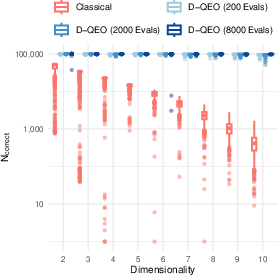
Figure 5: Number of correct solutions (K0) for the separable Ackley function, confirming robust D-QEO performance in non-differentiable, multi-modal regimes.
Classical Computational Effort
The quantum preconditioning step yields substantial reductions in required classical BFGS iterations, shifting classical solvers from costly volume-exploration to high-resolution, local convergence.
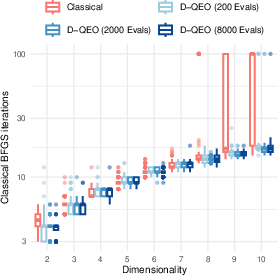
Figure 6: Classical optimization effort required to achieve convergence. The quantum preconditioning phase sharply reduces the number of BFGS iterations, confirming a significant computational efficiency uplift.
Volume and Minima Reduction
The D-QEO pipeline mathematically quantifies the exponential collapse of both the ambient search volume and the number of local minima surviving into the classical refinement phase. For instance, in 10D Rastrigin, the search is reduced from K1 to merely K2 localized minima by the quantum phase—a compression ratio of over K3—breaking the classical exponential scaling bottleneck and providing a deterministic pathway for robust solution finding.
Discussion and Future Directions
Practical and Theoretical Implications
D-QEO provides an implementable quantum-classical hybrid template for high-dimensional optimization where only limited quantum hardware is available. Its practical viability in the NISQ context is enhanced by relegating the high-noise, shallow quantum circuits to the role of "topographical scouts," with error tolerance far exceeding that required for high-fidelity quantum numerical computation.
Theoretically, the observed exponential search volume reduction and resilience to both differentiability failures and multi-modality suggests a new algorithmic pathway for global optimization in both scientific and industrial domains, particularly those with separable or weakly-coupled objective functions.
Extensions and Generalizations
While D-QEO's current scope effectively addresses separable functions, scaling to non-separable or entangled landscapes will demand advances in quantum circuit cutting, tensor network knitting, and error mitigation protocols. The methodology also opens questions regarding the optimal sampling, circuit depth, and classical/quantum handoff strategies as QPU hardware matures.
Conclusion
Distributed Quantum-Enhanced Optimization advances the state of global optimization by integrating parallel quantum topographical mapping as a preconditioner for high-dimensional classical solvers. The D-QEO framework achieves exponential reduction in the effective search volume and classical computational effort, enabling robust, scalable solution strategies for previously intractable high-dimensional landscapes. As quantum hardware capabilities grow, this hybrid architecture is positioned to deliver tangible computational efficiency in both foundational and applied optimization tasks.

