- The paper presents a hierarchical Bayesian model using latent Gaussian fields and INLA for EV charging demand forecasting in urban Scotland.
- It integrates rich temporal and spatial data to capture weekday-weekend seasonality and tariff-induced shifts in charging patterns.
- Empirical results show that the Bayesian approach outperforms local models in improving key accuracy metrics for risk-aware infrastructure planning.
Spatio-Temporal Bayesian Modelling of Electric Vehicle Charging Demand in Urban Scotland
Introduction
The stochastic nature of electric vehicle (EV) charging demand, instigated by dynamic spatio-temporal factors and evolving operational constraints, presents growing challenges in infrastructure planning and grid management for urban regions. This paper addresses these with an empirical study centered on the urban Scottish context, notably Glasgow, leveraging a newly introduced, large-scale, longitudinal dataset of public EV charging sessions (October 2022–April 2025) and proposing a hierarchical Bayesian spatio-temporal modelling framework based on latent Gaussian fields.
Data and Exploratory Analysis
A comprehensive curation and enrichment pipeline was applied to open-access logs from ChargePlace Scotland, integrating metadata (e.g., charger type, power, accessibility) and territory mapping to Postcodes and Local Authority boundaries. The volume of observed sessions provides high temporal and spatial resolution, critical for rigorous statistical modelling.
Exploratory analysis revealed (i) distinct weekly seasonality in session volumes, with Friday exhibiting highest average demand and weekends significantly lower and less volatile, (ii) pronounced tariff sensitivity, as introduction of fees in previously free regions resulted in persistent and substantial declines in charging activity, and (iii) strong divergences between charger categories, with rapid/ultra-rapid chargers exhibiting higher and more regular utilization than AC units. The analysis motivates explicit inclusion of temporal, policy, and infrastructure covariates in downstream models.
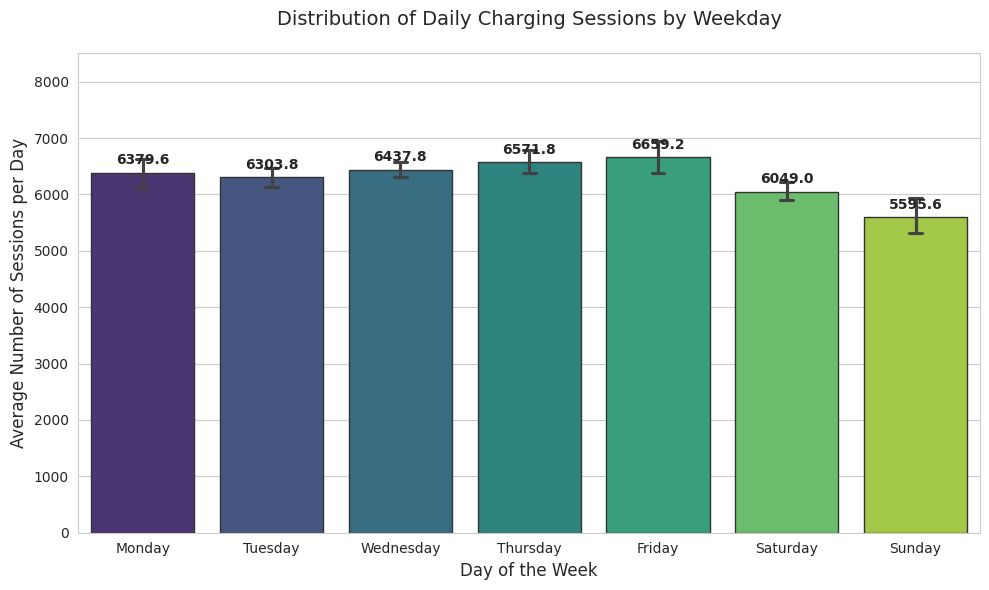
Figure 2: Average daily EV charging session volumes, highlighting characteristic weekday-weekend seasonality and stability of overall demand.
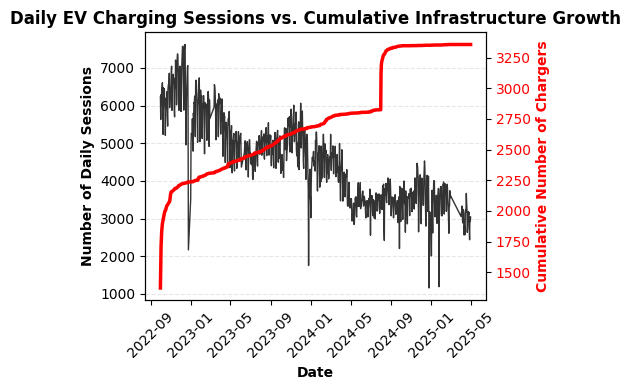
Figure 1: Temporal co-evolution of daily session counts and cumulative infrastructure (public charger) growth on the Scottish network.
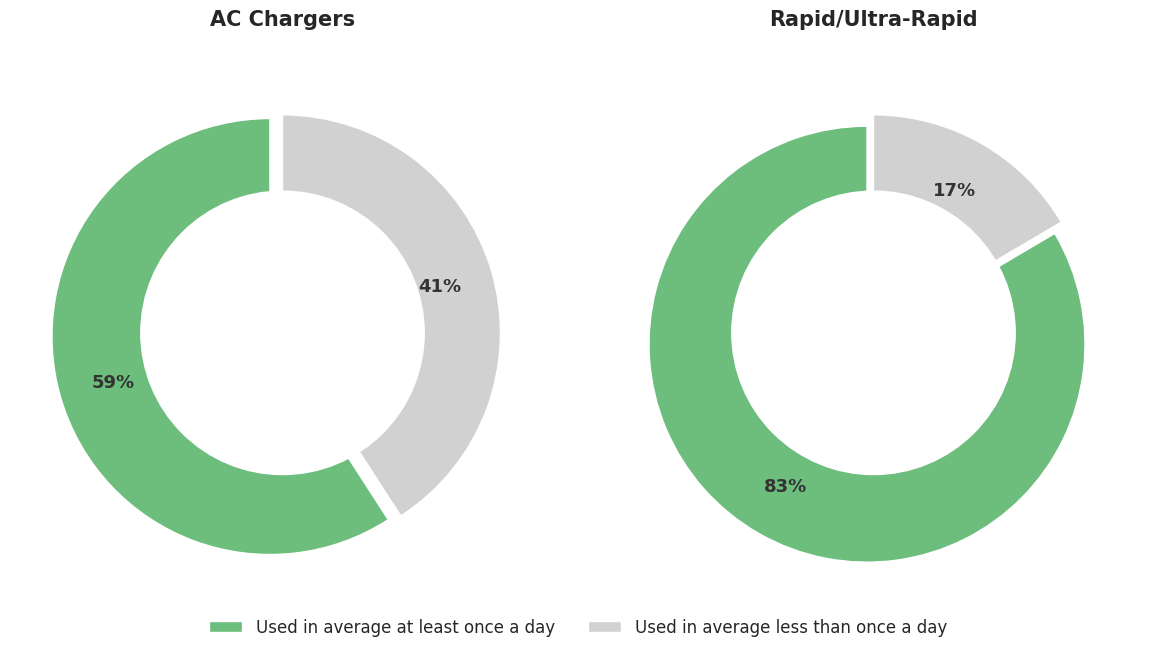
Figure 3: Utilization rates by charger type; rapid/ultra-rapid units display substantially higher daily activity compared to AC chargers (83% vs 59%).
Methodology: Hierarchical Spatio-Temporal Bayesian Modelling
Forecasting EV charging demand at the station level was cast as a hierarchical latent Gaussian model. The conditional mean of the Poisson likelihood was governed by a log-linear predictor block—partitioned into observed covariate effects, latent spatial effects, and latent temporal effects. For computational tractability and robust posterior inference, the framework employs Integrated Nested Laplace Approximation (INLA).
Temporal Dynamics: The temporal trajectory was regularized via a second-order Random Walk (RW2), enabling smooth, nonparametric adaptation to regime shifts (notably, tariff introductions) and cyclic factors.
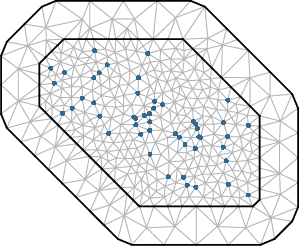
Spatial Dynamics: Two alternative spatial stochastic processes were compared:
Empirical Results
Model comparison involved benchmarks against station-level Poisson GLMs and XGBoost regressors, which lack spatial pooling. On key accuracy metrics (MAE, MAPE), both ICAR–RW2 and SPDE–RW2 outperformed local models at 70–77% of stations. Dominance is more pronounced on MAPE, with RMSE showing near-parity—indicative of the spatial Bayesian models’ effectiveness at reducing average and relative errors, but not extreme local fluctuations (highly nonstationary spikes).
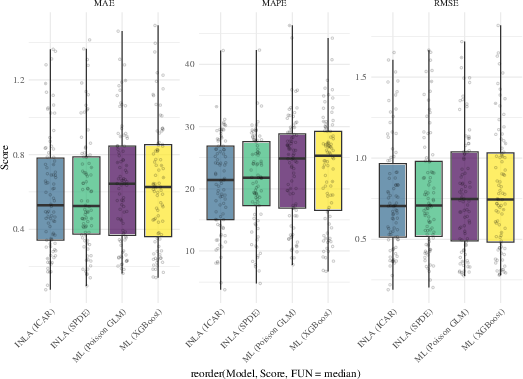
Figure 8: Benchmarking predictive performance (RMSE, MAE, MAPE) across (i) local regressors (XGBoost, GAM) and (ii) Bayesian spatio-temporal models (ICAR–RW2, SPDE–RW2), demonstrating concentrated improvement in error distributions under the Bayesian approach.
Posterior parameter estimates confirmed:
- Charger type: Rapid/Ultra-Rapid connectors drive significantly higher demand (β^≈0.91).
- Tariff status: Free charging significantly increases activity (β^free≈0.14).
- Temporal effects: Both models capture the structural break and post-tariff stabilization, with high latent trend smoothness (RW2 precision ∼2×10⁵).
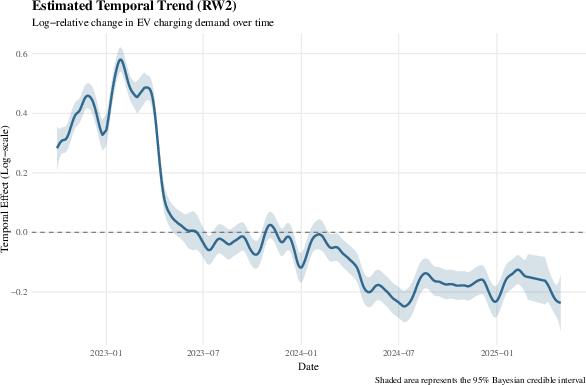
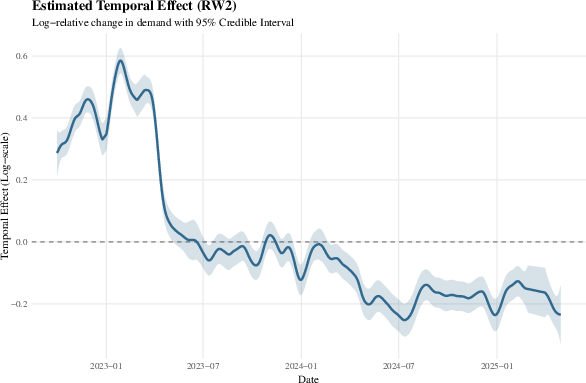
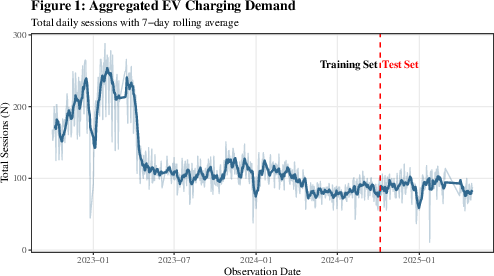
Figure 4: Posterior mean of the RW2 temporal latent component, marking the demand drop and stabilization post-tariff introduction.
Spatial range in the SPDE: Posterior mean ρ^=684m coheres with the observed spatial density of the network, supporting the local spatial dependence hypothesis.
Practical and Theoretical Implications
Practically, the framework enables risk-aware, station-level demand forecasting with principled uncertainty quantification—features absent in conventional ML models. This is crucial for infrastructure scaling, tariff design, and operational grid resilience, especially under policy-driven demand shocks. The latent structure allows for interpretable separation of spatial, temporal, and covariate-driven effects.
Theoretically, this work formalizes and validates the application of INLA-based GMRF and SPDE methods in demand forecasting for public urban EV charging infrastructure. The paper demonstrates the statistical efficiency and interpretability advantages of latent Gaussian models over prevailing black-box ML methods, especially in capturing nonstationarities and nonlinear spatio-temporal dependencies.
Future Research Directions
Significant avenues for extension include:
- Network Scaling: Application to Scotland-wide, heterogeneous, and sparser networks, entailing adaptive mesh construction and spatial prior hierarchies.
- Hierarchical Forecasting: Multi-level models for coherent predictions across points, neighborhoods, and authorities.
- Load and Power: Extension from session counts to continuous load/energy variables, requiring additional distributional flexibility.
- Hybrid ML–Bayesian Pipelines: Two-stage models in which complex covariate interactions are captured via ML (e.g., XGBoost) and structured dependencies are subsequently handled via INLA (Hu et al., 13 Aug 2025).
Conclusion
This study demonstrates the feasibility and efficacy of hierarchical Bayesian spatio-temporal models, implemented with INLA, for fine-grained EV charging demand modelling in urban contexts. By unifying robust uncertainty quantification, interpretable spatial/temporal decomposition, and competitive predictive performance, this approach forms a methodological blueprint for demand-driven planning of electrified urban infrastructure.