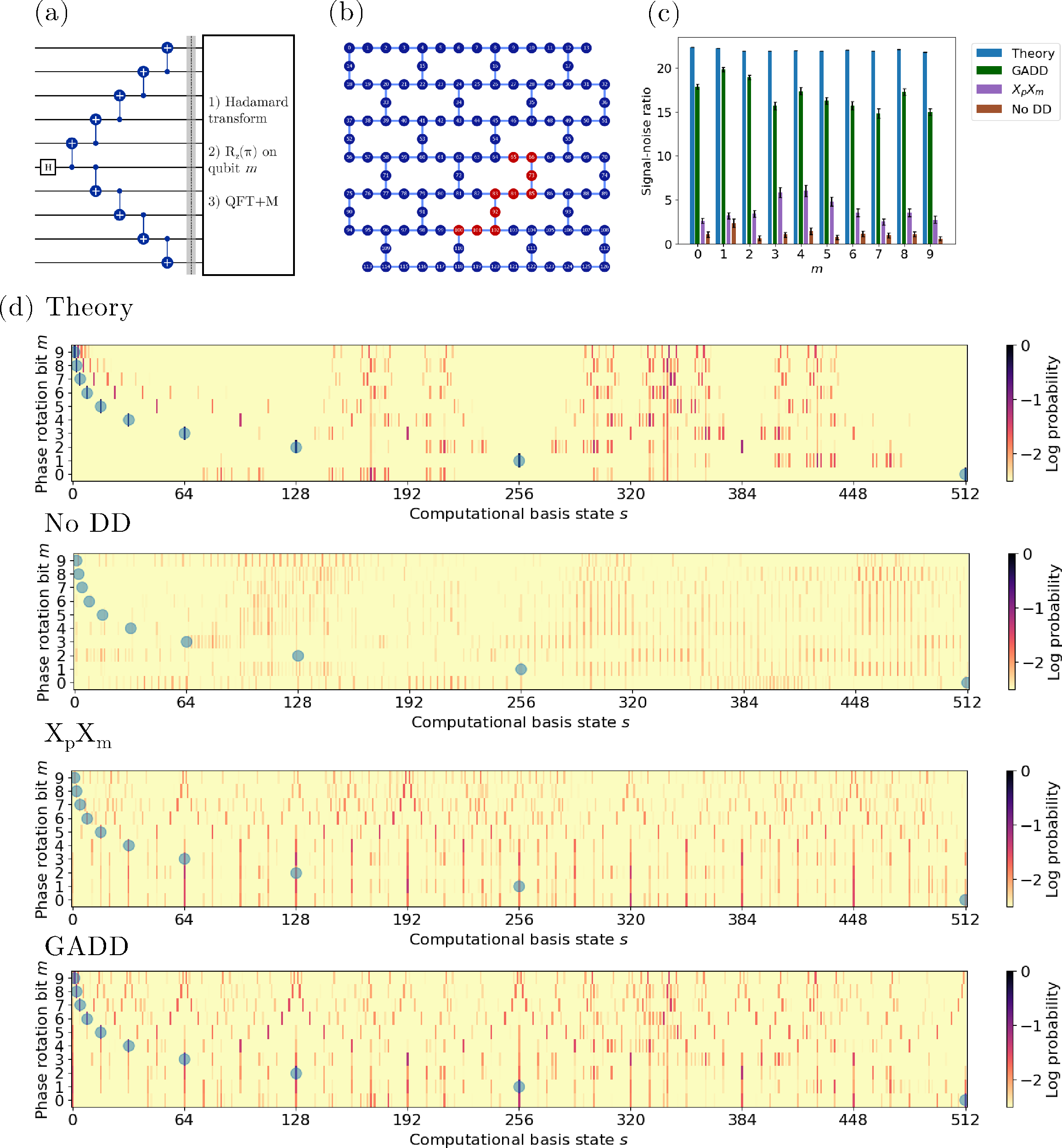
- The paper introduces a motif-based genetic algorithm tailored to optimize dynamical decoupling in dynamic quantum circuits with mid-circuit measurements.
- It empirically partitions circuits into spatiotemporal motifs and assigns context-aware DD sequences to mitigate measurement-induced errors.
- Experimental results show up to a three-fold reduction in error per layer and significant fidelity improvements in QFT+M circuits.
Empirical Optimization of Dynamical Decoupling for Dynamic Quantum Circuits
Introduction
This work addresses error suppression in dynamic quantum circuits incorporating mid-circuit measurements (MCMs), feedforward conditional operations, and real-time classical control. Conventional error mitigation techniques for quantum circuits, particularly dynamical decoupling (DD), are insufficient in dynamic circuits due to the spatially and temporally structured noise introduced by MCMs. The reported framework introduces empirical learning-based optimization of DD sequences, partitioning circuits into spatiotemporal motifs and leveraging genetic algorithms for hardware-level tuning. Extensive experimental validation demonstrates substantial error reductions and improved algorithmic fidelity compared to theoretically derived, measurement-agnostic DD strategies, with significant implications for quantum error correction, algorithmic depth, and extensibility to larger, connectivity-constrained devices.
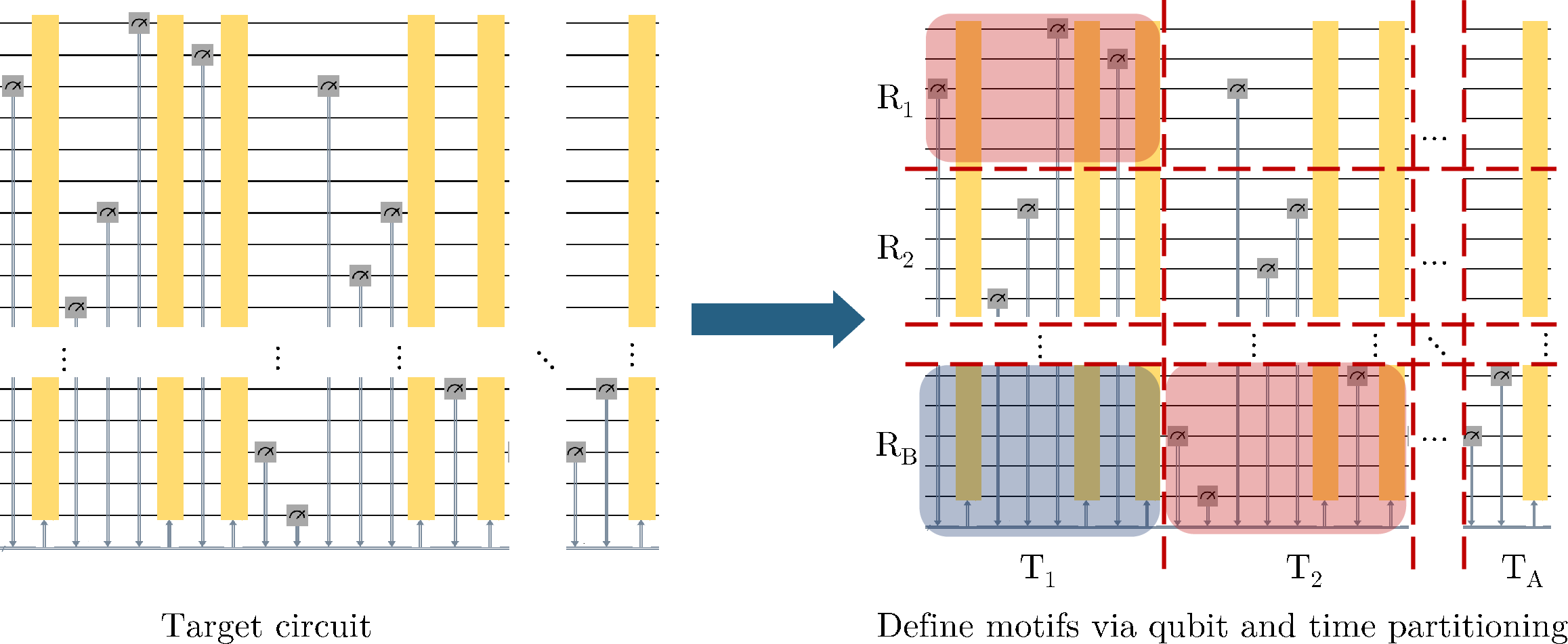
Figure 1: (Left) Schematic of a dynamic quantum circuit with mid-circuit measurements and conditional feedforward; (Right) Circuit partitioning into temporal intervals and qubit registers for motif-based GADD optimization.
Spatiotemporal Motifs and Empirical DD Optimization Protocol
Motif Decomposition and Learning Architecture
Dynamic circuits are decomposed into spatiotemporal motifs by partitioning both the time axis (each interval containing MCMs) and the physical qubit register based on device connectivity and crosstalk structure. This partitioning reflects the locality of measurement-induced errors, which can exhibit both spatial (neighboring qubit) and temporal (specific layer) specificity. Each motif is then independently optimized, enabling parallel GADD (Genetic Algorithm for Dynamical Decoupling) training across motifs with trivial inter-motif qubit correlations.
The empirical learning protocol utilizes a classical genetic algorithm optimizer, which iteratively proposes DD sequence candidates evaluated by executing parameterized circuits on hardware. Performance is quantified via an application-proximal utility function—specifically, the 1-norm similarity between the empirical and theoretical distribution of MCM-inclusive training circuit outcomes. Motif-level sequence coloring (assignment of pulse sequence variants to idle qubits based on proximity to measured qubits) is applied to guarantee crosstalk cancellation and context awareness.
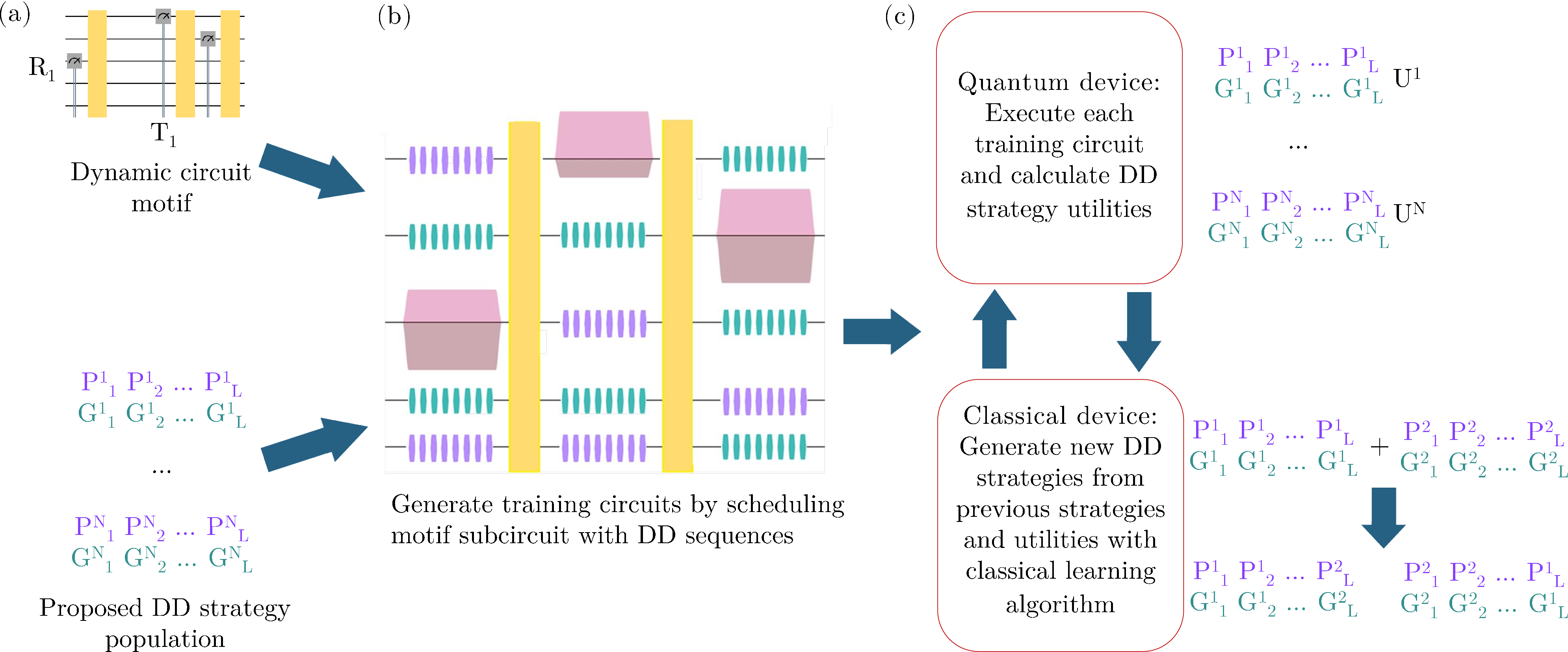
Figure 2: Independent optimization of colored DD sequences within a motif; color assignment is based on qubit distance from measured qubits, ensuring context-aware decoupling.
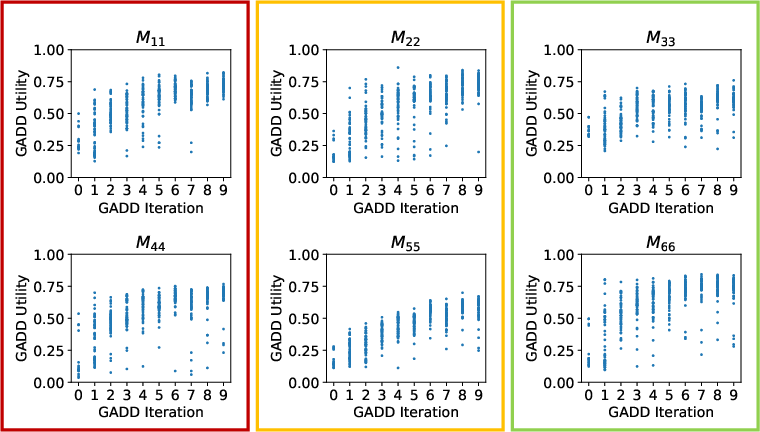
Figure 3: Utility progression of GADD populations through 9 training iterations for all 6 motifs in a 30-qubit QFT+M circuit, showing consistent convergence.
Evaluation: Randomized Benchmarking and Motif Generalization
MCM-RB and DC-RB: Protocols and Comparative Results
Effectiveness of motif-learned DD is quantified using two protocols:
- MCM-RB: Probes local suppression of measurement-induced errors for each motif using randomized sequences interleaved with MCMs, mapping the reduction in error per layer (EPL) for each unitary-measured qubit pair.
- DC-RB: Probes generalization to global circuit performance, executing large-scale randomized benchmarks (e.g., 20-qubit chains) with MCMs and conditional logic blocks.
Strong empirical results provide up to a three-fold reduction in EPL for unitary qubits experiencing MCM-induced errors: median EPL drops from 0.060 (no DD) to 0.021 (empirical DD), and analogous improvements are observed in application-independent DC-RB settings.
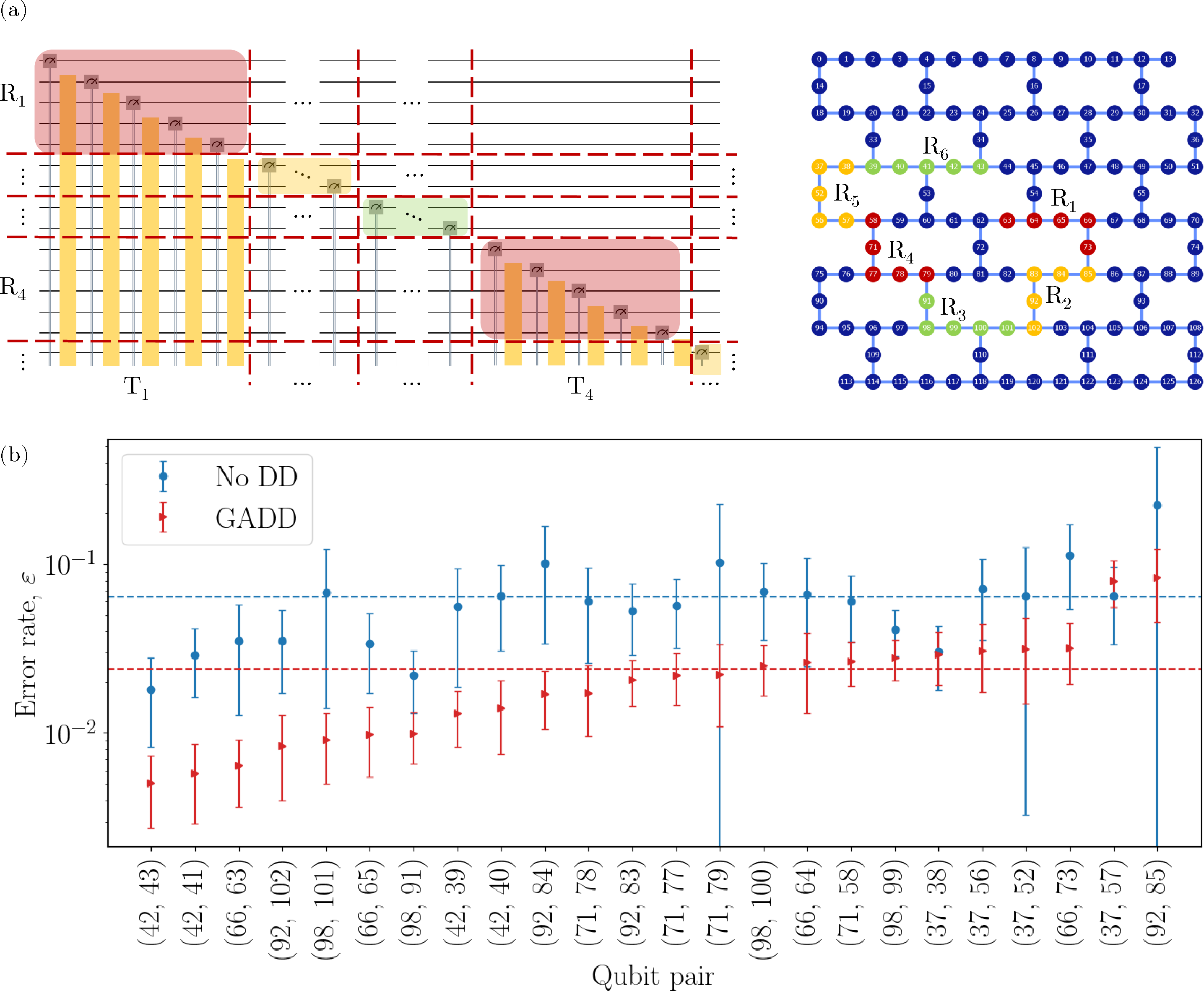
Figure 4: (a) Partitioning of a 30-qubit QFT+M circuit into motifs enables parallel GADD optimization; (b) EPL statistics before (blue) and after (red) GADD, with motif-level granularity.
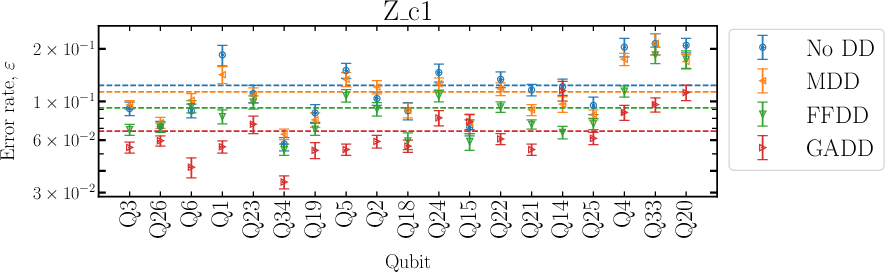
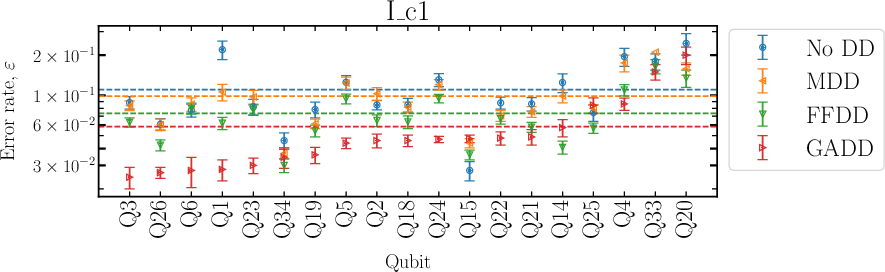
Figure 5: EPL by qubit for DC-RB blocks Zc1 (top) and Ic1 (bottom); GADD outperforms both theoretically derived MDD/FFDD strategies—without requiring calibration of feedforward delays.
Scaling, Motif Assignment, and Fidelity Metrics
Motif-learned DD sequences are transplanted into QFT+M circuits of varying sizes, benchmarking process fidelity (F) across random computational basis inputs for connected qubit chains (a nontrivial error environment). Empirical DD enables nontrivial F out to larger problem sizes (N=16, with F≥1% sustained versus rapid decay for canonical strategies).
Key results:
- Median fidelity increases more than tenfold for 8≤N≤14 compared to measurement-agnostic staggered strategies.
- Performance persists above random guessing thresholds (F=2−N) up to N=20, while agnostic strategies fail for N>14.
Ablation experiments validate the need for motif-specific and locality-aware sequences. Random or nonlocal DD assignment rapidly destroys Ic10.
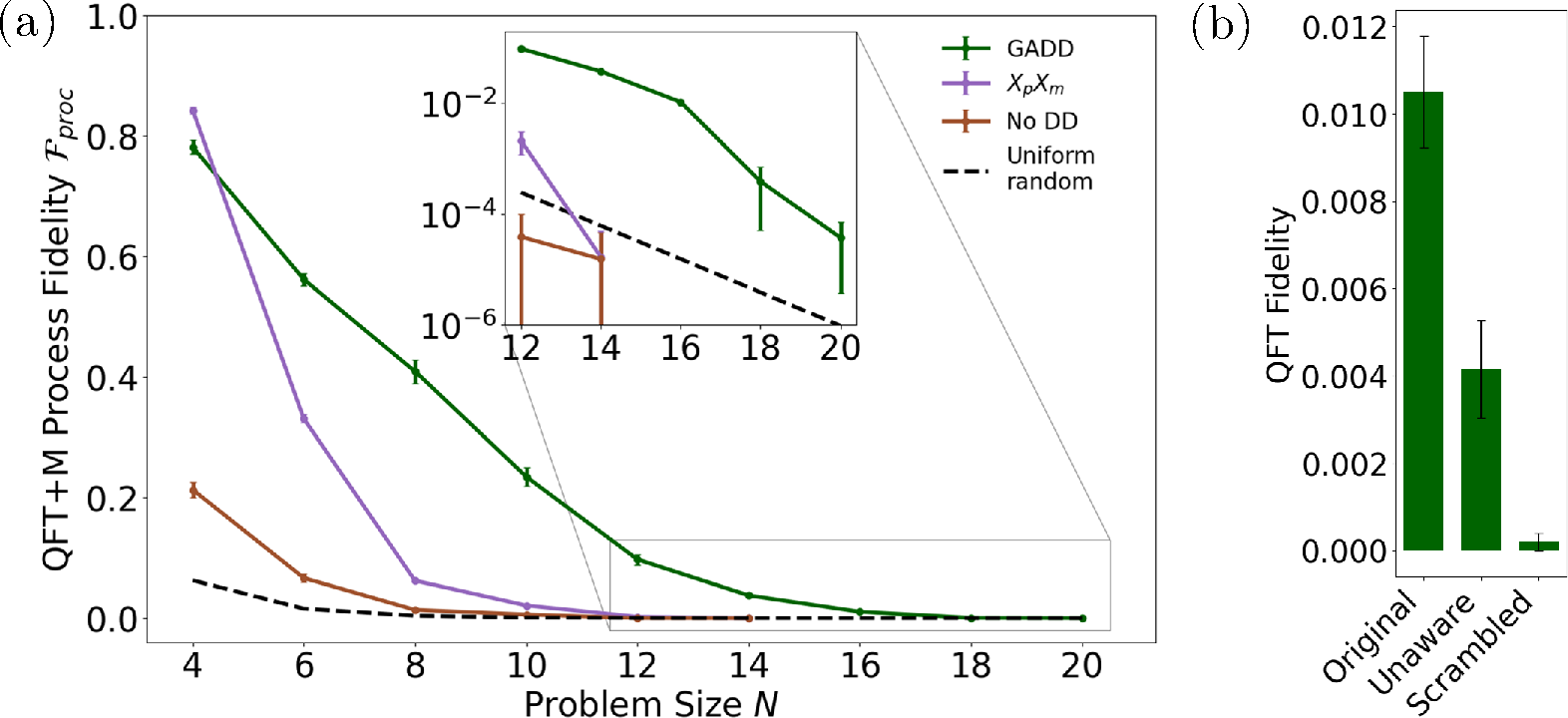
Figure 6: (a) Strong scaling of QFT+M process fidelity Ic11 under GADD-learned DD versus canonical strategies and no DD; (b) Counterfactual tests (unaware/scrambled assignment) confirm motif specificity is critical.
High-Fidelity QFT+M of Entangled Many-Body States
GHZ State Transformation and Many-Body Interference
Generalization is further evaluated in the QFT+M transformation of 10-qubit entangled X-basis GHZ states with local Ic12 rotations. This protocol probes the sensitivity to collective, spatially correlated noise—dynamically decoupling all motifs is a stringent test due to device-wide entanglement.
Empirical DD enables:
Practical and Theoretical Implications
The empirical DD learning framework is platform-agnostic—requiring only the ability to execute parameterized circuits and measure bitstring distributions—and does not require a microscopic device noise model. Its optimization protocol is efficient, converging in Ic17 device iterations per motif, with natural parallelism. These direct hardware-level error reductions are critical for scaling quantum error correction, reducing the cost of probabilistic error mitigation, and enabling robust measurement-conditioned quantum protocols. The superiority of empirical DD relative to theoretically derived strategies—despite the latter being optimized for dynamic circuits—demonstrates the inadequacy of static error models for high-fidelity, adaptive computation.
Conclusion
This study establishes motif-based, empirically learned dynamical decoupling as a superior error suppression protocol for dynamic quantum circuits, particularly in the presence of mid-circuit measurements and feedback. Hardware-specific, locality-sensitive sequence optimization achieves substantial reductions in logical and algorithmic error rates, extends the reliable depth and width of measurement-intensive circuits, and preserves many-body coherence in challenging regimes. These advances provide a practical path to scalable, robust quantum computation as dynamic circuits become ubiquitous in error-corrected and NISQ-era devices.
Reference: "Learning error suppression strategies for dynamic quantum circuits" (2604.18734)