- The paper introduces BAGEL, a Bayesian framework that models dense passage retrieval as a budget-constrained global optimization problem.
- It leverages Gaussian Processes with LLM scores in warm-start and iterative active learning phases to balance exploration and exploitation.
- Empirical results across diverse datasets reveal significant boosts in recall and NDCG, outperforming conventional dual-stage rerankers.
Bayesian Active Learning with Gaussian Processes Guided by LLM Relevance Scoring for Dense Passage Retrieval
Motivation and Challenges in Budget-Constrained Passage Retrieval
LLMs have demonstrated strong zero-shot semantic relevance modeling, yet their high computational cost limits their applicability for large-scale passage retrieval. Conventional approaches typically follow a dual-stage pipeline: a dense retriever generates a candidate set using vector similarity, which is subsequently reranked with an LLM. This framework introduces two major limitations. First, recall is bounded by the coverage of the dense retriever, and relevant passages in semantically distant clusters are systematically missed. Second, existing methods fail to propagate relevance signals throughout the embedding space, neglecting the semantic structure that connects passages and impeding efficient global exploration.
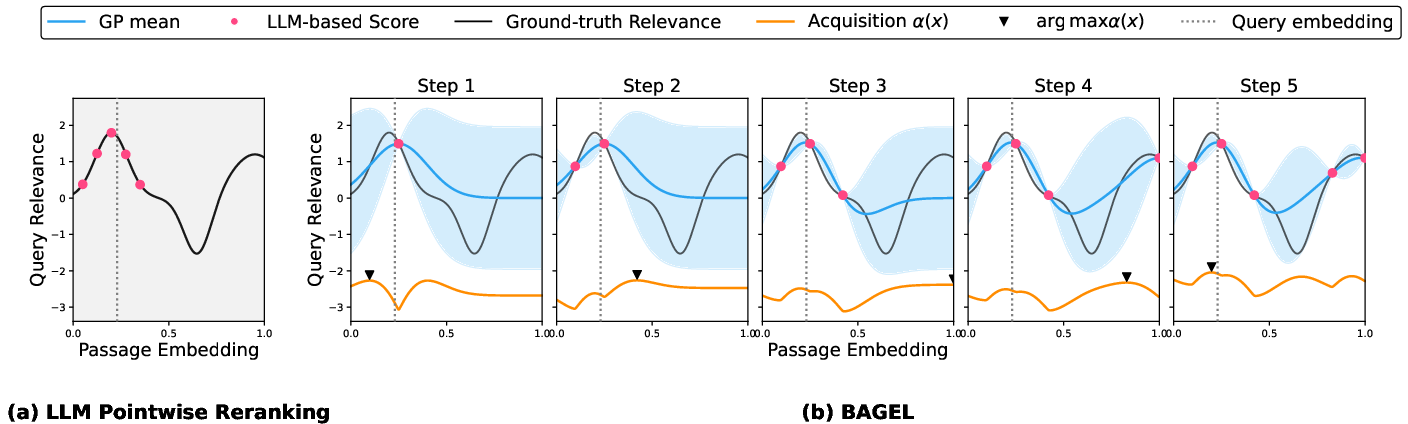
Figure 1: Comparative passage selection strategies: Pointwise LLM reranking is confined to the local neighborhood, while BAGEL actively explores the embedding space, guided by Gaussian Process predictive mean and uncertainty, uncovering relevant passages in diverse clusters.
BAGEL Framework: Gaussian Process-Based Active Learning
The paper introduces BAGEL, which reframes passage retrieval as a budget-constrained global optimization problem by leveraging Gaussian Processes (GPs) to propagate sparse LLM relevance signals across a dense embedding space. BAGEL acts through two phases: warm-start initialization and iterative active learning. In warm-start, LLM scores are acquired for the query embedding and top-M dense retrievals to seed the GP. The GP, with a stationary kernel (typically RBF), models the multimodal relevance distribution for each query over the entire passage embedding space.
In the active learning phase, BAGEL iteratively selects passages for LLM scoring by maximizing a Bayesian acquisition function, primarily an Upper Confidence Bound (UCB). This function combines the GP's predicted mean and uncertainty, balancing exploitation of regions expected to be highly relevant and exploration of regions characterized by high uncertainty. This approach efficiently searches for relevant passages outside the local dense neighborhood, mitigating the recall ceiling imposed by conventional rerankers.
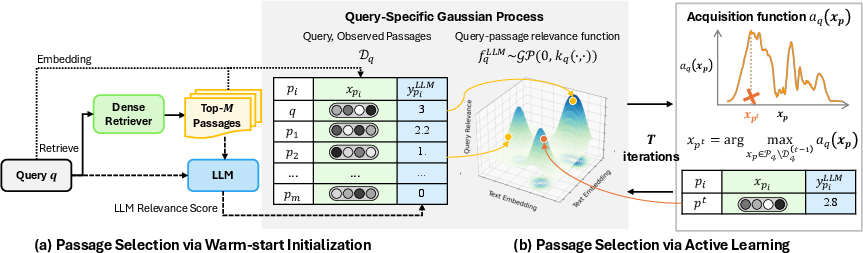
Figure 2: BAGEL overview: GP is initialized with dense retrieval warm-start, then passages are actively selected via acquisition functions based on GP predictive mean and uncertainty.
BAGEL is validated across four retrieval datasets (Covid, NFCorpus, Robust04, TravelDest) and two LLM backbones (Qwen3-14B, GPT-4o). Under a fixed LLM scoring budget (50 per query), BAGEL consistently outperforms all baselines, including LLM pointwise and listwise reranking. For example, it increases NDCG@50 from 29.3 to 41.6 on TravelDest. BAGEL's Recall@50 scores demonstrate its ability to locate relevant passages beyond those provided by dense retrieval, owing to its active exploration of the embedding space.
Statistical analyses confirm the significance and robustness of BAGEL's improvements. Paired Wilcoxon Signed-Rank Test and bootstrap confidence intervals show strong, stable gains, particularly at higher rank cutoffs and recall metrics.
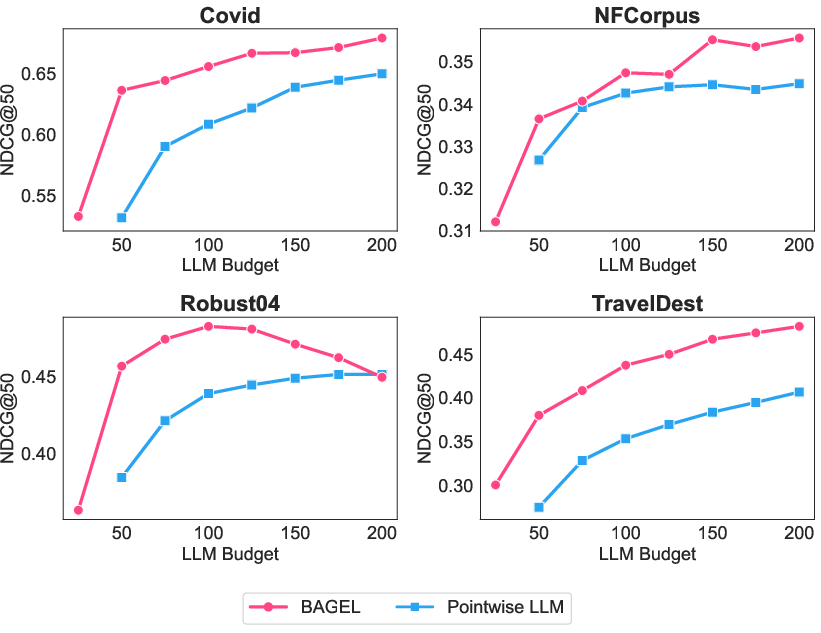
Figure 3: BAGEL performance as a function of LLM inference budget: BAGEL maintains superior performance and sample efficiency over pointwise LLM rerankers across budget regimes.
Case studies using UMAP visualizations illustrate BAGEL's exploitation/exploration dynamics in different relevance distributions. In datasets like Covid, where relevant passages are locally clustered near the query, BAGEL's exploration remains local but still recovers outliers missed by dense retrievers. In globally dispersed or ambiguous query datasets like TravelDest, BAGEL samples from diverse clusters, significantly improving coverage of relevant passages.
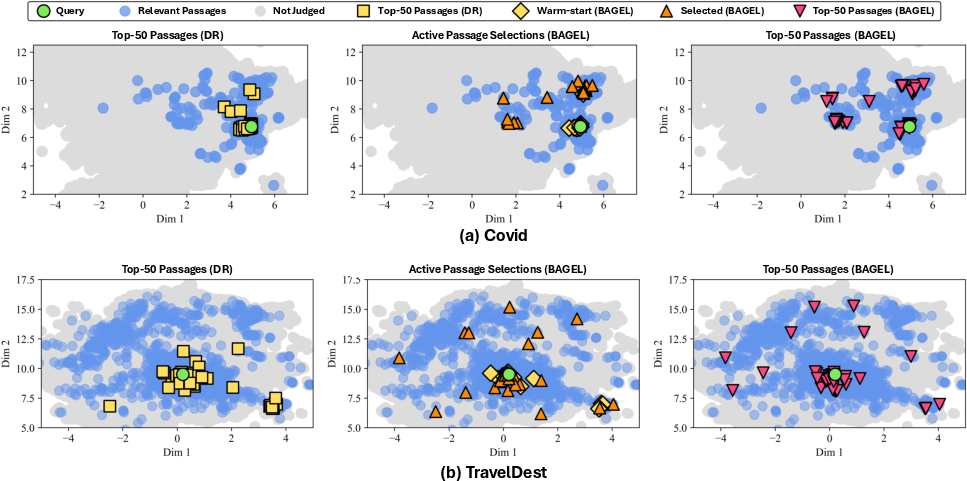
Figure 4: BAGEL's selection coverage in UMAP-projected embedding space: BAGEL samples relevant passages broadly across global clusters, contrasting with the dense retriever's limited and locally focused sampling.
Component Analysis: Kernels, Acquisition Functions, and Parameter Sensitivity
The kernel choice is critical for modeling the multimodal relevance landscape. Empirical analysis shows that stationary kernels (RBF, Matérn) outperform linear kernels by effectively capturing score multimodality and preserving local neighborhoods. The acquisition function, likewise, is essential for active selection. Random and dense strategies fail to balance exploration and exploitation, while Bayesian acquisition functions (PI, EI, UCB, TS) yield significant performance gains by leveraging GP uncertainty.
Parameter studies reveal dataset-dependent optimal values for warm-start size, UCB β, and GP noise α. Performance is robust across moderate parameter variations, but tuning is essential as excessive smoothing or exploration can degrade retrieval quality.
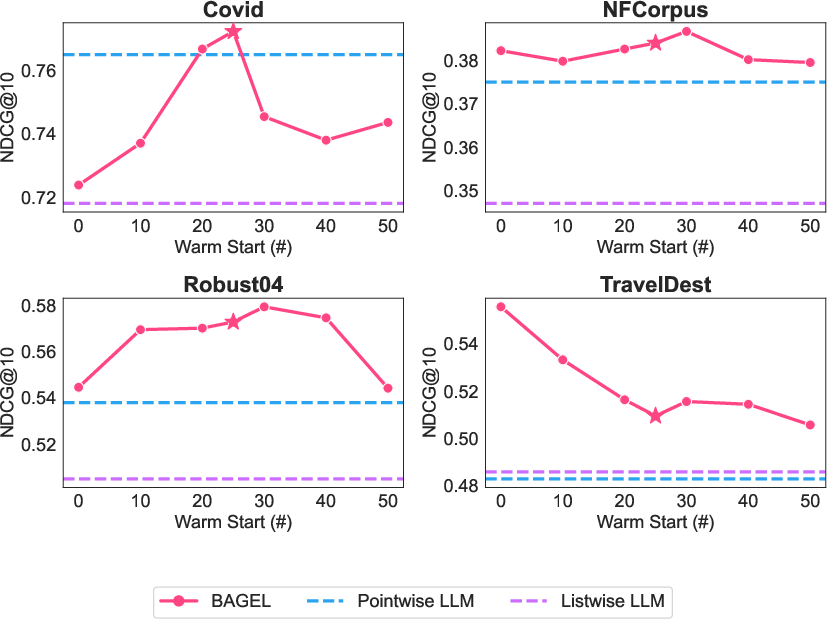
Figure 5: Impact of warm-start passage count on final retrieval performance.
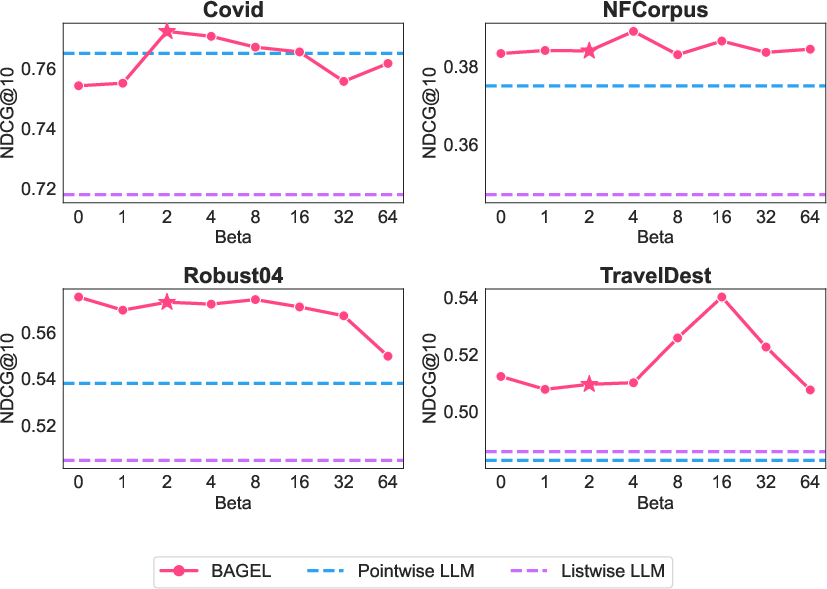
Figure 6: Performance sensitivity to UCB β, which modulates the balance between exploration and exploitation.
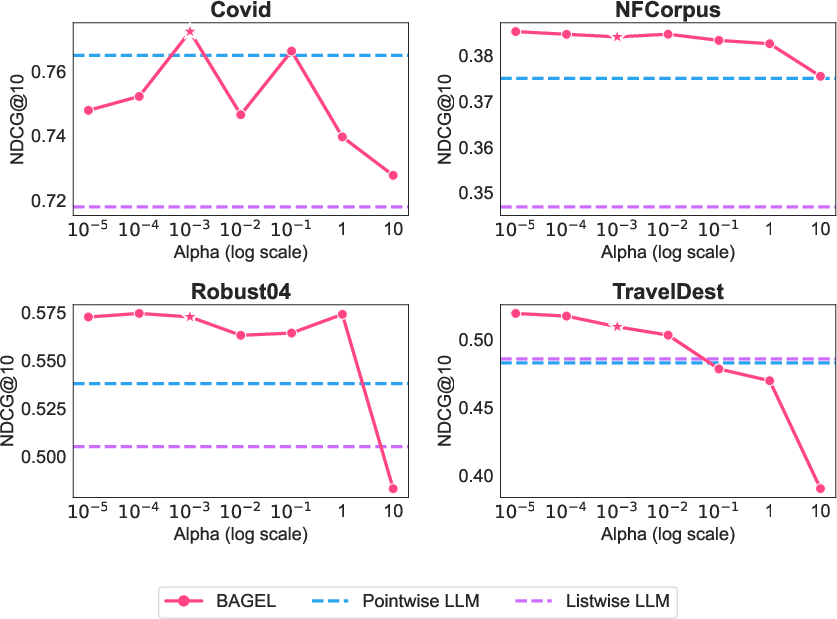
Figure 7: Performance sensitivity to GP observation noise parameter α.
Practical and Theoretical Implications
BAGEL provides a principled mechanism for budget-efficient retrieval under computational constraints. By extrapolating relevance signals and actively probing uncertain regions, it elevates the recall ceiling, enabling retrieval of semantically diverse relevance clusters often missed by classical pipelines. Theoretically, BAGEL exemplifies the value of integrating Bayesian surrogate modeling and active learning into IR, leveraging uncertainty for sample-efficient search. Practically, it paves the way for scalable retrieval frameworks that maximize the utility of expensive LLM inference via global embedding space exploration.
However, the approach is not without limitations. BAGEL depends heavily on the quality and distributional fidelity of the dense embedding space, and LLM scoring noise can propagate erroneous relevance signals via GP interpolation. Furthermore, scaling to web-scale corpora requires additional strategies, such as hierarchical pruning, since calculation of GP-based uncertainty for billions of passages is computationally demanding.
Conclusion
BAGEL introduces a novel Bayesian framework for budget-constrained dense passage retrieval, integrating LLM-based relevance scoring and Gaussian Process-guided active learning. Empirical results demonstrate its superiority in recall and ranking metrics compared to conventional LLM reranking across heterogeneous datasets and model backbones. By propagating and extrapolating sparse relevance signals across the embedding manifold, BAGEL enables global exploration and retrieval of semantically distinct relevant clusters. These findings support future research in scalable Bayesian surrogate modeling, active search, and uncertainty-aware retrieval strategies for large-scale information access.
(2604.17906)

