Warm-Start Initialization Strategies
- Warm-start initialization is a method that uses prior knowledge to set informed starting points for iterative algorithms, reducing convergence time and computational effort.
- It is applied across optimization, sampling, and quantum methods by leveraging learned mappings, spectral decompositions, and heuristic relaxations to enhance performance.
- Empirical studies demonstrate significant speedups and efficiency gains in diffusion models, fixed-point solvers, and various combinatorial and quantum applications.
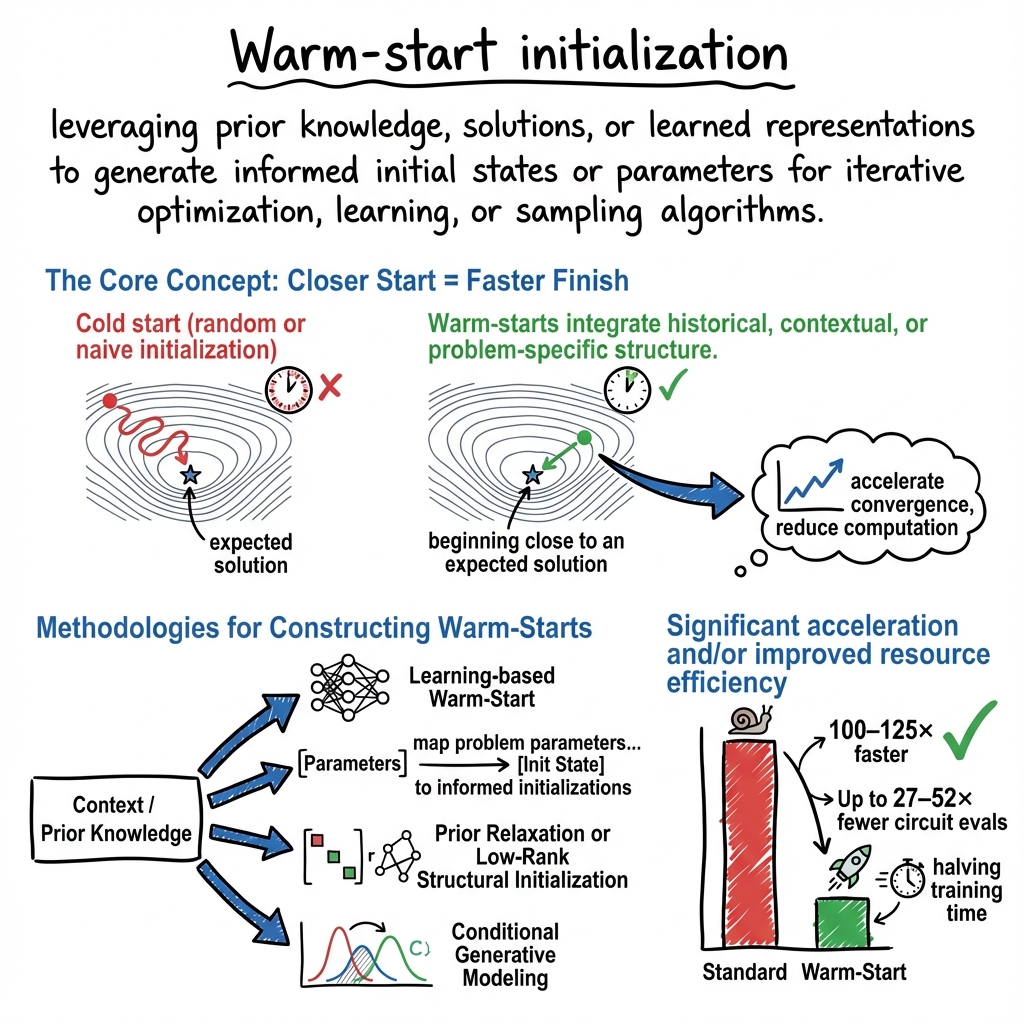
Warm-start initialization refers to the strategy of leveraging prior knowledge, solutions, or learned representations to generate informed initial states or parameters for iterative optimization, learning, or sampling algorithms. This approach, spanning domains from generative modelling to control, convex optimization, neural network training, and combinatorial/quantum algorithms, aims to accelerate convergence, reduce computation, and improve sample efficiency by beginning close to an expected solution or within a region of high probability or fit. Unlike cold start (random or naive initialization), warm-starts integrate historical, contextual, or problem-specific structure.
1. Mathematical Formulation and General Principles
The concept of warm-starting centers on initializing the variables, parameters, or states of an iterative or optimization-based procedure using information that meaningfully approximates or informs the target solution. The formal structure depends on context:
- Optimization and Fixed-Point Algorithms: Warm-starts initialize the decision variable not randomly, but via a learned or problem-induced map , where is a problem instance or context, and then run steps of a generic operator :
The initialization is chosen so that is as close as possible to the unique solution or yields low residual (Sambharya et al., 2023).
- Sampling in Generative Models: Standard diffusion or flow-matching models generate from an uninformed prior . Warm-starting instead draws 0 from a contextually predicted informed prior 1, where 2 come from a deterministic model 3 (Scholz et al., 12 Jul 2025).
- Combinatorial/Quantum Optimization: For QAOA or VQE, the initial quantum state or parameter vector is set using a relaxation-based heuristic (e.g., SDP solution and randomized rounding) or a generative model trained over prior problems, not a uniform/zero start (Egger et al., 2020, Zou et al., 2 Jul 2025).
Warm-starts are characterized by:
- Exploiting prior runs, dataset similarity, parameter continuity (e.g., in parametric programming), problem structure, or learned transfer functions.
- Reducing the initialization-to-solution "distance" in the algorithm's state/parameter space, often measured by KL divergence, residual norm, or data-likelihood (Scholz et al., 12 Jul 2025, Sambharya et al., 2023).
- Maintaining compatibility with existing algorithmic architectures (e.g., via normalization tricks or modular interfaces).
2. Methodologies for Constructing Warm-Starts
Warm-start strategies vary by application domain:
a. Learning-based Warm-Start
A neural network 4 is trained to map problem parameters 5 or dataset meta-features 6 to informed initializations, using downstream performance (e.g., residual loss or validation metric) as the training objective (Sambharya et al., 2023, Kim et al., 2017). Examples:
- Meta-Learned Feature Mappings: In Bayesian hyperparameter optimization, a Siamese network maps datasets to meta-features to select initial hyperparameters from similar tasks (Kim et al., 2017).
- End-to-End Differentiable Warm-Starts: For fixed-point solvers, networks predict initial solutions to minimize the 7-step residual or Euclidean distance to the downstream solution (Sambharya et al., 2023).
b. Prior Relaxation or Low-Rank Structural Initialization
- Low-Rank Approximation: For factorization machines or Ising models, spectral decompositions (e.g., computing the top-8 eigencomponents of an interaction matrix 9) provide analytically optimal warm-starts, with selection of 0 guided by random-matrix theory (Seki et al., 2024).
- Relaxation-Based Rounding: For QAOA, relaxations such as SDP provide continuous solutions 1, which are clipped, scaled, and mapped to quantum amplitudes, constructing a product state that, under randomized rounding, preserves classical approximation ratios (Egger et al., 2020).
c. Conditional Generative Modeling
- Moment-Matching Network: In accelerated generative modelling, a context encoder network 2 outputs per-instance Gaussian prior parameters 3, ensuring the initial sample 4 is close in the first two moments to the conditional distribution 5. A simple normalization aligns this with the standard model and sampler (Scholz et al., 12 Jul 2025).
d. Cut and Polyhedral Transfer in Parametric MINLP
- Cut-Tightening: In outer-approximation for sequences of MINLPs, polyhedral relaxations (cuts) and integer solutions from prior runs (6) are updated to 7, shifting only the right-hand side coefficients, enabling single-iteration convergence when the integer part of solutions remains constant (Tamm et al., 11 Jul 2025).
3. Impact on Convergence, Sample Complexity, and Empirical Performance
Warm-start initialization typically yields significant acceleration and/or improved resource efficiency across methods:
| Domain/Task | Standard Start vs. Warm-Start | Empirical Speedup/Benefit |
|---|---|---|
| Diffusion Models (Inpainting) | 1000 DDPM steps vs. 1+10 warm | FID from 6.22/2.18 to 5.27/2.19 at 1% compute (Scholz et al., 12 Jul 2025) |
| Contextual CMA-ES | vanilla vs. context-GP warm-start | Convergence in 1/4 to 1/2 function calls (Sekino et al., 18 Feb 2025) |
| VQE (Quantum Chemistry) | Adam vs. flow-based warm-start | Up to 27–52× fewer circuit evals; fine-tuning 50× faster (Zou et al., 2 Jul 2025) |
| MINLP OA Algorithm | cut restarts vs. cut-tightening | Up to 10× fewer MILP subproblems, often single iteration (Tamm et al., 11 Jul 2025) |
| Semidefinite Programming (SDP) | cold USBS vs. warm USBS | 100–125× faster on large MaxCut, 25–75× on entity-resolution SDPs (Angell et al., 2023) |
| Neural Network Online Training | cumulative time (warm-scratch) | Shrink–perturb matches test acc. while halving training time (Ash et al., 2019) |
| Federated Learning (WarmFed) | standard FL vs. diffusion warm-start | One-shot personalized acc. 94% vs 85.6%; five-round acc. 96% (Feng et al., 5 Mar 2025) |
These benefits arise from alignment of initialization with likely solution regions, steep gradients driving convergence, and reductions in the initial KL divergence, 8, or similar measures.
4. Algorithmic Techniques and Pseudocode Patterns
While warm-start deployment is inherently context-dependent, several canonical patterns recur:
- Two-Phase Generative Sampling:
9 (Scholz et al., 12 Jul 2025)
- Initialization in Parametric OA MINLP:
- Learning Warm-Start for Fixed-Point Solvers:
9
- Shrink-and-Perturb in Neural Network Online Training:
0
- Quantum Optimization:
Prepare the initial quantum state from rounded 1 or from a prior solution, then run standard circuit layers (Egger et al., 2020, Zou et al., 2 Jul 2025).
5. Theoretical Guarantees and Bounds
- Convergence Acceleration: In spectral bundle and SDP methods, the number of iterations required is 2, so initializing with 3 closer to 4 linearly reduces iteration complexity (Angell et al., 2023).
- Optimality Preservation: In parametric OA, if the integer solution is stable across 5, cut-tightening yields optimality in one iteration (Tamm et al., 11 Jul 2025).
- Generalization: PAC-Bayes generalization bounds hold for neural warm-start predictors: after 6 steps, residual is bounded by empirical residual plus a 7 complexity term (for 8-contractive operators), where warm-start closeness tightens constants (Sambharya et al., 2023).
- Quantum Approximation: Warm-started QAOA inherits approximation guarantees of underlying relaxations; any improvement by the circuit increases the bound (Egger et al., 2020).
6. Applications and Domain-Specific Realizations
Warm-start initialization is widely adopted in:
- Conditional Generative Modeling (diffusion/flow models) for accelerated image inpainting, text synthesis, weather simulation (Scholz et al., 12 Jul 2025).
- Fixed-Point and Convex Optimization (SDP, QP, SOCP, ADMM, SCS, OSQP): warm-start by predictor networks or cut transferring reduces solver times in control, signal processing, statistics (Angell et al., 2023, Sambharya et al., 2023, Tamm et al., 11 Jul 2025).
- Hyperparameter Optimization: Use of meta-features to transfer optimal configurations between related datasets or tasks (Kim et al., 2017).
- Federated Learning: Initialization via client-customized diffusion models for efficient global and personalized adaptation (Feng et al., 5 Mar 2025).
- Neural Architecture Search: Meta-learned DARTS initialization speeds search on new tasks with strong task similarity embedding (Grobelnik et al., 2022).
- Quantum Algorithms: SDP-relaxation-informed initial states for QAOA and generative initialization for VQE and policy iteration massively cut quantum resources (Egger et al., 2020, Zou et al., 2 Jul 2025, Meyer et al., 2024).
- Network Flow: Learning-augmented, warm-started push-relabel for image segmentation, delivering sublinear data-driven runtime reductions (Davies et al., 2024).
- Recurrent Neural Networks: Multistability-maximizing initialization improves sequence modeling and RL long-term memory (Lambrechts et al., 2021).
7. Limitations, Open Questions, and Extensions
- Distributional Shift: Warm-starts relying on prior data or neural prediction may degrade under significant distributional shift or task mismatch (Sambharya et al., 2023, Kim et al., 2017).
- Parameter/Problem Stability: In parametric sequences, one-step convergence hinges on integer solution stability; highly degenerate or combinatorial transitions reduce warm-start effectiveness (Tamm et al., 11 Jul 2025).
- Overfitting and Catastrophic Forgetting: In continual learning, naive copying of old weights can exacerbate forgetting; attribution-aware methods mitigate this by targeted transfer (Goswami et al., 2022).
- Computational Overhead: Preparation (e.g., full eigendecomposition, neural meta-training) or attribution scoring can be non-trivial for large-scale problems, requiring further optimization.
Prospective research includes integrating adaptive, instance-specific warm-starts, extending structural priors to more general data modalities, and formalizing warm-start construction in deep and quantum learning pipelines at scale.
Warm-start initialization provides a theoretically justified and empirically verified mechanism to dramatically enhance the speed, reliability, and resource efficiency of a wide range of iterative, learning, and optimization methods across classical and quantum paradigms (Scholz et al., 12 Jul 2025, Sambharya et al., 2023, Zou et al., 2 Jul 2025, Tamm et al., 11 Jul 2025, Angell et al., 2023, Ash et al., 2019, Seki et al., 2024, Sekino et al., 18 Feb 2025, Goswami et al., 2022, Grobelnik et al., 2022, Kim et al., 2017, Egger et al., 2020, Meyer et al., 2024, Feng et al., 5 Mar 2025, Davies et al., 2024, Lambrechts et al., 2021).