- The paper demonstrates that explicit in-network progress tracking and selective throttling can reduce step misalignments from 24–35 to as few as 3–6 steps.
- It employs fine-grained, hardware-efficient mechanisms within switches to restore pipeline alignment and lower collective completion times by up to 54%.
- Real-system evaluations and a P4-based prototype validate Symphony's deployability, robustness, and significant training improvements across diverse workloads.
Symphony: In-Network Mitigation of Step Misalignments in Ring-Based Collective Operations
Introduction and Motivation
The paper "Symphony: Taming Step Misalignments in the Network for Ring-based Collective Operations" (2604.16880) addresses a critical yet underexplored inefficiency in large-scale distributed AI training: step misalignment in ring-based collective communication schemes such as Ring-AllReduce. While ring collectives are fundamental to current DNN/LLM workloads due to superior pipelining and link utilization, their optimality relies on the strict lockstep progression of communication steps. In production datacenter networks, even trivial runtime perturbations—such as ECMP hash collisions, microbursts, or transient congestion—trigger step misalignments, cause bandwidth fragmentation, introduce cascading delays, and inflate collective completion time (CCT).
The paper demonstrates via simulation and real-system traces that even highly-resourced, well-balanced clusters experience persistent misalignments, which current data center optimizations (e.g., load balancing, host-side scheduling, and straggler mitigation) fail to resolve. This bottleneck is fundamentally temporal and intra-collective, distinct from traditional congestion or load imbalance. The authors' key insight is that bandwidth allocation alone cannot resolve pipeline divergence in ring-based collectives: explicit, fine-grained temporal flow synchronization is required (Figure 1).
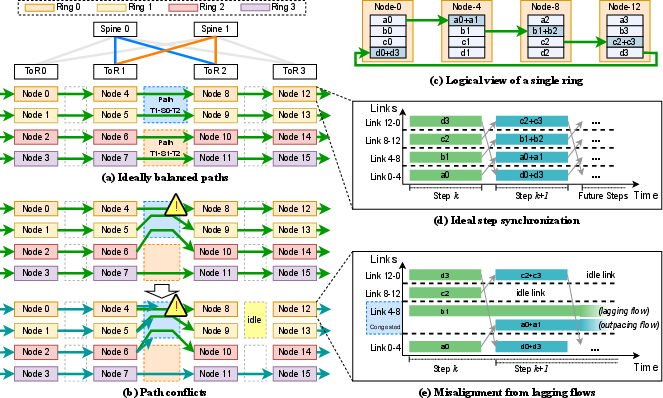
Figure 1: Network-level temporal perturbations in ring collectives induce pipeline bubbles and amplify misalignment, contrasting ideal and practical behaviors.
Symphony Design
Symphony is proposed as a fully in-network, deployable mechanism that detects and eliminates step misalignment, thereby restoring pipeline alignment for ring-based collectives. It achieves this via two orthogonal mechanisms:
- Per-Job Lightweight Progress Tracking: Switches maintain minimal state (anchored by job and step indices) to estimate the progression of both lagging ("slowest") and outpacing steps across ring flows, using readily-extractable packet metadata.
- Selective Throttling of Outpacing Flows: By leveraging ECN marking but only for flows ahead of the lagging step, Symphony proactively induces congestion backpressure on outpacing flows, thereby freeing bandwidth for stragglers to catch up. The marking is both probabilistic (modulated by the degree of misalignment) and adaptive to persistent divergence.
This mechanism is strictly local: switches act without global coordination, making deployment feasible within datacenter constraints. Symphony's design choices—approximating intra-step progress using time-windowed max PSN, windowed aggregation for misalignment metrics, and robust self-correcting state updates for step detection—make it both hardware-efficient and resistant to transient inconsistency.
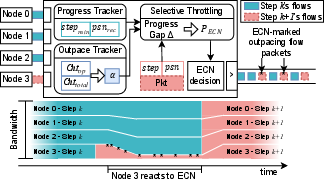
Figure 3: The Symphony in-network agent tracks step progress and selectively throttles ahead-of-group flows to maintain ring synchronization without global coordination.
Evaluation and Results
Step Misalignment Mitigation
Symphony is evaluated first for its primary function—limiting the degree of step overlap and restoring step synchronization. Simulations under a spectrum of network conditions affirm that, compared to baseline DCQCN (or priority queuing), Symphony consistently clamps the number of overlapping steps from typical runaway values (24–35) to a minimal 3–6. This truncates the compounding delay feedback loop (Figure 3).
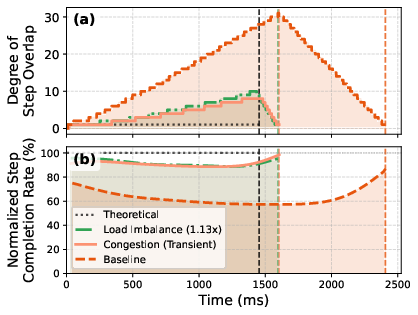
Figure 2: Degree of step overlap and normalized step completion rates, showing Symphony's efficacy in bounding overlap and restoring synchronization.
Impact on Collective and Job Completion Times
By aligning the progression of steps, Symphony reduces CCT by up to 54% compared to state-of-the-practice, with median improvements of 22–50% on communication-bound workloads (Table and Figure 4).
Notably, Symphony outperforms strict priority queuing, which incurs starvation and aggressive congestion backoff, affirming the import of nuanced, misalignment-aware throttling over naive priority strategies.
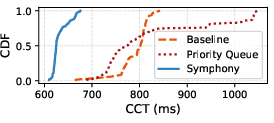
Figure 5: CDF of CCT for Ring AllReduce, showing Symphony's significant reduction of communication timelines relative to baseline and priority queueing.
End-to-End Training Gains and Parameter Robustness
On large-scale end-to-end training workloads (e.g., VGG, ResNet, and Transformer), Symphony delivers strong improvements on communication-dominant phases (up to 54% reduction in JCT for VGG on 512-node clusters), with efficacy increasing as communication-to-computation ratio grows—an important trend in next-generation, accelerator-rich hardware.
Symphony remains robust across a wide range of system and workload parameters. Gains amplify with network imbalance or larger chunk sizes. The core parameter k (throttling aggressiveness) demonstrates a broad viable range, reducing concern about cluster-specific tuning.
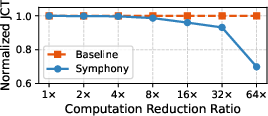
Figure 4: Normalized JCT for Transformer training, indicating Symphony's advantage increases with greater communication bottleneck.
Multi-Tenancy and Hardware Feasibility
Symphony's design is explicitly multi-tenant, isolating state per job in switch memory and interfacing cleanly with SDN cluster orchestrators. Simulations under randomized job arrivals and resource contention confirm size-proportional gains: up to 17% JCT reduction for large jobs, while being safe for small jobs (no regression).
A P4-based prototype on Intel Tofino2 demonstrates that all logic—including approximate marking, stateful ALUs for windowed counters, and step/progress logic—fits easily within modern ASIC constraints. Hardware experiments confirm that Symphony promptly rescues lagging flows, truncating misalignment durations without penalizing concurrency (Figure 7).
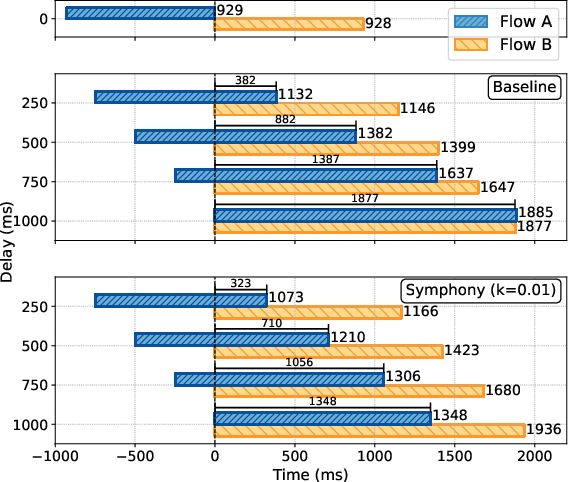
Figure 6: Transmission timelines on Tofino2 hardware prototype, showing Symphony (blue) mitigates misalignment effects compared to standard DCQCN.
Implications and Future Directions
Symphony exposes a previously underappreciated, temporally-coupled inefficiency in the dominant communication primitive of modern AI. It motivates a new line of in-network mechanisms focused not merely on spatial load or average throughput, but on fine-grained, step-wise alignment—opening routes to further co-designed network-communication stacks. Practically, Symphony is highly deployable: it can be incrementally introduced, requires no per-flow state, and integrates cleanly with existing ECN-based congestion control (e.g., DCQCN).
Limitations include its current specialization for ring-based collectives (though these dominate at LLM scale), with adaptions for tree or other all-to-all collectives as promising next steps. Its deployment depends on modest switch programmability and traffic marking, both of which are rapidly spreading with programmable dataplane adoption. Future hardware trends (e.g., UEC) will further lower integration friction.
Conclusion
The paper rigorously demonstrates that step misalignment is a fundamental, temporal bottleneck in ring-based datacenter collectives. Symphony provides an efficient, hardware-friendly in-network mitigation mechanism that delivers substantial improvements in CCT and DNN training times across a spectrum of conditions. By targeting step-wise progress coupling, Symphony establishes a new design axis for networked AI system optimization, with strong practical readiness for deployment and clear paths for future expansion.
Reference: "Symphony: Taming Step Misalignments in the Network for Ring-based Collective Operations" (2604.16880)