- The paper introduces a novel tiled memory scheme for hermitian operators that halves memory requirements relative to traditional density matrix simulations.
- It employs cache-efficient kernels and SIMD vectorization, achieving 2x–4x speedups for quantum channel and native gate operations.
- Benchmark evaluations demonstrate scalability up to 15 qubits, with significant performance gains preventing memory thrashing on commodity hardware.
Orkan: Cache-Friendly Simulation of Quantum Operations on Hermitian Operators
Introduction and Context
Classical simulation of quantum operations provides essential insights for quantum algorithm development, benchmarking, and noise analysis. Existing methodologies, especially for density matrices, typically vectorize the n-qubit density matrix into a $2n$-qubit state, leveraging state-vector kernels and their optimizations. However, this approach results in a substantial 22n memory footprint and fails to exploit the intrinsic hermitian symmetry of the system’s operator representations.
The paper introduces Orkan, a simulation framework purpose-built to address the inefficiencies in simulating generic quantum channels (completely positive maps) on hermitian operators. Orkan employs a novel tiled memory layout, storing only the independent (lower-triangular) elements of the hermitian matrix at tile granularity. This architectural decision aims to minimize memory usage and optimize cache performance, facilitating scalable and efficient quantum simulation agnostic to the Schrödinger or Heisenberg picture.
Methodological Advances
Orkan’s core innovation is its cache-efficient, hermiticity-aware storage format. The simulation library covers the hermitian matrix with square tiles of edge length M=2m, retaining only those in the lower triangle to avoid redundant storage. This design leads to approximately a twofold reduction in memory requirements compared to traditional density matrix representations, with negligibly small padding overhead at practical problem scales.
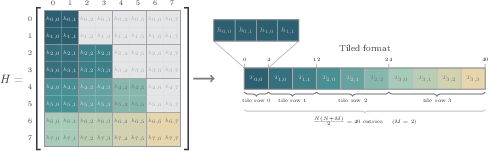
Figure 1: The tiled format with a tile size of M=2. Tiles Tti,tj with ti≥tj are stored, all elements within each tile in row-major order, supporting efficient SIMD vectorisation.
Simulating a generic k-local quantum operation on n qubits involves two main updates: intra-tile and cross-tile, reflecting whether all active qubits are within a single tile or not. Orkan exploits the block invariance induced by k-locality, operating directly on the relevant subspaces and performing block updates via gather–transform–scatter kernels, benefiting from precomputed transfer matrices (Kraus/Liouville representation). For native gates (unitary operations), gate-specific kernels further reduce arithmetic overhead—some, such as Pauli $2n$0 operations, become pure memory permutations rather than involving complex conjugations.
The framework also ensures parallel scaling by allocating whole tiles to threads and maximizing contiguous access within cache lines, removing the false-sharing and load-imbalance characteristics of standard packed formats. Tile sizing is selected for cache-residency (e.g., $2n$1 KiB per tile for $2n$2 at double-complex precision), which enables efficient SIMD vectorization and reduces memory traffic per operation.
Numerical Evaluation and Results
The benchmark suite compares Orkan's tiled and packed-memory implementations to prominent alternatives, including Qiskit Aer, QuEST, and Qulacs. Key test cases include generic quantum channels (e.g., single-qubit depolarizing) and native unitary gates (e.g., Pauli $2n$3). The analysis quantifies both wall-clock runtime and logical memory bandwidth across system sizes from $2n$4 up to $2n$5 qubits.
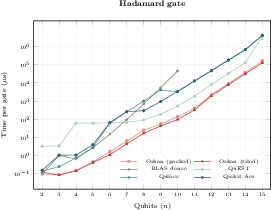
Figure 2: Time per execution of the Hadamard gate averaged over all possible qubit positions, demonstrating reduced execution times for Orkan’s tiled format as qubit numbers increase.
Orkan’s tiled and packed implementations consistently outperform established simulators, achieving speedups of $2n$6 to $2n$7 in wall-clock time for both noisy channels and native gates for $2n$8. At the upper end ($2n$9), the reduction in storage from 22n0 GiB to 22n1 GiB for hermitian matrices prevents out-of-core computation and memory thrashing, widening the speedup gap to 22n2 in the presence of OS-level swapping in the competitors.
Significantly, for native gates, the deployment of direct single-pass conjugation algorithms in Orkan further doubles bandwidth relative to standard double-pass vectorized approaches, resulting in up to 22n3 acceleration over state-of-the-art (Qiskit Aer, QuEST) for mid-scale systems (22n4–22n5). The peak logical memory throughput approaches 22n6 GiB/s, indicative of effective exploitation of on-chip cache hierarchies and efficient parallel scaling.
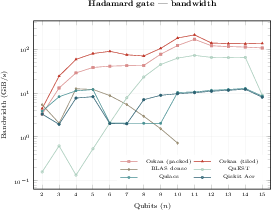
Figure 3: Effective bandwidth of the Hadamard gate execution over all possible qubit positions, with Orkan’s tiled implementation sustaining roughly double the throughput of QuEST at large 22n7.
Benchmark analysis further indicates that, for small systems (22n8), the advantage of the tiled approach is less pronounced due to full matrix L1/L2 residency and tile-padding overhead. For larger 22n9, where working sets overflow to system memory, Orkan’s memory advantages and cache-friendly access patterns become dominant.
Practical and Theoretical Implications
Orkan advances quantum simulation by aligning the storage model with the operational realities of quantum manipulation—every prediction is an expectation value, and the evolution can equivalently proceed via states or observables. This approach empowers research in algorithm prototyping, noise modeling, and small code evaluation without structural assumptions (e.g., sparsity, stabilizer structure, or low entanglement) that existing methods require.
On the practical side, Orkan enables large-scale, RAM-resident simulation for generic, arbitrary quantum channels at a halved memory cost and improved throughput, effectively pushing the scalability frontier on commodity hardware. The unified treatment of Schrödinger and Heisenberg pictures also facilitates flexible experimentation in quantum algorithm design.
Theoretically, Orkan demonstrates that supporting hermitian operator evolution natively—rather than shoehorning the problem into full density-matrix vectorization—provides fundamental performance advantages. This insight likely generalizes to distributed-memory and GPU-accelerated settings, suggesting avenues for future work in hybrid-architecture quantum simulation.
Conclusion
Orkan represents a substantial advancement in the cache-efficient simulation of quantum operations on hermitian operators. By developing a tiled memory format and tailored execution kernels, the framework achieves both a M=2m0 memory reduction and operational speedups of M=2m1–M=2m2 across a range of quantum channels and gate operations. These results challenge the status quo of density-matrix simulation, motivating broader adoption of hermiticity-aware and cache-conscious algorithmic design.
The framework's open-source release positions it for widespread use and integration. Looking ahead, extensions to distributed and heterogeneous compute environments, as well as continued benchmarking on diverse architectures, are likely to further amplify Orkan’s impact within quantum computing research and high-performance simulation.
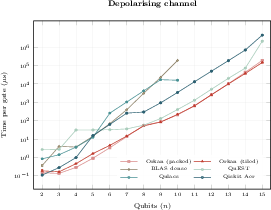
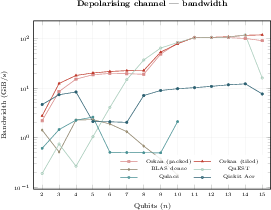
Figure 4: Time per execution of the single-qubit depolarizing channel, with tiled and packed implementations dominating as M=2m3 increases.
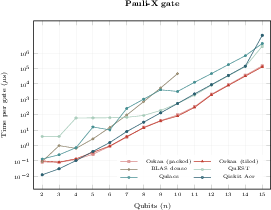
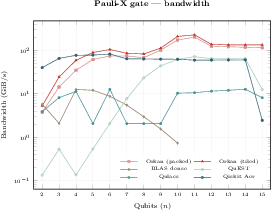
Figure 5: Execution performance for the Pauli-M=2m4 gate, confirming the pronounced speedup of Orkan’s approach for native permutation gates.
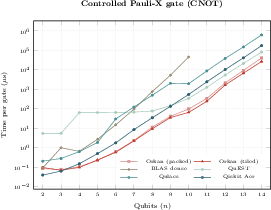
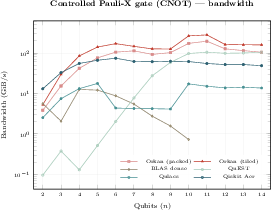
Figure 6: Performance profile for the controlled Pauli-M=2m5 (CNOT) gate, showing a sustained advantage for the tiled format in both time-per-operation and bandwidth.
References
For full details and empirical data, consult "Orkan: Cache-friendly simulation of quantum operations on hermitian operators" (2604.15765).