- The paper presents a detailed digital quantum simulation of an SU(2) bosonic matrix model with a quartic potential using a trapped-ion quantum computer.
- It employs Fock-space truncation and Pauli decomposition to map Hamiltonians onto qubits, carefully quantifying Trotter and hardware noise effects.
- Results indicate that while error mitigation techniques like zero-noise extrapolation and symmetry post-selection improve accuracy, circuit depth remains a primary challenge.
Simulating the Dynamics of an SU(2) Matrix Model on a Trapped-Ion Quantum Computer
Introduction and Motivation
This work presents a systematic implementation and analysis of the real-time quantum simulation of an SU(2) bosonic matrix model with a quartic potential on a trapped-ion quantum computer. Motivated by the centrality of matrix models in theoretical physics—where they are foundational in quantum gravity, holography (notably the BFSS and BMN models), and quantum chaos—the study focuses on the intersection of nonlocal Hamiltonians, gauge constraints, and the limitations imposed by NISQ-era quantum hardware. Unlike spin chains, matrix quantum mechanics features O(N2) bosonic degrees of freedom, infinite local Hilbert spaces, and dense nonlocal couplings. Simulating their real-time, out-of-equilibrium dynamics is classically intractable, notably due to the "sign problem" and absence of efficient analytic continuation.
On the quantum hardware side, advances in trapped-ion quantum computers have enabled precise control and all-to-all connectivity, positioning them as suitable platforms for nonlocal Hamiltonian simulation. However, the high circuit depth required, device noise, gate compilation, and the necessity of Hilbert space truncation introduce significant technical barriers. This work benchmarks and dissects these issues using a tractable single-matrix SU(2) model, aiming to clarify resource requirements, error mechanisms, and mitigation strategies relevant for scaling towards more physically compelling matrix models.
The target system is the SU(2) bosonic matrix quantum mechanics defined by the Hamiltonian
H=Tr[P2+m2X2+4NλX4],
with X a traceless Hermitian N×N matrix, P its conjugate, and λ the 't Hooft coupling. For N=2, the system reduces to three degrees of freedom (from expansion in the Pauli basis), subject to a constraint that physical states are SU(2) gauge singlets, equivalently ℓ=0 states under the SO(3) mapping. Radial reduction maps the system to a 1D quantum particle in an anharmonic central potential; this further enables efficient classical validation via exact diagonalization and spectral methods.
The spectrum is readily analyzed as a function of λ, revealing monotonically increasing gaps and facilitating precise benchmarking of quantum simulation observables, such as the Loschmidt echo. The analytic tractability of the model underpins the accuracy assessment of circuit-based quantum evolutions.
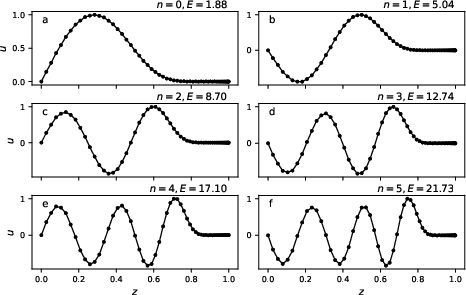
Figure 2: The first six eigenfunctions of the interacting time-independent radial Schrödinger equation, resolved for λ=10, displaying the structure of the low-lying eigenstates relevant for quantum simulation.
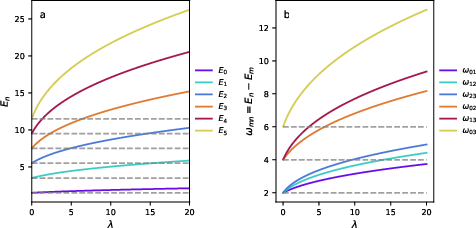
Figure 4: The interacting spectrum as a function of coupling: panel (a) shows low-lying energy levels, and panel (b) displays increasing spectral gaps, H=Tr[P2+m2X2+4NλX4],0, confirming the absence of level crossings and the analytic tractability of the target model.
Digital Quantum Simulation and Qubit Encoding
Fock-Space Truncation
To regularize the infinite-dimensional Hilbert space, mode-by-mode Fock-space truncation is employed: for each oscillator, only the lowest H=Tr[P2+m2X2+4NλX4],1 occupation states are retained, mapped to H=Tr[P2+m2X2+4NλX4],2 qubits. This truncates the computational basis and defines a finite-dimensional Hilbert space. The truncation itself induces controlled symmetry violations—in particular, the gauge generators no longer close the SU(2) algebra, but for observables with weak boundary support, these errors are exponentially suppressed at moderate cutoffs.
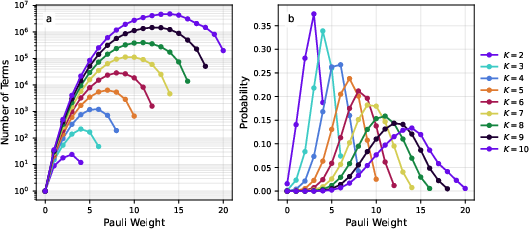
Figure 5: The Pauli decomposition of the truncated Hamiltonian: panel (a) reveals exponential yet sparse growth in the number of Pauli terms with increasing qubits per oscillator; panel (b) tracks the shift in the normalized Pauli weight distribution towards higher-weight, nonlocal operators as truncation deepens.
Qubit Hamiltonian Synthesis and Circuit Construction
The Hamiltonian and observables are systematically mapped to qubit operators via Pauli string expansions. The Lie-Trotter product formula is used for real-time evolution, enabling efficient grouping of commuting terms to minimize depth. Notably, as truncation H=Tr[P2+m2X2+4NλX4],3 increases, both the number of Hamiltonian terms and the circuit depth scale exponentially (approximately as H=Tr[P2+m2X2+4NλX4],4 for the SU(2) case), posing a prohibitive challenge for simulating larger models or longer evolution times.
Observable Design: Loschmidt Echo and Spectral Analysis
The primary dynamical observable is the Loschmidt echo,
H=Tr[P2+m2X2+4NλX4],5
computed for the free vacuum state. The echo sensitively probes differences between interacting and free evolution, encoding full spectral information (energy gaps and overlaps) in its Fourier transform.
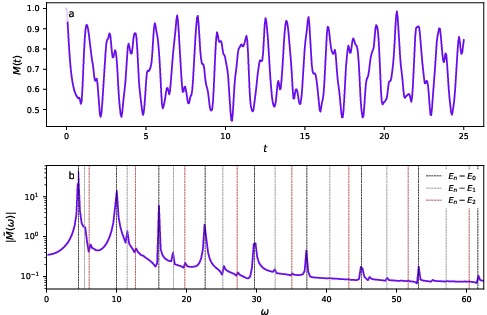
Figure 6: (a) Loschmidt echo H=Tr[P2+m2X2+4NλX4],6 for H=Tr[P2+m2X2+4NλX4],7 displaying time-dependent loss and recurrence; (b) Fourier transform H=Tr[P2+m2X2+4NλX4],8 with vertical lines indicating dominant energy gaps, demonstrating spectral extraction from time-domain data.
The echo serves as an integrated measure of the combined effects of truncation, Trotterization, and device noise, and facilitates direct spectral benchmarking.
Hierarchical Error Analysis: Truncation, Algorithmic Approximation, and Hardware Noise
Truncation Effects
Benchmarking against exact diagonalization, the truncation error for H=Tr[P2+m2X2+4NλX4],9 proves negligible (X02% peak amplitude discrepancy), consistent with previous results indicating doubly-exponential convergence with truncation for gauge-invariant observables. Thus, modest Fock-space truncations suffice in the SU(2) case for dynamical quantities of interest, with the main resource constraint stemming from nonlocal operator structure rather than Hilbert space size.
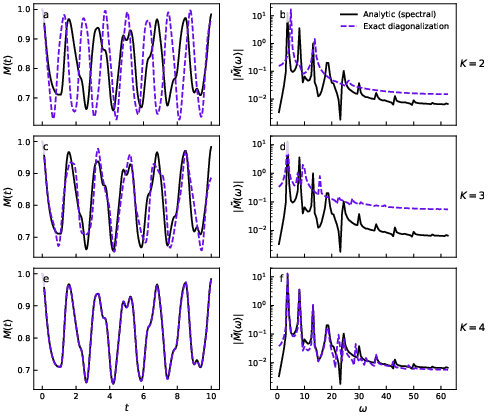
Figure 7: Effect of varying truncation level X1 on the Loschmidt echo and its spectrum, with increasing X2 yielding near-exact agreement with the analytic result, particularly for X3.
Trotterization Error
First-order Trotterization yields errors scaling as X4 per step, with practical implementation requiring balancing reduced digitization error (smaller X5, more steps) against circuit depth constraints. Benchmarks show that for small step sizes (X6), Trotter errors in noiseless simulation are moderate (1-10%), but quickly escalate under realistic noise.
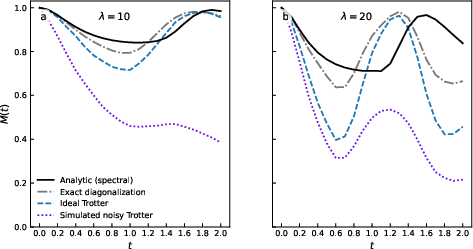
Figure 8: Simulated Loschmidt echo under a depolarizing noise model, highlighting substantial fidelity loss at higher depths.
Hardware Execution and Error Mitigation
Experiments are performed on the Quantinuum H2-2 device at X7 (6 qubits). The raw hardware output suffers strong deviations from ideal dynamics, but application of zero-noise extrapolation (ZNE) reduces absolute errors by up to 96% (for X8), particularly at early times or moderate circuit depths. However, ZNE efficacy is limited at maximal depth, where signal is overwhelmed by shot noise and additional folding can harmful overshoot.
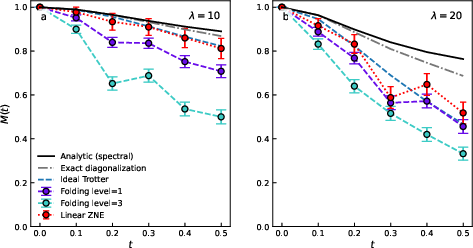
Figure 9: Hardware Loschmidt echo results with and without ZNE; reference lines represent exact, truncated, and ideal Trotter solutions, clarifying the impact of device noise and mitigation.
Symmetry-Based Post-Selection
The gauge singlet requirement (even occupation in all oscillators) enables a straightforward post-selection scheme to detect and discard corrupted measurement outcomes. While this approach improves observable accuracy—for the total number operator, post-selection reduces error by 6-38%—the discard rate grows with circuit depth, indicating poor scalability for larger instances.
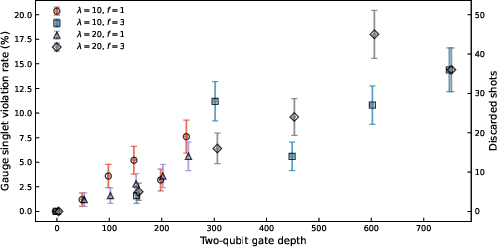
Figure 1: Discard rate (fraction of shots violating the singlet condition) grows with two-qubit gate depth, reflecting accumulation of bit-flip errors and hardware noise.
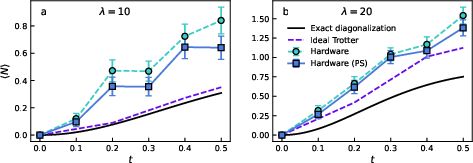
Figure 3: Expectation value of the total number operator under hardware evolution, with singlet post-selection systematically improving agreement with classical predictions.
Implications, Limitations, and Outlook
The systematic decomposition and analysis of errors in this work demonstrate that, even for the simplest SU(2) matrix model, the challenge of simulating dynamics on current trapped-ion quantum hardware is dominated by the exponential scaling of circuit depth (from nonlocal Hamiltonian structure and Fock-space truncation), not Hilbert space size per se. Hardware noise, though partially mitigable by ZNE and symmetry-based post-selection, remains the primary bottleneck for longer simulations or larger models.
Given these limitations, near-term progress will require not only improved error-mitigation but more fundamentally, classical circuit compression and efficient compilation. Techniques such as quantum circuit compiling and ansatz compression [Zhang et al. (Zhang et al., 2024), D'Anna et al. (D'Anna et al., 2 Jul 2025), Gibbs & Cincio (Gibbs et al., 2 Jun 2025)] become essential to simulate matrix models of physical and holographic interest (e.g., BFSS/BMN mini-models, which require additional matrices, quartic commutator interactions, and fermions).
This work validates the feasibility of mapping matrix model Hamiltonians to quantum circuits, provides concrete resource estimates and error decompositions, and highlights strategies that are effective at small scales but will be inadequate for true quantum advantage. Going forward, practical quantum simulation of non-trivial matrix models will require scalable mitigation, circuit compression, and eventually, integration of error-correction protocols.
Conclusion
The digital quantum simulation of the SU(2) bosonic matrix model developed and analyzed here establishes a systematic pipeline for encoding, synthesizing, and executing nonlocal gauge-invariant dynamics on trapped-ion quantum hardware. The work provides a rigorous hierarchy of error analysis—truncation, Trotterization, device noise—and evaluates the efficacy of lightweight mitigation strategies. Strong numerical results confirm that Fock-space truncation quickly converges, while circuit depth and hardware noise are the main challenges. The demonstrated methodologies form a foundation for extending quantum simulation toward larger, less tractable matrix models that are directly relevant for high-energy theory and questions in quantum gravity. Significant theoretical and algorithmic advances in circuit synthesis and error correction will be required to reach the regime where quantum hardware can address classically inaccessible observables in these models.