LogosQ: A High-Performance and Type-Safe Quantum Computing Library in Rust
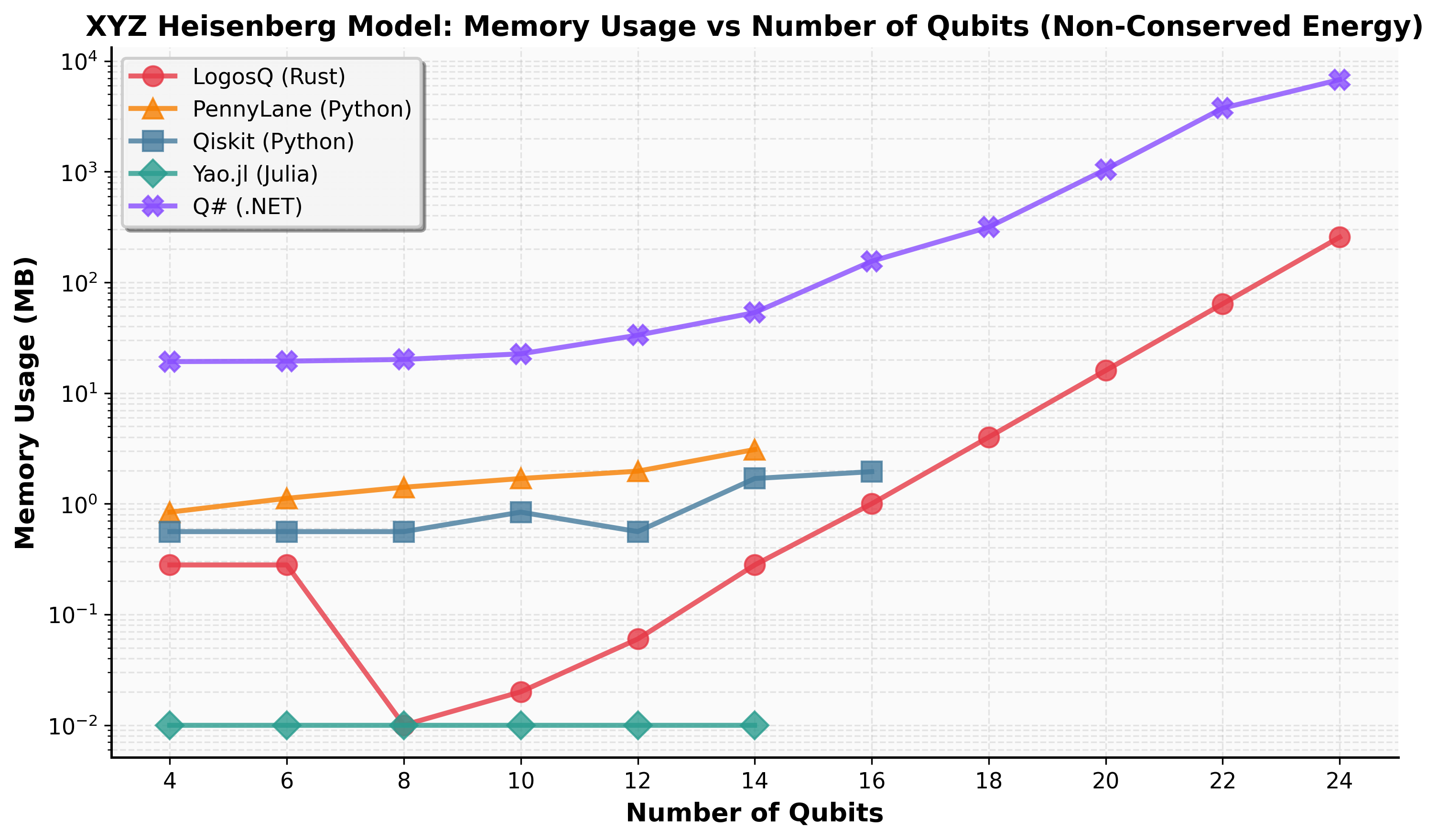
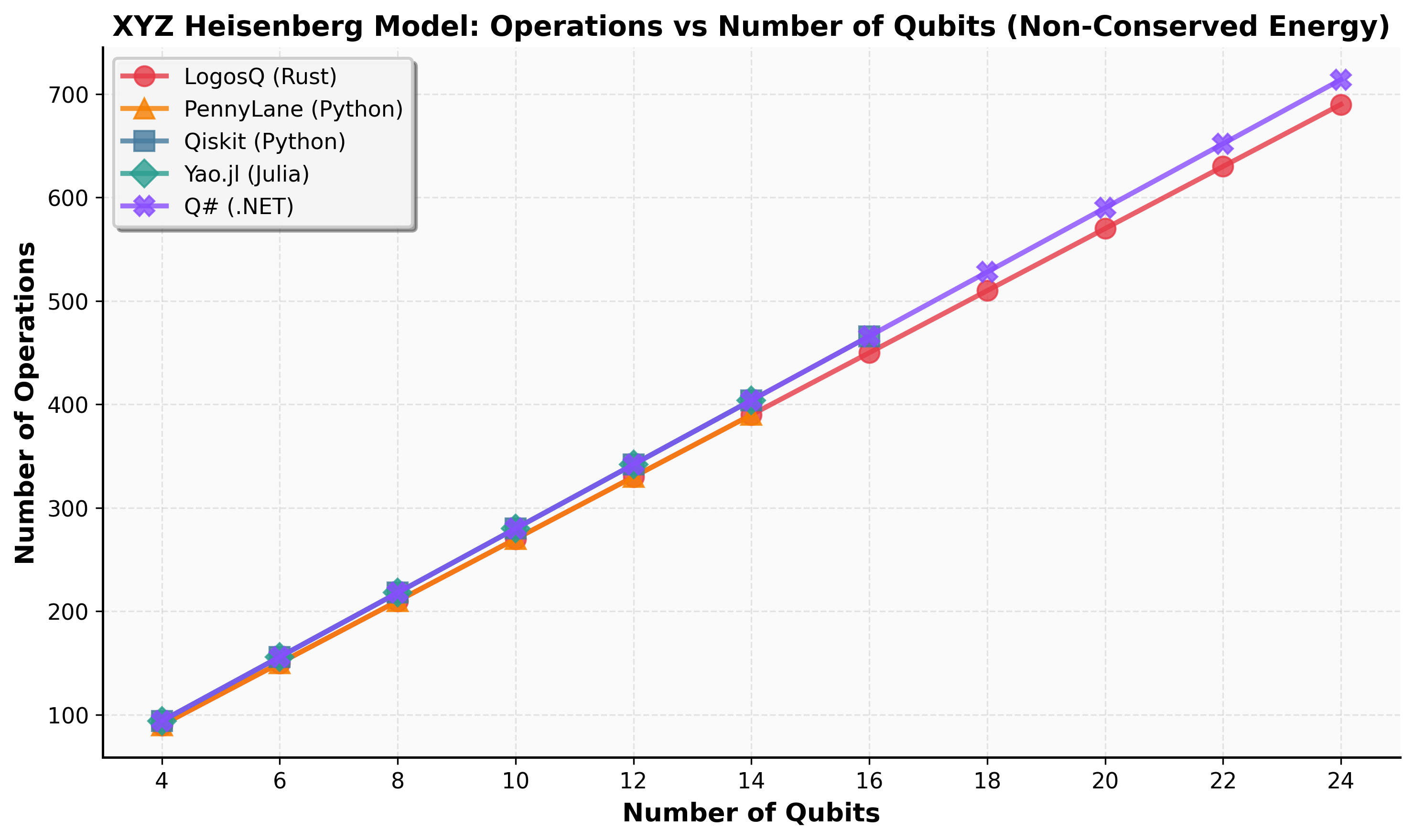
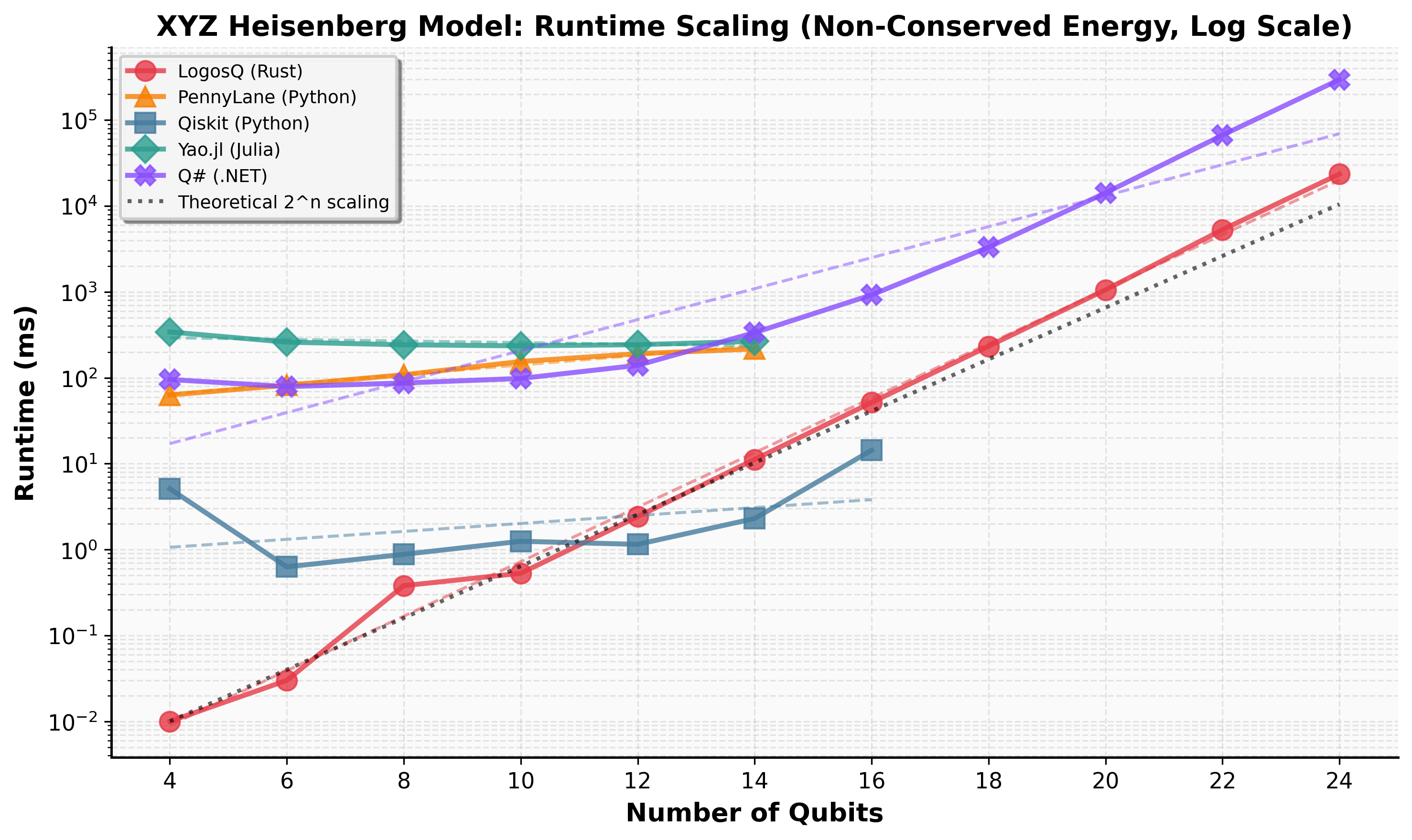
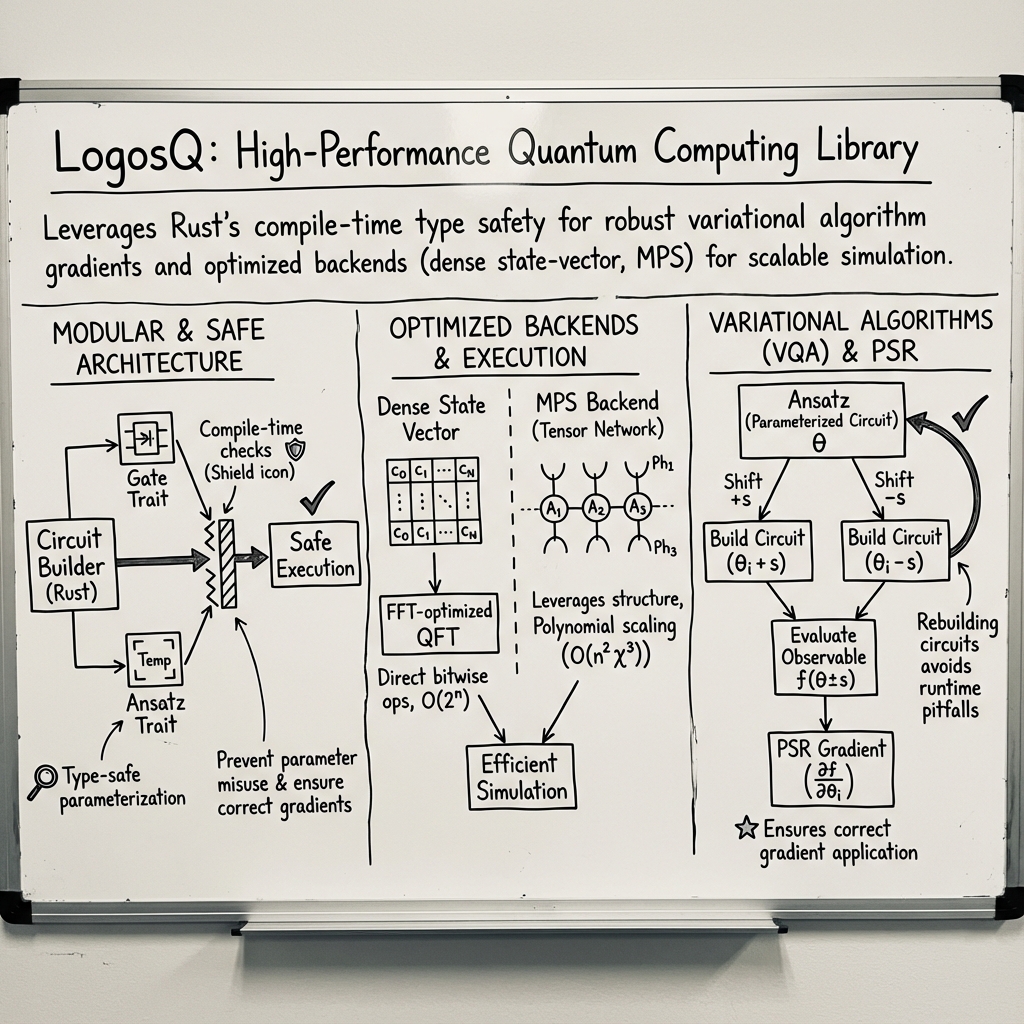
Abstract: Developing robust and high performance quantum software is challenging due to the dynamic nature of existing Python-based frameworks, which often suffer from runtime errors and scalability bottlenecks. In this work, we present LogosQ, a high performance backend agnostic quantum computing library implemented in Rust that enforces correctness through compile time type safety. Unlike existing tools, LogosQ leverages Rust static analysis to eliminate entire classes of runtime errors, particularly in parameter-shift rule gradient computations for variational algorithms. We introduce novel optimization techniques, including direct state-vector manipulation, adaptive parallel processing, and an FFT optimized Quantum Fourier Transform, which collectively deliver speedups of up to 900 times for state preparation (QFT) and 2 to 5 times for variational workloads over Python frameworks (PennyLane, Qiskit), 6 to 22 times over Julia implementations (Yao), and competitive performance with Q sharp. Beyond performance, we validate numerical stability through variational quantum eigensolver (VQE) experiments on molecular hydrogen and XYZ Heisenberg models, achieving chemical accuracy even in edge cases where other libraries fail. By combining the safety of systems programming with advanced circuit optimization, LogosQ establishes a new standard for reliable and efficient quantum simulation.
Paper Prompts
Sign up for free to create and run prompts on this paper using GPT-5.
Top Community Prompts
Explain it Like I'm 14
Easy-to-Understand Summary of “LogosQ: A High-Performance and Type-Safe Quantum Computing Library in Rust”
Overview
This paper introduces LogosQ, a new software library that helps people build and test quantum algorithms on a computer. It’s written in the Rust programming language and focuses on two big goals: making simulations run fast and stopping common mistakes before the program even runs. The authors show that LogosQ can be much faster than popular tools written in Python and Julia, while also being more reliable for certain tasks.
What Questions Does the Paper Ask?
Here are the main questions the authors wanted to answer:
- How can we make quantum simulations both fast and safe from common programming mistakes?
- Can we guarantee correct gradient calculations (the “slopes” used to train quantum circuits), even when circuits mix different types of gates?
- Can we handle both small and large quantum systems with one flexible design?
- How does LogosQ compare to other popular tools in speed and accuracy?
How Did They Do It?
To answer those questions, the authors built LogosQ with a few key ideas. Think of a quantum circuit like a recipe: ingredients (gates), steps (their order), and tools (the simulator). LogosQ makes sure the recipe is correct before you start cooking.
- Using Rust for safety: Rust catches many mistakes before the program runs. This is called “compile-time type safety.” It’s like having a spell-checker that won’t let you print a book until all mistakes are fixed.
- Reliable gradients with the parameter-shift rule: In many quantum algorithms, you “train” a circuit by nudging its parameters and seeing how the output changes (like turning knobs and measuring the result). LogosQ rebuilds the circuit fresh for each small change, so the right parts get nudged and nothing breaks. This avoids hidden errors that can show up later in other tools.
- Two ways to represent quantum states:
- Dense state vector: This is like storing every detail of a picture. It’s very precise and fast for small systems.
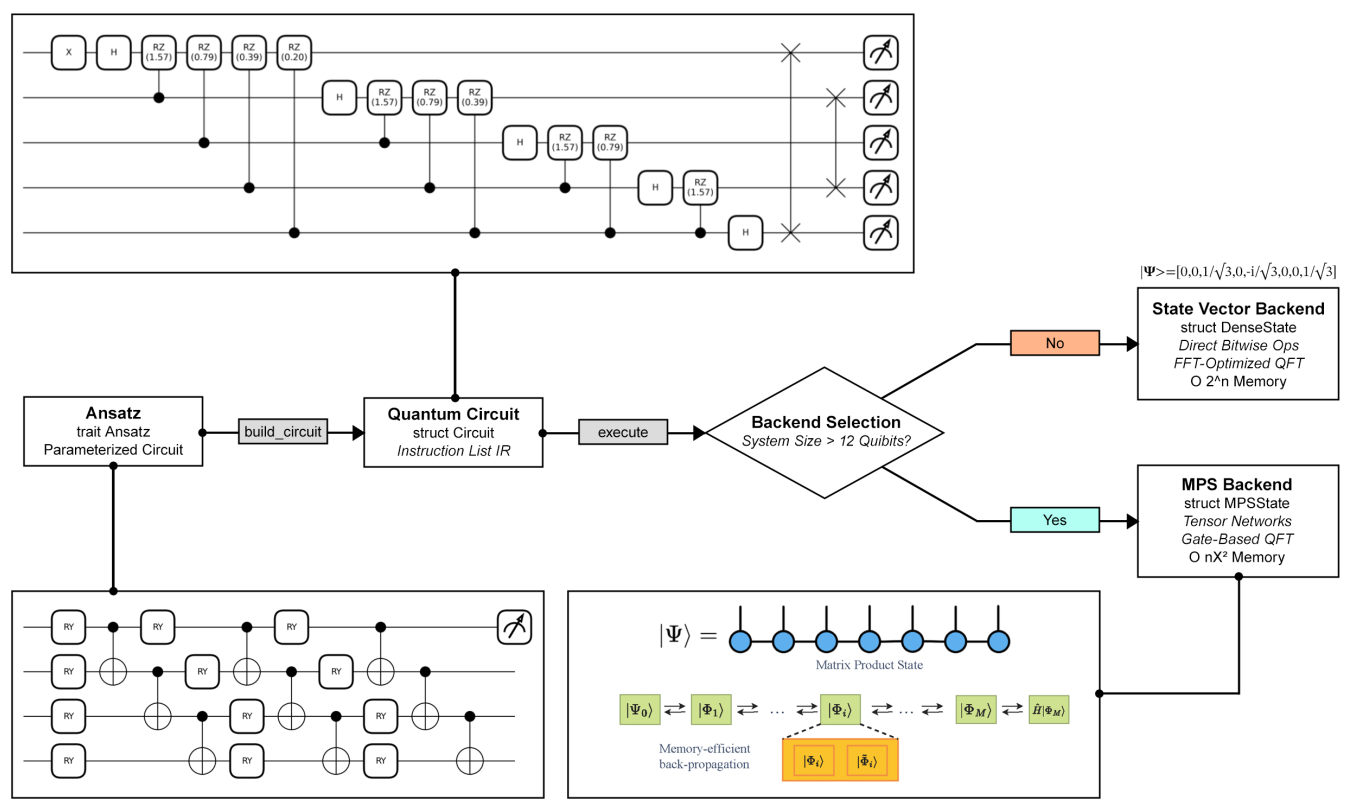
- Matrix Product State (MPS): This is like breaking a long story into linked chapters. It keeps things manageable for larger systems by focusing only on the important connections (“bond dimensions”).
- Speed tricks and optimizations:
- Direct state manipulation: Instead of doing big, slow matrix math, LogosQ flips and updates the right numbers directly using fast bit operations (like smart, targeted edits instead of rewriting a whole document).
- Adaptive parallel processing: It can spread work across CPU cores when helpful.
- Faster Quantum Fourier Transform (QFT): For small-to-medium sizes, it uses FFT (a very fast math shortcut) to speed up QFT; for larger sizes, it uses the MPS method with local gates to stay efficient.
The authors then benchmarked LogosQ on the same tasks as other libraries (like PennyLane, Qiskit, Yao.jl, and Q#) to compare speed and accuracy.
What Did They Find, and Why Does It Matter?
The results show big wins in both speed and reliability.
- Speed improvements:
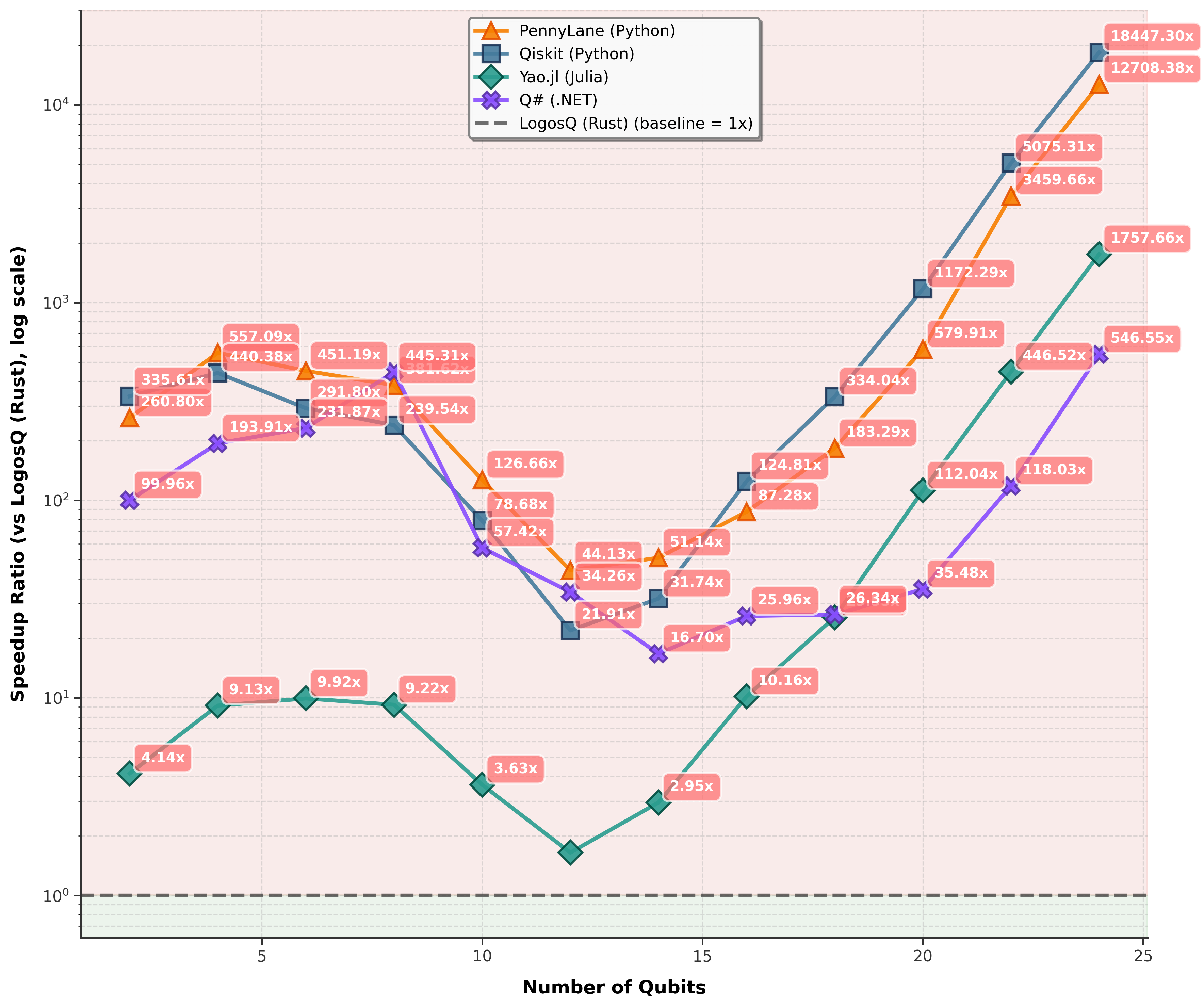
- Up to about 900× faster for QFT-based state preparation compared to some Python tools.
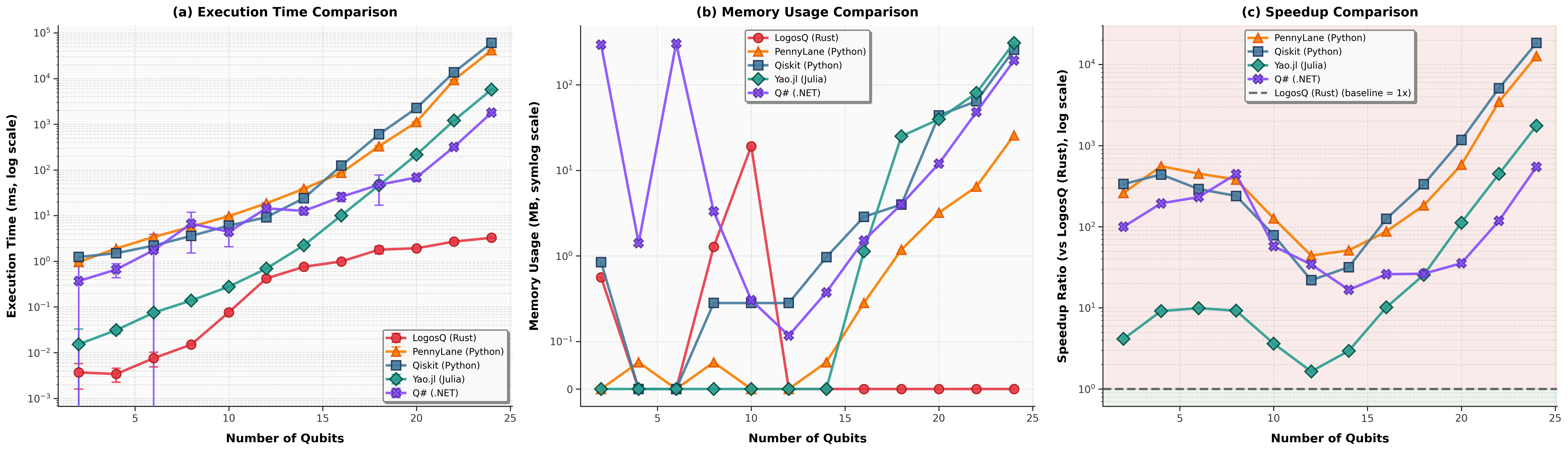
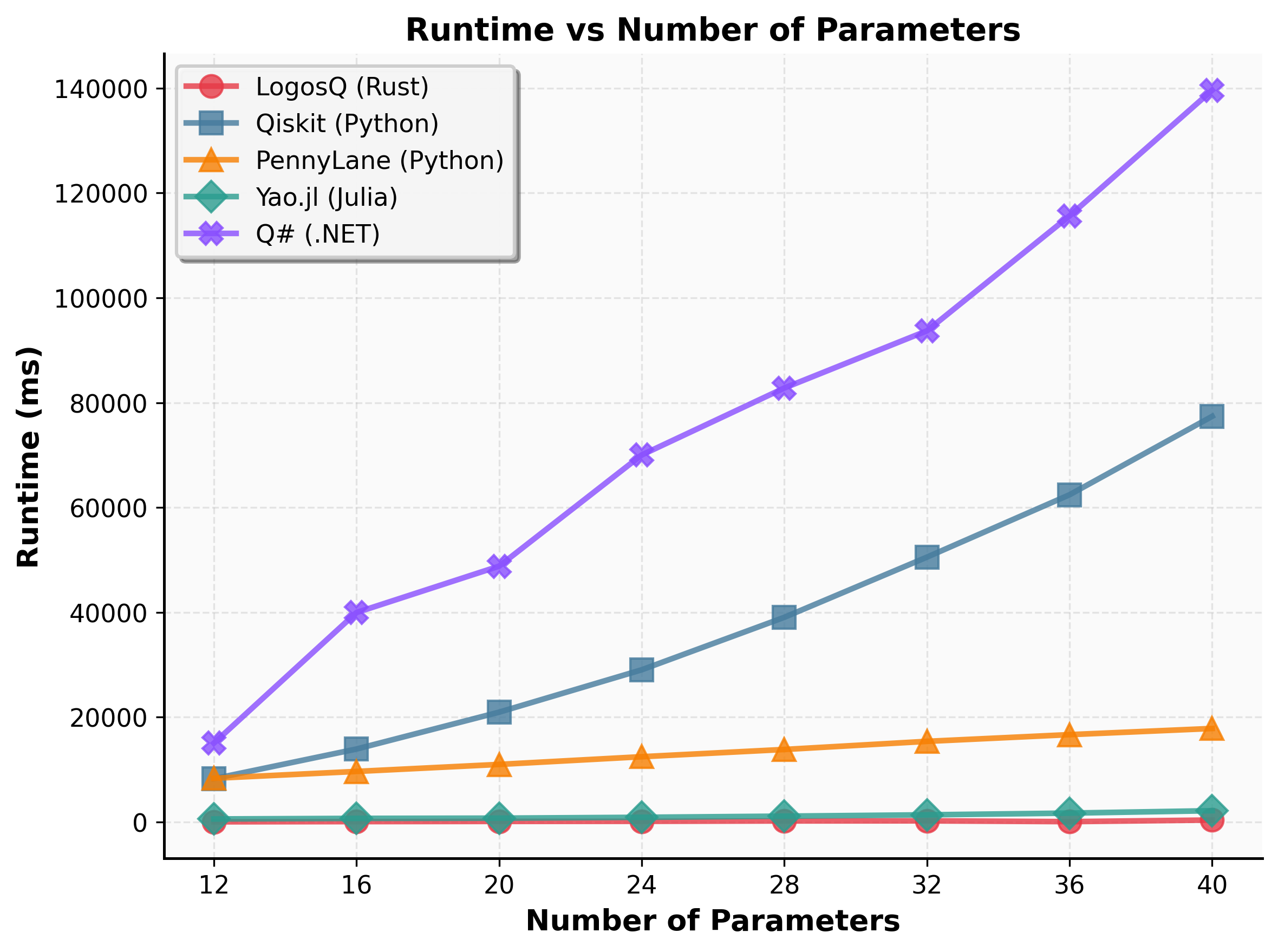
- About 2–5× faster on training-style (variational) workloads than Python libraries like PennyLane and Qiskit.
- About 6–22× faster than Julia’s Yao.jl in several tests.
- Performance competitive with Microsoft’s Q#.
- Fewer errors during training:
- LogosQ’s design prevents certain runtime mistakes—especially in gradient calculations—which can otherwise waste time or break experiments halfway through.
- Scientific accuracy:
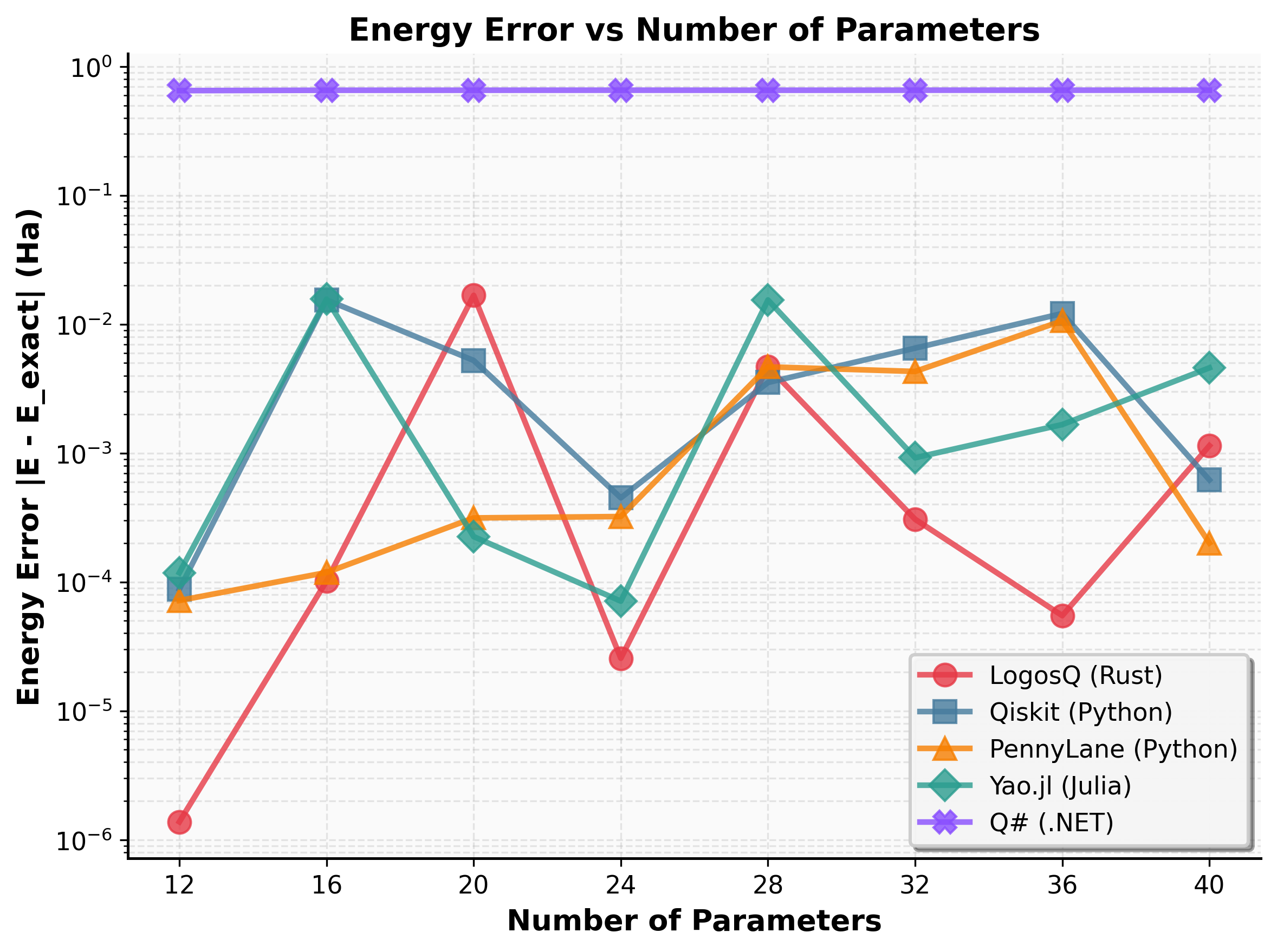
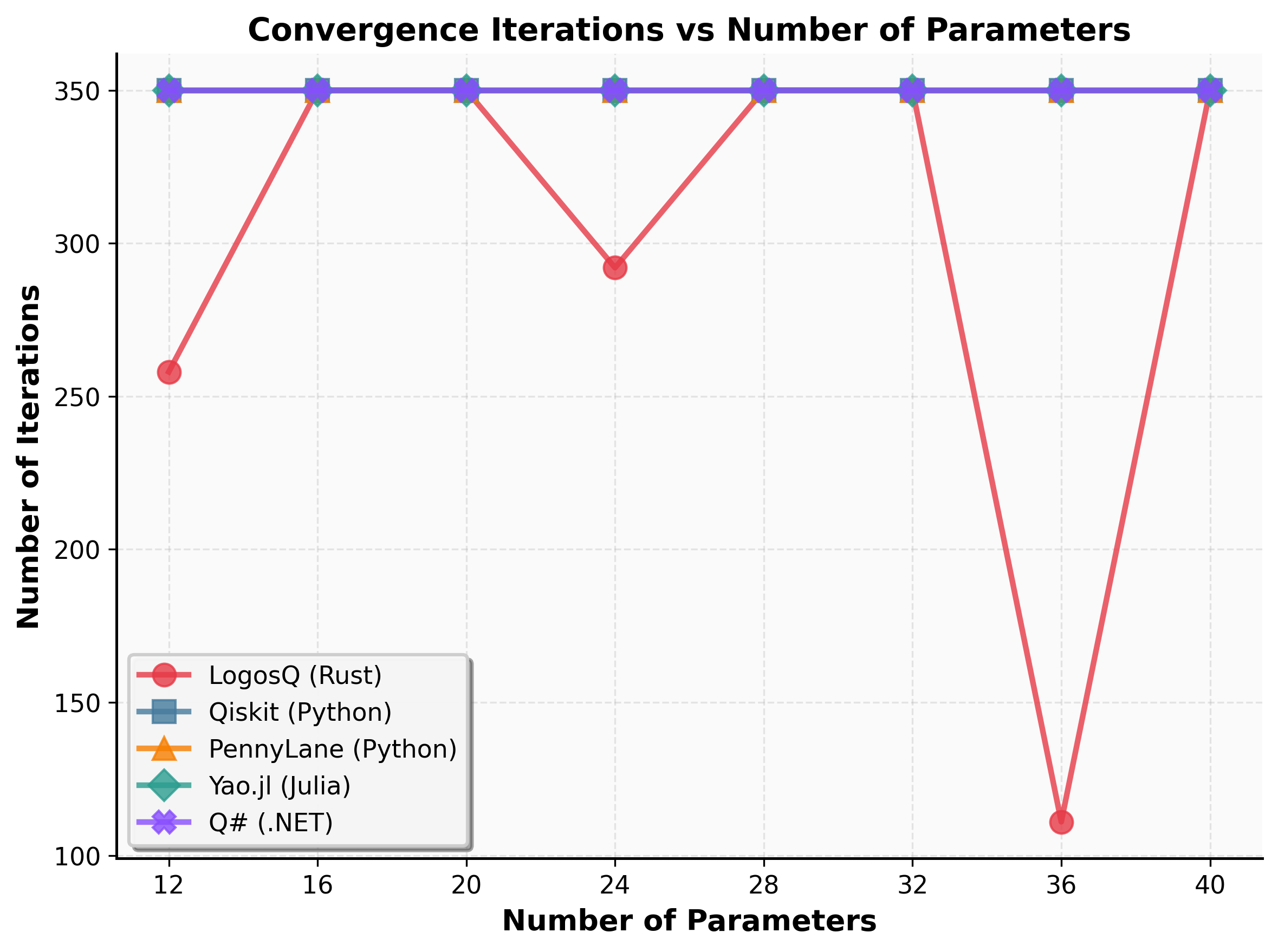
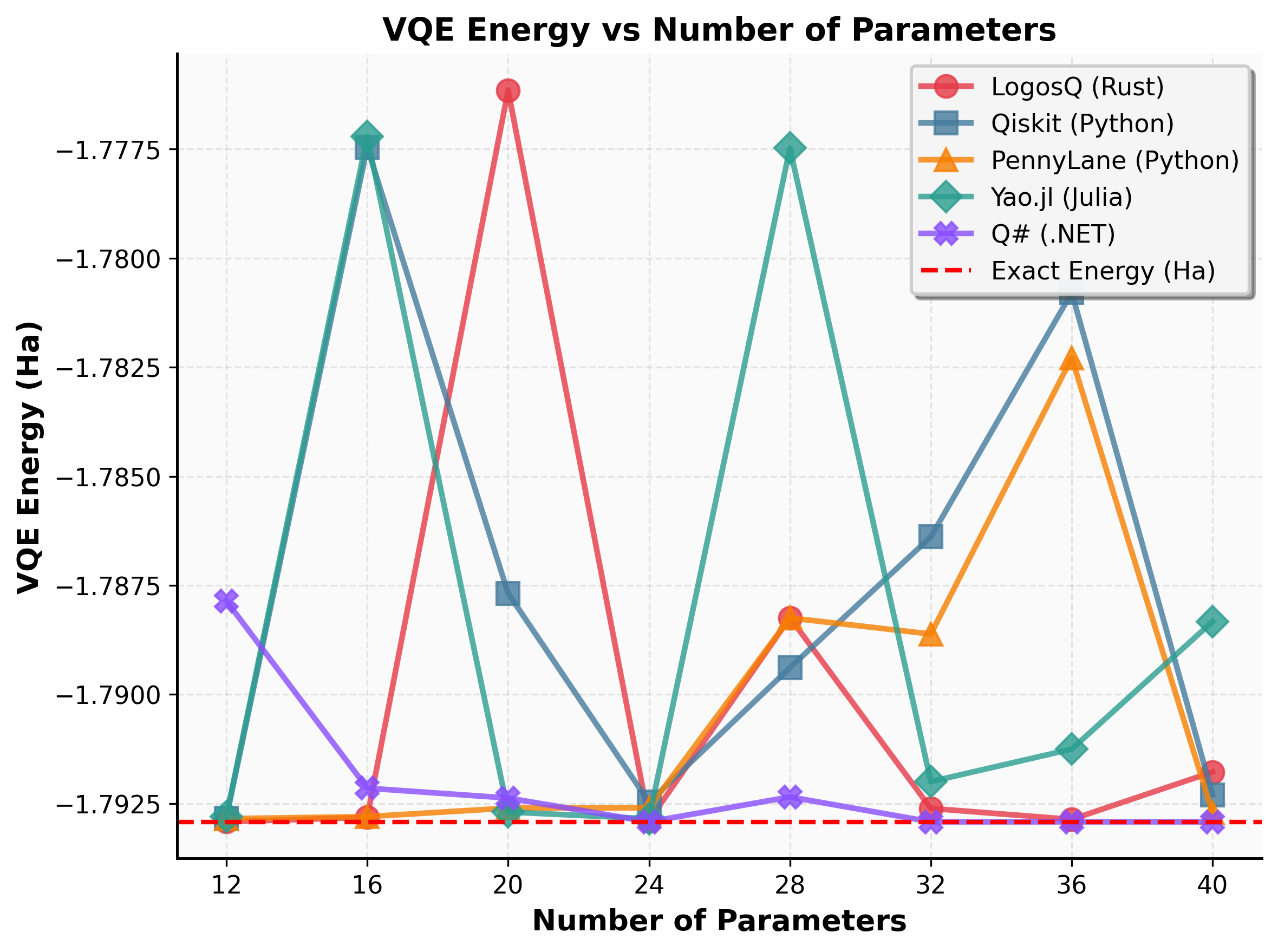
- On real test problems (like finding the energy of a hydrogen molecule and simulating the XYZ Heisenberg model), LogosQ reached “chemical accuracy,” even in tricky cases where other tools sometimes failed. That means its results are precise enough to be trusted by scientists.
These findings matter because researchers and developers can run experiments faster, trust their results more, and spend less time chasing confusing bugs.
What’s the Big Impact?
- For students and researchers: Faster tools mean you can try more ideas in less time. Safer tools mean fewer “mystery bugs” and more reliable learning.
- For the quantum community: LogosQ sets a higher bar for both performance and correctness. It shows that using systems programming (Rust) can make quantum software both speedy and dependable.
- For the future: The library is modular and open-source, so people can add new features, new backends (like other tensor networks), or even connect to future quantum hardware.
In short, LogosQ combines speed, safety, and flexibility to make quantum algorithm development smoother and more dependable—like giving you a race car with a strong safety cage and a great dashboard.
Knowledge Gaps
Knowledge gaps, limitations, and open questions
The paper introduces LogosQ and demonstrates promising performance and type-safety features, but it leaves several aspects unresolved that future work could concretely address:
- Provide a formal proof (or counterexamples) for the claim that compile-time type checks guarantee correct parameter-shift gradients; today, parameter bounds are still enforced via runtime asserts (e.g., slice indexing), not const generics or typestate patterns.
- Extend type-level guarantees to dynamic circuits (data-dependent control flow, loops), mid-circuit measurements, and classical feedback; clarify how compile-time safety applies under these semantics.
- Define and implement the referenced NoiseModel trait and its integration in execute(), including supported channels (Kraus, Lindbladian), parameterization (T1/T2, depolarizing, readout), application order, and validation against known noise benchmarks.
- Compare parameter-shift rule (PSR) with alternative gradient methods: adjoint differentiation, reverse-mode through state vector/MPS, stochastic PSR, SPSA, and second-order methods; quantify gradient quality and wall-clock for large parameter counts.
- Incorporate shot-based sampling and analyze gradient variance under finite shots; add shot-frugal estimators and study convergence trade-offs.
- Characterize multi-thread scalability (strong/weak scaling), SIMD/vectorization, cache/NUMA effects, and provide GPU/accelerator backends (CUDA/HIP/Metal) or distributed-memory simulation; include detailed scaling plots.
- Reconcile the stated dense state-vector limit (~10–12 qubits) with presented QFT results up to 24 qubits; document per-qubit memory footprints, algorithm-specific ceilings, and failure modes.
- Quantify MPS truncation error: provide fidelity/observable error vs bond dimension χ and truncation threshold ε; implement adaptive χ control based on Schmidt spectra/entanglement.
- Analyze when MPS becomes impractical for highly entangling circuits (e.g., QFT): report χ growth, runtime, and accuracy as n increases.
- Replace or augment SWAP networks for non-adjacent gates on MPS with alternatives (MPO-based application, routing heuristics, fermionic/teleportation strategies); measure overhead on entanglement and depth.
- Specify and implement the “adaptive backend selection” policy: what metrics (entanglement, gate density, memory) trigger switching between dense and MPS, and how correctness is maintained during transitions.
- Prove and test FFT-based QFT equivalence to gate-level QFT: detail bit-ordering/bit-reversal, global phase conventions, and provide unit tests and error bounds; clarify when FFT-QFT is inappropriate (e.g., hardware execution, structured subcircuits).
- Standardize benchmark methodology for fair cross-library comparisons: fix precision, thread counts, compiler flags, device types (CPU vs GPU), and publish full configurations for variational tasks (ansatz, qubits, optimizer, stopping criteria).
- Document parallel controlled-phase and other parallel gate implementations: thread scheduling, contention avoidance, memory bandwidth utilization, and scalability curves.
- Expand VQE validation beyond H2 and XYZ Heisenberg: include larger molecules (e.g., LiH, H4), different mappings (Jordan–Wigner, Bravyi–Kitaev), basis sets, and quantify chemical accuracy thresholds and optimizer robustness (barren plateaus).
- Generalize observables: support sums of Pauli terms, sparse Hamiltonians, MPO observables, batched expectations, and efficient measurement of many terms; benchmark the impact.
- Introduce compile-time enforcement for qubit index bounds and wire sets, replacing add_operation_unchecked and runtime asserts with safe builders (const generics, typestate, static wire typing).
- Validate cross-backend semantic equivalence (dense vs MPS): provide test suites showing identical outputs (within tolerance) for state evolution and gradients, and characterize bias introduced by MPS truncation.
- Add hardware integration: export/import via OpenQASM/QIR, adapters for cloud providers, and study how compile-time safety maps to hardware constraints (connectivity, calibration, transpilation).
- Build measurement APIs: shot-based sampling, marginal distributions, measurement error mitigation, mid-circuit measurement semantics; quantify performance and accuracy.
- Explore error mitigation and noise-aware optimization (ZNE, probabilistic error cancellation, robust optimizers) and their interplay with PSR.
- Investigate automatic differentiation through tensor operations (e.g., differentiable SVD for MPS) and compare to PSR in accuracy and runtime for tensor-network backends.
- Measure the overhead of dynamic dispatch (Arc<dyn Gate>) vs generics/monomorphization and consider generic gate composition to reduce virtual-call costs; provide microbenchmarks.
- Optimize memory layout/micro-architecture: AoS vs SoA for complex numbers, cache blocking, prefetching, fused operations; quantify throughput gains.
- Provide interop with ML ecosystems (C/Python bindings) and examples of end-to-end training with PyTorch/JAX while preserving type safety; evaluate overhead of FFI and data transfer.
- Guarantee determinism and reproducibility under parallel execution; document thread-safety, RNG seeding, and eliminate sources of nondeterminism in multithreaded runs.
Practical Applications
Practical applications derived from the paper
Below is an overview of actionable, real-world applications enabled by LogosQ’s findings, methods, and innovations. Each item notes relevant sectors, potential tools/products/workflows, and key assumptions/dependencies that may affect feasibility.
Immediate Applications
- High-reliability variational algorithm pipelines with compile-time-safe gradients
- Sectors: software, research/academia, cloud platforms
- Tools/workflows: Rust-based VQE/VQA pipelines; CI checks that fail at compile-time if parameter usage is invalid; reproducible gradient evaluation via circuit rebuilding; safer refactoring of ansätze in large codebases
- Assumptions/dependencies: circuits built from parameter-shift-compatible gates or properly registered generalized PSR rules; Rust adoption or FFI bindings to Python/Julia stacks for existing teams
- Faster QFT acceleration as a drop-in simulation primitive
- Sectors: software, security/cryptanalysis research, education
- Tools/workflows: FFT-optimized QFT microservice/CLI; “QFT-as-a-service” in benchmarking harnesses; period-finding and phase-estimation simulations accelerated for algorithm prototyping
- Assumptions/dependencies: CPU-focused optimizations (RustFFT) deliver observed speedups on target hardware; teams can call LogosQ via C-ABI/FFI from other languages
- Scalable one-dimensional many-body simulations via MPS and TEBD
- Sectors: materials science, condensed matter physics, quantum dynamics
- Tools/workflows: TEBD time-evolution scripts for spin chains and 1D models; MPS-backed VQE for 1D Hamiltonians; parameter scans and quench dynamics studies
- Assumptions/dependencies: bounded entanglement (area law) for tractability; careful choice of bond dimension and truncation thresholds to manage accuracy-speed trade-offs
- Robust small-molecule and model-Hamiltonian studies achieving chemical accuracy
- Sectors: chemistry, materials (academic and industrial R&D)
- Tools/workflows: VQE for H2 and similar small systems with provably stable gradient computations; regression tests for “edge” instances where other libraries showed failures
- Assumptions/dependencies: problem sizes remain within dense or MPS limits; high-quality ansätze and optimizers; domain experts remain in loop for verification
- Reproducible benchmarking and performance engineering for quantum software
- Sectors: software engineering, cloud simulation services, hardware validation
- Tools/workflows: LogosQBenchmarks for cross-framework comparisons; nightly CI performance tracking; mutation testing of quantum programs with deterministic, compile-time-checked runs
- Assumptions/dependencies: standardized benchmark configs; comparable hardware; agreement on metrics (latency, memory, gradient correctness)
- Backend-agnostic circuit authoring with explicit, type-checked APIs
- Sectors: quantum SDK vendors, industrial dev teams, open-source toolchains
- Tools/workflows: trait-based extension of custom gates/observables; organizational code standards that require compile-time parameter checks before merges; plugin backends (state vector vs MPS) chosen per workload
- Assumptions/dependencies: Rust trait literacy within teams; stable ABI for internal plugins; documentation and templates to ease custom gate development
- Hybrid ML experiments with safer variational components
- Sectors: machine learning for science, quantum ML research
- Tools/workflows: PSR gradients wired into classical optimizers (Adam/SGD) with explicit control of circuit rebuilds; interop via PyO3 or cbindgen to PyTorch/JAX/Burn
- Assumptions/dependencies: interop layer maintained; training loops tolerate 2n circuit evaluations per parameter vector (PSR cost)
- Education and training modules that avoid runtime surprises
- Sectors: education, outreach
- Tools/workflows: classroom labs on QFT, VQE, and spin models; assignments that intentionally mix parameterized and non-parameterized gates to demonstrate compile-time safety and gradient correctness
- Assumptions/dependencies: student access to Rust toolchain; curated examples and docs; small to medium qubit counts for commodity hardware
- Security-oriented simulations to inform cryptanalysis research
- Sectors: cybersecurity R&D, standards evaluation
- Tools/workflows: accelerated QFT/PEA experiments to assess algorithmic resource requirements; reproducible simulations for transition planning toward post-quantum cryptography
- Assumptions/dependencies: simulations remain classical; extrapolation to fault-tolerant regimes treated cautiously
- Cloud/HPC batch simulation services with deterministic behavior
- Sectors: cloud providers, internal platform teams
- Tools/workflows: containerized LogosQ services for job queues; stable, safe gradients in long-running parameter sweeps; parallel controlled-phase gates for multicore CPUs
- Assumptions/dependencies: orchestration and monitoring; licensing and security reviews; service-level objectives defined around jobs with PSR overhead
Long-Term Applications
- Hardware-native Rust runtime with topology- and calibration-aware compile-time constraints
- Sectors: hardware/software co-design, quantum cloud
- Tools/workflows: compile-time checks for hardware connectivity and gate-set compatibility; transpilation passes that preserve type-safe parameter semantics end to end; execution on real devices
- Assumptions/dependencies: hardware vendor SDKs for Rust or stable FFI; device maps/calibration exposed as types or constraints; expanded error models/noise integration
- Certified, verifiable quantum software pipelines and standards
- Sectors: policy/standards, enterprise compliance, safety-critical domains
- Tools/workflows: conformance test suites that require compile-time gradient safety; audit trails that capture parameterized circuit rebuilds; certification programs akin to “static guarantees for quantum”
- Assumptions/dependencies: community consensus on correctness criteria; backing from standards bodies and major vendors; formal-methods integration (e.g., linear/affine types)
- Scalable tensor-network backends beyond MPS (PEPS, TTN) with GPU/distributed acceleration
- Sectors: HPC, materials discovery, chemistry at scale
- Tools/workflows: PEPS/TTN backends for 2D/trees; hybrid CPU–GPU kernels; distributed SVD/contractions; adaptive backend selection by entanglement diagnostics
- Assumptions/dependencies: high-quality Rust GPU libraries or bindings (CUDA/HIP/oneAPI); distributed runtime; careful numerical stability management and checkpointing
- Domain solutions built on reliable variational stacks (materials, pharma, finance, energy)
- Sectors: healthcare/pharma, materials, finance, grid/operations research
- Tools/workflows: turnkey VQE/VQA templates with type-safe gradients; domain-specific ansätze and Hamiltonian builders; MLOps-like lifecycle for quantum models (data, training, validation, deployment)
- Assumptions/dependencies: problem encodings fit within near-term simulators or modest hardware; meaningful business value at accessible system sizes; smooth hybrid integration with classical solvers
- Compiler and optimizer research using type-safe primitives
- Sectors: quantum compilers, programming languages
- Tools/workflows: new IRs and passes that preserve parameter semantics; cost models that exploit circuit rebuilding to simplify differentiation; verified transformations for commutation and gate cancellation
- Assumptions/dependencies: community IR interoperability; proof frameworks for transformations; collaboration with existing compiler ecosystems
- Large-scale cryptanalytic simulation studies to guide PQC policy
- Sectors: policy, cybersecurity strategy
- Tools/workflows: realistic resource estimation for Shor-like workflows using fast QFT; scenario planning dashboards that integrate simulator outputs with cost models
- Assumptions/dependencies: careful calibration to hardware error rates; translating classical simulator timings to fault-tolerant projections; interdisciplinary ownership (policy + engineering)
- Interactive, browser-based quantum education via Rust→WASM
- Sectors: education, daily life (STEM outreach)
- Tools/workflows: WebAssembly builds of LogosQ for QFT/VQE playgrounds; safe-by-construction examples that prevent silent gradient errors in the browser
- Assumptions/dependencies: WASM performance for complex numbers/FFT; reduced memory footprints; curated pedagogical content
- End-to-end hybrid ML frameworks with native differentiable TN and quantum blocks
- Sectors: ML for science, applied AI
- Tools/workflows: unified differentiable programming over circuits and tensor networks; gradient-aware schedulers that mix PSR with classical AD; auto-tuning of backend (state vector vs TN) per batch
- Assumptions/dependencies: robust AD for TN in Rust; interop with major ML ecosystems; scheduler research and runtime support
Notes across all applications:
- Performance and scalability depend on hardware (core count, memory bandwidth) and circuit entanglement structure; dense state-vector paths are limited by O(2n) memory, while MPS paths assume bounded entanglement.
- The parameter-shift rule incurs a 2× evaluation per parameter; batching, parallelism, and careful optimizer selection mitigate costs.
- Interop layers (Python, Julia, C#) will influence adoption; sustained maintenance of FFI bindings and documentation will be key.
Glossary
- Adaptive parallel processing: Dynamically adjusts parallel execution strategies based on workload or data characteristics to improve performance. "adaptive parallel processing"
- Aliasing model: A formal property of a type system that constrains how references can alias memory, enabling stronger static guarantees. "The type system's aliasing model provides formal guarantees"
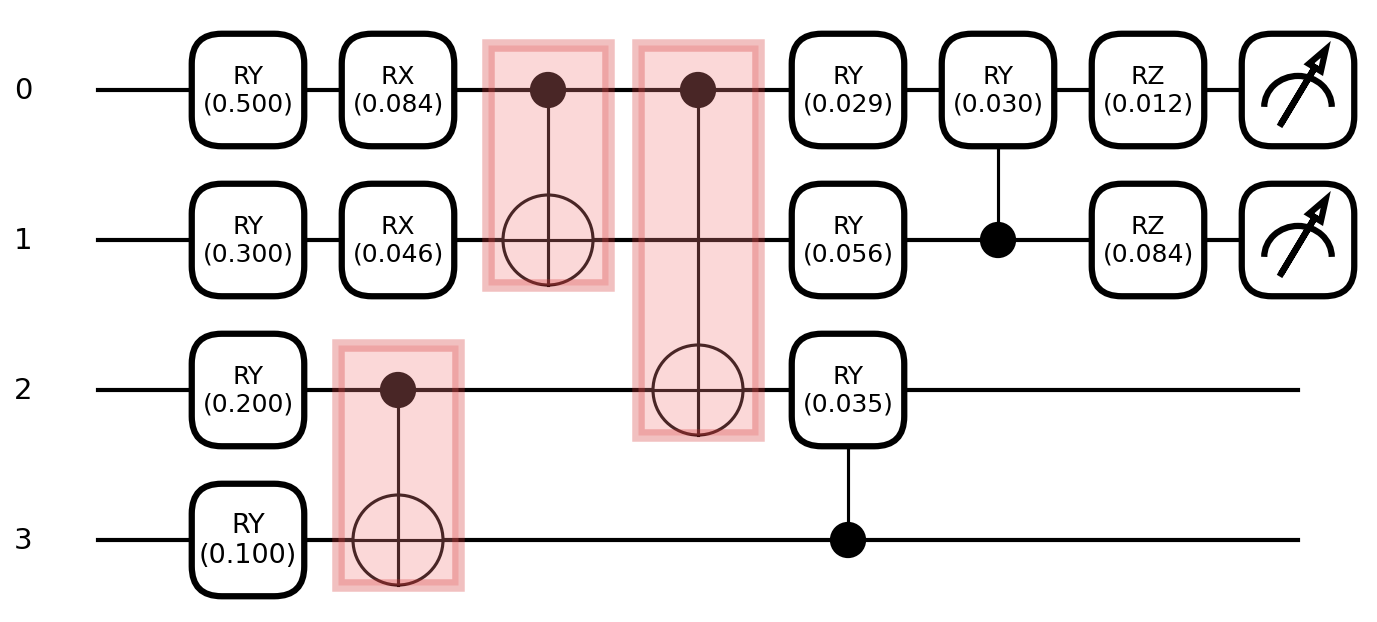
- Ansatz: A parameterized circuit structure designed to approximate a target state or optimize an objective in variational algorithms. "LogosQ's Ansatz trait abstracts parameterized quantum circuits"
- Area-law entangled states: Quantum states where entanglement scales with the boundary (area) of a region rather than its volume, enabling efficient tensor network representations. "For area-law entangled states (typical of gapped Hamiltonians)"
- Bond dimension: The size of the auxiliary indices connecting tensors in an MPS, controlling representational capacity and entanglement. "The bond dimension quantifies the entanglement between sites and "
- Canonical form: A normalized MPS configuration that stabilizes numerical operations and truncations while preserving state properties. "maintain the canonical form"
- Chemical accuracy: A precision threshold in quantum chemistry (≈1 kcal/mol) indicating results accurate enough for chemical predictions. "achieving chemical accuracy even in edge cases where other libraries fail"
- Closure-based API: An interface design where closures capture and enforce parameter usage and circuit construction logic at compile time. "LogosQ uses a closure-based API where the compiler statically verifies parameter usage"
- Compile-time type safety: Guarantees provided by the compiler that certain classes of errors (e.g., parameter misuse) cannot occur at runtime. "compile-time type safety"
- Controlled-phase gate: A two-qubit gate that applies a phase shift to the target conditional on the control qubit’s state. "controlled-phase gate "
- Dense state vector representation: A simulation method storing the full quantum state as a complex vector, suitable for smaller systems. "dense state vector representation"
- Differentiable programming: Techniques that allow automatic differentiation through programs or computational graphs, enabling gradient-based optimization. "Recent advances in differentiable programming with tensor networks"
- Entanglement entropy: A measure of quantum entanglement reflecting information shared between subsystems. "the entanglement entropy is bounded"
- Fast Fourier Transform (FFT): An algorithm for efficiently computing discrete Fourier transforms in O(N log N) time. "FFT-optimized Quantum Fourier Transform"
- Generator (of a unitary gate): The Hermitian operator G that defines a one-parameter unitary family U(θ) = exp(-iθG/2). "with generator "
- Hadamard gate: A single-qubit gate that creates superposition by rotating between computational and Hadamard bases. "Apply Hadamard gate to qubit "
- Heisenberg models: Spin system Hamiltonians (e.g., XYZ) used to study quantum magnetism and many-body physics. "XYZ Heisenberg models"
- Inverse discrete Fourier transform: The transformation mapping frequency-domain amplitudes back to the time (or computational basis) domain with normalization. "equivalent to the inverse discrete Fourier transform"
- Matrix Product State (MPS): A tensor network representation of quantum states that factorizes global amplitudes into local tensors with limited entanglement. "matrix product state (MPS) backend"
- Noise models: Stochastic or parametric models that simulate non-ideal hardware effects (decoherence, gate errors) in circuits. "optional noise models"
- Observable: A Hermitian operator whose expectation value is measured with respect to a quantum state. "Defines observables (Pauli operators, custom operators)"
- Open boundary conditions: An MPS convention where boundary bond dimensions are set to 1, simplifying tensor shapes at the edges. " for open boundary conditions"
- OpenQASM: A standardized assembly language for quantum circuits that facilitates interoperability between platforms. "OpenQASM"
- Parameter-shift rule: A technique to compute gradients by evaluating circuits at shifted parameter values and taking finite differences. "parameter-shift rule"
- Pauli operators: The set {X, Y, Z} of fundamental single-qubit Hermitian matrices used for rotations, measurements, and Hamiltonians. "Pauli operators"
- Pauli rotations: Parameterized single-qubit gates defined by exponentiating Pauli operators, e.g., RX, RY, RZ. "For Pauli rotations "
- Projected Entangled Pair States (PEPS): A higher-dimensional tensor network generalizing MPS to lattices with loops. "PEPS (Projected Entangled Pair States)"
- Quantum Fourier Transform (QFT): The quantum analogue of the discrete Fourier transform, central to phase estimation and factoring. "Quantum Fourier Transform"
- Quantum phase estimation: An algorithm that estimates eigenphases of unitary operators, underpinning applications like factoring. "quantum phase estimation"
- QuantumStateBackend: A trait-based interface abstracting how gates apply to different state representations (dense, MPS). "QuantumStateBackend trait"
- Send + Sync: Rust concurrency traits ensuring types can be transferred across threads (Send) and accessed concurrently (Sync). "The Send + Sync bounds indicate that gate types are safe to transfer between threads and can be accessed concurrently"
- Singular value decomposition (SVD): A matrix factorization used in MPS to split and truncate tensors while controlling entanglement. "singular value decomposition (SVD)"
- SWAP network: A sequence of SWAP gates used to bring non-adjacent qubits together for local two-qubit operations. "uses SWAP networks"
- State-vector simulation: A method that evolves the entire 2n-dimensional amplitude vector under gate operations. "state-vector simulation"
- Time-Evolving Block Decimation (TEBD): An algorithm that applies Trotterized local gates to MPS for efficient time evolution. "Time-Evolving Block Decimation (TEBD) approach"
- Toffoli gate: A three-qubit controlled-controlled-NOT gate fundamental in reversible and quantum logic. "The Toffoli gate (three-qubit controlled operation) extends this approach"
- Tree Tensor Networks (TTN): A tensor network architecture arranged in a tree topology to capture hierarchical correlations. "TTN (Tree Tensor Networks)"
- Trotter gates: Local gates derived from Suzuki–Trotter decompositions to approximate time evolution under a Hamiltonian. "applies Trotter gates directly"
- Variational quantum algorithms: Hybrid quantum-classical methods that optimize parameterized circuits using gradient or gradient-free techniques. "variational quantum algorithms"
- Variational quantum eigensolver (VQE): A variational algorithm to estimate ground-state energies of Hamiltonians. "variational quantum eigensolver (VQE) experiments"
- Wavefunction: The complex amplitude representation of a quantum state over a basis, often the computational basis. "representing the wavefunction as a tensor network"
Collections
Sign up for free to add this paper to one or more collections.

