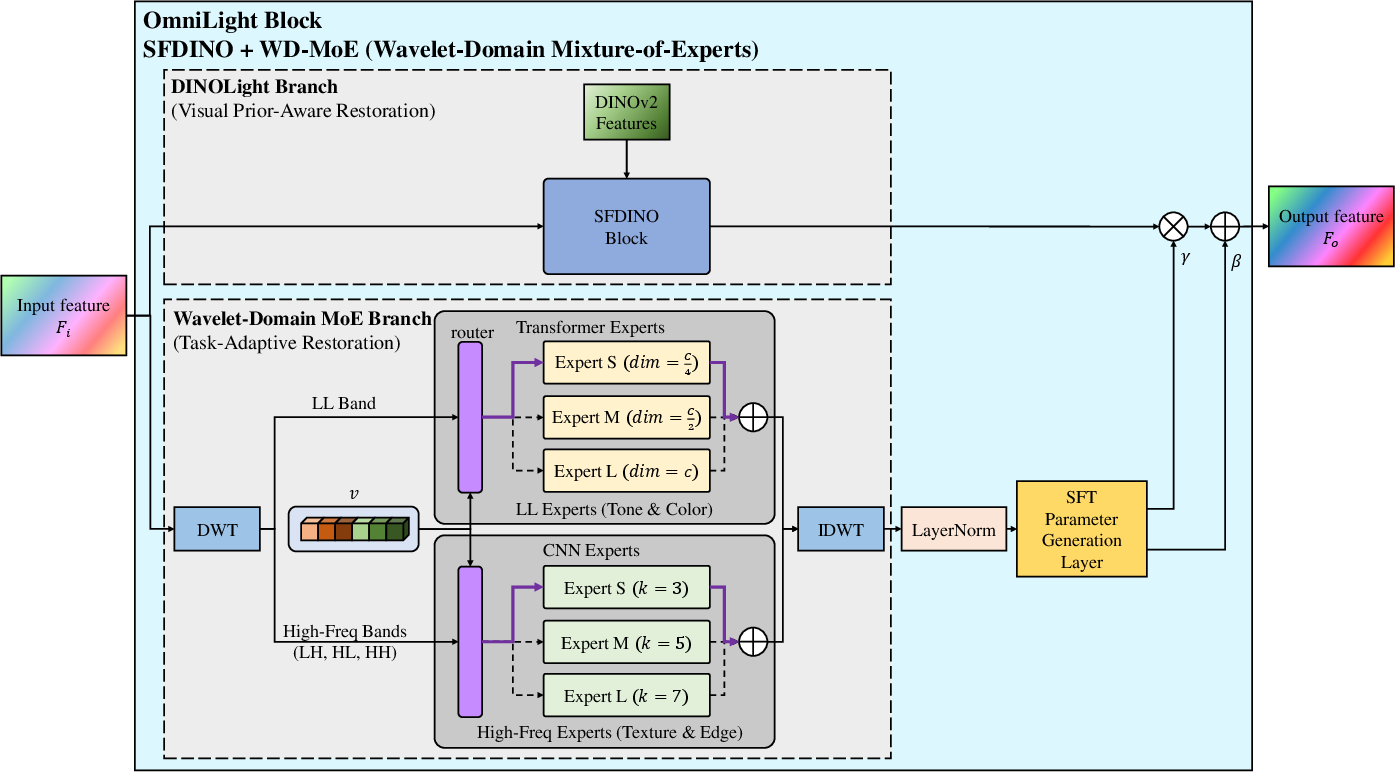
- The paper introduces OmniLight, a unified deep restoration model that concurrently handles shadow removal and ambient lighting normalization using a novel dual-branch MoE design.
- It innovatively integrates DINOv2 visual priors with discrete wavelet transforms to achieve robust multi-scale feature extraction and degradation-aware routing.
- Experimental results on NTIRE 2026 challenge datasets demonstrate competitive performance and enhanced generalization across varying lighting conditions.
OmniLight: Unified Deep Restoration Under All Lighting Conditions
Introduction and Problem Scope
Lighting-induced image degradations, such as complex cast shadows and multi-source chromatic illumination, fundamentally challenge low-level computer vision. Traditional restoration tracks (e.g., denoising, deblurring, super-resolution) are relatively well-defined, but ambient lighting normalization (ALN)—which entails restoring images with non-uniform, multi-source chromatic illumination—remains uniquely ill-posed. Shadow removal, traditionally addressed as a binary segmentation problem, is insufficient for real scenes with spatially continuous shading transitions and diverse lighting objects. Recent specialized datasets, such as Ambient6K and CL3AN, have further underscored the need for more general, semantically aware, and physically motivated restoration models.
The paper introduces the OmniLight architecture (2604.15170), representing the first unified framework that simultaneously addresses single-image shadow removal, ALN under white lighting, and ALN under color lighting—in effect, merging these into a “lighting-related image restoration” problem domain. This unified approach is positioned against the alternative strategy of “specialized task learning,” typified by the DINOLight baseline, which leverages strong visual priors but is optimized for narrow distributional targets.
Methodology: OmniLight Architecture
The OmniLight architecture is U-Net-based, but with crucial innovations in both multi-scale feature extraction and task generalization. Specifically, the backbone builds on SFDINO blocks, leveraging frozen DINOv2 visual priors while fusing them through dual-branch processing in novel OmniLight blocks.
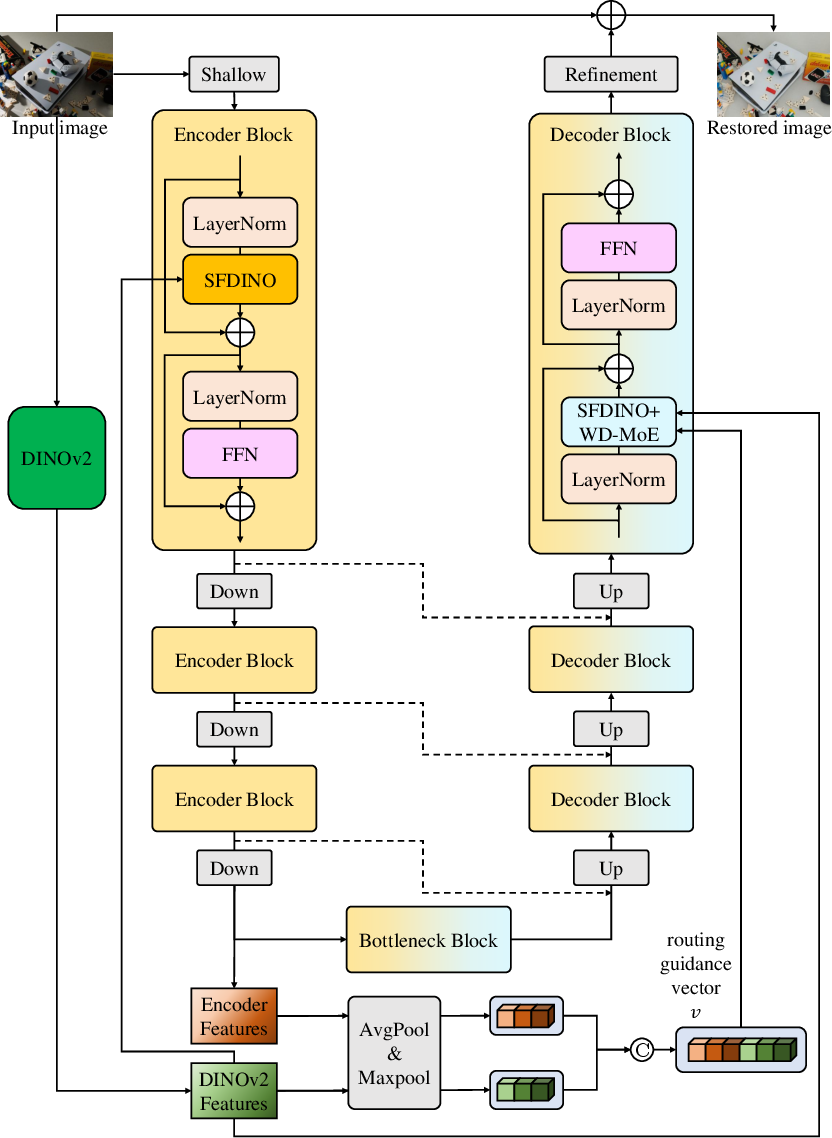
Figure 1: The high-level OmniLight architecture, employing a U-Net backbone with DINOv2-augmented encoders and WD-MoE-informed decoder/bottleneck for multi-task lighting-related restoration.
Each OmniLight block comprises a DINOLight branch and a Wavelet Domain Mixture-of-Experts (WD-MoE) branch:
WD-MoE deploys expert sub-networks for both low and high wavelet bands. Restormer blocks address low-frequency (global tone, penumbra, chromatic shift), while NAFNet blocks (lightweight CNNs) target high-frequency content (sharp shadow boundaries, textures). These sub-band experts are conditionally routed via a vector constructed from global statistics (global average/max pools of both feature and DINOv2 representations), enabling robust degradation-aware adaptation. An inverse DWT reconstructs the spatial map, which is fused via spatial feature transform to modulate the DINOLight backbone.
The network is trained with a composite loss: pixel L1, multi-scale SSIM, and an auxiliary load-balancing term to stabilize the MoE routing.
Experimental Results
Comprehensive evaluations demonstrate the efficacy and trade-offs between DINOLight (specialized) and OmniLight (unified) approaches.
OmniLight achieves top performance across multiple public lighting-related datasets and the NTIRE 2026 Challenge, securing:
- 1st (Perceptual) in ALN (White Lighting)
- 2nd (Fidelity), 4th (Perceptual) in ALN (Color Lighting)
- Consistently competitive or near-leading positions in single-image shadow removal
Numerical results reveal a typical trade-off pattern: DINOLight marginally outperforms on the dataset it is specialized for, while OmniLight, trained multi-domain, achieves superior generalization and robust competitive performance on all fronts—often surpassing all previous methods in average perceptual and structural metrics.
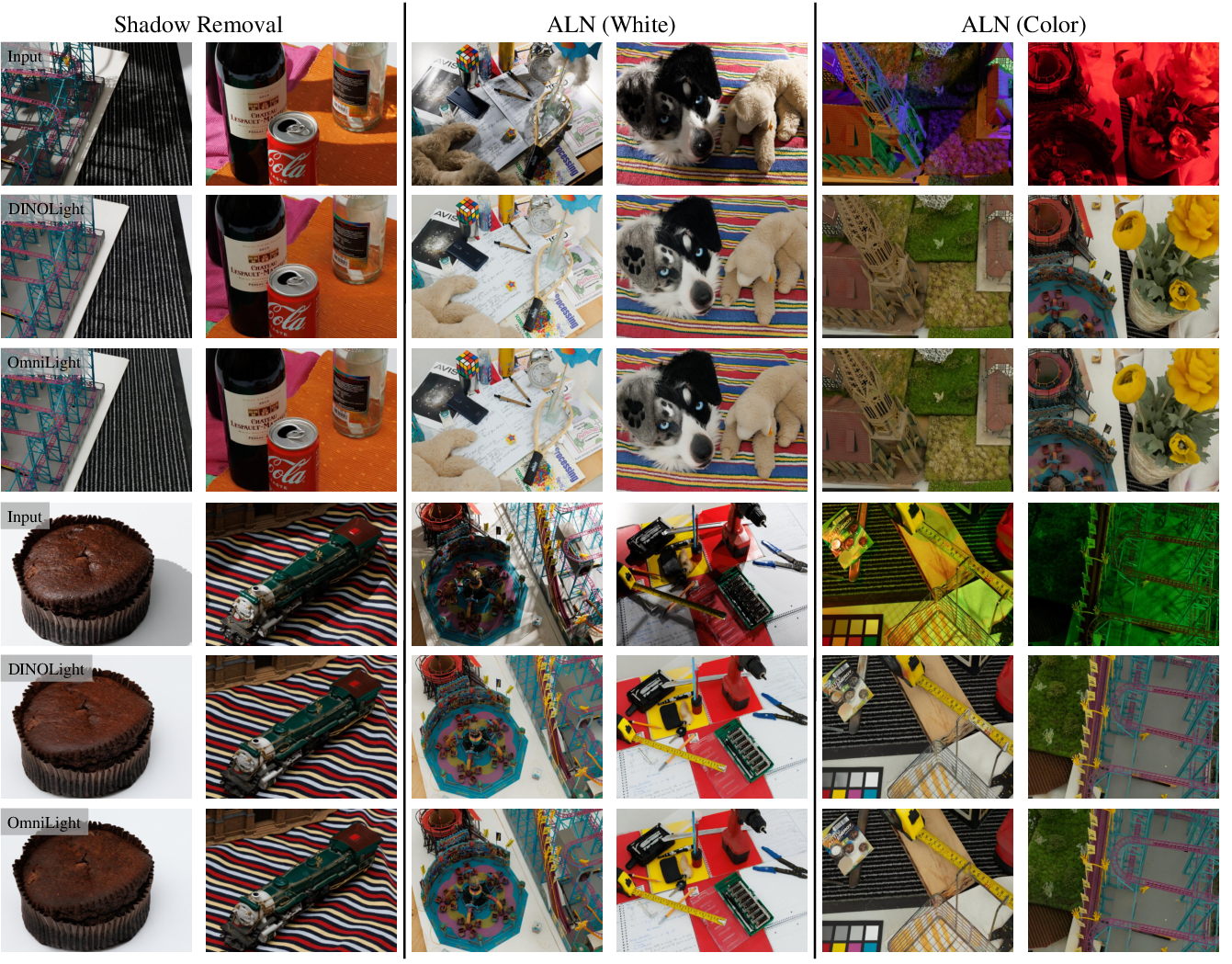
Figure 3: Qualitative samples on NTIRE 2026 Challenge test sets, illustrating realistic restoration of shadows and chromatic degradation by OmniLight.
Cluster analysis of the WD-MoE’s routing vector via t-SNE reveals that the model internally distinguishes degradation modes, with clear separation between shadow, white, and colored lighting cases.
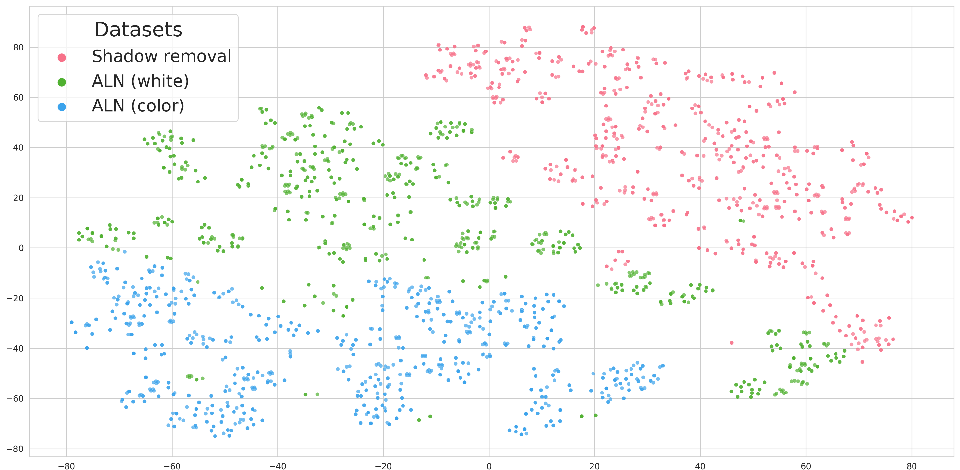
Figure 4: t-SNE embedding of WD-MoE routing guidance vectors, demonstrating effective domain-aware routing in OmniLight across diverse lighting tasks.
Failure cases are mostly localized color shifts in shadow removal tasks, indicating that joint training can sometimes imperfectly disentangle chromatic adaptation, especially when exposed to datasets emphasizing extreme color distributions.
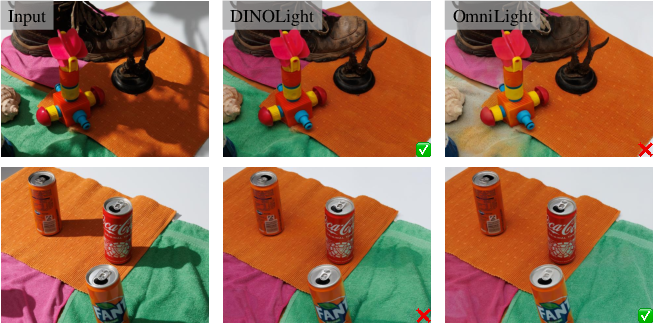
Figure 5: Examples from NTIRE 2026 shadow removal set showing both successful restoration and failure cases with artifact introduction.
Implications and Theoretical Perspective
This work formalizes and advances the “unification” paradigm for image restoration under adverse, heterogeneous illumination. By demonstrating that structured MoE design in the wavelet domain with domain-aware routing mitigates negative transfer, it pushes the field beyond specialized mask-based or semantic prior-heavy approaches. The network’s ability to generalize domain knowledge—both geometric and chromatic—across lighting distributions establishes a strong basis for further research into unified low-level vision architectures.
Practical implications include more robust vision systems deployed in unconstrained environments, where hand-designed or dataset-specific models would otherwise fail. Theoretically, the results encourage broader exploration of frequency-domain decoupling, context-conditional expert selection, and stronger integration of foundational model priors (e.g., DINOv2) even in low-level vision.
Future Directions
While the dual-branch MoE routing successfully reduces negative transfer, the current model shows some residual interference across domains. Future work should develop more sophisticated dynamic routing mechanisms, optimize batch/sample allocation for expert balance, and investigate strategies for finer disentanglement of chromatic and structural priors. Extending this approach to even broader multi-corruption or scene understanding tasks represents a natural evolution.
Conclusion
The OmniLight model substantiates that it is feasible to unify lighting-related restoration—spanning shadow removal and complex chromatic ALN—within a single deep architecture. The combination of semantic priors, frequency-domain MoE design, and expert routing yields a model robust to the intricacies of real-world illumination. The results set a high bar for future developments in all-in-one restoration, with the potential to simplify deployment and increase reliability for advanced computer vision systems operating under diverse lighting conditions.