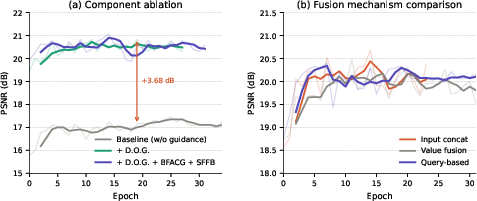
- The paper demonstrates that replacing geometric priors with DINOv3-based semantic priors improves color normalization, with PSNR gains over 1.2 dB on challenging benchmarks.
- It introduces innovative modules like DINO Omni-layer Guidance (D.O.G.) and decoder-side frequency-color refinement to decouple structure and chromatic corrections.
- Empirical evaluations on datasets like CL3AN and Ambient6K confirm enhanced fidelity and perceptual quality under complex, multi-chromatic lighting conditions.
Illumination-Invariant Semantic Priors for Ambient Lighting Normalization: An Analysis of CANDLE
Introduction and Motivation
Color ambient lighting normalization (ALN) under multi-source, spatially-varying, and multi-chromatic illumination remains a fundamentally ill-posed inverse problem. Standard geometric and low-level image priors often fail when spatially heterogeneous color shifts from ambient light occlude intrinsic material and object colors, resulting in severe chromatic contamination, highlight saturation, and reflectance artifacts. Prior art explores geometric priors (e.g., normal maps), frequency domain cues, or task-specific guided restoration, yet none show semantic invariance adequate for robust ALN under strong colored illumination.
CANDLE (“Color Ambient Normalization with DINO Layer Enhancement”) introduces a semantic-driven paradigm shift, leveraging the illumination-robust self-supervised features of DINOv3 to guide high-fidelity color normalization. By replacing conventional geometric priors with semantic priors, and by introducing refined decoder-side mechanisms to decouple structural and chromatic corrections, CANDLE achieves substantial gains across challenging real-world ALN benchmarks.
Semantic Priors: Feature Consistency Analysis
A critical observation motivating CANDLE is the empirical feature stability of DINOv3 representations under chromatic perturbation. To quantify illuminant invariance, patch-wise feature consistency across colored-lit and ambient-lit image domains is evaluated for DINOv3 (self-supervised), CLIP (vision-language), and supervised ResNet-50 encoders. DINOv3 retains both global and local region-wise consistency, while CLIP and ResNet-50 display substantial feature drift.
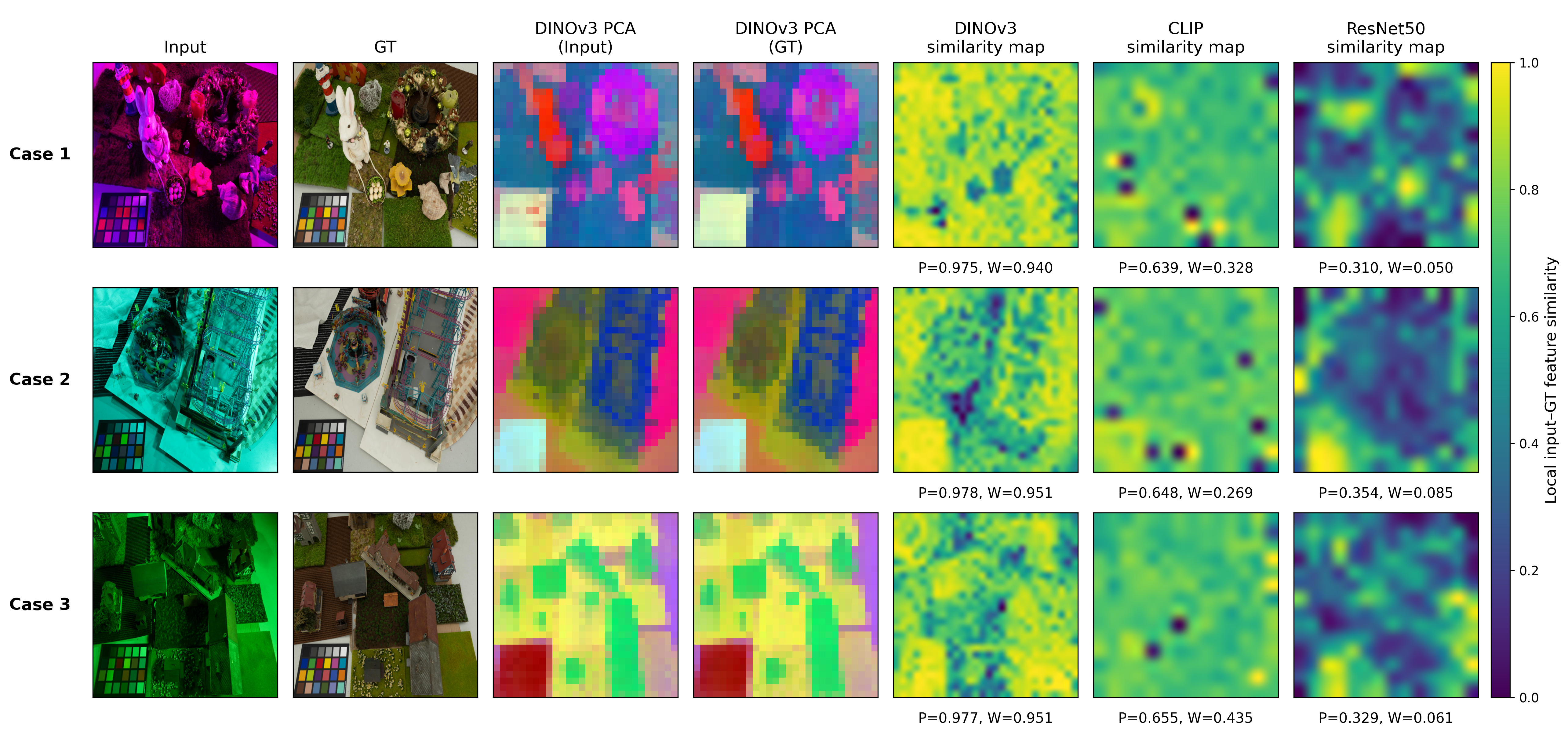
Figure 1: DINOv3 features remain highly consistent under severe colored illumination, in contrast to supervised and vision-language alternatives.
Quantitative metrics over diverse scenes show DINOv3 having the highest mean cosine patch similarity and minimal degradation in highly corrupted regions.
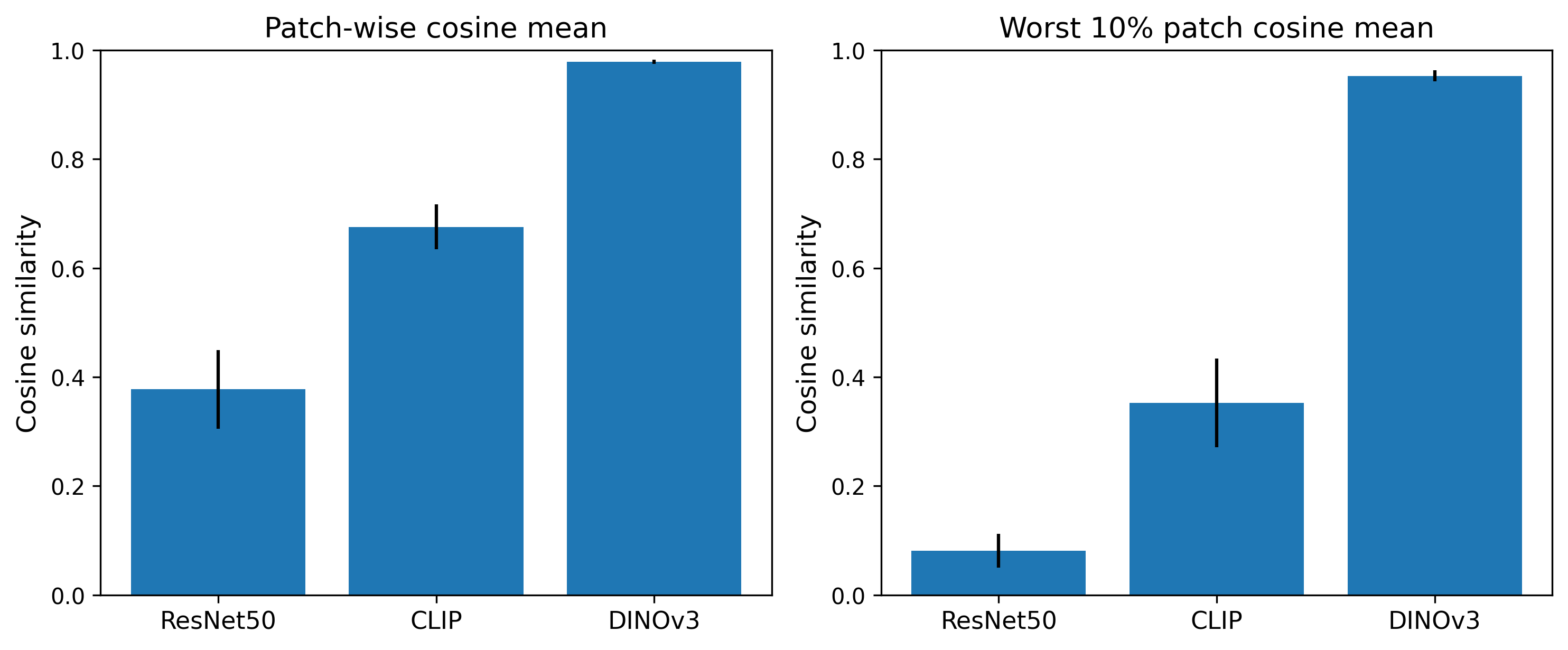
Figure 2: Quantitative analysis: DINOv3 is superior in patch-wise representation consistency across 10 input/ground-truth pairs.
This intrinsic robustness is attributed to DINOv3’s self-supervised training objective, which suppresses sensitivity to intensity/color deviations while preserving class-relevant semantic structure—an inductive bias unavailable to geometric or frequency-based priors.
CANDLE Architecture: DINO Omni-layer Guidance and Color-Frequency Refinement
CANDLE is anchored by two technical pillars: the DINO Omni-layer Guidance (D.O.G.) module and a color-frequency refinement pathway (BFACG + SFFB), designed to enforce illumination-invariant conditioning and decoder-side stabilization, respectively.
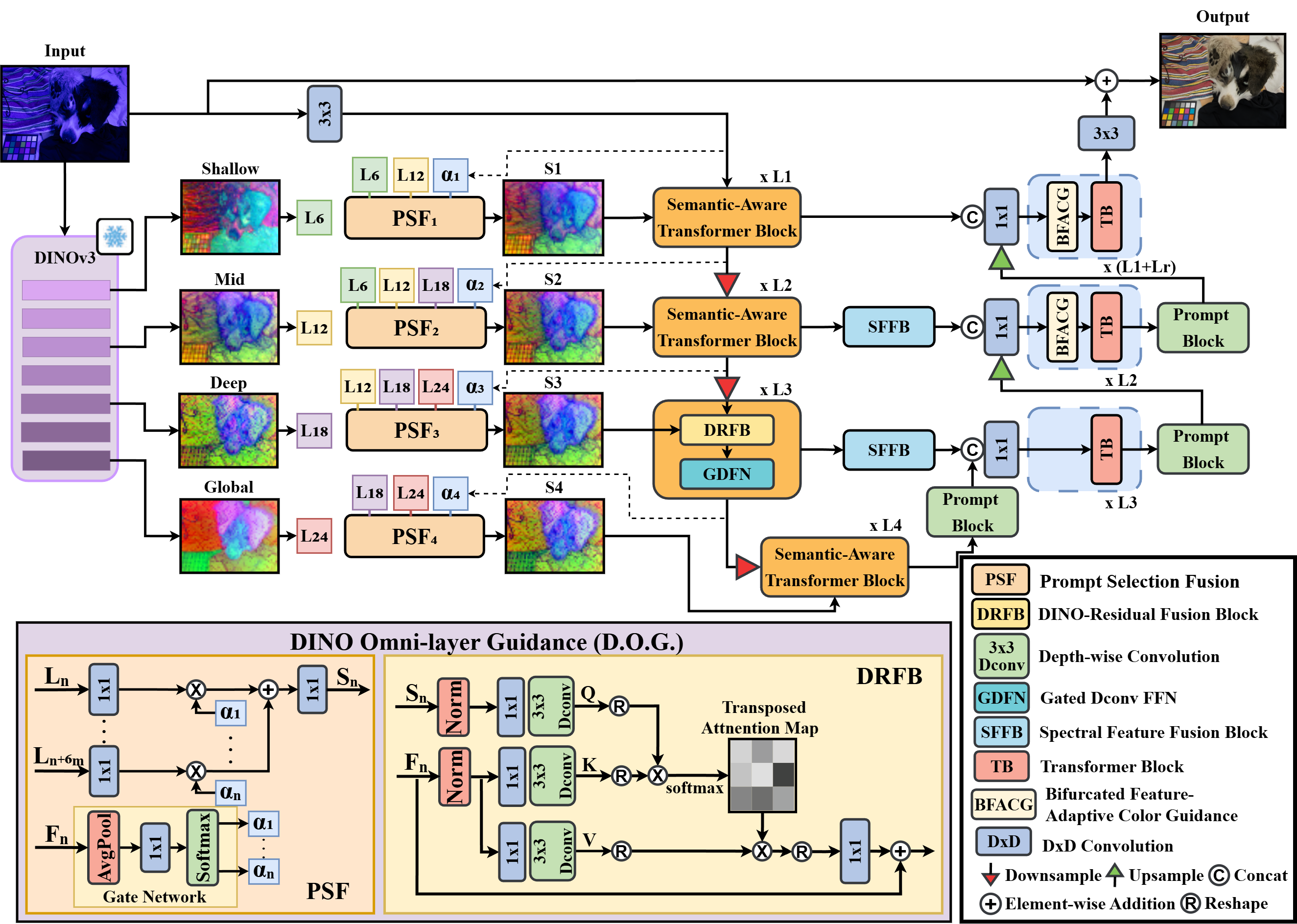
Figure 3: Overview of CANDLE: DINOv3 features from multiple transformer layers are adaptively fused into encoder stages; decoder side uses BFACG and SFFB to decouple structure/color and suppress illumination leakage.
DINO Omni-layer Guidance (D.O.G.):
- Layer Fusion: Features from DINOv3 ViT-L/16 at layers 6, 12, 18, and 24 are extracted. Prompt Selection Fusion (PSF) yields stage-adaptive semantic representations, where per-encoder-stage gating selects relevant semantic granularity.
- Cross-attention Injection: DINO-derived semantic priors are fused into encoder stages via DINO-Residual Fusion Block (DRFB), using cross-attention—a highly effective mechanism for conditioning the backbone on external, contextually relevant priors.
Decoder-side Refinement (BFACG + SFFB):
- BFACG: Bifurcated convolutional branches separately estimate structural and chromatic restoration, modulated by an edge-aware mask, ensuring that color corrections do not contaminate high-gradient (boundary) regions.
- SFFB: Haar wavelet decomposition is applied to skip-connection features to isolate illumination-sensitive low-frequency components, which are selectively suppressed by a learnable gating mechanism before reconstructive fusion.
The full model estimates the ambient-normalized image via global residual learning.
Experimental Evaluation
Experiments are conducted on CL3AN (complex multi-colored lighting, highlights, and spill) and Ambient6K (white-light only). Core evaluation metrics: PSNR, SSIM, LPIPS, and FID.
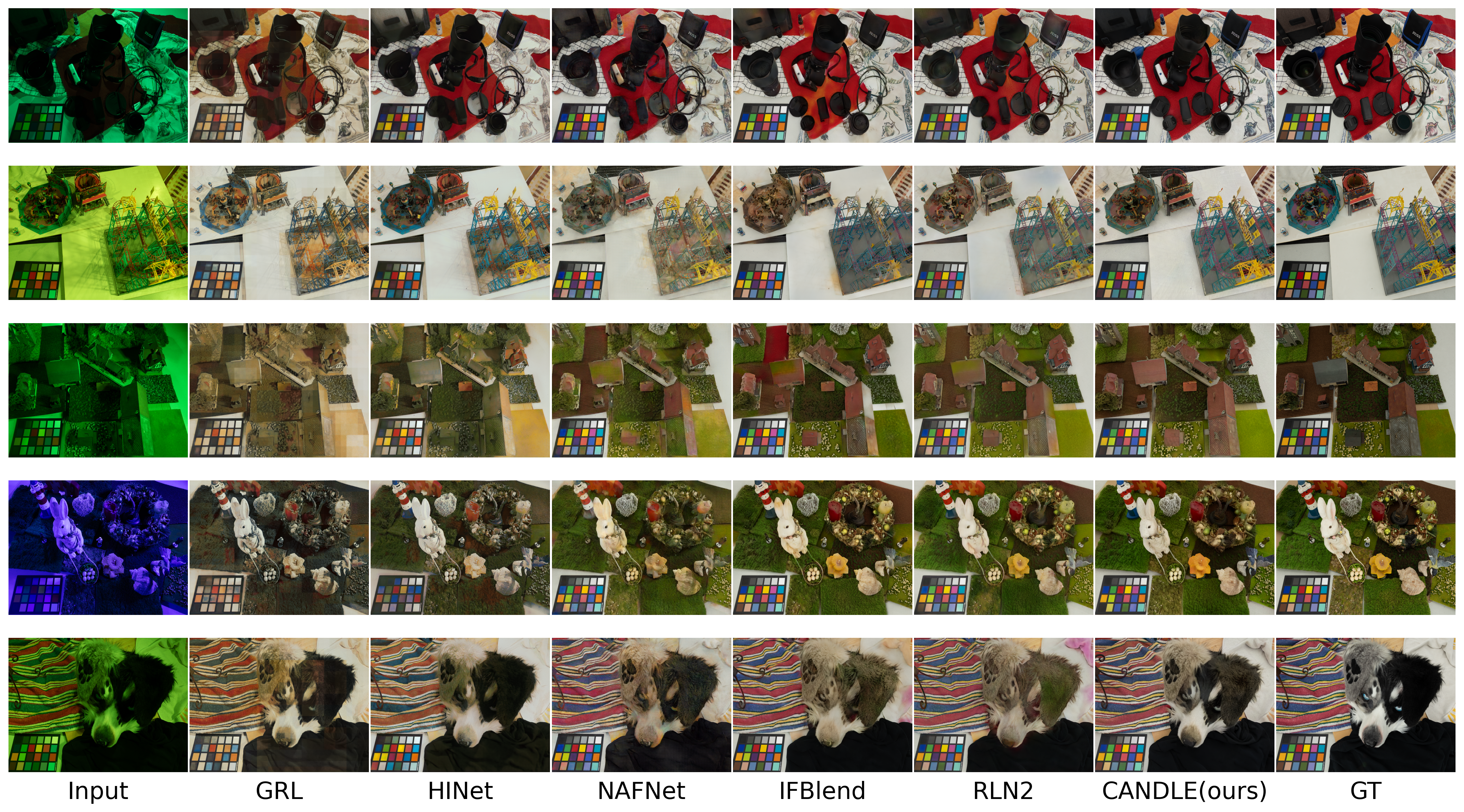
Figure 4: Qualitative comparison on CL3AN; CANDLE achieves better color restoration and sharper boundaries under extreme chromatic bias than geometric or frequency-prior methods.
Numerical Results
On CL3AN, CANDLE achieves 21.07 dB PSNR, outperforming RLN2-Lf by +1.22 dB, and PromptNorm by +1.85 dB. This marks a strong improvement enabled by replacing geometric (normal) priors with DINO-based illumination-robust semantic guidance, confirmed by ablation studies.
In the NTIRE 2026 ALN Challenge, CANDLE ranks 3rd in perceptual ranking (color lighting), 2nd in fidelity with lowest FID (white lighting), and demonstrates strongly competitive performance across both perceptual and fidelity-oriented metrics.
Ablation and Component Analysis
Implications and Future Directions
CANDLE’s results establish illumination-invariant semantic priors (specifically, self-supervised transformer features) as fundamentally superior to geometric or frequency cues for ambient color normalization under nontrivial illumination domains. The decoupling of semantic guidance and decoder-side refinement suggests a robust modular blueprint applicable to a variety of intrinsic image decomposition and illumination normalization tasks.
Practical Implications: Robust ALN via CANDLE is immediately relevant for real-world image forensics, computational photography, robotics (under arbitrary lighting), and downstream vision tasks where stable, color-consistent imagery is essential.
Theoretical Impact: CANDLE motivates broader adoption of multi-layer self-supervised vision transformer semantics as explicit priors for a range of inverse problems suffering from input domain shift or nontrivial environmental corruption.
Future Developments: Extensions may include:
- Optimizing DINO feature extraction for computational efficiency.
- Integrating joint semantic-frequency priors beyond color normalization (e.g., for reflection removal, direct/indirect lighting decomposition).
- Exploring closed-loop training with generative models to further bridge the semantic gap under unseen illuminant distributions.
Conclusion
CANDLE demonstrates that illumination-invariant semantic priors, sourced from self-supervised transformer representations, are decisive for challenging color ambient lighting normalization tasks. The D.O.G. mechanism and decoder-side frequency-color refinement yield notable fidelity and perceptual improvements, superseding traditional geometric or frequency domain priors. Empirical analysis across benchmarks and competition results confirms the efficacy and generalizability of this approach, charting a path for semantic-driven restoration in adverse illumination scenarios.