- The paper introduces an extended gravity framework in quantum cosmology that overcomes the timeless barrier of the conventional Wheeler–DeWitt formulation.
- It employs weak measurement techniques and treats spatial curvature as an operator to enable dynamic cosmic time evolution.
- The de Broglie-Bohm pilot-wave interpretation is used to derive classical trajectories and resolve cosmic boundary condition challenges.
Quantum Cosmology Beyond Wheeler-DeWitt: Measurement, Time, and de Broglie-Bohm Interpretations
Introduction: Revisiting Quantum Cosmology
This paper (2604.15130) addresses fundamental questions in quantum cosmology concerning the measurement process, the emergence of time, and the classical limit of the universe viewed as a quantum system. The authors move beyond the conventional Wheeler-DeWitt (WDW) mini-superspace formalism, advocating for a Hamiltonian approach in extended gravity theories (with explicit torsion), and critically analyzing the implications of third quantization, weak measurements, and pilot-wave interpretations.
Classical Cosmology and Extended Gravity Framework
The discussion begins with the standard cosmological model under the FLRW metric, expressing energy densities through idealized, non-interacting fluids. The authors maintain the spatial curvature parameter K, usually set to zero in many treatments, arguing its necessity for time dynamics. The classical Hamiltonian form is derived from the Friedmann equation, treating the cosmological expansion as equivalent to a point particle in a potential V(a;Ω), with spatial curvature as a conserved "energy." This structure is generalized to encompass extended gravity models (e.g., Covariant Canonical Gauge Gravity) where additional terms, such as torsional contributions, appear in the Hubble function.
Canonical Quantization and the Role of Time
The canonical quantization prescription follows with explicit operator ordering to avoid ambiguities inherent in WDW approaches. By retaining the curvature parameter K as a quantum operator, the resulting eigenvalue problem is a second-order PDE with K as the spectrum variable. Unlike the Wheeler-DeWitt equation, which yields a frozen, timeless universe, this formulation allows for dynamic cosmic time conjugate to spatial curvature.
Wave function normalization and expectation value calculations are defined over the mini-superspace. The wave function is constructed as a superposition of curvature eigenstates, ψU(a,τ;Ω)=K∑cU(ΩK)ψK(a;Ω)e−iΩKτ, enabling time evolution. The absence of wave function collapse upon astronomical measurement is discussed through the notion of weak (subquantum) measurement, which refrains from projecting the universal wave function onto an eigenstate.
Boundary Conditions and Classical Emergence
The problem of boundary conditions is addressed through DeWitt's and Hartle-Hawking's criteria, with an emphasis on suppressing singular behavior at the cosmic origin (i.e., R(a=0)=0). The self-adjointness of the momentum operator and periodic boundary conditions are considered for mathematical rigor, and classical emergence is analyzed in the limit where the quantum potential becomes negligible.
Measurement Theory in Quantum Cosmology
A central focus is the measurement dilemma: standard quantum mechanics demands an external observer, but no such entity exists in cosmology. The authors formally construct weak measurements using the apparatus configuration y, the pointer mapping F(y), and statistically disjoint supports to avoid collapse. The effective wave function of the universe is consequently restricted empirically, with Gaussian-weighted expansion coefficients reflecting observational data (notably Hubble parameter values).
The de Broglie-Bohm (Pilot-Wave) Interpretation
The Bohmian framework is invoked for interpreting cosmic measurement and dynamics without an external observer. The pilot-wave equations are derived in polar form, assigning classical trajectories to the scale factor, with the quantum potential encoding departures from classical physics. Probability density flows, as visualized in canonical quantum phenomena (double-slit experiment), are shown to govern the expansion trajectory.
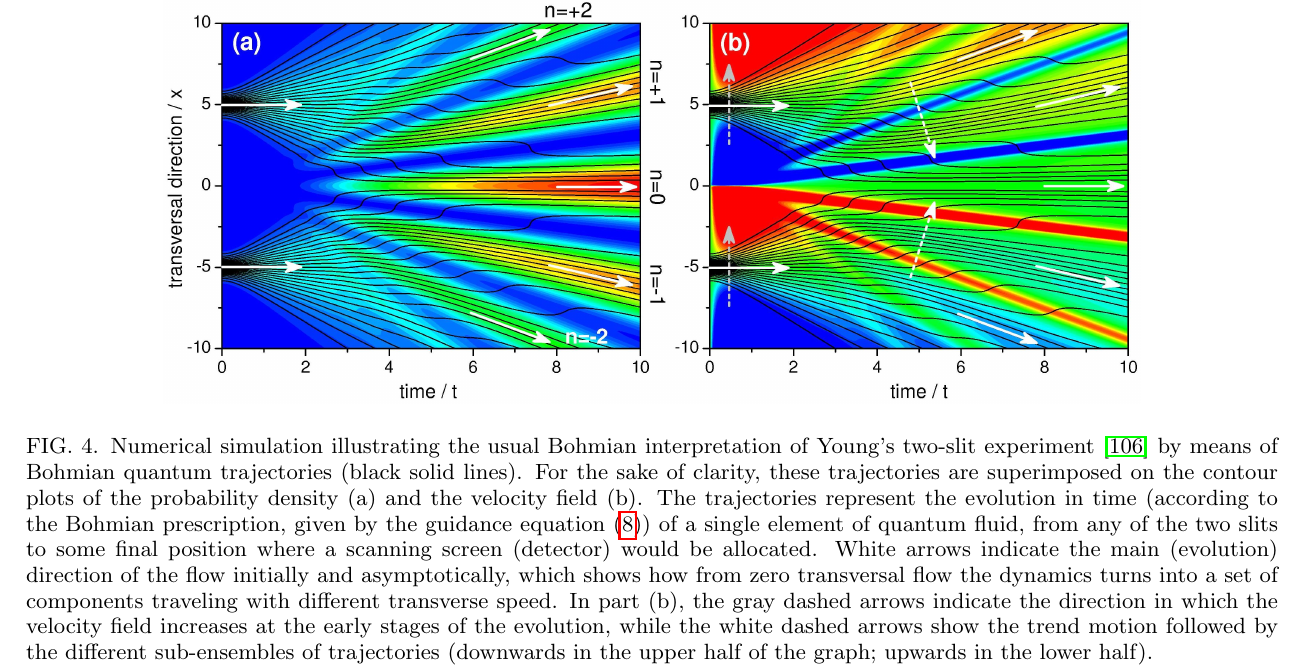
Figure 1: Bohmian trajectory visualization—quantum probability density and guidance patterns illustrate non-classical behavior and escape dynamics.
The paper asserts that Bohmian mechanics provides an epistemic uncertainty (stemming from initial conditions), as opposed to the ontic indeterminacy of Copenhagen interpretation. Non-locality and the connection to Bell's theorem are explicitly emphasized.
Initial Conditions for Bohmian Trajectories
Two options for trajectory initial conditions are explored:
- Inflationary Initial Condition: Probability density vanishes at the origin, forcing trajectories to rapidly escape and thereby generating inflation.
- Hubble Slot: Empirical present-day constraints (a0=1, h=H0/H100) limit the trajectory configurations to the observed universe, sidestepping ambiguities associated with the beginning of cosmic time.
These boundary choices are shown to restrict the scale factor evolution and are tied directly to the effective wave function shaped by real astronomical observations.
Implications and Future Directions
This formalism resolves several long-standing issues in quantum cosmology: the role of time, measurement theory, and boundary condition selection. The preservation of time via spatial curvature operator conjugacy departs from WDW, enabling dynamic histories without invoking decoherence. The weak measurement framework permits empirical restriction of the universal wave function compatible with observed Hubble rates. Bohmian mechanics further allows for classical dynamics to emerge consistently within the quantum formalism, addressing both epistemic and non-local aspects.
The authors claim that by avoiding instantaneous collapse and external observer dependence, their framework unifies quantum cosmological theory with empirical measurement, providing a robust structure for future numerical analysis of cosmic evolution in extended gravity theories. The pilot-wave formalism's capability for non-local trajectory dynamics is emphasized, with expectations of new insights from potential-induced tunneling and cyclic cosmological histories as numerical studies proceed.
Conclusion
The paper develops a comprehensive approach to quantum cosmology based on third quantization in an extended gravity framework. By retaining curvature as a dynamical quantum operator and implementing weak measurement protocols, the approach circumvents conceptual issues related to time disappearance, wave function collapse, and observer externality. The de Broglie-Bohm interpretation is shown to provide a mathematically consistent and physically motivated scheme for extracting classical behavior from quantum cosmological dynamics. Anticipated future work focuses on systematic numerical investigation of eigenfunctions, boundary conditions, and guidance dynamics, with the aim of elucidating the quantum-to-classical transition and possible new cosmological phenomena afforded by extended theories.
Figure 1: Bohmian trajectories in quantum mechanics reveal the non-local structure and escape dynamics that are analogously relevant to quantum cosmology.

