- The paper identifies explicit optimal constants for the BV trace inequality on cone-shaped domains with corners, highlighting distinct values like √2 for specific configurations.
- It employs a variational framework involving inner tangent spheres to rigorously derive the constant, revealing scaling invariance and the issue of non-existent maximizers.
- The results enhance our understanding of energy minimization in variational problems by accurately capturing the geometric effects of boundary singularities in non-smooth domains.
Explicit Optimal Constants in the Trace Inequality for BV on Domains with Corners
Background and Motivation
The paper "Optimal constant for the trace inequality in BV for domains with corners" (2604.13770) addresses a fundamental problem in geometric measure theory and the calculus of variations concerning traces of functions of bounded variation (BV) on domains with non-smooth boundaries. The trace inequality bounds the L1 norm of the trace of a BV function on the boundary in terms of its BV norm in the domain, which is crucial for energy minimization problems blending bulk and boundary energies. The explicit value of the optimal constant in this inequality is established for domains exhibiting a particular class of singularities—specifically, corners modeled as cones.
For domains with Lipschitz boundary, classical results ensure trace operators are bounded, and Giusti [giusti1976boundary] showed that the optimal constant is $1$ for smooth boundary points. However, outward-pointing corners dramatically modify this constant, creating sharp geometric dependence and challenging the existence of minimizers in variational contexts. This work rigorously determines such constants for cones with inner tangent spheres.
Trace Inequality and Geometric Characterization
For a domain Ω⊂Rn and u∈BV(Ω), the classical trace inequality reads: $\int_{\partial \Omega} |\Tr(u)(x)| \, d\mathcal{H}^{n-1} \leq C \|u\|_{BV(\Omega)}$
where BV0 combines the BV1 integrability and variation norm. When boundary singularities are present, the optimal constant BV2 in this inequality is determined by a geometric variational problem: BV3
with BV4 defined as a supremum over local sets BV5 of finite perimeter near BV6, the ratio of the trace contribution to perimeter.
For points of smooth boundary, BV7. In contrast, at singularities associated to corners, BV8, and the paper provides explicit values depending on the geometry—showing, for instance, that certain cone configurations yield BV9 (as for the book-cone example).
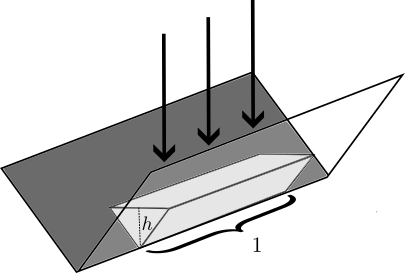
Figure 1: The 'book' cone, a fundamental example illustrating variation in BV0 from 1 at flat boundary portions to BV1 at the outward-pointing corner.
Main Theoretical Results
Explicit Constant for Cones with Inner Tangent Sphere
Let BV2 be a cone whose base BV3 admits an inscribed sphere BV4. The main theorem asserts: BV5
where BV6 is the radius of the inscribed sphere in the base.
The sets BV7 achieving equality in the maximization problem are precisely those given by intersection of BV8 with a half-space orthogonal to the sphere center (i.e., BV9 for some L10).
This rigorous characterization allows exact computation of the optimal constant for a broad class of cone singularities, thereby extending Giusti's results from L11 boundaries to singular geometries.
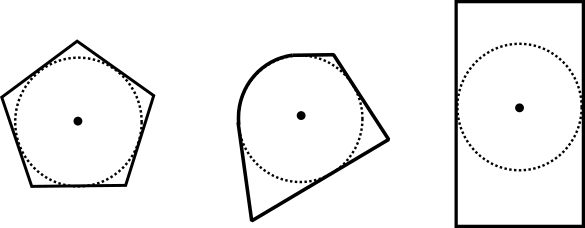
Figure 2: Visualization of cone bases with inner tangent spheres/balls—efficiently attaining the optimal constant; configurations lacking such spheres (e.g., non-square rectangles) do not allow this reduction.
Non-Existence of Maximizers and Scaling Invariance
For cones such as the book-cone, maximizing sequences in the variational characterization yield sets with vanishing volume, precluding genuinely attaining the supremum (i.e., the optimal constant is approached but not achieved). This phenomenon arises from scaling invariance—the maximizer, if it existed, would collapse to measure zero, undermining compactness arguments based on bounded perimeter.
Practical and Theoretical Implications
Applications in the Calculus of Variations
The optimal constant ensures the lower semi-continuity in variational formulations where boundary and bulk energies interact, crucial for existence theorems. For negative boundary weights, knowing the precise constant bounds the parameter range where minimizers exist, forestalling instability or ill-posedness due to corner effects.
Generalization and Geometry Dependence
The sharp geometric dependence (only on the radius L12 of the inner sphere tangent to the cone) readily translates to practical calculations for arbitrary polyhedral domains, and indicates that convexity and the presence of described balls are key for trace bounds. Further relaxation may generalize the theorem to convex cones, as suggested by the discussion for future research.
Non-Uniqueness and Scaling Pathology
Even in cases where maximizers exist, uniqueness is lost due to scaling invariance: any rescaling of a maximizing set remains optimal, and in some cones, no set attains the supremum (the optimal constant is only approached).
Outlook and Directions for Future Work
Potential developments include extending these characterizations to broader classes of convex cones, understanding the conditions under which maximizing sets exist, and refining estimates for domains lacking inner tangent spheres. The interplay between geometric measure theory and variational PDEs remains a fertile area, particularly for non-smooth boundary phenomena, with possible implications for interface problems and phase transitions in materials.
Conclusion
This paper rigorously determines explicit optimal constants for the trace inequality in L13 for domains with corners modeled by cones having bases admitting an inscribed sphere, with the constant L14 arising from sharp geometric analysis. The work unifies boundary regularity and singularity phenomena within a precise measure-theoretic framework, and its results delineate existence, uniqueness, and non-existence of optimizers in variational problems, advancing the understanding of geometric effects in functional inequalities.