- The paper introduces RealVuln, a benchmark evaluating rule-based, LLM-driven, and security-specialized scanners on intentionally vulnerable Python repositories.
- It reveals that security-specialized systems, like Kolega.Dev, achieve superior recall with an F3 score of 73.0 compared to GP-LLMs and rule-based tools.
- The study underscores the importance of domain-aware architectures and robust false-positive traps for accurate and cost-effective vulnerability detection.
Authoritative Summary of "RealVuln: Benchmarking Rule-Based, General-Purpose LLM, and Security-Specialized Scanners on Real-World Code" (2604.13764)
Context and Motivation
The RealVuln benchmark addresses a prominent gap in the evaluation landscape for code vulnerability scanners. Prior work either relies on synthetic datasets, lacks public ground truth, evaluates only a narrow set of scanner types, or fails to measure false positive rates rigorously. Industry reports flag persistent issues: substantial noise (false positives) and low recall in SAST outputs, leading practitioners to disregard scanner findings. RealVuln is specifically constructed to enable systematic comparison of Rule-Based SAST tools, General-Purpose LLMs, and Security-Specialized systems on a unified suite of real-world, intentionally vulnerable Python repositories with comprehensive hand-labeled vulnerabilities and false-positive traps.
Benchmark Structure and Methodology
RealVuln v1.0 comprises 26 multi-file Python repositories designed for educational and CTF purposes, aggregated to cover five major web frameworks and 18 distinct CWE families. The dataset includes 796 ground-truth findings, with 676 confirmed vulnerabilities and 120 false-positive traps—serving to quantitatively assess both recall and specificity. All entries are hand-labeled, minimizing label noise and maximizing auditability.
Scanner output matching is implemented by considering file path normalization, CWE classification (including acceptable alternatives), and proximity in line numbers, explicitly handling multi-location reports common in agentic LLM-based approaches. Ground truth, scoring scripts, scanner outputs, and all evaluation procedures are open-sourced for fully reproducible results.
The primary metric is strict F3, giving recall nine times the weight of precision (reflecting security risk asymmetry), alongside secondary metrics F2 and F1 for broader interpretability. Micro-averaging and strict-micro modes account for scanner completion rates and robustness.
Comparative Evaluation of Scanner Categories
Fifteen scanners were evaluated across three categories:
- Rule-Based SAST: Semgrep, Snyk Code, SonarQube (pattern-matching/static analyzers)
- General-Purpose LLMs: Ten agentic runs spanning seven model families (Anthropic Claude, Google Gemini, xAI Grok, Moonshot Kimi, GLM, Minimax, Qwen)
- Security-Specialized: Kolega.Dev (proprietary, purpose-built with LLM reasoning and domain-targeted architecture) and GitHub SecLab Taskflow Agent (multi-stage agentic analysis driven by GPT-5.4).
All LLMs operated in agentic mode, exploiting iterative file exploration, tool use, and multi-stage reasoning, standardized via a shared prompt and output schema.
Key Empirical Results
A clear hierarchy is observed under all weighting schemes, with the principal findings in recall-weighted strict F3 (best for production security contexts):
- Security-Specialized Scanner (Kolega.Dev): Achieves F3=73.0, recall =0.809, precision =0.388; highest coverage among all scanners.
- Best General-Purpose LLM (Claude Sonnet 4.6): F3=51.7, recall =0.498, precision =0.785.
- Rule-Based SAST (Semgrep): F20, recall F21, precision F22.
This ordering persists across F23 and F24, though the dominance of General-Purpose LLMs appears under metrics prioritizing precision.
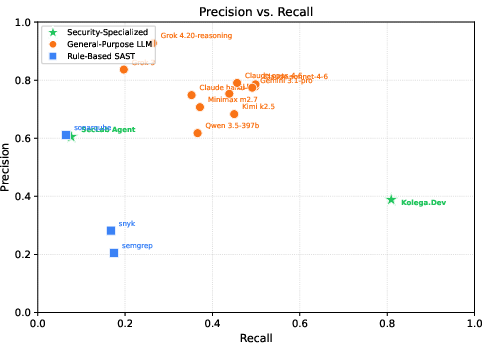
Figure 1: Precision vs. recall for all 15 scanners, highlighting the superior recall of Kolega.Dev and the clusterings of GP-LLMs and Rule-Based SAST tools.
The second Security-Specialized tool, SecLab Taskflow Agent, returns high precision (F25) but extremely low recall (F26, F27), underscoring that architectural specialization is necessary but not sufficient for effective coverage; broad vulnerability detection is critical.
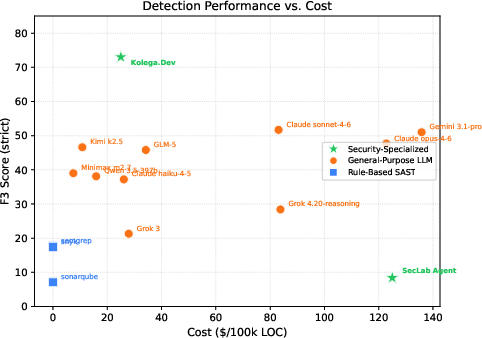
Figure 2: Strict F3 versus cost per 100k LOC; Kolega.Dev achieves the highest F3 at the lowest cost, with GP-LLMs trailing by both recall and cost.
Cost-Effectiveness and Practical Deployment
Cost-normalized analysis reveals that Kolega.Dev outperforms all other paid scanners: F28 at \$F_29F3=51.7F_1$083/100k LOC, while others are less economical and less performant. Rule-Based SAST tools are largely open-source or free but offer an order of magnitude lower recall than modern AI-powered tools.
Reliability is a critical factor: several frontier LLMs suffer from non-trivial timeout/failure rates on benchmark repositories. Coverage gaps from GP-LLMs (e.g., Opus 4.6, Minimax M2.7), and their non-deterministic outputs, reinforce the necessity of reliability-adjusted evaluation.
Discussion and Implications
The empirical results establish:
- Three-tier taxonomy: Security-Specialized scanners with domain-aware pipelines outperform GP-LLMs, which in turn outperform Rule-Based SAST.
- Recall is paramount: For security contexts where missed vulnerabilities pose severe risk, high recall (even at moderate precision) is preferable—justifying the recall-heavy strict $F_1$1 metric.
- Domain-specific architecture matters: Kolega.Dev's outperformance of GP-LLMs (even those based on frontier models) demonstrates the importance of integrating LLM reasoning into purpose-built vulnerability detection pipelines, beyond prompt engineering.
- Agentic LLMs improve over basic prompting: GP-LLMs deliver higher recall than SAST, particularly for semantic vulnerabilities and multi-file dataflows, but lack sufficient reliability and comprehensive coverage for production use.
- False positives and traps: The incorporation of false-positive traps provides a robust negative set, validating scanner specificity and preventing inflated recall via memorization.
Practical implications include recommending Security-Specialized AI scanners for compliance and high-risk production code, using recall-weighted metrics for procurement and risk analysis, and transitioning away from legacy SAST tools for vulnerability detection.
Limitations and Threats to Validity
- Language and benchmark scope: The benchmark currently covers only Python and intentionally vulnerable code (Type 1). Real-world generalizability will require extension to production codebases, memory-unsafe languages, and broader vulnerability types.
- Potential training data contamination: Some repositories may have appeared in LLM training sets, although false-positive trap analysis mitigates memorization as a confounding factor.
- Scanner selection bias: Security-Specialized representation is limited to two systems; broader inclusion will be necessary for comprehensive category analysis.
- LLM completion and stochastic variation: Run failures and nondeterminism among GP-LLMs may skew results, highlighting need for repeated and reliability-adjusted benchmarks.
Theoretical and Future Directions
The results imply that further advancements in vulnerability detection will come from:
- Deeper integration of LLM reasoning with domain-aware pipelines for detection coverage.
- Expansion of benchmarks to multi-language, real-world, and low-vulnerability-density codebases (planned for RealVuln v2).
- Agentic LLM approaches are promising but require architectural adaptation and greater reliability for production viability.
- Community-driven benchmark evolution, with versioned ground truth, transparent scoring, and reproducible dashboards, will be essential for rigorous comparative assessment as tools evolve.
Conclusion
RealVuln establishes a rigorous, open, reproducible framework for evaluating code vulnerability scanners, providing strong evidence that Security-Specialized systems with domain-aware LLM architectures substantially outperform both general-purpose LLMs and legacy static analysis tools on real-world code. The benchmark's design and transparency enable ongoing community-driven improvement in both dataset and scanner coverage. Future developments should focus on architectural innovation, broader codebase representation, and robust methodology for evaluating evolving AI-based vulnerability detection systems.