- The paper presents a novel system integrating an ergonomic VR interface, closed-loop quality assurance, and data mixing strategies to scale dexterous manipulation tasks.
- It achieves an 85% data validity rate and reduces real-robot data requirements by up to 20× through effective human demonstration decoupling.
- Experimental results demonstrate robust zero-shot policy transfer across heterogeneous robots and cost-efficient scaling for complex, long-horizon tasks.
XRZero-G0: Scalable, High-Fidelity Data Acquisition for Dexterous Robotic Manipulation
Introduction
XRZero-G0 presents a comprehensive hardware-software co-designed framework targeting the principal limitations that have constrained generalist robotic embodiment—namely, efficient collection of high-quality, action-aligned data, robustness against noisy demonstrations, and economically viable scaling of real-robot and robot-free datasets. The system integrates an untethered VR-based ergonomic interface, a closed-loop quality assurance pipeline, and empirically validated data-mixing strategies, culminating in the G0-Dataset exceeding 2,000 hours and supporting 3,000 manipulation tasks. This infrastructure enables generalist vision-language-action (VLA) policy pre-training and robust zero-shot cross-embodiment transfer, driving cost-efficient advancements in real-world, long-horizon manipulation.
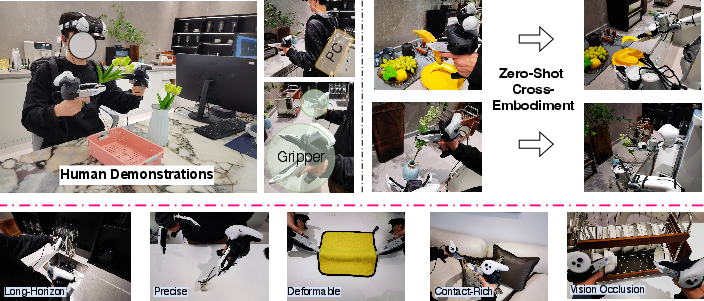
Figure 1: The XRZero-G0 system allows scalable, robot-free data collection through a VR wearable, enabling immediate cross-embodiment mapping.
System Architecture
XRZero-G0 is anchored in a tightly integrated hardware and software pipeline. The system comprises a backpack-powered VR interface with an egocentric RGB camera, dual-wrist cameras, and two physically heterogeneous grippers—the H-shaped (press-actuated, macroscopic interaction) and G-shaped (dexterous, finger-driven) devices. This configuration supports robust, drift-resistant spatial tracking and enables ergonomic demonstrations unconstrained by a robot’s kinematic limitations or workspace.
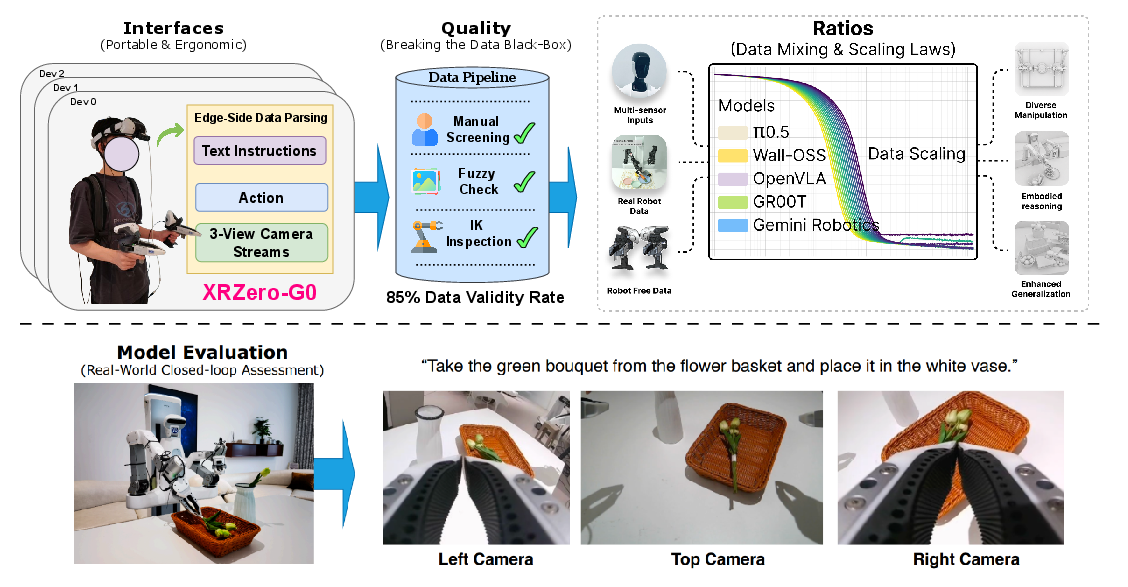
Figure 2: XRZero-G0 system architecture featuring an ergonomic, multi-view VR interface and closed-loop data verification.
A real-time edge computing unit synchronizes high-frequency 6-DoF controller trajectories and RGB streams, transmitting spatiotemporally aligned packets to a backend server for immediate ingestion into the quality pipeline. The closed-loop Collection-Inspection-Training-Evaluation pipeline encompasses visual frame cleansing, motion downsampling, kinematically valid retargeting (via URDF/IK), open-loop robot playback, and semantic subtask annotation. This process achieves an 85% data validity rate, systematically eliminating the degradation phenomena observed in prior open-loop, human-centric data regimes.
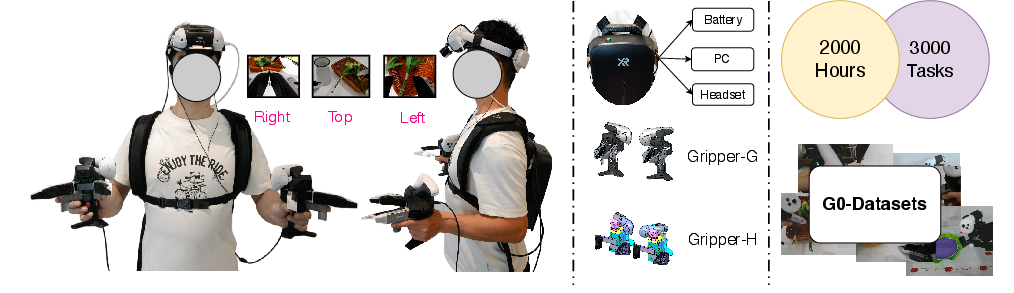
Figure 3: Backpack-powered XRZero-G0 data collection rig delivers rapid, ergonomic acquisition with customized physical grippers.
Dataset Composition and Distribution
The G0-Dataset collected with XRZero-G0 spans 2,000+ hours and captures over 3,000 distinct tasks. Distribution analysis shows a pronounced long-tail: the dataset includes abundant repeatable primitives (e.g., folding, sorting) while extensively covering rare, semantically specialized skills. This compositional structure enhances policy generalization by providing both robust core alignment and task-specific operational diversity. Egocentric viewpoints and physical gripper alternation enrich the data’s morphology, with semantic bounding boxes granting explicit supervision for multimodal learning.
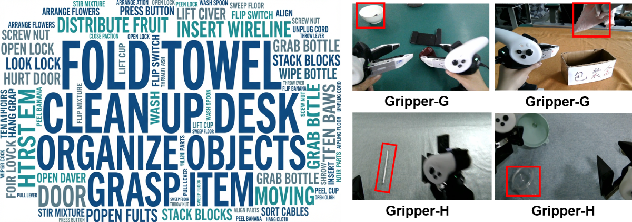
Figure 4: Overview of G0-Dataset with long-tail task distribution and diverse egocentric visual frames, including semantic annotations.
XRZero-G0 attains peak data acquisition rates exceeding 93 episodes/hour, which far outstrip conventional teleoperation and VR-based baselines, consolidating its position as a throughput-optimized pipeline for large-scale embodied datasets.
Experimental Results
Data Collection Efficiency
Empirical benchmarks demonstrate XRZero-G0’s significant improvements in human operator throughput and task usability. Compared to master-slave teleoperation, mean episode duration reduces by 2.33× for simple, 1.88× for medium, and 1.71× for complex tasks. These gains are attributed to decoupling human demonstration from rigid robotic kinematics, reducing cognitive-motor mapping friction and leveraging proprioceptive feedback from physical grippers.
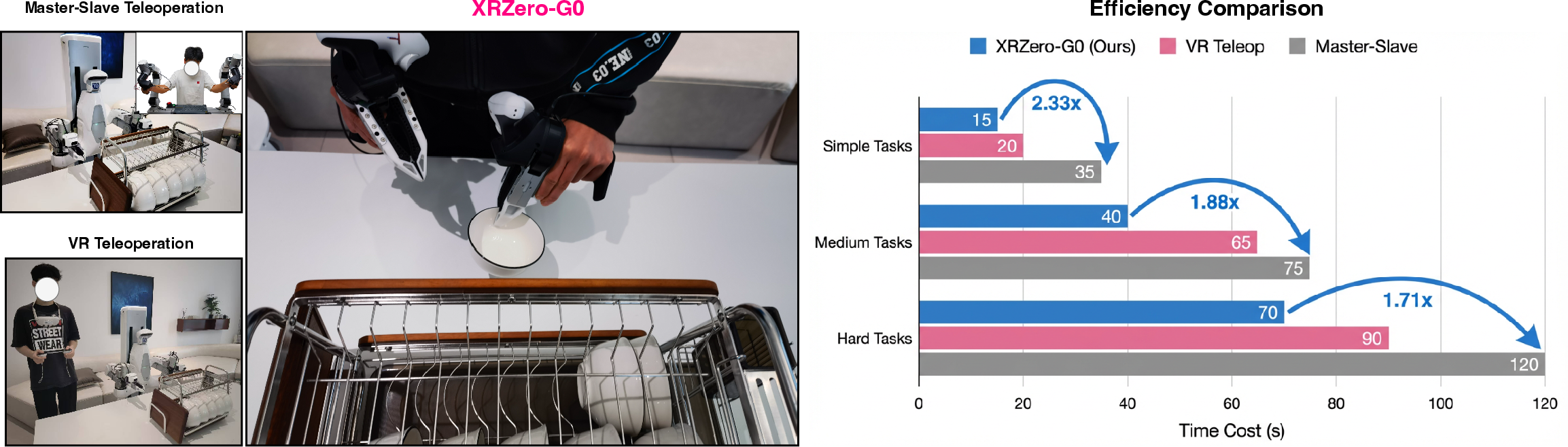
Figure 5: XRZero-G0 outperforms traditional teleoperation and VR interfaces in data collection speed across multiple task complexities.
Cross-Embodiment Transfer and Robot-Free Data Scaling
A core result is the empirical validation of pure robot-free data for direct policy inference. Robot-free demonstrations can be kinematically mapped and replayed 1:1 on heterogeneous dual-arm robots, demonstrating functional equivalence to real-robot teleoperation data. Scaling the pure robot-free dataset from 300 to 500 episodes yields a strong linear uplift in grasping task performance (up to 75% success in challenging tasks using Wall-OSS and π0), while scaling further for complex long-horizon dual-arm tasks (up to 2,000 episodes) shows robust generalization across variation in robot height, a setting where fixed-base teleoperation data typically overfits catastrophically.

Figure 6: Success rates scale linearly with more robot-free data for both basic and long-horizon dual-arm tasks, substantiating robust spatial generalization.
Data Mixing Laws and Cost-Efficiency
Central to XRZero-G0 is the establishment of optimal data-mixing strategies. Empirical analysis reveals that augmenting a moderate-size real-robot anchor with equivalent robot-free data (1:1 mixture) not only increases the asymptotic performance ceiling but also amplifies sample efficiency in data-abundant regimes. Remarkably, a 10:1 mixture—replacing 90% of expensive real-robot data with robot-free episodes—matches or is statistically indistinguishable from real-robot-only baselines across key tasks. This substantiates the Few-Shot Physical Anchoring effect: minimal real-robot data provides embodiment-specific kinetic priors after generalized environment and affordance learning from abundant robot-free demonstrations.
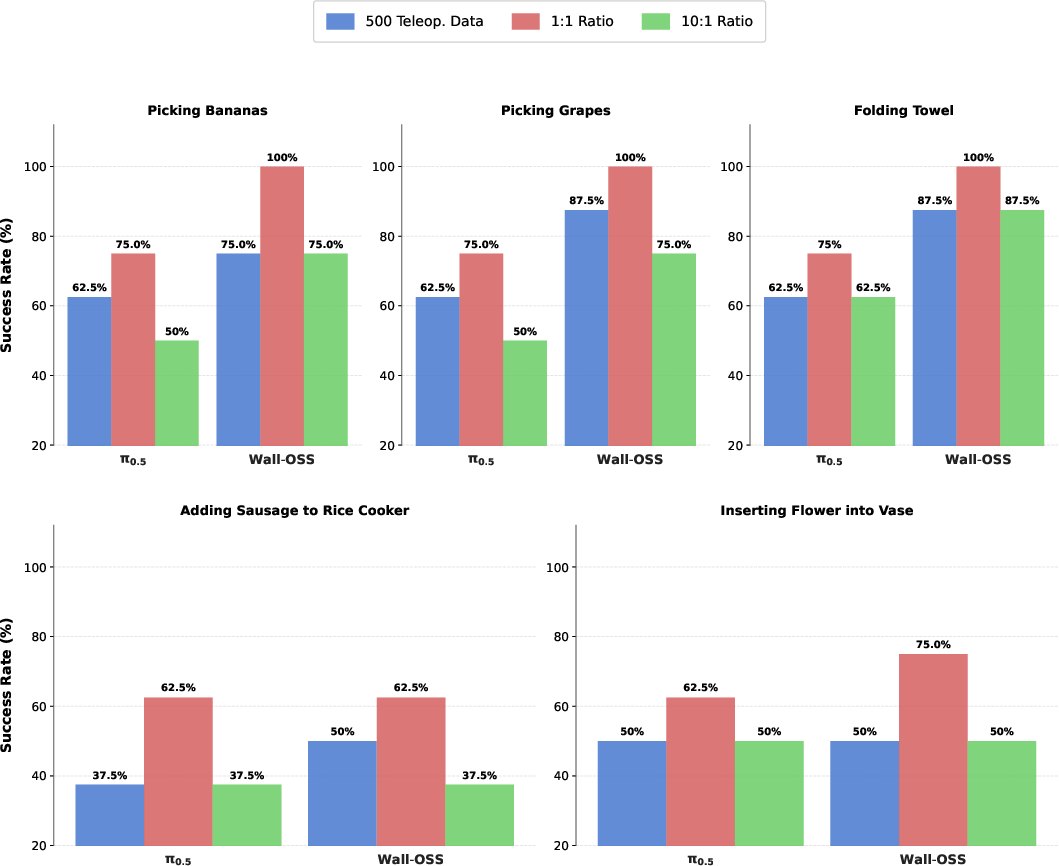
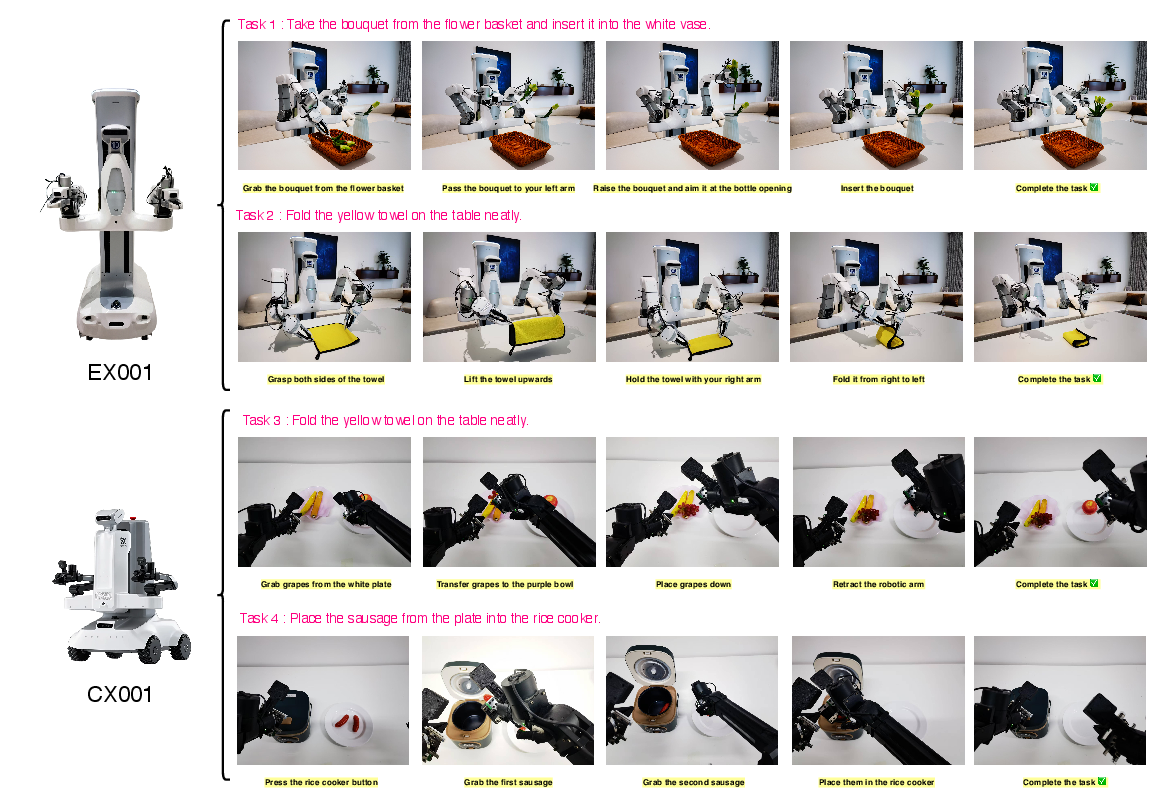
Figure 7: Data mixing experiments show that 90% cost substitution with robot-free data incurs no performance drop when anchored with a small volume of real-robot trajectories.
Qualitative experiments on structurally disparate robots confirm stable, zero-shot transfer using policies trained with all mixing ratios, reliably executing intricate behaviors such as dexterous manipulation, tool use, and handling of highly deformable objects.
Implications and Future Prospects
XRZero-G0’s results have both practical and theoretical import. Practically, the demonstrated 20× reduction in real-robot data requirements alongside robust performance scaling directly enables democratized embodied policy learning for organizations without extensive hardware infrastructure. The closed-loop quality regime ameliorates the recurrent brittleness in prior human-centric datasets, while modular, ergonomic interfaces offer extensibility to future sensor fusion (tactile/auditory) and further miniaturization.
Theoretically, the findings affirm that:
(1) Large-scale, morphologically diverse human demonstrations—when rigorously verified—are sufficient to drive direct cross-embodiment policy learning;
(2) A small fraction of embodiment-specific anchoring data is adequate for task transfer without catastrophic distribution shift or spatial overfitting;
(3) Data scaling laws and mixing ratios can be operationalized for resource-constrained settings.
As embodied policies progress toward end-to-end world modeling and long-horizon cognition, the G0-Dataset structure and pipeline exemplified here provide the fundamental data infrastructure for open-world generalization, robust spatial invariance, and policy pre-training across arbitrary morphologies.
Conclusion
XRZero-G0 advances the field of dexterous robotic manipulation by solving the core data bottlenecks through hardware-software codesign. The system achieves record data throughput, high fidelity (85% validity), ergonomic usability, and empirically validated data mixing strategies that enable massive cost reduction and stable cross-embodiment transfer. This framework authoritatively demonstrates that the era of scalable, cost-efficient, and robust robot-free data for generalist policy learning is operationally attainable, paving the way for broader deployment of embodied intelligence in practical environments.
(2604.13001)