- The paper demonstrates a significant decline in the perceived importance of most cognitive skills for an AI-dominated future, with metacognition uniquely increasing.
- It employs a quantitative, researcher-led survey with repeated-measures ANOVA on data collected from 17 undergraduate computing students.
- Findings suggest a curriculum gap where students may over-rely on AI, risking the atrophy of essential cognitive competencies.
Perceived Importance of Cognitive Skills Among Computing Students in the Era of AI
Study Motivation and Context
The proliferation of generative AI and LLM-based tools within both educational and professional environments has introduced a paradigm shift in computing education. While the potential for AI-enabled cognitive offloading is acknowledged, there is scant empirical research on how upcoming professionals perceive the relevance of foundational cognitive skills in an AI-rich context. The investigated work empirically interrogates this perception gap, focusing on undergraduate computing students and their anticipated valuation of eleven core cognitive skills across three time frames: pre-AI, present, and an imagined, more AI-integrated future (2604.10730).
Methodology
A quantitative, researcher-moderated, within-subject survey methodology was deployed among 17 undergraduate computing majors (sophomores or higher) at a US research university. The controlled protocol was structured into discrete steps: (i) demographic survey, (ii) cognitive skill definition induction, (iii) importance rating for current, past (pre-LLM), and future (more AI-integrated) professional contexts. Cognitive skills were explicitly defined to reduce misunderstanding and standardize interpretation during rating.
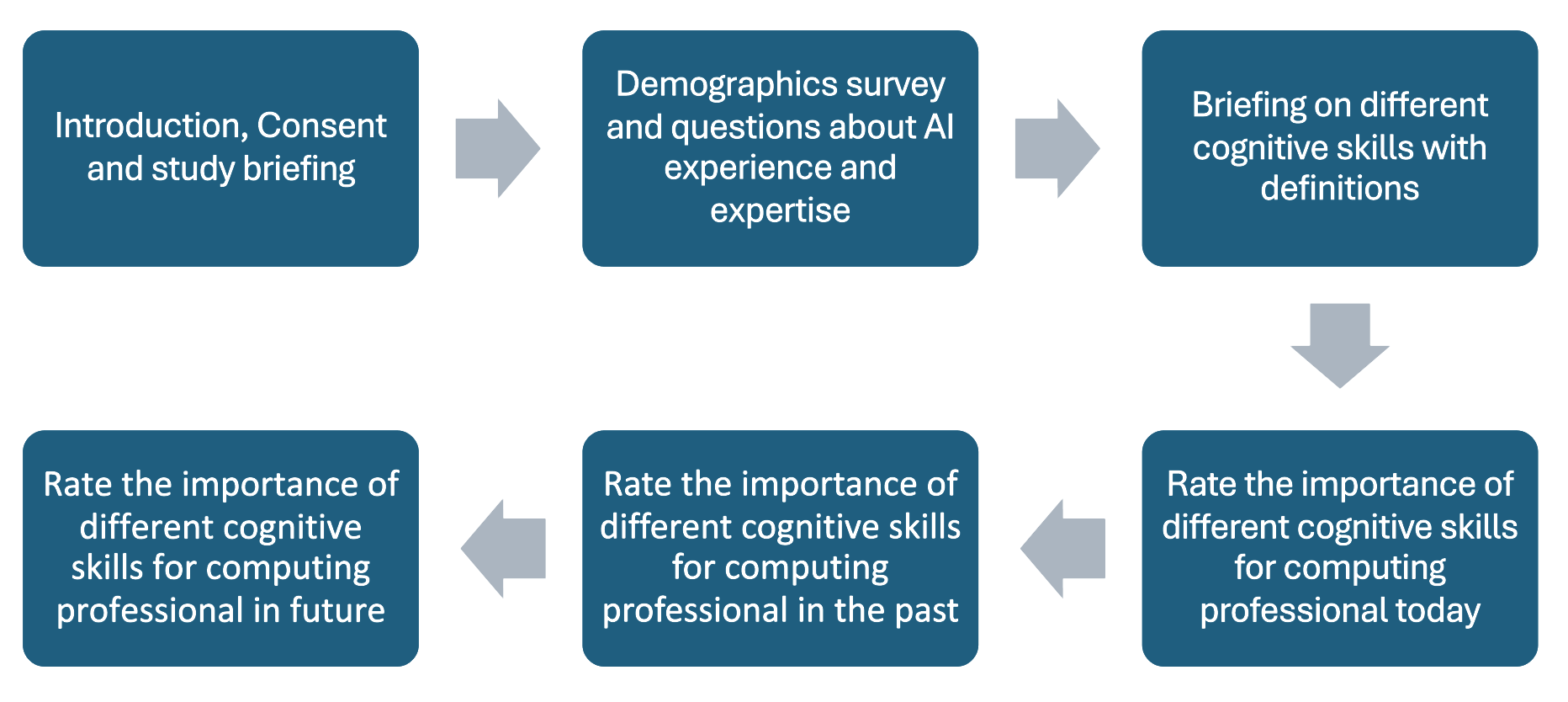
Figure 1: The controlled, session-based survey protocol used to gather perceived importance ratings across three temporal contexts.
Findings: Perception of Cognitive Skills Across Time
Descriptive statistics and repeated-measures ANOVA were used for analysis. Present-day ratings indicated that all eleven cognitive skills are currently perceived as important (all means >6, scale 1–10), with problem solving (mean=9.29, SD=1.26), abstract reasoning (mean=9.23, SD=0.83), and critical thinking (mean=9.11, SD=1.11) receiving the highest ratings. The lowest-rated, though still above median, were working memory (mean=6.47, SD=1.58), metacognition (mean=7.00, SD=1.80), and creativity (mean=7.11, SD=2.34).
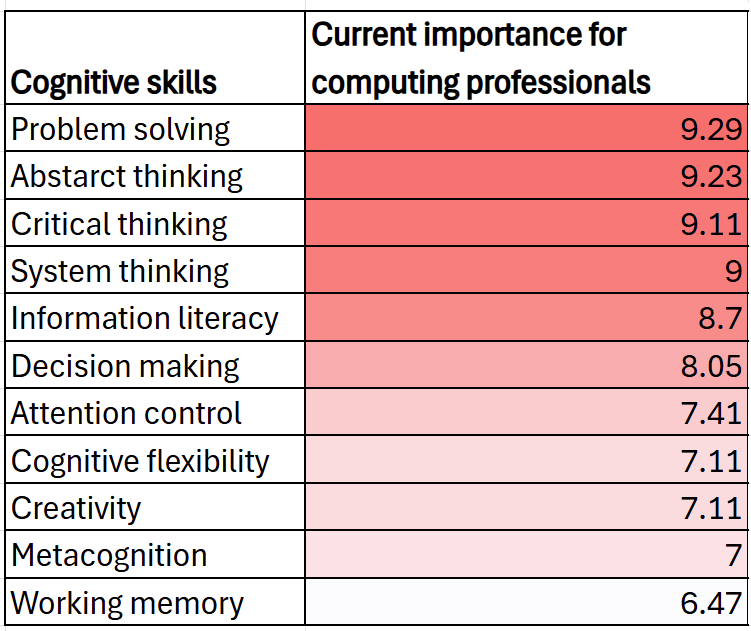
Figure 2: Mean cognitive skill importance ratings in the present for undergraduate computing students; higher heatmap gradient indicates greater perceived importance.
More critically, the study demonstrates a statistically significant decline in the perceived importance of most cognitive skills in the AI-dominated future scenario. Notably, the following skills showed pronounced reduction:
- Problem solving: from a mean of 9.52 (past) and 9.29 (present), plunging to 6.52 (future), p < .001.
- Abstract reasoning, working memory, cognitive flexibility, information literacy, and systems thinking also showed significant declines (all p < .05).
- Contrarily, metacognition was the single cognitive skill whose mean importance increased in the AI-integrated future (from 7.58 in the past/present to 8.05 in the future, p = .04).
- Critical thinking, decision making, attention control, and creativity exhibited more modest or no significant changes over time, though the direction was generally downward except for creativity (slight, nonsignificant future increase).
Discussion and Theoretical Implications
The findings present a contradiction to prevailing educator and workforce narratives, which hold that cognitive skills such as problem solving, systems thinking, and information literacy are enduring competencies, if not heightened in criticality, under increasing AI integration. Computing students, however, anticipate much less reliance on their own problem-solving and reasoning faculties, suggesting expectations of pervasive AI outsourcing. This cognitive offloading is particularly salient for working memory and information processing skills—aligning with cognitive psychology literature warning of skill atrophy through overreliance on externalization.
The singular exception—an increased future emphasis on metacognition—is noteworthy. This suggests a recognition, among students, of the growing necessity to monitor and regulate their use of AI-mediated processes, possibly as a form of adaptive self-awareness required to collaborate effectively with intelligent systems.
A subtle, residual importance attached to critical thinking and decision making points to student intuition that certain higher-order skills remain resilient to automation due to their role in evaluating, selecting, and integrating AI-generated output. Still, this adjustment is minor relative to the more robust declines observed elsewhere.
Practical Implications and Future Directions
These empirical results suggest that curriculum designers, pedagogical researchers, and industry stakeholders face a latent risk: student undervaluation of cognitive skills essential to robust, ethical, and adaptable professional performance. If these trends generalize, future cohorts of computing professionals may enter the workforce with the expectation (and habit) of over-delegating to AI, without retaining critical internalized competencies for assessment, innovation, and conceptual navigation of complex systems.
Educational interventions are warranted to explicitly scaffold and reinforce cognitive skill development within AI-rich learning ecosystems, possibly embedding metacognitive training to sensitize students to the epistemic limitations and operational fallibilities of AI systems.
Researchers are urged to extend this work with longitudinal field data (beyond self-reported perception), triangulate with instructor and industry views, and examine to what extent perceived non-importance translates into diminished actual proficiency. Objective behavioral measures and manipulation studies involving real-world AI tool use are promising next steps.
Conclusion
This study identifies a significant perception gap among undergraduate computing students, who anticipate marked decreases in the future importance of virtually all cognitive skills except metacognition, under conditions of advanced AI integration. The apparent readiness to offload core thinking tasks to AI signals a potential misalignment with the competencies required for meaningful, adaptive, and responsible computing practice. Theoretical implications challenge assumptions about digital-era cognitive priorities, and practical implications underscore the need for reinforced curricular emphasis on those skills students believe are obsolescing but which remain essential amid ongoing AI proliferation.

