- The paper introduces a novel methodology using manifold learning and persistent homology to visualize and analyze attractor landscapes in Neural Cellular Automata.
- It demonstrates how both macroscopic dynamics and intricate microscopic cell behaviours contribute to the emergence of stable attractor cycles.
- The study bridges gaps in interpretability for differentiable CA models, paving the way for reliable deployment in adaptive computational systems.
Visualising the Attractor Landscape of Neural Cellular Automata
Introduction
The investigation of interpretability in Neural Cellular Automata (NCAs) is increasingly critical, as these systems transition from abstract models of morphogenesis to practical frameworks in computational biology, adaptive computation, and artificial life. The opacity intrinsic to black-box neural NCA update rules complicates mechanistic understanding and prevents rigorous confidence in their operational behaviours. This paper introduces a technical methodology for visualising and analysing the attractor landscape of NCAs, employing state-of-the-art manifold learning and topological data analysis to interrogate both global (macroscopic) and cell-level (microscopic) system dynamics (2604.10639).
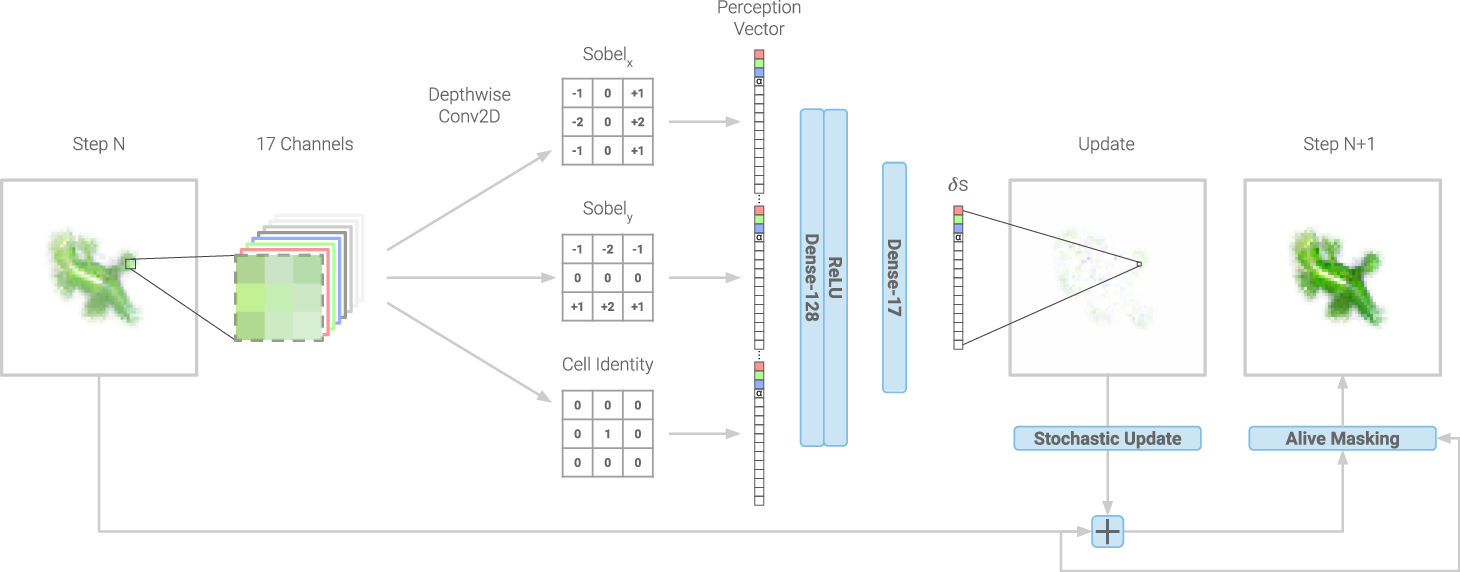
Figure 1: Schematic of the NCA update step, depicting the composition of the neural update operation and network structure.
The NCA generalizes classical cellular automata by replacing discrete update rules with differentiable, parameterized neural networks. Each cell maintains a real-valued state vector, and update dynamics are spatially local through convolutions and parametric reaction terms. The CA morphogenesis task can thus be formulated as partial differential equation parameter learning, where the NCA is trained to produce target macroscale patterns (e.g., the canonical gecko example) or self-organising textured outputs from seed states. Differentiability enables backpropagation-based optimization of behaviour, but forfeits interpretability present in rule-based automata.



Figure 2: Examples of classic and texture target patterns used in NCA training, spanning static shape morphologies and dynamic, structured textures.
Macroscopic and Microscopic State Representations
The NCA state space, both at the grid and cell level, is nominally very high-dimensional; however, typical system dynamics are believed to evolve on low-dimensional, structured manifolds. Macroscopic analysis vectorizes the full grid at each timestep, while microscopic analysis instead considers the time evolution of individual cell state vectors.
Dimensionality Reduction Techniques
Principal Component Analysis (PCA), dense and sparse autoencoders (AEs and SAEs), and parametric UMAP are leveraged for manifold learning. While PCA efficiently identifies linear structure, autoencoders (especially non-linear, convolutional, and sparse variants) are essential for reconstructing non-linear attractor geometry and identifying underlying compositional features learned by the system.
Topological Data Analysis via Persistent Homology
Persistent homology (PH) is used to robustly characterize the topology (such as the number of connected components H0, cycles H1, and voids H2) of embedded attractor manifolds, immune to linear projection artifacts and noise perturbations. PH diagrams provide topological ground truth, distinguishing between genuine cycles and artifacts of projection or sampling.

Figure 3: Illustration of persistent homology: constructing a persistence diagram by growing neighborhoods around data points and monitoring cycle and void births/deaths as radius increases.
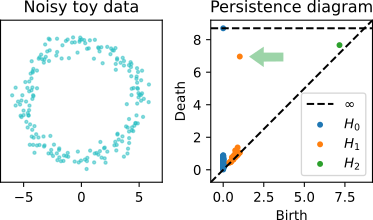
Figure 4: Example persistence diagram, highlighting a robust cycle feature amidst noisy, short-lived topological transients.
Empirical Results
Macroscopic Attractor Landscapes
Analysis of the blue/green gecko NCA, trained to alternate morphologies in response to external cues, reveals critical changes in system dynamics after a transition epoch (∼4000). Loss dynamics, latent space trajectories, and persistence diagrams jointly confirm the emergence of a stable cycle linking two distinct attractors—corresponding to the green and blue gecko states.
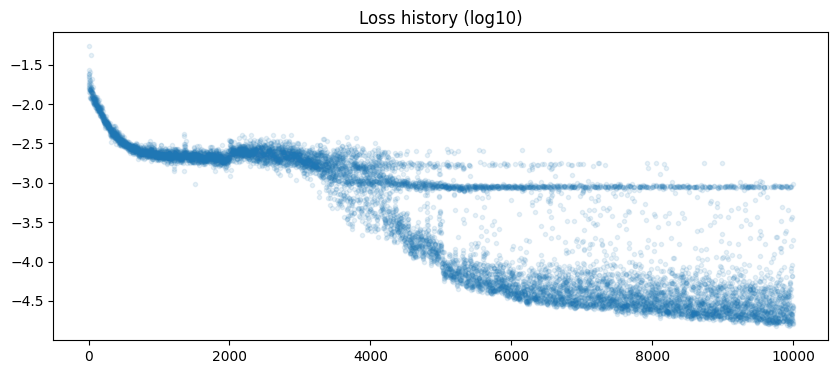
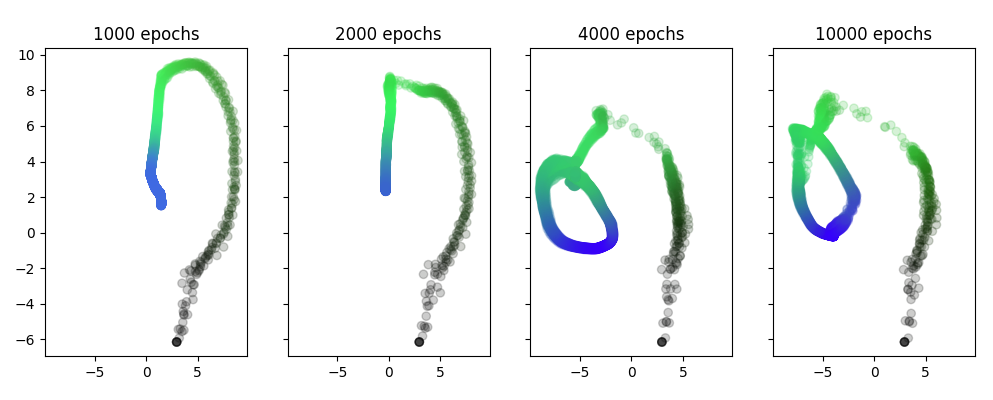
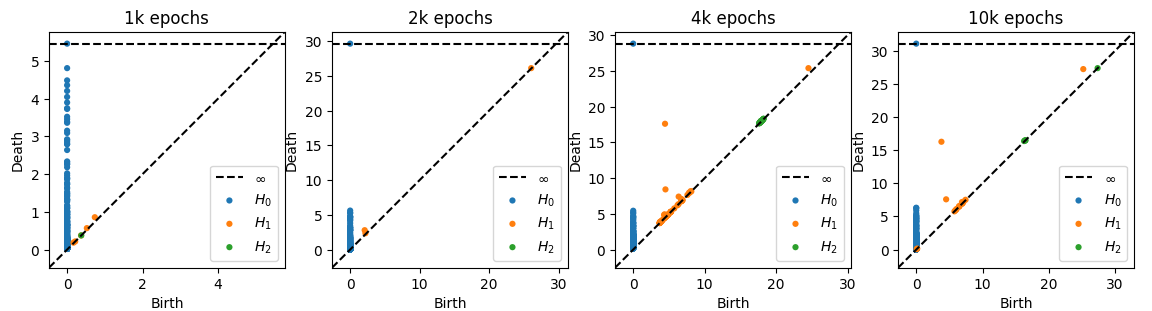
Figure 5: Evolution of training: (top) loss curve with critical transition, (middle) autoencoder latent space at different training stages, and (bottom) persistent homology revealing emergence of a cycle post-transition.
Robustness and Perturbation
Perturbation experiments assess the system’s resilience: following a destructive reset (cell zeroing), the global attractor landscape reliably reforms, and the state returns to an attractor. However, the possibility of attractor switching (returning to green from blue) is observed, validated by vector field analysis in latent space, which delineates the stable basins of attraction and system response directionality.
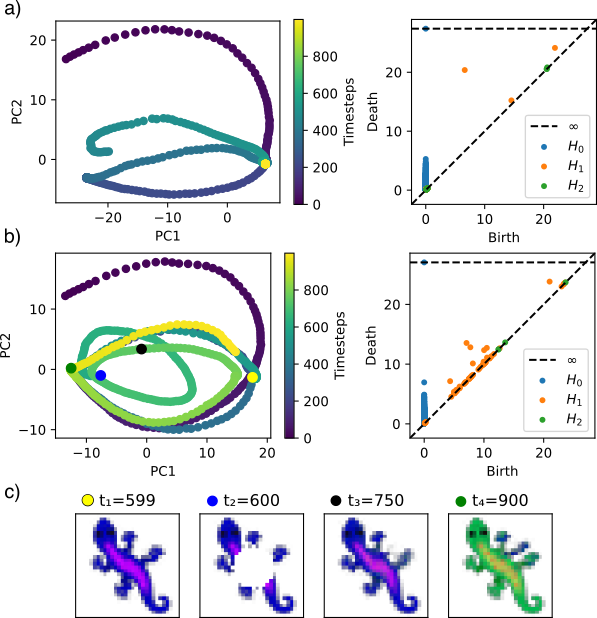
Figure 6: System response to perturbation—manifold trajectories and PH analysis reveal return to attractor structure.
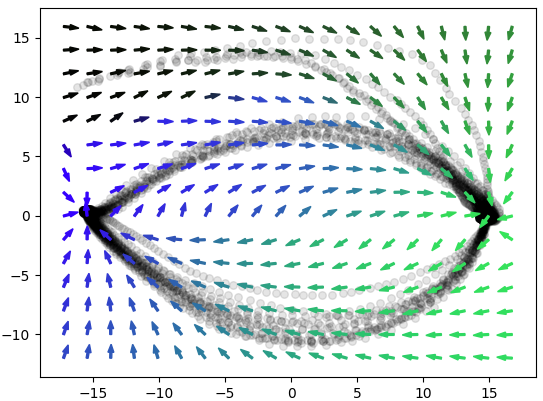
Figure 7: Latent space vector field, showing dynamical flows and regions of attraction for the NCA system.
Microscopic Complexity
At the per-cell level, the attractor landscape is conspicuously more intricate. Autoencoder mapping of individual cell states exhibits a fragmented, multi-cluster structure, indicative of many localized attractors imposed by spatial heterogeneity and neighborhood effects.
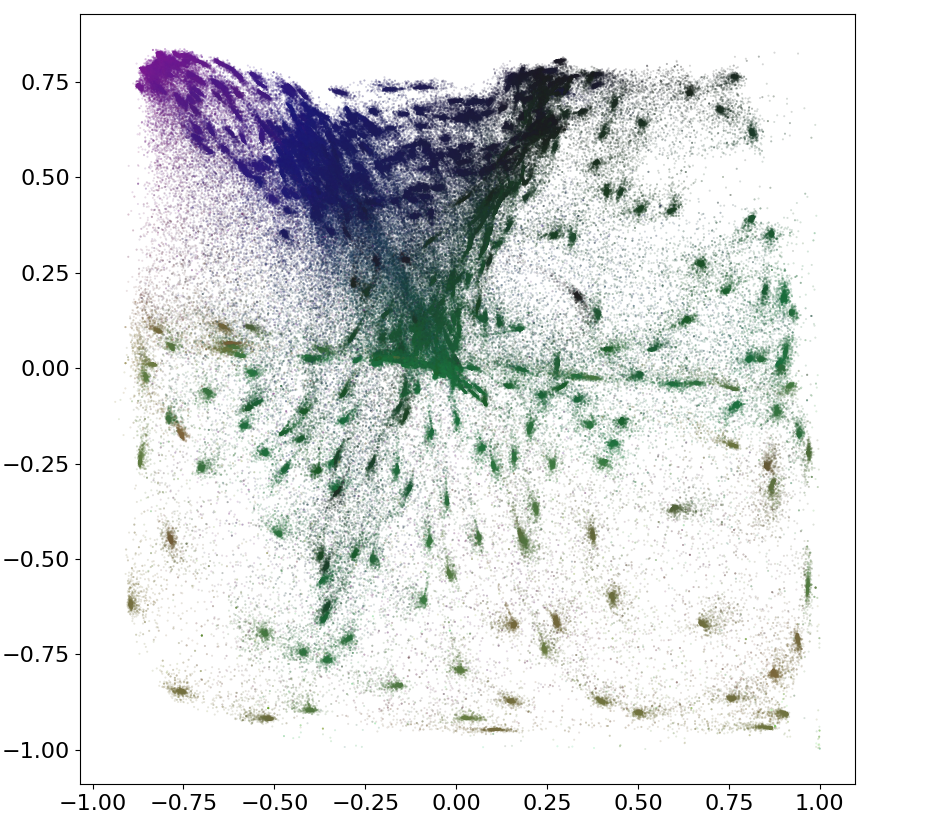
Figure 8: Autoencoder-decomposed microscopic latent space for cell states in the gecko NCA, showing multiple localized attractor clusters.
Sparse feature decomposition via SAE constitutes a critical methodological contribution, demonstrating that aggregation (mean feature vector across cells per frame) re-capitulates global behavioural cycles observed at the macroscopic level, reconciling the one-to-many relationship between local cell dynamics and macro patterns.
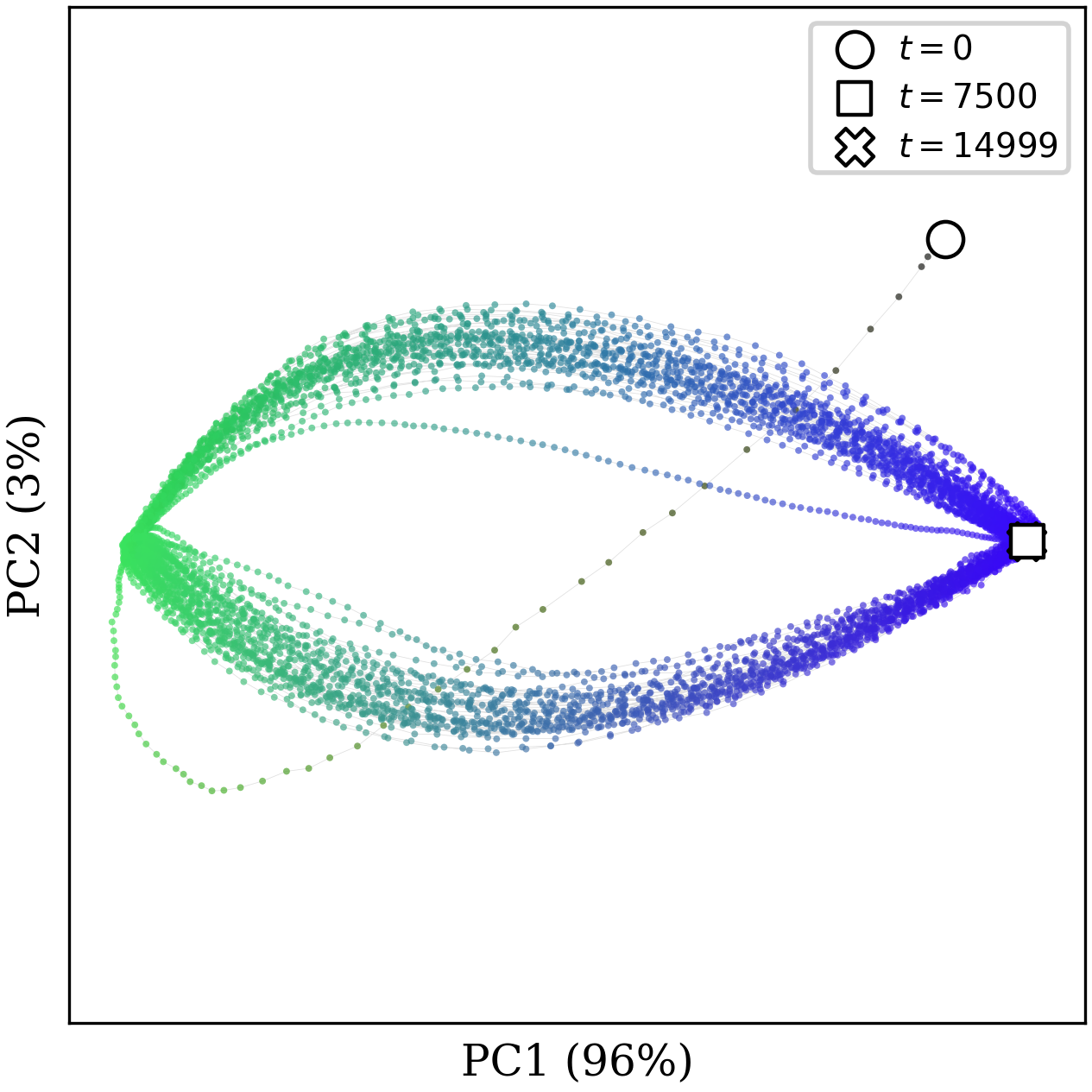
Figure 9: SAE per-frame manifold: mean aggregated cell features projected via PCA, recovering the global attractor topology.
Texture NCAs and Topological Detection
For NCAs trained on structured textures, PH analysis on appropriately, spatially-consistent subsamples reveals toroidal topology (two cycles, one void), aligning with the periodic structure of the generated pattern. Full data PH analysis is undermined by sampling sparsity and noise, highlighting limitations and constraints of computational topology in ultra-high dimensional settings.
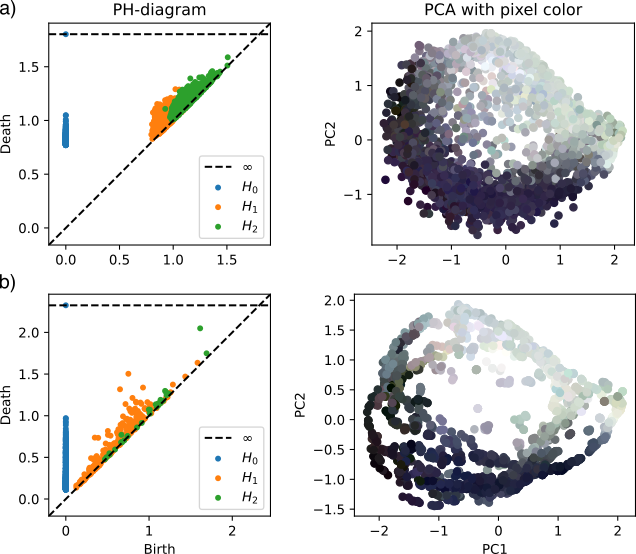
Figure 10: Comparison of persistence and PCA projection for full substrate vs. subsampled data in texture NCA; toroidal topology emerges only in well-sampled subsamples.
Implications and Theoretical Significance
This work rigorously demonstrates that top-down manifold learning, coupled with persistent homology, provides a robust framework for analysing attractor landscapes in black-box, differentiable CA models. The macroscopic state space of NCAs trained for regular tasks is demonstrably low-dimensional, with clear attractor geometry, whereas local dynamics are much richer and can exhibit compositional structure highly dependent on task complexity, training regime, and representational capacity. The introduction of SAEs as cell-state feature decomposers enables an overview of global and local perspectives, providing new avenues for mechanistic interpretability.
These findings suggest a path towards formal verification and reliable deployment of NCA-based systems in settings requiring stringent behavioural guarantees. Additionally, the pipeline outlined offers concrete tools for future work in explainable self-organising systems and developmental artificial intelligence.
Conclusion
Dimensionality reduction and persistent homology facilitate a nuanced, quantitative, and visual exploration of NCA attractor landscapes at multiple levels. Through these analyses, conventional interpretability limitations of neural-based morphogenetic models are substantially alleviated, offering principled insights into learned dynamics, robustness, and emergent organisation. This approach is instrumental for the responsible engineering of NCAs and, by extension, other high-dimensional, self-organising dynamical systems. Future directions will encompass extensions to more complex tasks, richer environmental interactions, and integration with formal verification methods.

