- The paper introduces the Neuro-Symbolic Delta (NS-Δ), a first-order analytic decomposition that quantifies each atomic query's marginal contribution within fused embeddings.
- It defines manifold-aware Boolean operators (AND, OR, NOT) that adjust for semantic bottlenecks, enhancing precision in complex logical queries.
- Empirical results show NSFL improves mean average precision by up to 81% and further boosts state-of-the-art models by an average of 20%.
NSFL: Neuro-Symbolic Fuzzy Logic for Post-Training Boolean Logic in Neural Embeddings
Dense neural embeddings are foundational in retrieval systems, yet they notoriously lack native mechanisms for compositional Boolean reasoning—AND, OR, NOT—necessary for multi-atom logical queries. Standard approaches to combining concepts via vector fusion result in additive semantic effects, but do not enforce crisp set operations. Prior work in Neuro-Symbolic AI and fuzzy logic has either relied on in-training optimization (e.g., Logic Tensor Networks, LogiCoL) or geometric region-based embeddings (e.g., Query2Box, BetaE), at significant computational or architectural cost. NSFL directly addresses these limitations by offering a post-training, training-free framework that imbues arbitrary encoder spaces with rigorous, order-aware logical calculus.
Neuro-Symbolic Delta and Semantic Calculus
The essential innovation is the Neuro-Symbolic Delta (NS-Δ): a first-order analytic decomposition quantifying the marginal contribution of each atomic query to the fused embedding. Instead of relying solely on zero-order similarity scores (cosine similarity to atomic or fused embeddings), NSFL computes the semantic gradient (delta) induced by fusion. This enables isolation of individual atomic impact within composite queries, overcoming the signal dilution and representation collapse endemic to convex aggregation in dense representational spaces Figure 1.
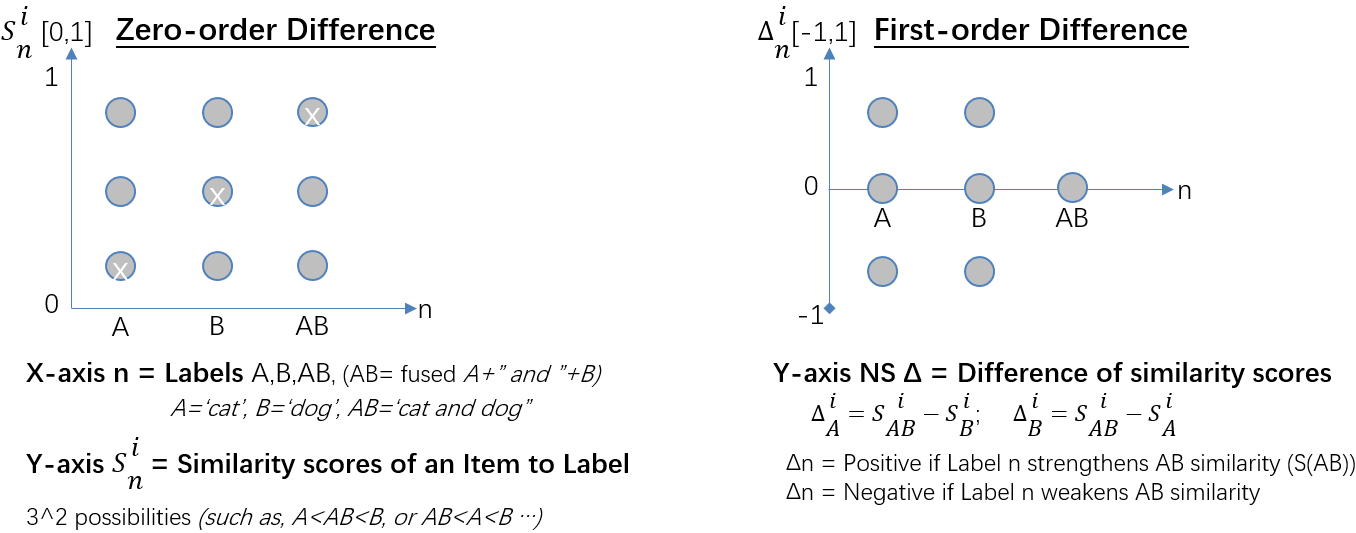
Figure 1: Comparison of zero-order similarity scores and first-order Neuro-Symbolic Deltas across retrieval candidates.
Empirically, NS-Δ reveals that the "weaker" atom (lowest marginal similarity) serves as the dialogic constraint—termed the semantic bottleneck—governing logical validity. This phenomenon has strong geometric justification, as intersection (AND) and exclusion (NOT) operations are asymmetric with respect to atomic contributions, and classical fuzzy logic's monotonicity is routinely violated in uncalibrated neural spaces.
Manifold-Aware Logical Operators
NSFL formally defines Boolean operators as manifold-aware, order-sensitive scoring functions:
- AND (A∧B): Re-ranks by boosting the marginal contribution of the bottleneck atom, leveraging the parametric Hamacher t-norm and non-compensatory formulation. Syncretic states (superadditive fusion) preserve native co-occurrence reward; otherwise, delta amplification enforces logical intersection.
- NOT (A∧¬B): Subtracts the delta of B from the base score of A, effectively pruning semantic noise via an inhibitory steering mechanism. Smoothed variants normalize penalty strength based on local confidence.
- OR (A∨B): Extends Zadeh's t-conorm to include fused and monolithic representations, accounting for superadditivity and maintaining stability via boundary noise floors.
Each operator incorporates empirically-motivated boundary stability criteria, preventing hallucinated logical outputs in edge cases where the embedding space lacks relevant semantic grounding.
Spherical Query Optimization for Efficient Deployment
To reconcile logical calculus with the constraints of approximate nearest neighbor search (ANNS), NSFL introduces Spherical Query Optimization (SQO). Logical formulas are mapped to differentiable scoring functions and projected onto the unit hypersphere via Riemannian Stochastic Gradient Descent. This yields an optimized query vector compatible with standard ANNS indices, providing a practical accuracy-latency trade-off—reranking offers maximal logical precision, while SQO enables sub-millisecond deployment in latency-critical environments.
Empirical Validation and Strong Numerical Results
Evaluations on QUEST (text-to-text) and COCO-LOGIC (text-to-image) benchmarks, spanning six encoder architectures and two modalities, demonstrate consistent and notable gains:
- NSFL improves mean average precision (mAP) up to 81% on challenging logical templates.
- Even when applied atop state-of-the-art, logic-fine-tuned models (e.g., LogiCoL-E5v2), NSFL achieves further improvements of 20% on average and up to 47% for complex compositions.
- Inhibitory and disjunctive logic templates exhibit stronger gains and absolute scores than conjunction, elucidating the limitations of strict intersection in current models.
The additive nature of NSFL's gains across pretrained and fine-tuned encoders confirms its orthogonality to model training and its operational applicability as a post-hoc logical correction layer.
Theoretical and Practical Implications
NSFL proffers a unified mathematical framework for logical operations in high-dimensional embedding spaces, bridging the gap between symbolic reasoning and sub-symbolic representation. By isolating atomic semantic deltas and enforcing manifold stability, NSFL preserves context integrity, prevents representation collapse, and enables dynamic scaling without architectural modification or retraining.
Practically, the approach is agnostic to encoder architecture and post-training, making it widely deployable. The low computational overhead of reranking and SQO further broadens its usability in production retrieval systems.
Theoretically, NSFL lays the groundwork for future research in learned manifold logic and dynamic scaling, addressing open problems such as the conjunction gap and adaptive coefficient tuning.
Limitations and Paths Forward
While inhibitory and disjunctive operators benefit substantially from NSFL's calculus, conjunction templates remain the weakest performers, constrained by the strict requirement of simultaneous satisfaction and signal attenuation in fused representations. Adaptive scaling and encoder-specific optimization are promising avenues for addressing this gap.
As a post-hoc method, NSFL inherits the biases and limitations of the underlying encoder. Ethical deployment must encompass bias auditing, particularly for NOT operators in underrepresented demographic contexts.
Conclusion
NSFL constitutes a robust, post-training framework for Boolean logical reasoning in neural embeddings, achieving substantial retrieval improvements across multiple modalities and encoder configurations. Its empirical and theoretical contributions underpin a scalable, mathematically rigorous bridge between symbolic and neural reasoning. Future work should focus on adaptive scaling for conjunctions, integration with learned coefficients, and broader benchmarking in complex multi-condition IR scenarios.