- The paper introduces a deterministic Minkowski sum method to engineer spatially correlated atomic arrays for subradiant state creation.
- It employs spectral analysis of nested dimer and periodic structures to reveal regimes with sharply defined dark states and disorder resilience.
- The work outlines pathways for scalable quantum memory designs through modular and hierarchical array constructions in waveguide QED.
Subradiance Engineering via Minkowski Sum-Generated Nested Atomic Arrays
Introduction
The study systematically investigates robust collective subradiant states in one-dimensional (1D) waveguide quantum electrodynamics (QED) by leveraging deterministic atomic array design using Minkowski sum constructions. The proposed methodology enables the creation of quasi-disordered but highly correlated atomic structures that inherit analytical tractability and offer symmetry-protected suppression of radiative decay. These results have direct implications for scalable quantum memory, coherent light storage, and circuit-QED platforms, advancing the engineering toolbox for robust quantum state manipulation in photonic systems.
Model and Method: Minkowski Sum Construction for Atom Arrays
The central approach is to employ the Minkowski sum to generate complex atomic arrays from simple 'seed' subsets, such as dimers or small chains. Given arrays X(A) and X(B), the Minkowski sum X(A)⊕X(B) produces an array where positions are indexed by all possible pairwise sums of elements from the seeds. The resulting Hamiltonian, under the Markovian approximation for single-photon excitations, acquires a block structure that reflects the hierarchical nesting of the seeds. This block structure is analytically tractable and exposes symmetries that can be harnessed for subradiant state engineering.
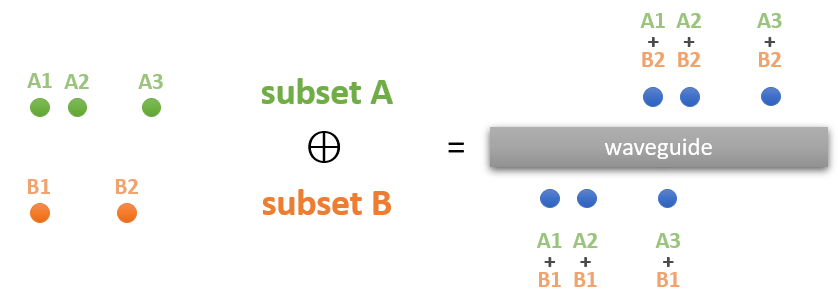
Figure 1: Atom positions along one-dimensional array obtained by the Minkowski sum of arbitrary and dimer subset arrays, yielding translated duplicates with built-in positional correlations.
The built-in positional correlations stemming from the Minkowski sum allow for mode-selective manipulation of radiative coupling. Interactions between the dark modes of seed arrays are parametrically suppressed, while bright modes retain the capacity to hybridize across the duplicates. This structure naturally leads to families of long-lived defect or interface states, and their properties are preserved or enhanced in arrays constructed with deeper levels of nesting.
Nested Dimer Arrays: Spectral Structure and Disorder Robustness
The simplest instantiation involves two nested dimers (NA=NB=2), resulting in a four-atom array with positions {0,dA,dB,dA+dB}.
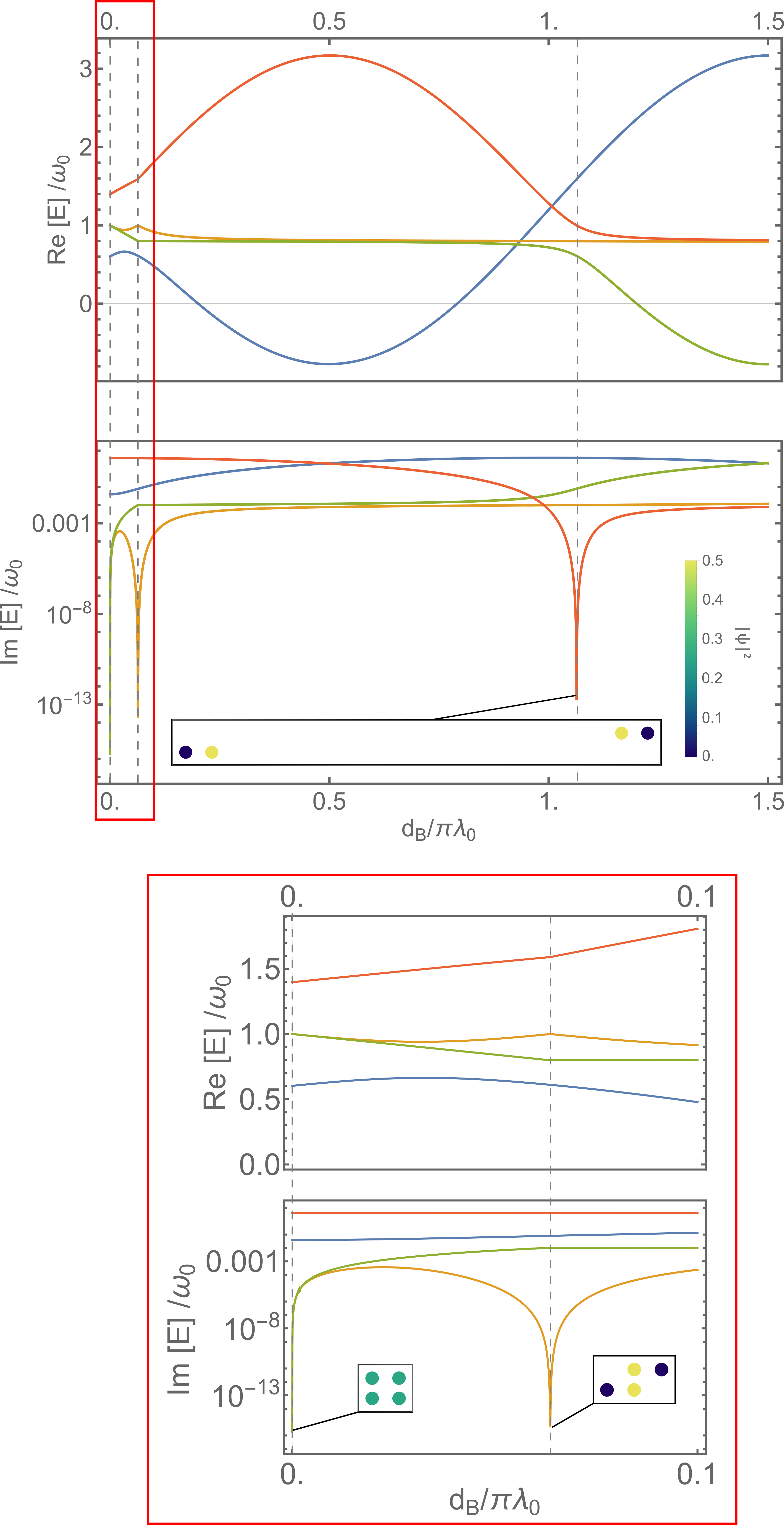
Figure 2: Real and imaginary parts of the eigenvalues of a nested dimer system for varying dB, revealing two distinct regimes based on overlap and separation.
The spectral analysis distinguishes two primary regimes:
- Regime I (dA>dB): Overlapping clusters, with sharp subradiant resonances due to spatial overlaps between atom positions. Exceptional points (dB=0 and dB=dA) yield two perfectly dark states.
- Regime II (dA<dB): Well-separated duplicate clusters, exhibiting symmetry-protected long-lived resonances at periodic intervals (X(B)0) attributable to symmetry-protected bound states in the continuum (BICs).
The lifetimes of these subradiant modes are sensitive to positional disorder. Introducing randomness to atom positions leads to a pronounced reduction in dark state lifetimes, especially as disorder approaches the shortest intra-dimer spacing scale.
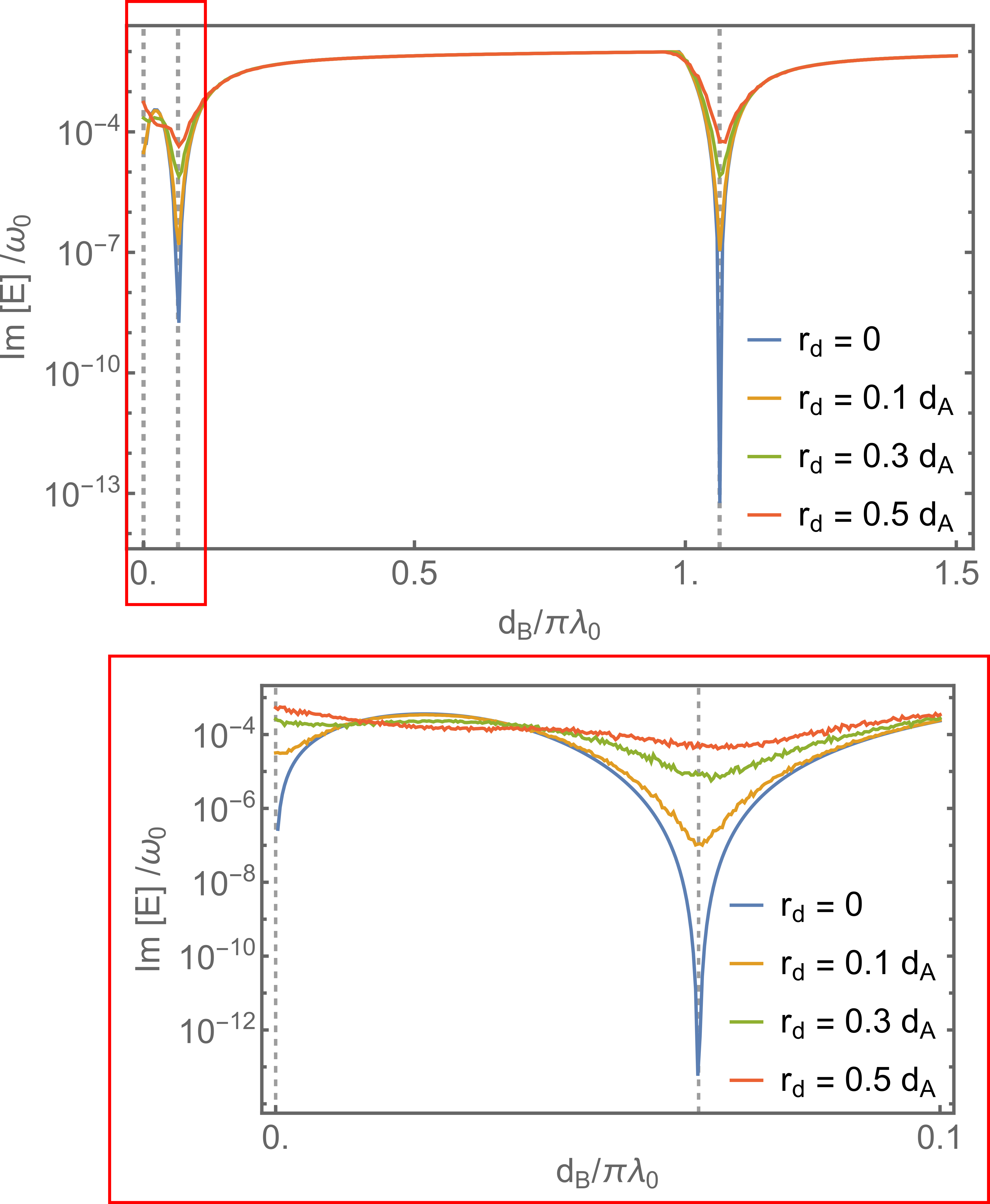
Figure 3: Average decay rate (imaginary part of the eigenvalue) of the slowest-decaying mode in a nested dimer array under increasing random positional disorder.
For moderate disorder (X(B)1), pronounced subradiant resonances persist at special X(B)2 values, whereas larger disorder erases these interference-protected features.
Nested Periodic Arrays: Extension to Larger and Cladded Structures
Extending the construction to nest a periodic subwavelength-spaced array in a dimer demonstrates the scalability of the approach. With X(B)3 and X(B)4, the resulting spectrum manifests multiple subradiant branches in addition to the pair of bright superradiant modes.
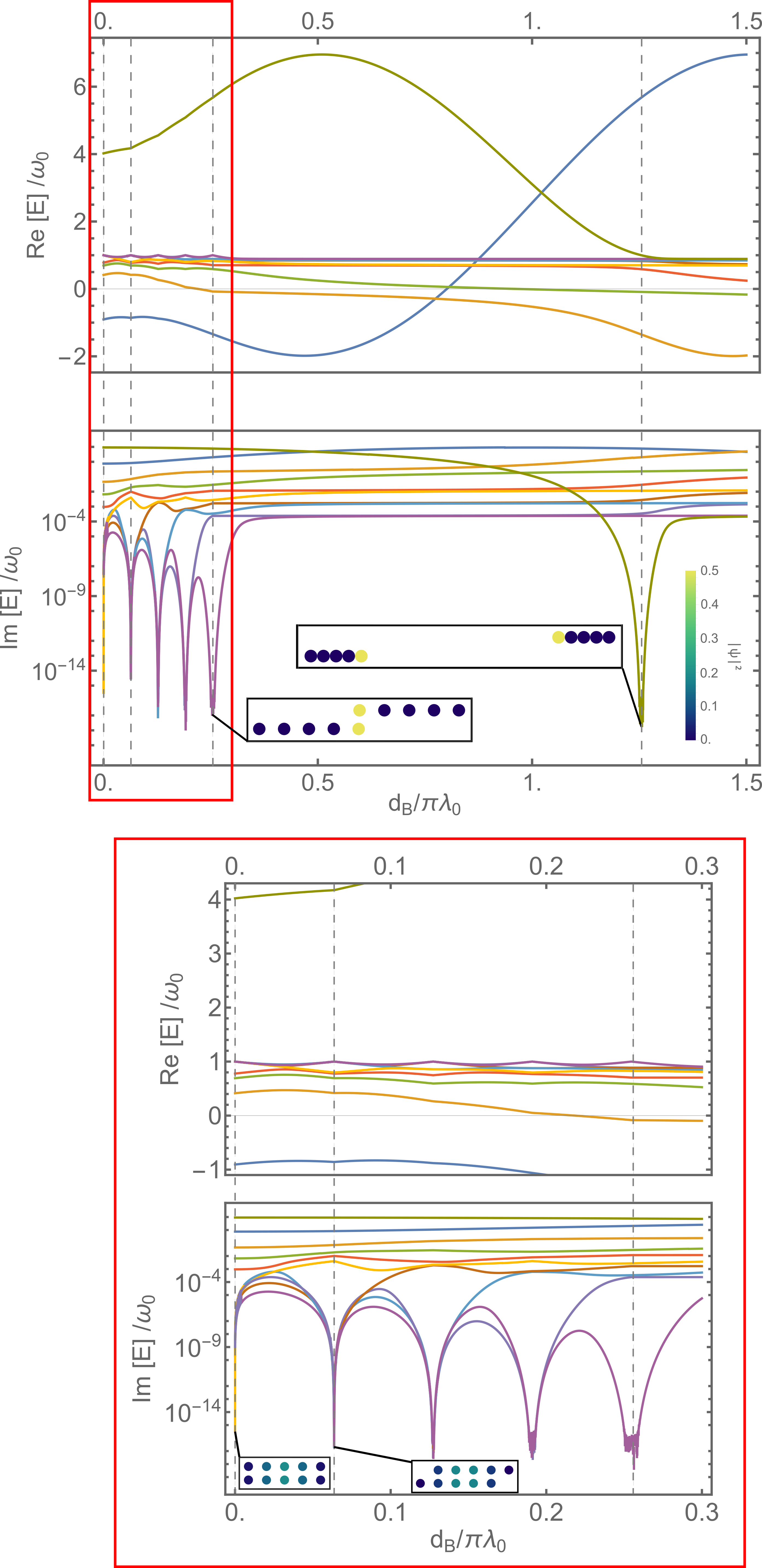
Figure 4: Spectrum of real and imaginary parts of eigenvalues for a periodic array nested in a dimer array, with bright and dark mode families distinguished and localized at interfaces.
The interplay between array overlap (regime I: partially overlapping, regime II: separated duplicates) underpins the structural origin of dark states, now aided by the presence of a 'cladding' region that acts as a photonic reflector. The localization and reflection effects of the cladding enhance the longevity and disorder insensitivity of subradiant states, as observed in the participation profiles. In regime II, defect-like subradiant modes are pinned at the interface between duplicate arrays, robustly surviving variations in X(B)5.
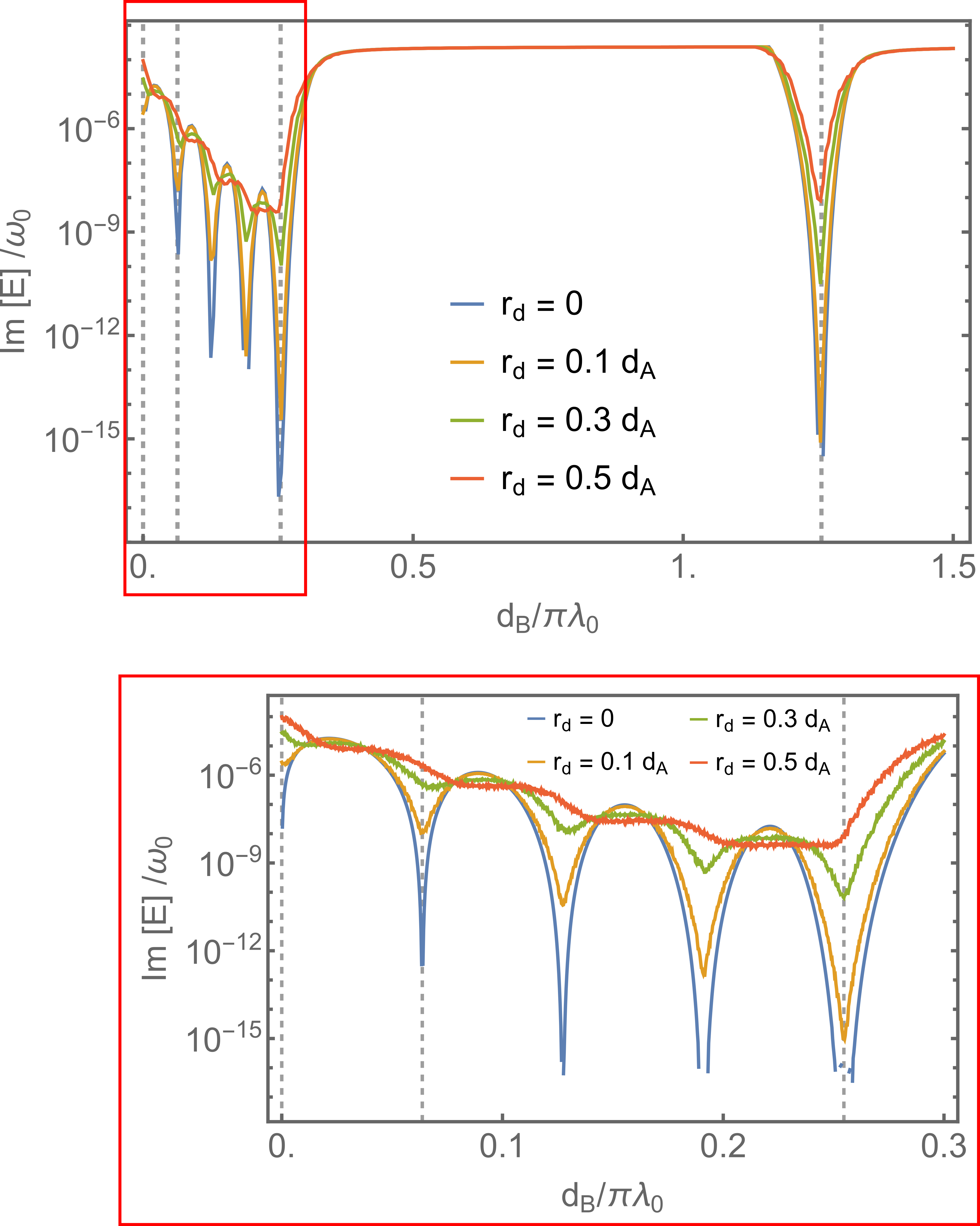
Figure 5: Average decay rate for the slowest mode in a nested periodic array under random disorder, illustrating enhanced insensitivity in overlapped and cladded configurations.
Notably, increasing the number of cladding layers with deeper or larger arrays further expands the window of disorder robustness, a critical asset for experimental scalability.
Deeper Nesting: Hierarchical Structures and Enhancement of Subradiance
Hierarchical nesting—by recursively applying the Minkowski sum to generate 'arrays of arrays'—yields additional length scales and symmetry sectors. The doubly nested dimer configuration introduces further structural complexity, yielding multiple families of subradiant modes localized at the expanded set of overlapping positions. As X(B)6 is tuned, multiple subradiant resonances appear at positions corresponding to inter-dimer or inter-cladding overlaps. The resonance windows broaden, and the density of subradiant peaks increases with nesting depth.
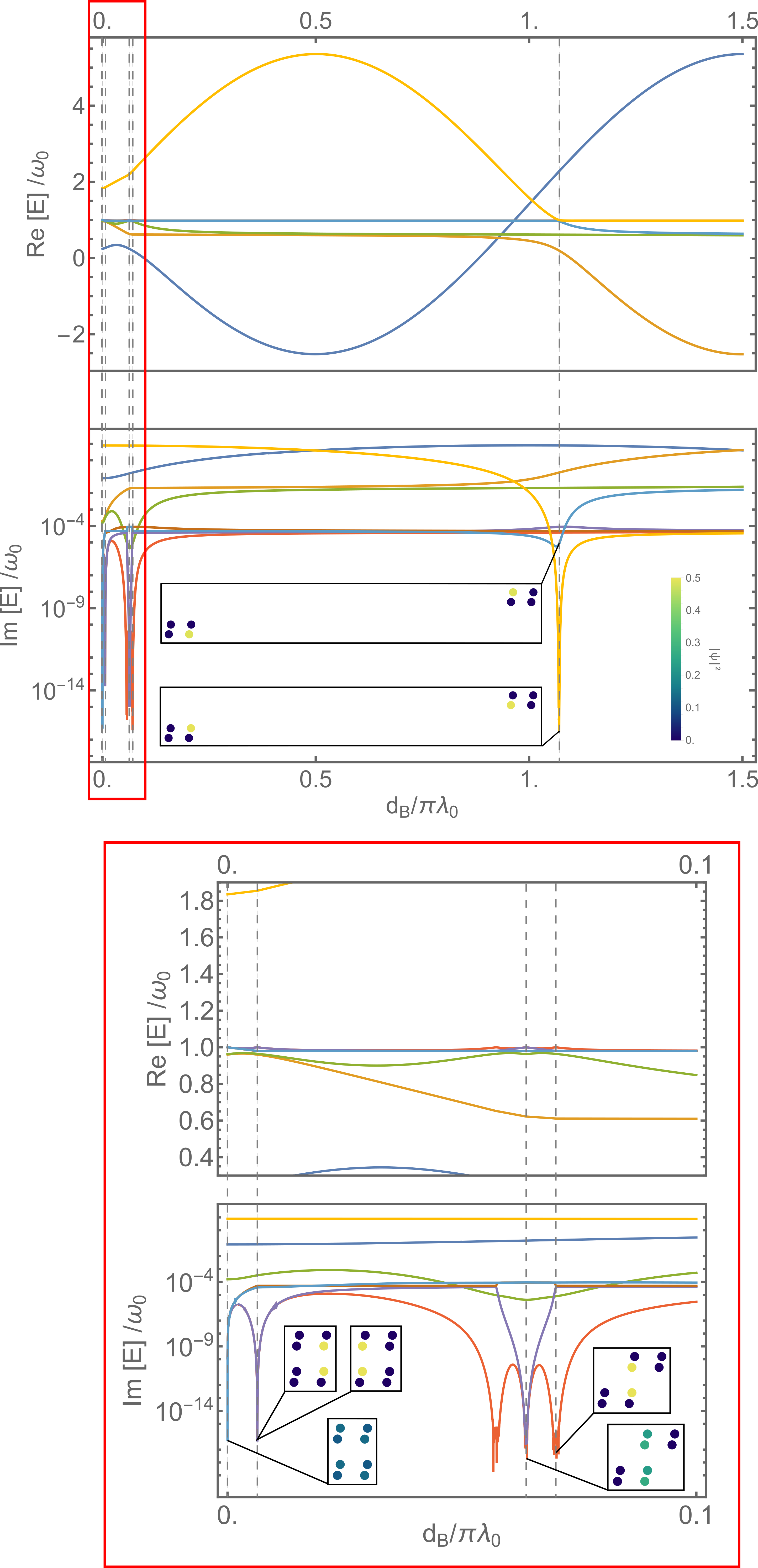
Figure 6: Spectrum for doubly nested dimer arrays, showcasing multiple long-lived subradiant mode bands and intensity profiles for notable X(B)7 locations.
The broader subradiant resonance windows in multiply nested arrays translate into increased insensitivity to moderate disorder, outperforming shallower nestings.
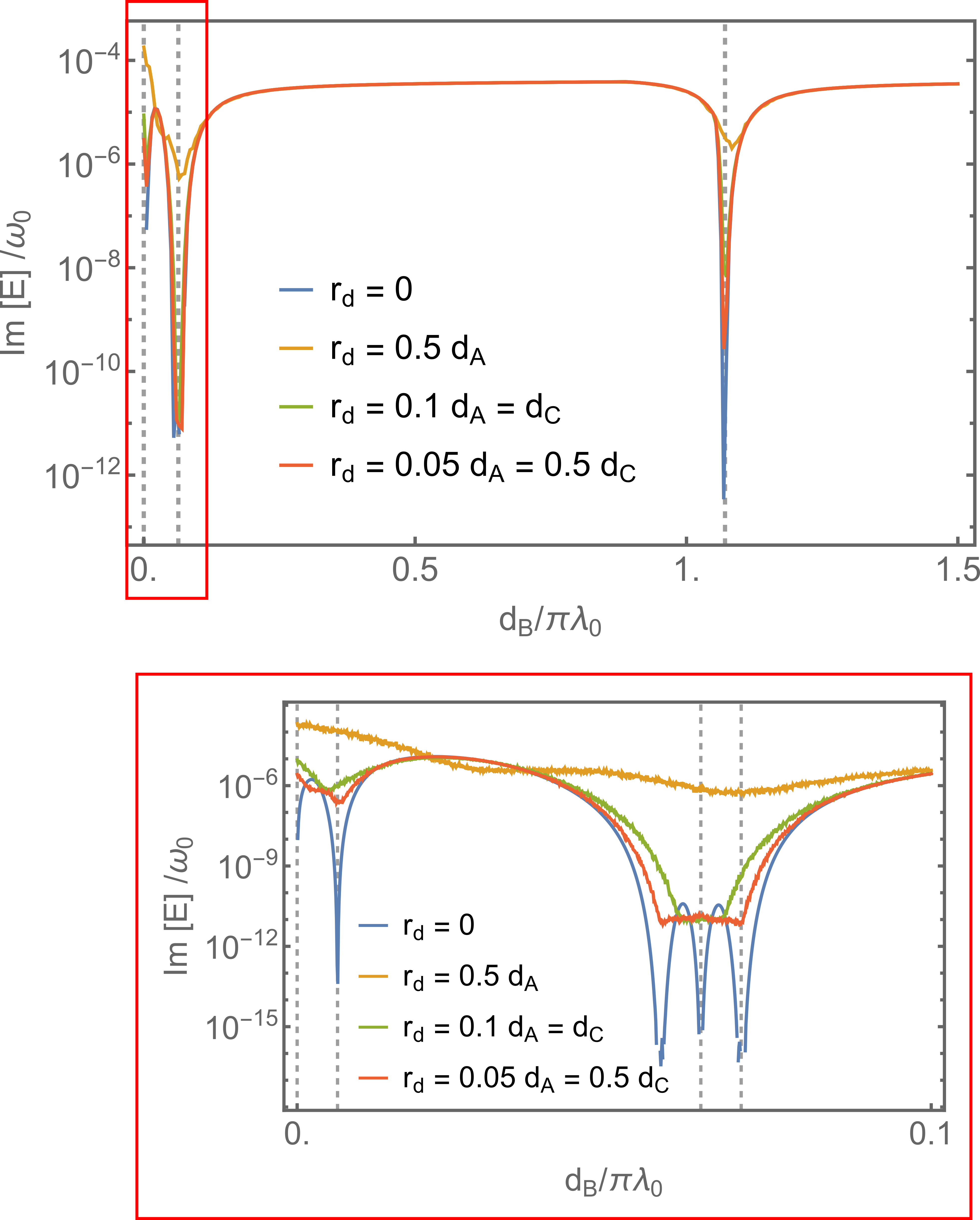
Figure 7: Average decay rate of the darkest mode in doubly nested dimer arrays versus disorder, revealing expanded windows of subradiance persistence.
The theoretical inheritance of eigenbasis structures from previous nestings allows semi-analytical control and design, facilitating systematic advancement toward arbitrarily complex, yet analytically manageable, quasi-disordered robust photonic structures.
Implications and Future Directions
This work elucidates a deterministic and modular route to interference-protected subradiance in waveguide QED, establishing a design paradigm that is resilient to moderate experimental imperfections. The block-structured Hamiltonians and explicit positional correlations derived from the Minkowski sum construction offer a versatile platform for engineering long-lived photonic bound states with tuneable localization and mode selectivity.
On the theoretical front, these developments invite immediate extensions to multiphoton sectors and investigations into the entanglement structures possible when different photons populate different subradiant modes of nested arrays. The analogy to tensor-product structures and recent advances in quantum hypergraph states and nested network models signals fertile ground for exploring higher-order and topological photonic effects in complex atomic arrays. Additionally, leveraging these findings in the context of scalable atom–waveguide and circuit-QED platforms poses a promising avenue for practical quantum memory realizations and robust quantum information transfer protocols.
Conclusion
By leveraging Minkowski sum constructions, the research offers a semi-analytic, deterministic method for the design and understanding of interference-protected subradiant and bound states in nested atomic arrays. This approach systematically controls radiative coupling by built-in positional correlations, enables hierarchical engineering of dark states, and achieves substantial robustness to moderate disorder—addressing key challenges in practical waveguide QED. The modular and scalable character of this methodology opens pathways for advanced state engineering, robust quantum memories, and programmable photonic lattices in next-generation quantum technologies.
(2604.10197)