- The paper demonstrates that ordered atomic arrays produce cooperative super- and subradiance through photon-mediated dipole-dipole interactions.
- It employs site-resolved quantum gas microscopy on subwavelength Erbium arrays to precisely map spatial coherence and non-exponential decay dynamics.
- The findings reveal power-law scaling and geometric resonance effects, offering a programmable platform for dissipative many-body quantum optics.
Many-Body Super- and Subradiance in Ordered Atomic Arrays
Introduction
The study "Many-Body Super- and Subradiance in Ordered Atomic Arrays" (2604.11795) presents site-resolved experiments on ultracold erbium atoms trapped in subwavelength optical lattices. It demonstrates that spatial ordering fundamentally alters collective emission, enabling regimes beyond the traditional Dicke limit. The array geometry, combined with quantum gas microscopy, uncovers the emergence of strongly correlated super- and subradiant many-body states. Cooperative emission induced by photon-mediated dipole-dipole interactions yields profound modifications to radiative dynamics, correlation buildup, spatial textures, and scaling behaviors. These results establish a programmable platform for dissipative many-body quantum optics and atom-photon interfaces.
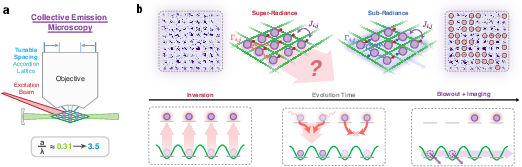
Figure 1: Subwavelength Er atom arrays and site-resolved quantum gas microscopy constitute a new platform for many-body quantum optics.
Subwavelength arrays are realized by loading ultracold 168Er atoms into two-dimensional lattices with a spacing a=266 nm, significantly below half the optical transition wavelength λ=841 nm (a/λ=0.316). Motional ground state preparation ensures minimal recoil, and a near-unity Mott insulator yields robust atom number control. The arrays are excited on a narrowband transition via σ− polarized light, and subsequent evolution is monitored by selective removal and single-site imaging of excited atoms. This detection circumvents inefficiencies of photon counting, especially for subradiant modes, and allows full population and spatial coherence readout.
Cooperative emission arises due to long-range, anisotropic dipole-dipole couplings embodied in the interaction matrices Jij (coherent exchange) and Γij (dissipative decay). These couplings dominate for a/λ<1, leading to nontrivial collective eigenmodes and radiative dynamics. The experiment systematically probes how these effects depend on atom number, inversion fraction, and lattice geometry, revealing key phenomena absent in disordered or cavity-coupled ensembles.
Direct Observation of Many-Body Super- and Subradiance
The excited-state population traces demonstrate pronounced departures from independent exponential decay. Initially, the decay rate surpasses that of a uniform ensemble, manifesting superradiant enhancement; at late times, population persists well above the baseline, evidencing subradiant modes dynamically populated by many-body evolution.
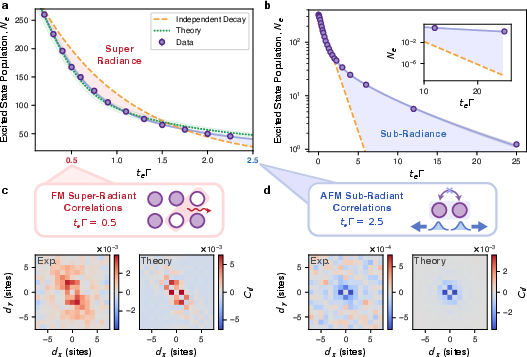
Figure 2: Population decay, correlation build-up, and transition from ferromagnetic (early) to antiferromagnetic (late) textures in a large array; numerical simulations closely match experiment.
Single-site resolution enables measurement of spatial correlation functions. Ferromagnetic "hole" correlations appear at early times, mirroring the dissipative interaction matrix and indicating rapid assembly of long-range coherence. This confirms that superradiance is driven by the formation of collective spin waves spanning many lattice sites, with pronounced anisotropy dictated by polarization and quantization axis. At late times, the system self-organizes into antiferromagnetic subradiant configurations; spatial antibunching reflects radiative repulsion, as overlapping excitations would otherwise decay rapidly. These results unambiguously demonstrate the strongly correlated quantum nature of both the superradiant and subradiant regimes.
Scaling of Collective Emission and Power-Law Behavior
The emission rate per excited atom, normalized to independent decay, is sharply time-dependent. After inversion, the array starts as a product state, and emission is driven by vacuum fluctuations. As decay events seed correlations, the normalized emission rate rises, peaking as a signature of superradiant burst. Power-law scaling γmax∝Nα is observed, with exponents exceeding unity (αnorm=1.13), confirming genuine many-body cooperativity that strengthens with system size. At late times, all system sizes converge to a common subradiant floor determined by localization, not collective physics.
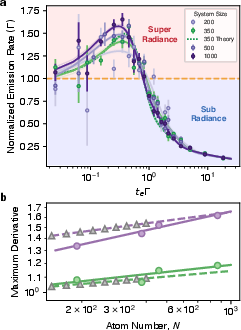
Figure 3: Extensive scaling of the superradiant burst and power-law dependence of emission on atom number.
This scaling directly contradicts models where emission is simply the sum over local patches. It confirms that ordered arrays emit as extended, multimode objects, fundamentally distinct from both the Dicke limit (single mode, small sample) and disordered clouds.
Partial Inversion, Dicke Manifolds, and Hilbert Space Traversal
Deviation from full inversion enables preparation of spin-wave textured states. The normalized emission rate increases almost linearly with decreasing excitation fraction, reflecting the selective seeding of directional superradiant modes. Remarkably, regardless of inversion, the system dynamically populations subradiant tails that arise not from initial overlap, but from inter-excitation interactions and rapid depletion of bright components.
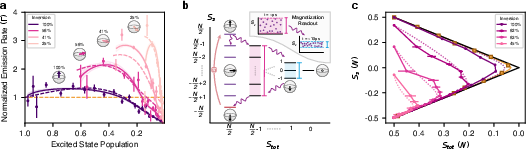
Figure 4: Finite inversion enhances directional superradiance, and the system migrates through Dicke manifolds, ending in low-spin subradiant sectors.
Measuring transverse magnetization and excited-state population, the experiment reconstructs trajectories through the (a=2660, a=2661) state space. Arrays begin in high-spin bright states (analogous to Dicke a=2662 configurations), then cascade into low-spin, dark sectors. This traversal evidences the impact of multimode radiative channels available in extended arrays and the formation of states with suppressed coupling to free space.
Geometric Resonances and Suppression of Scattering
Variable lattice spacing affords control over coupling to vacuum modes. Cooperative enhancement exhibits oscillatory structure with sharp geometric resonances, especially at spacings a=2663 and a=2664, where new radiative pathways open due to Bragg scattering and Umklapp processes.
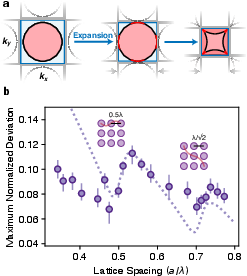
Figure 5: Superradiant geometric resonances emerge at spacing commensurate with the excitation wavelength, folding new scattering channels into the light cone.
Periodic arrays act as spectral filters, dramatically reducing incoherent scattering and enabling nearly lossless atom-photon interfaces. These resonances are absent in disordered systems, as confirmed by suppressed enhancements and smoothing out of the decay rate variances with increasing positional disorder.
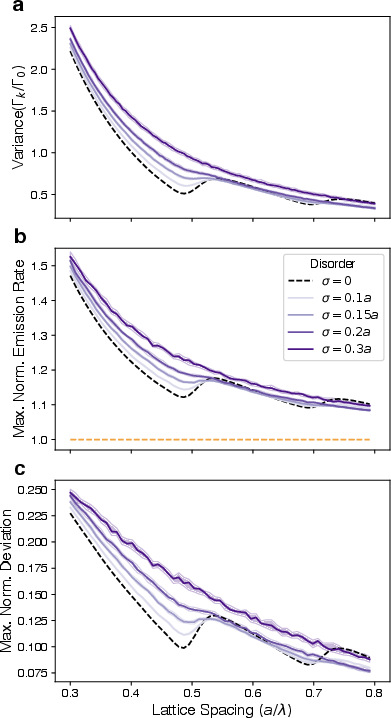
Figure 6: Positional disorder destroys geometric resonances, highlighting their dependence on lattice order.
Correlation Evolution and Texture Crossover
Temporal snapshots of the correlation matrix reveal the crossover from ferromagnetic (collective decay) to antiferromagnetic (subradiant repulsion) textures. The center region, with highest Mott insulator filling, is chosen to minimize loading artifacts.
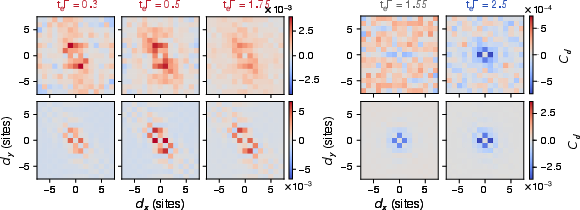
Figure 7: Temporal evolution of spatial correlations; experiment and theory show crossover from ferromagnetic to antiferromagnetic textures.
Practical and Theoretical Implications
This work realizes a programmable, cavity-free platform for controlling dissipative many-body quantum dynamics. It enables the following:
- Photon storage with subradiant modes: Subradiant lattice dark states facilitate long-lived photon storage and retrieval ("Photon control and coherent interactions via lattice dark states in atomic arrays" [rubies-bigorda_photon_2022], "Exponential Improvement in Photon Storage Fidelities Using Subradiance and 'Selective Radiance' in Atomic Arrays" [asenjo-garcia_exponential_2017]).
- Programmable emission directionality: Single-site phase imprinting enables directional photon sources and on-demand atom-photon interfaces ("Enhanced Optical Cross Section via Collective Coupling of Atomic Dipoles in a 2D Array" [bettles_enhanced_2016]).
- Entanglement generation via dissipative engineering: Engineered collective decay enables preparation and stabilization of exotic quantum phases (e.g., topological edge modes [perczel_topological_2017], measurement-induced entanglement [kastoryano_dissipative_2011, reiter_scalable_2016, lin_dissipative_2025, zhan_rapid_2025]).
- Quantum clocks and metrology: Controlling cooperative effects crucial for minimizing dipole shifts and exploiting subradiant modes for extended coherence ("Observation of millihertz-level cooperative Lamb shifts in an optical atomic clock" [hutson_observation_2024]).
- Quantum photonic devices: Arrays enable efficient photon storage, programmable memory, and on-demand entangled photon sources ("Deterministic Generation of Photonic Entangled States Using Decoherence-Free Subspaces" [rubies-bigorda_deterministic_2025]).
Theoretical advances include rigorous scaling bounds for correlated decay ("Universal scaling laws for correlated decay of many-body quantum systems" [mok_universal_2024]), analytic treatment of multimode emission beyond the Dicke model, and cumulant expansion techniques for large arrays ("Characterizing superradiant dynamics in atomic arrays via a cumulant expansion approach" [rubies-bigorda_characterizing_2023]).
Outlook and Future Developments
The demonstrated control over array geometry, excitation protocols, and site-resolved detection paves the way for programmable quantum photonics and exploration of open quantum systems, non-Hermitian physics, and measurement-induced dynamics. Further extension to more complex geometries, multi-level atoms, and engineered dissipation will enable stabilization of topological phases, quantum error correction via subradiant modes, and scalable quantum networking.
The interplay of cooperative emission, geometric resonances, and correlation dynamics observed here sets new standards for both fundamental quantum optics and practical applications. The scalability of superradiant bursts with atom number, robustness of subradiant tails, and flexible photon control constitute essential ingredients for next-generation quantum photonic platforms.
Conclusion
This work provides conclusive site-resolved evidence for strong many-body super- and subradiant emission in ordered atomic arrays, with comprehensive control over cooperative emission, correlation dynamics, and array geometry. The results establish many-body quantum optics as a platform for programmable atom-photon interfaces, lossless optical memory, and dissipative quantum state engineering. This framework will propagate advances in quantum simulation, metrology, entanglement generation, and scalable quantum photonic devices.