- The paper shows that arbitrary weak disorder transforms algebraic (power-law) scaling of subradiant decay into exponential suppression in quantum emitter arrays.
- Detailed finite-size scaling analysis reveals a crossover scale and critical exponents (ν ≈ 1.5–2) for strong and weak subradiant modes.
- The findings, grounded in Anderson localization, underscore the sensitivity of quantum photonic devices to positional fluctuations, impacting quantum memory designs.
Disorder-Induced Exponential Scaling of Subradiant Decay Rates in 1D Waveguide QED
Introduction
The study addresses how positional disorder impacts subradiant states in one-dimensional (1D) waveguide quantum electrodynamics (QED) arrays. In ordered arrays, subradiance—a form of collective suppression of radiative decay—exhibits universal power-law (N−3) scaling of decay rates for strong subradiant modes. This scaling underlies applications such as quantum information storage, where robust control of decoherence is essential. The manuscript presents a rigorous analysis demonstrating that arbitrary weak disorder destroys the algebraic scaling, inducing a sharp transition to exponential scaling of typical subradiant decay rates as a function of system size. This effect, denoted as the “subradiant scaling transition” (SST), is shown to be a manifestation of Anderson localization, establishing a direct connection between disorder-driven localization phenomena and collective emission in quantum optical platforms (2604.03576).
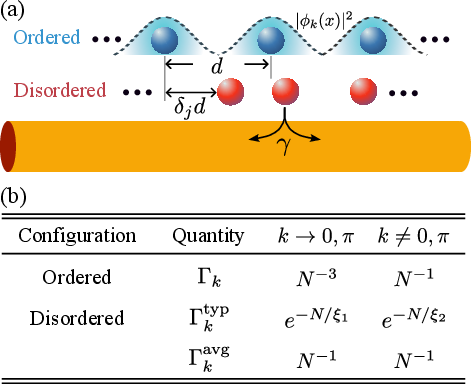
Figure 1: (a) Schematic of a waveguide-coupled qubit array with positional disorder δjd; ordered subradiant states are delocalized standing waves. (b) Distinct scaling laws in ordered (power-law) and disordered (exponential) chains for decay rates.
Model and Analytical Framework
The system consists of a chain of N qubits coupled to a 1D waveguide, governed in the Markovian limit by a non-Hermitian effective Hamiltonian encoding infinite-range coherent and dissipative couplings. Disorder is incorporated as random displacements in the qubit positions, with disorder strength W.
Decay rates of single-excitation eigenmodes are central to the analysis. Two subclasses are considered:
- Strong subradiant states (k→0,π): Power-law scaling (N−3) in ordered arrays,
- Weak subradiant states (k=0,π): Power-law scaling (N−1) in ordered arrays.
Given the broad, skewed distributions of decay rates in the presence of disorder, mean and typical values must be distinguished. The typical decay rate (geometric mean) captures the physically relevant behavior for the majority of realizations and is shown to exhibit a sharp crossover from algebraic to exponential scaling as system size increases or disorder is introduced.
Numerical Results and Subradiant Scaling Transition
Detailed finite-size scaling analyses reveal that, for both strong and weak subradiant states, the typical decay rate Γktyp transitions from its characteristic algebraic scaling to an exponential suppression Γktyp∼exp(−N/ξ∞) once the system size exceeds a characteristic crossover scale δjd0.
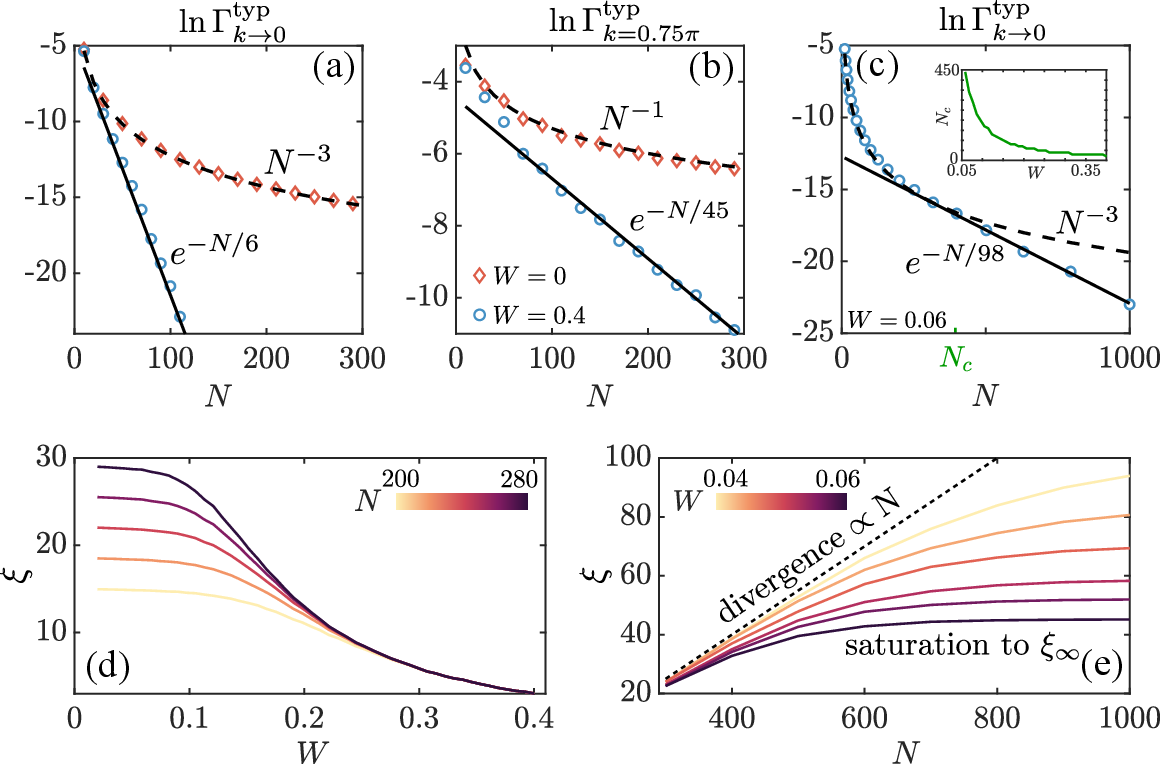
Figure 2: (a)-(c) Disorder-induced crossover from power-law to exponential decay in typical decay rates. (d)-(e) Divergence and saturation of the characteristic scale δjd1 with increasing δjd2 and as a function of disorder δjd3.
The characteristic scale δjd4—analogous to a localization length—diverges algebraically as δjd5 with critical exponent δjd6, indicating the SST is a disorder-driven critical transition. Numerically, the transition occurs at δjd7 for both subradiant subclasses, i.e., arbitrary weak disorder is sufficient to induce exponential scaling, signaling the fragility of collective subradiance against positional fluctuations.
Criticality and Universal Scaling
Finite-size scaling collapses for various δjd8 and disorder parameters establish the critical nature of the SST. The extracted critical exponents are δjd9 for strong subradiant states and N0 for weak subradiant states; the transition point remains at N1 for all subradiant modes. The data collapse is robust except near parameter regimes corresponding to superradiant states, which are not governed by SST.
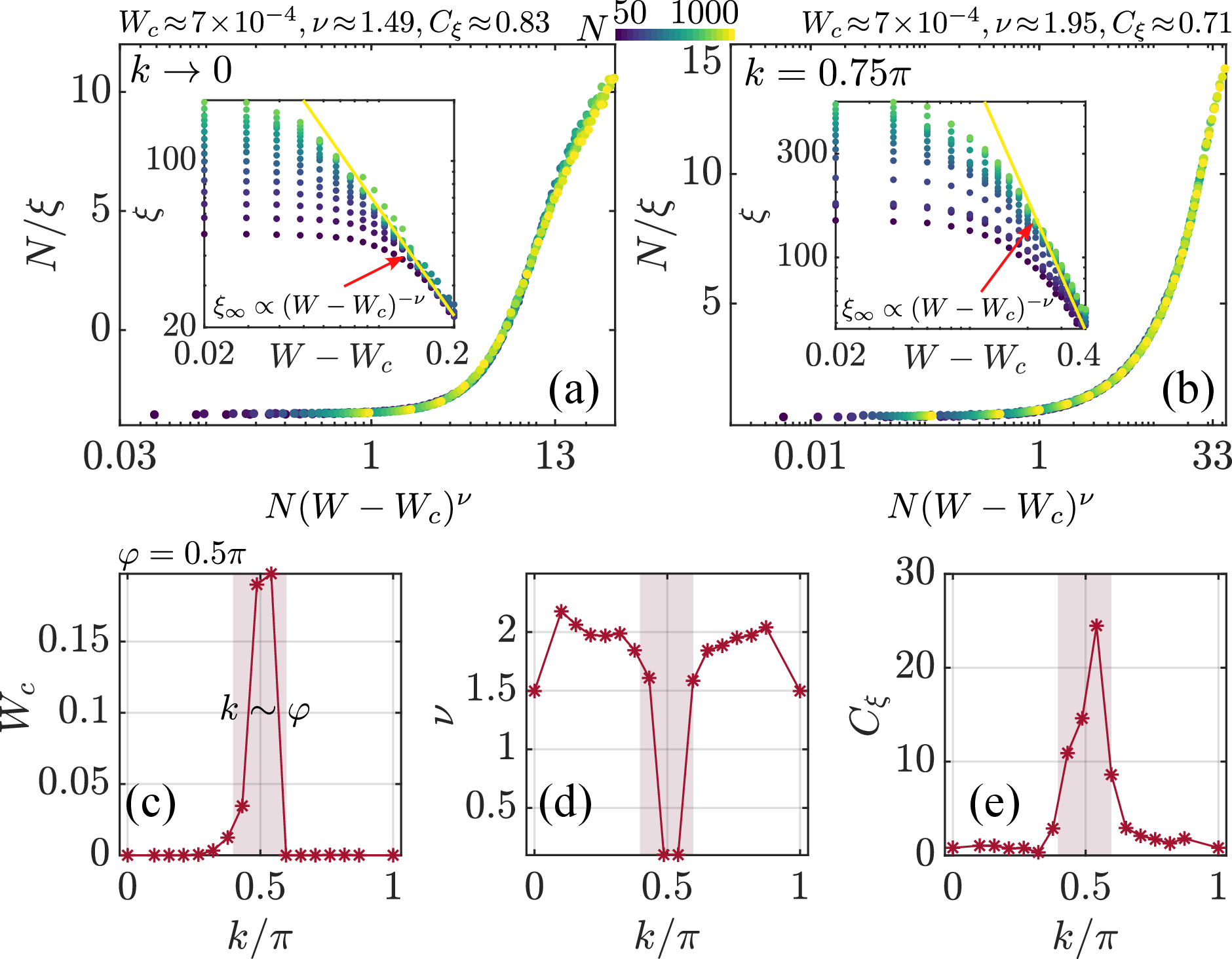
Figure 3: Data collapse of the finite-size characteristic scale N2 extracted from the scaling of N3, explicitly demonstrating universality and identifying the critical exponents N4 for different N5.
Anderson Localization and Physical Mechanism
The exponential scaling originates from disorder-induced Anderson localization. Analysis of the inverse effective Hamiltonian, mapping the problem onto a tight-binding model with boundary dissipation, reveals that the decay rate of a localized eigenstate is set by its amplitude at the open boundary, leading naturally to exponential suppression with the system size. The spatial localization length N6 of the states is shown to be physically equivalent to the exponential scale N7 extracted from the decay rates, confirming that the SST is the direct spectral signature of spatial Anderson localization.
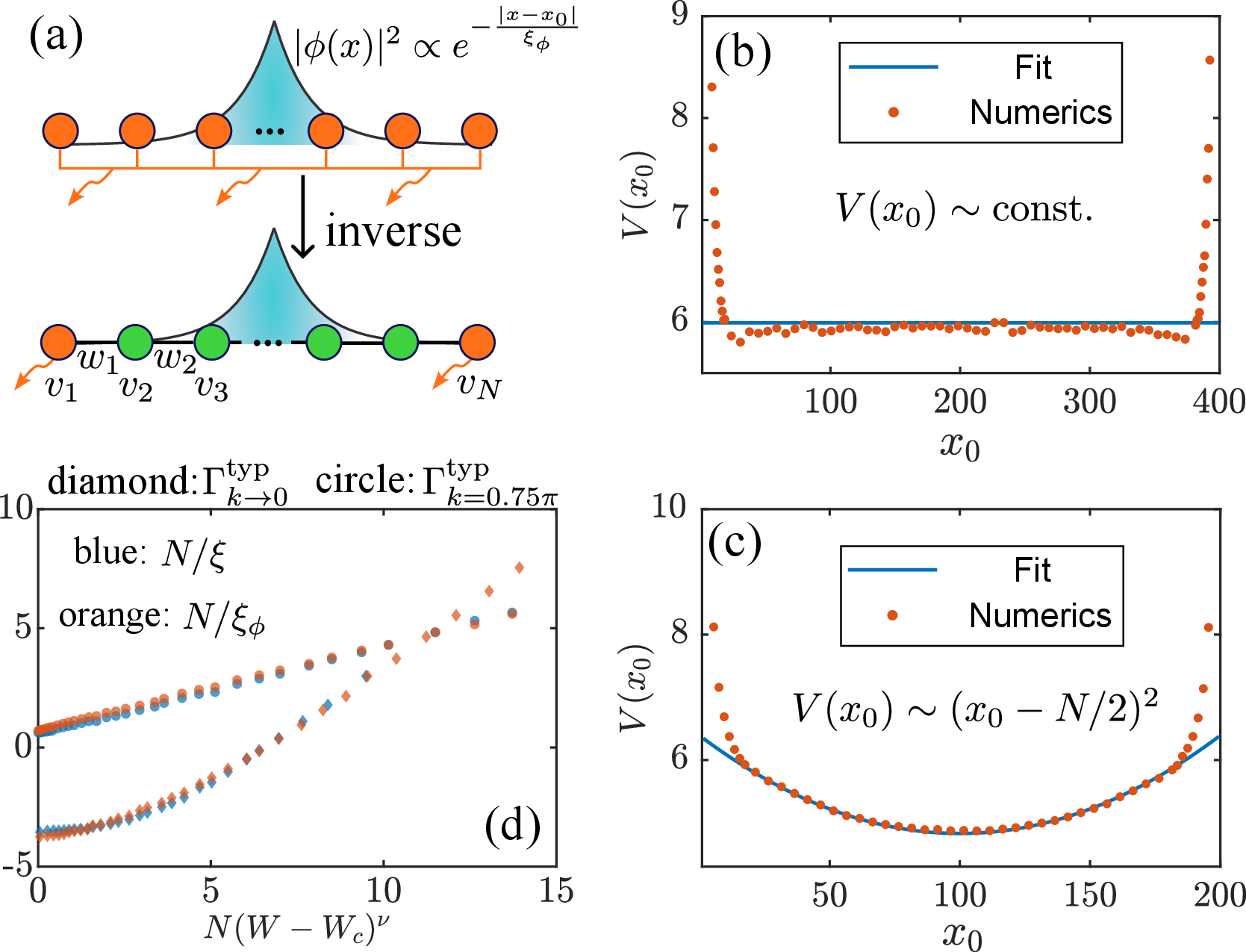
Figure 4: (a) Tight-binding representation of the inverse Hamiltonian with boundary dissipation illustrating localized wavepackets. (b)-(c) Effective localization potentials for strong/weak subradiant states. (d) Data collapse demonstrating equivalence between the spectral (decay rate) and localization length scales.
Implications and Outlook
These results unify the spectral and spatial signatures of disorder-induced localization with cooperative quantum optics in waveguide QED. The practical implication is that robust subradiance, essential for quantum memory and many-body photonic devices, is fundamentally sensitive to positional disorder—any nonzero positional fluctuation in the emitters induces exponential suppression of the typical subradiant decay rates. This constrains the engineering of quantum optical platforms and motivates new disorder-resistant architectures.
Theoretically, the established correspondence between the SST and Anderson localization allows the transfer of tools and concepts from condensed matter localization theory into the domain of waveguide QED, opening avenues to explore further phenomena such as many-body localization, non-Hermitian criticality, and engineering of localization-delocalization transitions using spatial correlations and symmetry-breaking fields.
Conclusion
The manuscript rigorously demonstrates that arbitrary positional disorder in a waveguide-coupled quantum emitter array induces a critical transition from algebraic to exponential scaling of typical subradiant decay rates. The subradiant scaling transition is shown to be a direct manifestation of Anderson localization, with critical properties fully characterized by finite-size scaling analysis. These results have significant consequences for the design of quantum photonic devices and establish a unified understanding of collective radiative phenomena and localization physics in disordered quantum systems.