- The paper presents an analytic framework that reveals universal N⁻³ linewidth scaling and boundary-induced oscillations in waveguide QED arrays.
- Analytical methods based on Green's functions and non-Hermitian Hamiltonians separate guided and free-space contributions to collective decay.
- Explicit formulas for both subradiant decay and energy shifts offer insights crucial for optimizing quantum photonic devices.
Analytical Theory of Many-Body Subradiance in Waveguide QED
Introduction and Context
The paper "Theory of the Collective Many-body Subradiance in Waveguide QED" (2604.03954) presents an advanced analytic treatment of subradiant collective modes in finite one-dimensional (1D) quantum emitter arrays coupled both to single-mode waveguides and to electromagnetic vacuum. The authors address open, non-Hermitian quantum many-body systems where collective emission features are intricately shaped by waveguide-mediated long-range interactions, system boundaries, and the interplay of guided and unguided radiative channels.
The work rigorously connects the universal N−3 linewidth scaling of Bragg-edge subradiant states with the impact of nonidealities, particularly leakage into free-space modes and deep-subwavelength atomic spacing where near-field terms dominate the collective spectral shift. Importantly, the manuscript simultaneously provides analytical forms for both decay rates and collective energy shifts—offering insights into features not captured by prior works focused solely on linewidths.
Model and Theoretical Framework
The system under consideration consists of N identical two-level atoms arrayed with spacing d and collectively coupled to a 1D single-mode waveguide and to all free-space modes (see Figure 1). Theoretical treatment is based on an effective non-Hermitian Hamiltonian in the single-excitation manifold, where Green's function techniques yield a clear separation of guided and unguided contributions.
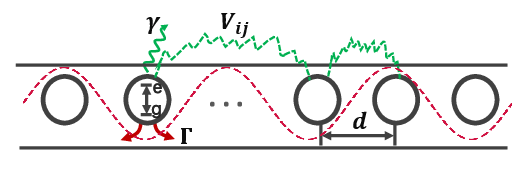
Figure 1: Schematic of an N-atom array with spacing d, coupled to a single-mode waveguide (guided emission rate Γ) and to free-space modes (scattering rate γ).
Guided decay kernels lead to infinite-range dissipative and coherent couplings, while free-space terms (modeled as vacuum Green's function) introduce distance- and orientation-dependent dipole-dipole interactions and additional radiative decay. The eigenproblem yields complex collective energies λξ=Jξ−(i/2)Γξ, with Jξ and Γξ corresponding to collective shifts and linewidths, respectively.
Universal Subradiant Scaling in the Ideal Waveguide
For idealized waveguides (N0), the manuscript employs Bragg-edge open-boundary ansatz and generalized Bloch theory to derive the eigenmodes and their spectra. Near the Brillouin zone edge, the most subradiant eigenmodes' linewidths are shown to universally scale as N1 for branch index N2, with the envelope and prefactor determined by N3. The analytic expressions are benchmarked against exact diagonalization, with excellent agreement, and exhibit progressive improvement in the deep-subwavelength (N4) and large-N5 limits:
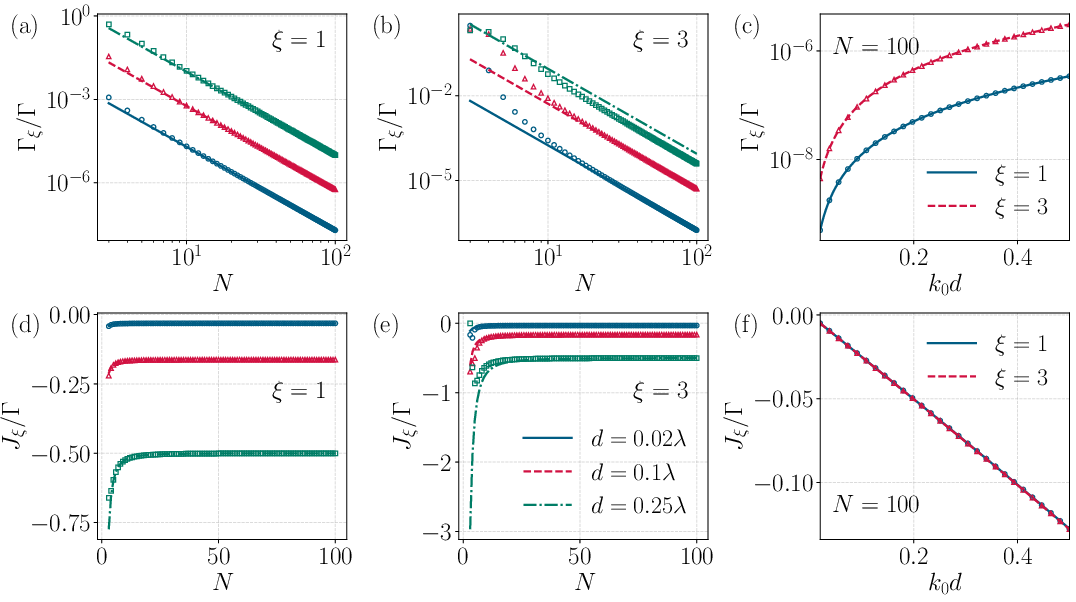
Figure 2: Benchmark of asymptotic formulas for linewidths and collective energy shifts against numerical results as functions of N6 and N7 for the most subradiant modes.
The collective energy shift N8, in contrast to the linewidth, saturates to a finite band-edge value with subleading finite-size corrections scaling as N9. This qualitative decoupling between linewidth suppression and persisting collective shift is analytically explicit.
Effects of Free-space Coupling and Deep-Subwavelength Regime
In the experimentally relevant regime where spontaneous emission into free-space (d0) is non-negligible, the deep-subwavelength condition (d1) enhances near-field terms such that boundary effects govern radiative properties. The authors analytically decompose both the guided and free-space contributions to the linewidth and shift using angular integrations and discrete autocorrelation expansions.
A striking result is the emergence of pronounced even–odd d2-dependent oscillations in the linewidths due to finite-size and interference effects, explicitly captured in analytic form and numerically confirmed. Both the waveguide and vacuum channels exhibit the same d3 scaling envelope, but their boundary-induced oscillation patterns differ:
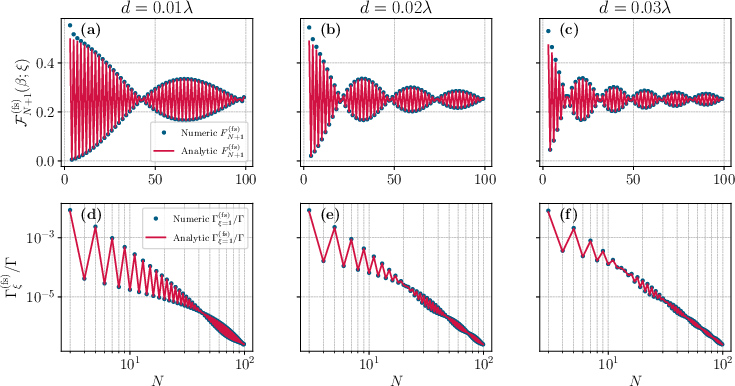
Figure 3: Comparison of exact and analytic results for the dimensionless free-space decay prefactor, showing oscillatory behavior and d4 scaling in the deep-subwavelength regime.
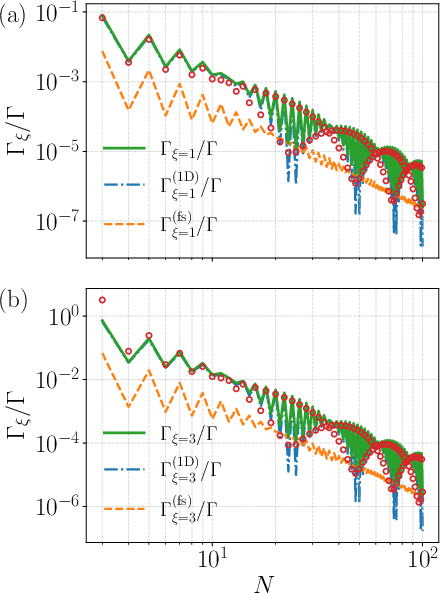
Figure 4: Analytical decomposition of decay rates into guided and unguided contributions, displaying both the universal scaling and pronounced even–odd oscillations with d5.
Collective Energy Shift in Realistic Waveguide-QED Arrays
The analytic theory for the energy shift d6 rigorously separates the contributions from guided and free-space interactions. As d7, the leading term is set exclusively by vacuum-mediated near-field interactions and diverges as d8 in the deep-subwavelength limit. Finite-size corrections decay as d9 and scale quadratically with the Bragg branch index (N0). The analytic formula for N1 is validated by direct diagonalization:
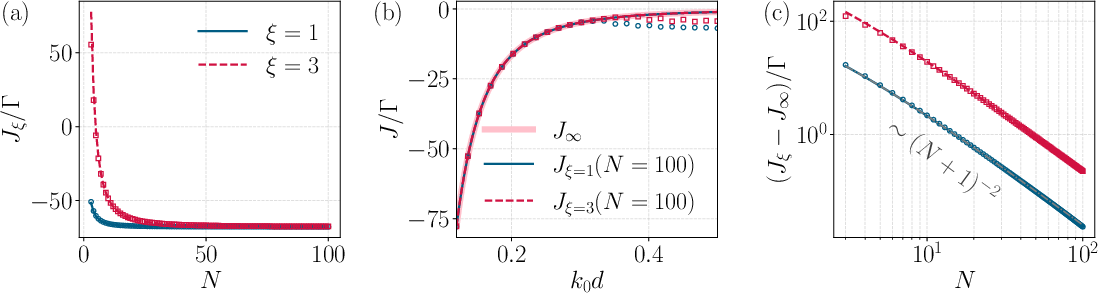
Figure 5: Collective energy shift convergence for increasing N2 and varying N3, with asymptotic finite-size correction scaling as N4.
Unlike the linewidth, the collective shift does not vanish in the thermodynamic limit, displaying strong sensitivity to atomic separation but not to collective destructive interference.
Summary of Principal Results
- Universal Linewidth Scaling: The subradiant branching linewidths in 1D emitter arrays coupled to waveguides universally scale as N5 for large N6, robustly persisting even in nonideal (leaky) systems.
- Parity-Dependent Oscillations: Pronounced even–odd oscillations in subradiant linewidths arise from boundary interference, analytically predicted and clearly visible in numerics.
- Divergent Collective Shifts: The collective energy shift approaches a finite band-edge value as N7, with leading corrections in N8 and a characteristic scaling set by vacuum near-field coupling N9.
- Full Spectral Theory: The analytic solution supports both the decay and frequency shift, enabling precise prediction of ultranarrow, strongly shifted collective resonances in physically realistic nanophotonic arrays.
Implications and Outlook
This analytic framework clarifies the spectral structure and scaling of the lowest-lying collective excitations in open quantum many-body photonic systems, encompassing ideal and leaky nanophotonic platforms. It has substantial implications for quantum storage, collective photon transport, and applications in precision metrology leveraging subradiant states. In particular, the explicit finite-size corrections and sensitivity to boundary conditions codified here are crucial for interpreting experiments on few- to many-atom waveguide QED systems.
Potential future directions include: exploring disorder, inhomogeneity, and quantum nonlinearities on subradiant physics; generalizing to chiral and topologically nontrivial waveguides; and employing the analytic theory for design optimization in quantum networked sensing and photonic circuitry. The analytic approach established here provides a transparent, scalable tool for such developments in advanced quantum photonics.
Conclusion
The work provides a rigorous, unified, and analytically controlled description of many-body subradiance in waveguide-QED arrays, encompassing both the linewidth and energy shift of collective modes and explicitly revealing the intertwined role of boundary effects, Bragg interference, and near-field interactions. These results set a new standard for the spectral theory of non-Hermitian many-body quantum optics and lay the groundwork for practical exploitation of subradiant states in engineered photonic environments.