- The paper demonstrates that CTAO observations of TeV GRBs robustly constrain IGMF strength, establishing a lower bound of 2×10⁻¹⁶ G under optimal conditions.
- It employs advanced 3D Monte Carlo simulations and realistic detector systematics to assess the impact of source spectral and temporal uncertainties on IGMF limits.
- Results indicate that variations in intrinsic GRB properties and observational delays can significantly alter the sensitivity of cosmological magnetic field measurements.
Impact of Observational and Modelling Assumptions on IGMF Constraints Using TeV GRBs Observed by CTAO
Introduction
The study systematically analyzes the sensitivity of intergalactic magnetic field (IGMF) constraints, derived from TeV gamma-ray burst (GRB) observations with the Cherenkov Telescope Array Observatory (CTAO), to a variety of observational and modeling assumptions. IGMFs, possibly of primordial origin, remain largely undetected but are indirectly probed via delayed secondary γ-ray cascades produced through interactions of very high-energy (VHE) photons from GRBs with the extragalactic background light (EBL). The secondary emission, affected by IGMF strength B and correlation length λB, becomes observable if its temporal and spectral signatures permit separation from the primary burst emission. This paper employs state-of-the-art 3D Monte Carlo simulations of two prominent GRBs—190114C and 221009A—to quantify the robustness of IGMF lower bounds attainable with CTAO under realistic scenarios, explicitly addressing the influence of varying intrinsic source properties and detection strategies.
Methodology
The analysis utilizes the CascadEl Monte Carlo simulation framework for electromagnetic cascade development, incorporating up-to-date EBL and cosmic microwave background (CMB) models within a ΛCDM cosmological context. The intrinsic primary GRB emission is parameterized as a power law in both energy and time, attenuated by an exponential cutoff at Ecut:
Φ(E,t>tmin)=Φ0E−γt−αexp(−E/Ecut).
CTAO instrumental systematics are modeled using the Gammapy package and official Instrument Response Functions (IRFs, prod5 version v0.1), with full simulation of the North and South CTAO configurations. Synthetic datasets are generated across a grid of injected B values, and time-resolved spectral fits recover best-fit values for B and intrinsic spectral-temporal parameters. Throughout, λB is fixed to 1 Mpc, and both idealized and sub-optimal detector/observational configurations are considered.
Results for GRB 190114C
The benchmark analysis with GRB 190114C (z=0.425) employs spectral indices γ=2.22 and λB0 motivated by MAGIC observations, and a conservative lower cut on λB1 TeV—reflecting recent LHAASO results at higher energies. With this constraint, the simulations identify three main IGMF regimes:
- Optimal Cascade Domain (λB2): Here, CTAO is sensitive to the cascade, and robust lower bounds on λB3 can be set.
- Low-Field Regime (λB4): Cascades are undetectable as their energy distribution shifts below CTAO's threshold.
- High-Field Regime (λB5): Secondary emission is suppressed, and spectral features degenerate with intrinsic λB6 effects.
Under optimal assumptions—with λB7 fixed—the study finds a robust lower limit of λB8 G for IGMF, invariant under most tested changes in source spectral shape, fluence, zenith angle, or detection delay.
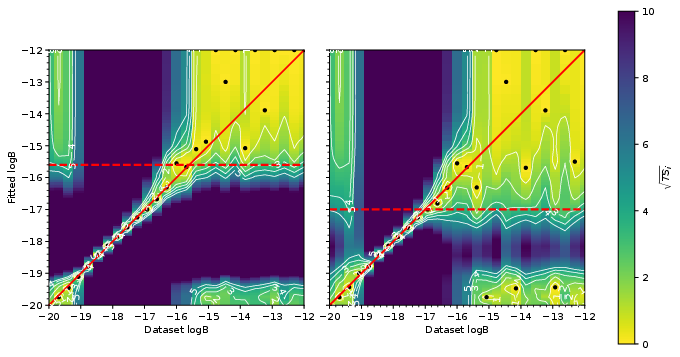
Figure 1: Confidence maps for GRB 190114C showing fitted λB9 versus simulated Λ0 for two scenarios: left—Λ1 TeV enforced; right—Λ2 free, illustrating the degeneracy between IGMF and intrinsic cutoff for strong fields.
However, if Λ3 is left unconstrained, the lower bound degrades to Λ4 G, primarily due to degeneracy between the suppressed cascade flux and an intrinsically lower Λ5. Other critical systematics include the true onset time of the VHE afterglow: significant delays or reduced primary fluence also degrade constraints. Specifically, a delay from the fiducial 6 s post-burst up to 1 hr or a fluence reduction by a factor of Λ6 still allows constraints at the Λ7 G level, but with further reductions, distinguishability is lost.
Results for GRB 221009A
For the exceptional GRB 221009A, observed up to Λ8 TeV (LHAASO), the analysis uses a segmented power-law lightcurve normalized to observed data and Λ9 TeV. Under ideal conditions (low energy threshold, prompt observation), CTAO could test IGMFs as strong as Ecut0 G. However, Moonlight-induced energy threshold increases and lost observing time (Ecut1 night missed) degrade the limit by up to an order of magnitude. Even under such adverse circumstances, CTAO can still set a lower limit at Ecut2 G, which improves the Fermi-LAT limits by an order of magnitude.
Implications and Prospective Developments
These findings confirm that CTAO, even under conservative or sub-optimal assumptions, consistently enhances the sensitivity to IGMF strengths by more than an order of magnitude relative to current instruments, pushing robust lower bounds to Ecut3 G (GRB 190114C) and as strong as Ecut4 G (GRB 221009A) under favorable conditions. The degradation observed only under extreme modeling changes or highly unfavorable observing configurations underscores the intrinsic robustness of GRB afterglow time-delay constraints to systematic uncertainties, provided that Ecut5 is physically motivated and Ecut6 is fixed.
Practical implications include the necessity of rapid CTAO follow-up, maximal coverage across both array sites, and prioritizing observational protocols that minimize energy threshold increases (e.g., Moonlight avoidance). Theoretically, the results suggest that, assuming Ecut7 Mpc and Ecut8 TeV are justified, future extreme GRBs could further improve the cosmological mapping of IGMF parameters, thereby constraining models of magnetogenesis on cosmological scales.
Conclusion
This analysis rigorously assesses the stability and attainable strength of CTAO-driven IGMF lower bounds derived from high-energy GRB afterglow observations. For typical bursts akin to GRB 190114C, CTAO will systematically extend constraints to Ecut9 G for Φ(E,t>tmin)=Φ0E−γt−αexp(−E/Ecut).0 Mpc, barring highly conservative or significantly degraded model/observation assumptions. For exceptional events, the potential sensitivity is even higher. The robustness to most systematics highlights GRB time-delay cascade observations as a premier probe of cosmological magnetism, contingent on continued optimization of instrumental and observational strategies.