- The paper introduces a hardware-efficient binary sparse SYK model that preserves chaos while enabling a traversable wormhole-inspired quantum teleportation protocol.
- It employs a variational quantum algorithm to prepare a thermofield double state and records a sign-asymmetric mutual information signature as evidence for traversability.
- Experimental results validate that even sparsified models align with Gaussian Orthogonal Ensemble predictions, paving the way for scalable quantum gravity simulations.
Quantum Simulation of Traversable-Wormhole-Inspired Teleportation in a Chaotic Binary Sparse SYK Model
Introduction and Theoretical Background
The interface between quantum gravity and quantum information theory has motivated experimental protocols to probe gravitational phenomena such as traversable wormholes via laboratory quantum systems. Central to this pursuit is the Sachdev–Ye–Kitaev (SYK) model, a paradigmatic ensemble of N Majorana fermions with random all-to-all q-body interactions, exhibiting maximal chaos and random-matrix-type spectral correlations at low energies. The mapping between eternal Einstein–Rosen bridges and entangled thermofield double (TFD) states underpins the duality between traversable wormhole dynamics and quantum teleportation protocols involving SYK Hamiltonians.
In this context, traversable wormholes are rendered traversable by introducing a double-trace deformation coupling the two boundaries, thereby violating the averaged null energy condition (ANEC) and permitting signal transmission. The protocol leverages a sign-dependent asymmetry in mutual information between injected and extracted qubits, correlating with the bulk's causal structure and holographically corresponding to quantum teleportation across an emergent geometry [Gao2017, Maldacena2017, Jafferis2022].
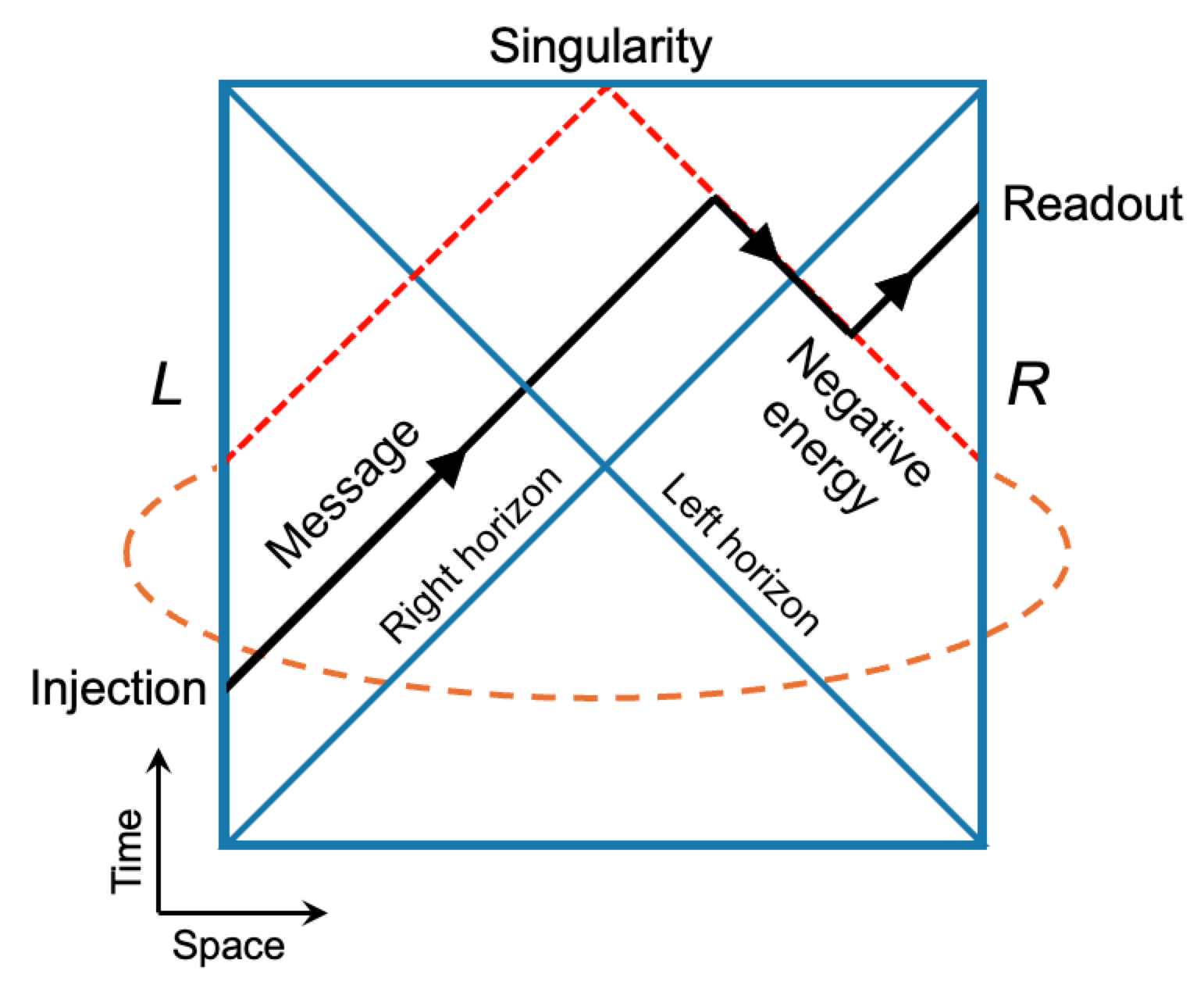
Figure 1: Schematic Penrose diagram for the traversable wormhole protocol, where a signal injected at the left boundary (L) traverses a region of negative-energy shockwave and emergences at the right boundary (R) rather than falling into the singularity.
Sparse SYK Constructions and Spectral Chaos
A significant barrier to quantum hardware implementation is the exponential circuit depth required by the dense q-local SYK Hamiltonian, which is incompatible with the decoherence constraints of current NISQ devices. Prior work has shown that random sparsification, while reducing complexity, may degrade the model's quantum chaotic properties [Orman2025]. There is currently tension in the literature regarding how much sparsification is acceptable before the breakdown of chaos and gravitational duality [Caceres2021].
The present work addresses this by employing a binary sparse SYK model [PhysRevB.107.L081103], which randomizes the sign of nonzero interaction coefficients, retains a much-reduced number of q-body terms (K≪(qN)), and preserves key spectral features diagnostic of chaos, such as the Gaussian-filtered spectral form factor (SFF) and level-spacing (gap-ratio) statistics. Numerical analysis for N=8, q=4 shows that even at K=10 (q0), the ensemble retains proximity to the Gaussian Orthogonal Ensemble (GOE) predictions.
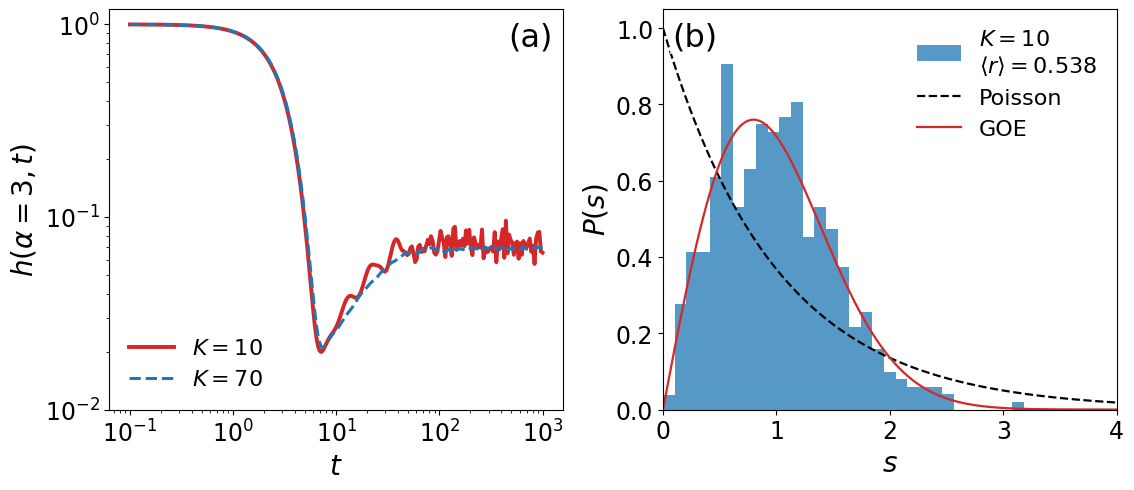
Figure 2: (a) Disorder-averaged SFF and (b) level-spacing statistics for binary sparse q1 SYK ensemble at q2, demonstrating preservation of spectral chaos relative to the dense case and the GOE.
Single-instance analysis for the selected q3 binary sparse SYK Hamiltonian further confirms the dip–ramp–plateau structure in the SFF and gap ratios q4 close to the GOE value, thus validating its use as a "chaotic minimal model" for hardware experiments.
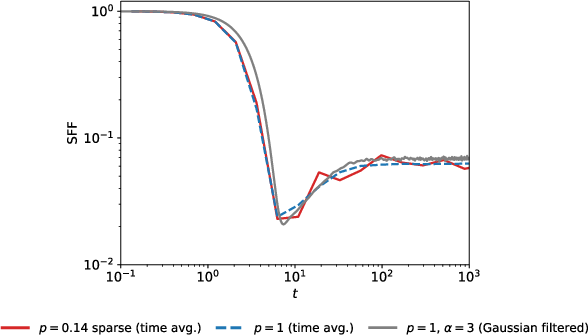
Figure 3: Time-averaged SFF for the chosen binary sparse SYK Hamiltonian compared to ensemble-averaged dense model SFF, confirming chaotic spectral character.
Implementation of Traversable-Wormhole Protocol
The traversable-wormhole protocol consists of preparing a TFD state of two q5 SYK systems (q6, q7), injecting a message qubit into one side, evolving under the total Hamiltonian, performing an interaction kick at q8 with sign-tunable bilinear coupling, and measuring mutual information across time. Diagnostics focus on the mutual information q9 between the reference and target qubits and specifically on the sign-asymmetry
L0
as a traversability signature.
Preparation of the TFD state employs a hardware-efficient variational quantum algorithm (VQA) using an L1 circuit ansatz, achieving L2 fidelity on IBM superconducting qubit hardware. Time evolution is Trotterized with a first-order Lie-Trotter decomposition, balancing accuracy and circuit depth for NISQ feasibility. The protocol reconstructs the reduced two-qubit state by tomographic measurements.
Experimental Results and Wormhole Traversability Signal
The mutual information for the fixed-injection-time protocol (L3) matches well between exact numerics and single-step Trotter emulation. The experiment reaches a circuit depth of approximately 1,000, aggregating to 377 two-qubit gates per shot—substantially deeper than earlier implementations but facilitated by the highly sparse binary Hamiltonian selected for commuting properties.
Experimentally, raw mutual information is suppressed by device noise but retains the hallmark sign-asymmetry near the teleportation time. The measured L4 is visibly positive near the optimal window, directly demonstrating information transfer consistent with traversable wormhole/teleportation dynamics, even in the presence of substantial noise.
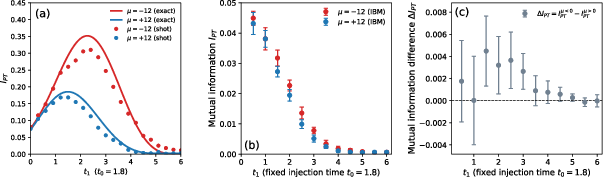
Figure 4: (a) Mutual information from exact numerics (lines) and Trotter emulation (dots); (b) hardware results for mutual information, (c) measured asymmetry L5, showing clear traversability signal.
Further, the protocol maintains causal time ordering; that is, the reemergence time of signals depends causally on the injection time, reflecting the bulk geometric intuition.
Size Winding and Operator Dynamics
In the SYK context, operator size growth ('size winding') is closely related to the information-theoretic interpretation of bulk traversability and scrambling [PRXQuantum.4.010320]. The phase of the winding-size distribution L6 exhibits approximately linear growth with size at the peak, and its slope reverses across the interaction, in line with the size winding predictions for traversable wormhole teleportation.
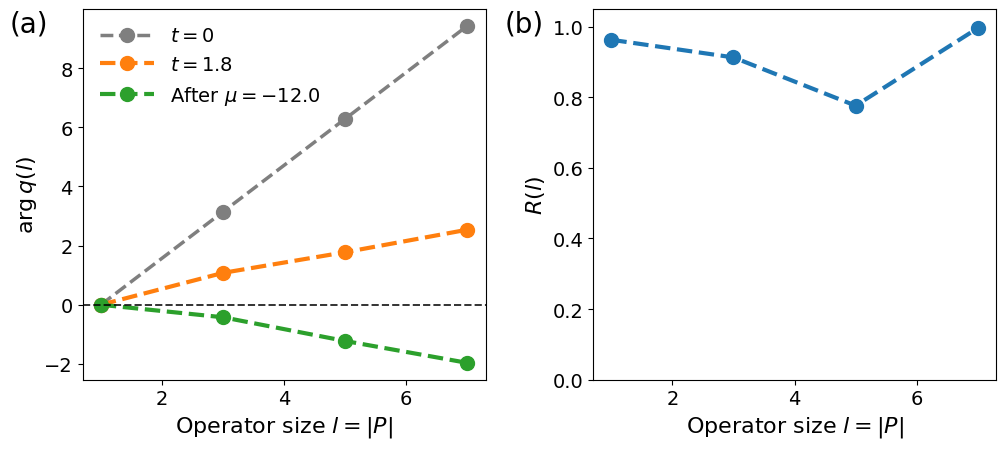
Figure 5: (a) Phase of L7 before/after interaction, (b) ratio L8 close to unity in relevant size sectors, confirming preservation of operator size winding at the protocol peak.
Ensemble Robustness and Generality
To test the genericity of the observed phenomena, the mutual information and its asymmetry are computed for 100 disorder realizations in both the dense and L9 binary sparse ensembles. The sign-asymmetry is preserved across the majority of instances, confirming that the traversable-wormhole teleportation signature is ensemble-typical rather than engineered or anomalous.
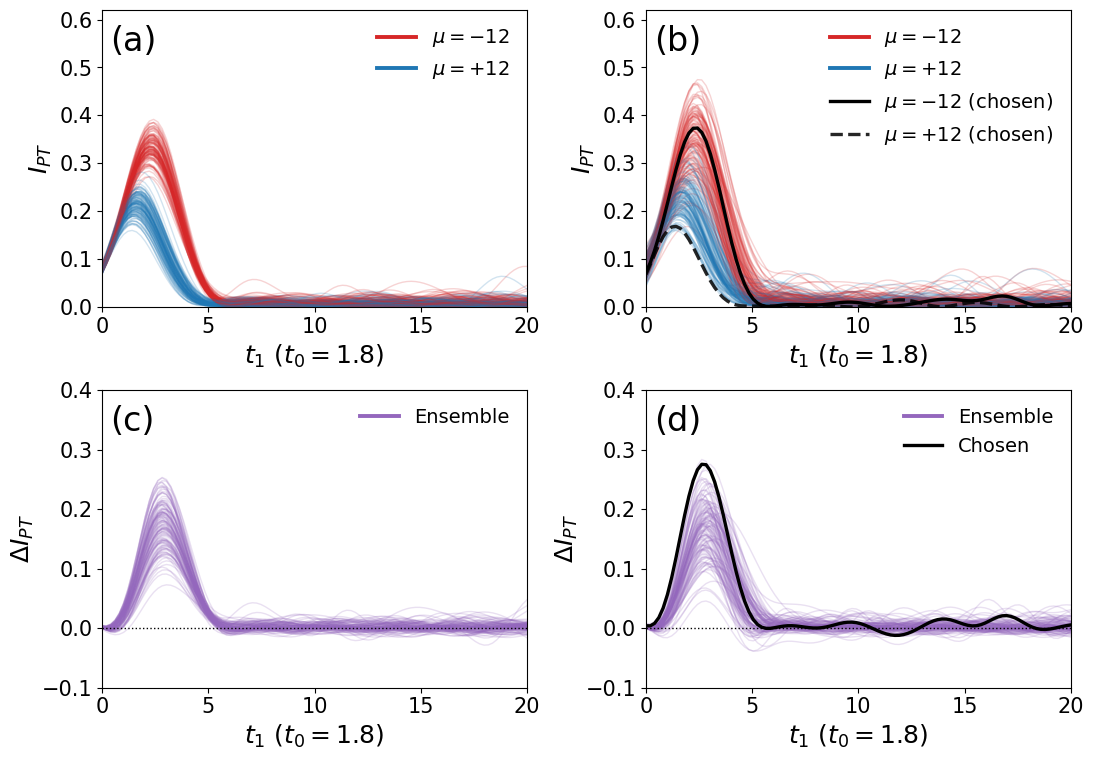
Figure 6: Mutual information and asymmetries for 100 disorder samples in dense (a,c) and binary sparse (b,d) ensembles, showing reproducibility of protocol signatures throughout the ensemble.
Implications and Prospects
This work demonstrates, for the first time, an explicit quantum-hardware realization of the traversable wormhole protocol using a Hamiltonian that is both hardware-efficient and manifestly chaotic by construction. The result substantiates the possibility of simulating holographically motivated dynamical protocols in NISQ-era platforms via carefully crafted sparse models, resolving an ongoing debate regarding the chaos/sparsity tradeoff [Orman2025].
From a practical perspective, the binary sparse SYK model opens a scalable path for larger system implementations. The results also provide a platform for testing more advanced holographic dualities and quantum error correction protocols in laboratory settings. Theoretically, these advances validate that chaos-preserving sparsification techniques can robustly reproduce gravitational dual phenomena in quantum circuits. A direction of high relevance is the extension to commuting or partially commuting SYK models to further reduce hardware requirements without sacrificing spectral properties [gao2024commutingsykpseudoholographicmodel, 1k6k-xhmk].
Experimentally, future progress will require more efficient error mitigation and may benefit from alternative quantum architectures with enhanced connectivity and gate fidelities (e.g., trapped-ion processors [Granet2026]). Broad generalizations of this approach, including more intricate protocols (e.g., Hayden–Preskill recovery, OTOCs, and the study of the Page curve), are imminent as quantum systems approach the scale and complexity needed to explore full-fledged quantum gravity analogues.
Conclusion
This study establishes a scalable, chaos-preserving binary sparse SYK model as a robust platform for simulating traversable-wormhole-inspired quantum teleportation protocols. It demonstrates both a practical circuit construction suitable for state-of-the-art quantum processors and the retention of essential holographic features, including operator size winding and information transfer asymmetry, across the ensemble. This work motivates both theoretical and experimental extensions towards more comprehensive quantum simulations of gravitational dualities and related phenomena in laboratory-controlled settings.