- The paper presents efficient reward modeling by dynamically triggering chain-of-thought (CoT) based on internal uncertainty.
- It introduces a hybrid loss discriminative scorer to precisely evaluate multi-step reasoning paths.
- Empirical results show significant reductions in inference latency and FLOPs while achieving state-of-the-art accuracy.
Efficient Generative Reward Modeling via Model-Internal Uncertainty
The work "Reason Only When Needed: Efficient Generative Reward Modeling via Model-Internal Uncertainty" (2604.10072) introduces a principled approach to improving both the efficiency and fidelity of reward modeling for LLMs performing complex reasoning tasks. By leveraging model-internal uncertainty as a task-agnostic signal to dynamically allocate reasoning computation and employing a discriminative, hybrid-loss reward model for stepwise path evaluation, the paper advances the state of the art in generative reward modeling. This essay details the framework's technical contributions, quantitative outcomes, and broader implications.
Motivation and Problem Specification
Generative Reward Models (GRMs) have demonstrated superior performance in complex reasoning tasks through Chain-of-Thought (CoT) prompting, as compared to scalar reward models. However, standard GRMs suffer from two chronic inefficiencies: (1) indiscriminate application of CoT to all inputs, resulting in wasted computation on simple cases, and (2) reliance on voting-based aggregation over CoT outputs, which lacks precision and granularity in selecting superior reasoning chains.
The paper identifies a critical gap in existing solutions, which generally either use static, handcrafted difficulty features or task-specific heuristics to trigger CoT, limiting generalization and operational scaling. In reward inference, most approaches aggregate CoT samples via plurality voting, obscuring nuanced distinctions in reasoning quality and propagating errors from plausible but incorrect chains.
Method: E-GRM Framework
The proposed Efficient Generative Reward Model (E-GRM) addresses these challenges through two integrated mechanisms:
Dynamic CoT Triggering via Model-Internal Uncertainty
E-GRM quantifies the necessity for multi-step reasoning by analyzing the consistency of answers produced in parallel decoding runs with varied sampling configurations. If the responses converge (Consensus(x)≥τ, τ typically 0.8), the input is classified as "short reasoning" and direct inference is executed. If the consensus is lower, the model triggers explicit CoT sampling, allocating computational resources adaptively.
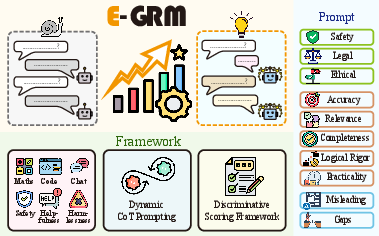
Figure 1: E-GRM illustratively enables efficient, accurate generative reasoning by dynamically allocating CoT computation based on model-internal uncertainty.
This strategy is computationally lightweight (adds <5% latency when applied) and task-agnostic, not requiring domain-specific features or tuning.
Discriminative Chain Selection with Hybrid Loss
To resolve the reward fidelity issues of majority voting, E-GRM introduces a lightweight scorer trained on both robust regression (Huber loss for alignment with annotated quality signals) and discriminative ranking (hinge loss for pairwise distinction). This scorer delivers fine-grained, continuous quality estimates for each reasoning path, enhancing selection accuracy for downstream RL or inference ranking.
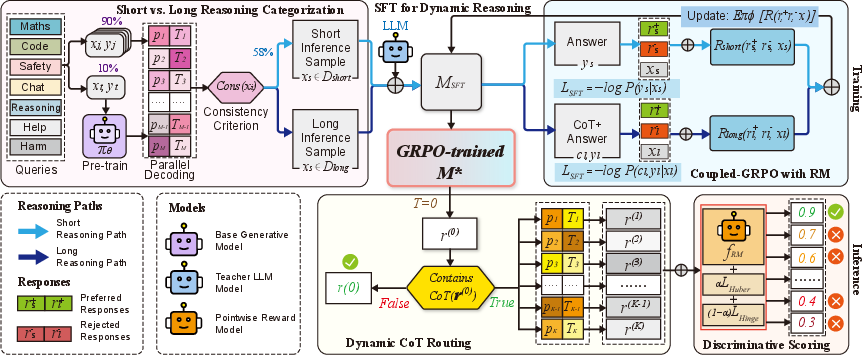
Figure 2: E-GRM pipeline, showing dynamic CoT triggering based on uncertainty and discriminative scoring of multi-path outputs. The two-stage process encompasses both training and reasoning/execution.
Preference Optimization
During policy refinement, E-GRM extends Group Relative Policy Optimization (GRPO) to explicitly use preference-paired data. The optimizer directly contrasts paired positive/negative responses using the reward model's discriminative scores, capturing differences in granular reasoning quality that standard group-based policy updates miss.
Experimental Results
Evaluation encompasses multiple reward-modeling benchmarks: RewardBench, RM-Bench, and RMB, each targeting a spectrum of scenarios from nuanced preference judgment to robustness in practical tasks.
Key outcomes:
- Efficiency: On the MATH dataset, E-GRM's dynamic triggering bypasses 58% of cases as "short reasoning", yielding a 62% reduction in average inference latency and 49% reduction in FLOPs versus forced-CoT, with no measurable drop in accuracy.
- Performance: Qwen-Instruct-32B-Ours, an E-GRM instantiation, achieves state-of-the-art mean accuracy on RM-Bench (79.2%) and RMB (0.743), surpassing GPT-4o and other recent models.
- Safety Alignment: The discriminative scorer boosts harmlessness judgment, with highest "pairwise harmlessness" alignment on RMB, demonstrating successful avoidance of unsafe or adversarial responses.
- Ablation: Disabling dynamic CoT explodes computational cost with minimal accuracy improvement; disabling discriminative scoring results in substantial accuracy degradation—highlighting the criticality of both components.
Theoretical and Practical Implications
E-GRM introduces model-internal uncertainty as a universal, domain-agnostic signal for adaptive reasoning allocation. This approach eliminates the dependency on external complexity heuristics, improving generalizability across novel tasks and domains. The discriminative, hybrid-loss reward module also yields higher-fidelity evaluations compared to black-box voting, providing more reliable supervision signals for RLHF or self-improving RL systems.
The key implication is that best-of-n sampling and adaptive reasoning depth can be directly regulated by introspective model properties, not only for computational gain but also for robustness against reward hacking and reward overfitting [pmlr-v202-gao23h, liu2024rrm]. Moreover, the RL pipeline benefits from paired preference supervision in a way that is algorithmically sound and empirically validated.
Broader Impact and Future Directions
The E-GRM framework scales reward modeling effectively with model size, but also demonstrates strong performance even in smaller parameter regimes due to its efficient resource allocation and fine-grained evaluation. This opens the door for deployment in resource-constrained, real-time applications, as well as in larger-scale collaborative LLM ensembles that require robust, domain-agnostic preference models.
Notably, model-internal uncertainty estimation could be further extended to multimodal reasoning, tool-based LLMs, or online-adaptive inference, providing a unifying principle for future alignment and judge systems. The calibration of uncertainty thresholds and reward model adaptation to unseen reasoning styles remains an open research area, as does the integration with process-level reward frameworks [setlur2024rewarding].
Conclusion
"Reason Only When Needed" (2604.10072) establishes an efficient, accurate paradigm for generative reward modeling in LLM alignment by harnessing model-internal uncertainty to minimize unnecessary CoT computation, and by applying discriminative, hybrid-loss scoring to elevate reward granularity. The empirical gains in inference efficiency, accuracy, and safety robustness validate the core hypothesis that resource allocation based on model generative behavior is both practical and general. The framework provides a foundation for further research on scalable, adaptive reward modeling across increasingly diverse and open-ended reasoning tasks.