- The paper eliminates exponential recency bias by replacing ℓ2-normalization with Tikhonov regularization that preserves early feedback.
- It introduces block variants—especially Block-NK—that process swipe sessions collectively to enhance stability and robustness in preference learning.
- Empirical results show improved alignment (Align@20 = 0.698) and superior noise robustness compared to standard Kaczmarz methods.
Kaczmarz-Based Online Preference Learning for Reciprocal Matchmaking: Elimination of Recency Bias and Stable Convergence
Introduction
This work addresses the problem of real-time personalized preference learning in reciprocal recommender systems encountered in matchmaking applications, where recommendations are valid only if accepted reciprocally. The paper provides a thorough algorithmic and empirical analysis of Kaczmarz-style update rules for learning user preference vectors from one-sided (single-swipe) binary feedback, proposes Tikhonov-regularized and block variants that analytically resolve key pathologies of previously deployed online learning approaches, and introduces a principled framework for candidate sampling and label-noise robustness analysis.
Exponential Recency Bias in Normalized Kaczmarz
The standard Kaczmarz algorithm solves overdetermined linear systems via iterative projections. In preference learning, this is operationalized by updating a user's preference vector by projecting it onto the constraint imposed by the latest swipe. However, prior Kaczmarz-inspired online learners employ post-step ℓ2 normalization to control norm growth, which the authors show induces an exponential recency bias: the influence of any interaction decays as ηn−t, where η is the step size.
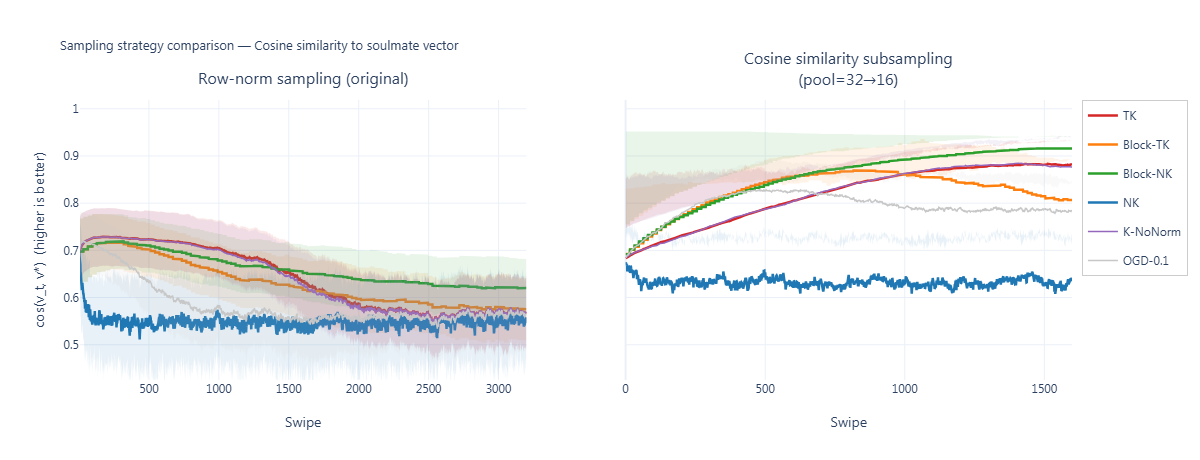
Figure 1: Mean cosine alignment cos(v^t,gu) over swipes, demonstrating that Block-NK (green) achieves the highest alignment while NK (blue) stagnates due to recency bias.
For η=0.5, the impact of an interaction falls to 10−6 after just 20 swipes, causing the model to forget early interactions almost completely. This directly violates the desideratum that informative early feedback should persist and accumulate, especially critical in cold-start and sparse-interaction regimes.
Tikhonov-Regularized Kaczmarz: Analytical Step Control
To resolve this, the authors replace normalization with a Tikhonov-regularized denominator so that step size is bounded analytically based on each candidate's tag density:
$v^{(t+1)} = v^{(t)} + \frac{r_t}{\norm{\bm{a}_{j(t)}}^2 + \alpha} \bm{a}_{j(t)}$
This update admits two major contributions:
- Recency bias elimination: Interaction history persists as no normalization-induced decay occurs.
- Per-candidate adaptive step size: Step magnitude adapts to the norm of the presented candidate's tag vector, which is crucial under realistic, non-uniform tag densities.
Notably, with pre-normalized candidates, this update collapses to standard online gradient descent (OGD); under real-world, variable candidate norms, the method is structurally distinct and non-replicable via any fixed-rate OGD.
Block Kaczmarz Variants and Stability
To further enhance stability, the Block-TK and Block-NK variants are introduced. These process entire swipe sessions as a single regularized Gram matrix solve, performing aggregation and projection onto the joint constraint space of a session. Block-NK, in particular, combines batch Gram solution and post-session normalization (once per session, not per swipe), crucially allowing within-session learning to persist and mitigating flip-induced drift.
Empirical results robustly demonstrate that Block-NK achieves:
- Highest early-stage alignment (Align@20 = 0.698) and final stability (Δs=0.994).
- Superior noise robustness, with almost flat degradation even at high flip rates.
Empirical Evaluation and Numerical Results
Large-scale simulations (over 6,400 swipes per user) are conducted on synthetic populations with simulated ground-truth soulmate vectors, using both row-norm sampling and adaptive cosine-based subsampling.
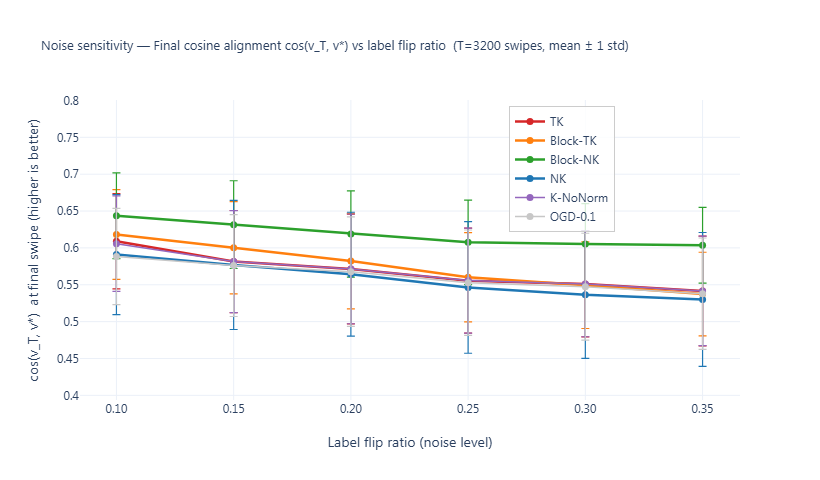
Figure 2: Final cosine alignment cos(v^T,gu) versus label flip ratio, indicating Block-NK's superior robustness across increasing noise.
Key quantitative findings include:
- NK (Normalized Kaczmarz) underperforms: It exhibits poor alignment (Align@20 = 0.626) and unstable session-to-session directions (Δs=0.738), directly resulting from recency bias.
- Block-NK dominates stability and robustness: Stable across high label noise and consistently best sessional direction stability.
- Adaptive candidate pool subsampling via cosine similarity accelerates convergence, with Block-NK achieving ηn−t0 by swipe 3,000, but introduces a positive feedback loop that can impede recovery from miscalibration.
- Sequential Tikhonov-Kaczmarz and K-NoNorm perform equivalently when candidate vectors are not normalized, indicating that the primary benefit of Tikhonovization here is step control per tag density, not the addition of the regularization constant ηn−t1 alone.
Implications and Prospective Developments
The research has both practical and theoretical consequences:
- Reciprocal recommenders in cold-start scenarios ought to prefer Tikhonovized and block Kaczmarz approaches—particularly Block-NK—when individual learning must be robust and sample-efficient, and when swipe sessions are naturally batched.
- Adaptive step-size control via per-candidate geometry yields both improved learning dynamics and analytical norm bounds, enhancing interpretability.
- Adaptive candidate subsampling demonstrates that careful design of the presentation policy can exploit current model beliefs for faster convergence, but system designers must monitor for self-reinforcing bias and be ready to revert to informativeness-driven sampling as needed.
Future extensions can pursue formal convergence analysis of Block-NK under adversarial noise, explore adaptive ηn−t2 and batch size ηn−t3 based on Gram matrix spectra, recalibrate label generation against raw dot product statistics, and conduct human subject trials in live systems with evolving preference drift.
Conclusion
This work systematically diagnoses and resolves the principal failure mode of existing Kaczmarz-based online preference learners—exponential recency bias introduced by post-update normalization—by advocating for Tikhonov-regularized, per-candidate step control and block solution frameworks. Block-NK, in particular, delivers both empirically verified and theoretically motivated improvements in alignment, stability, and robustness. These algorithmic insights are broadly applicable to real-world reciprocal recommendation systems, especially in data-sparse, privacy-preserving, or cold-start regimes, and suggest multiple promising avenues for further refinement and deployment in interactive, real-time applications.