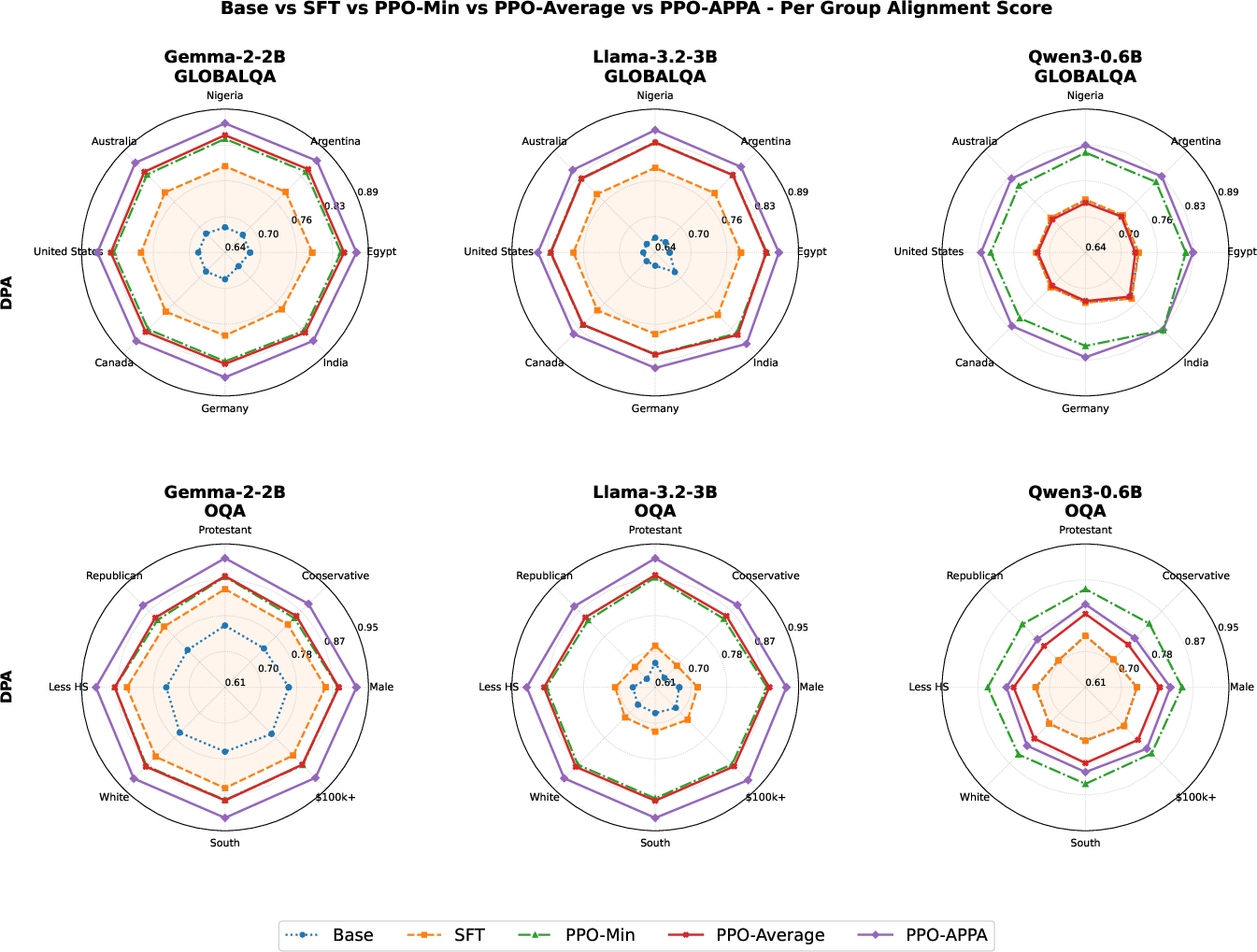
- The paper introduces APPA, using dynamic group-specific weighting to balance global utility and worst-group fairness in federated RLHF settings.
- It leverages adaptive aggregation with metrics like JS divergence and Wasserstein distance, achieving up to 28% improvement in worst-group alignment.
- The approach maintains privacy by transmitting only group-level rewards, setting a new baseline for scalable, fair LLM alignment protocols.
Adaptive Preference Pluralistic Alignment for Fair Federated RLHF of LLMs
Alignment of LLMs with human preferences fundamentally requires pluralistic alignment—specifically, policies that encode the values and social norms of heterogeneous user subpopulations. In pluralistic alignment, distinct demographic, cultural, or geographic groups each possess non-identical, and often conflicting, preference structures. Federated RLHF (FedRLHF) enables these groups to jointly train a shared model via local reward generation, avoiding the privacy and centralization concerns of raw data pooling. However, the aggregation of group-level rewards becomes the central challenge: naive averaging enforces majority dominance and neglects worst-group alignment, while minimax strategies collapse group contributions to the worst-served, typically at the expense of overall quality. This work targets robust, privacy-preserving optimization of the fairness–utility Pareto frontier for pluralistic alignment, under the strict constraint that only group-level reward signals (never raw preference data or local model parameters) are transmitted for aggregation.
Method: Adaptive Preference Pluralistic Alignment (PP)
The proposed framework, Adaptive Preference Pluralistic Alignment (PP), inserts an adaptive, group-weighted aggregation module into a PPO-based FedRLHF pipeline. Each federated group g maintains a frozen PluralLLM preference predictor, locally inferring group-specific distributional targets from a few-shot local context. Given global rollout data, each group returns local rewards rg,j for each rollout item, computed using metrics such as Jensen–Shannon (JS) divergence, Wasserstein distance (Was.), and cosine similarity, normalized to [0,1]. At the server, PP adaptively aggregates {rg,j}g using history-aware group-specific weights αgt.
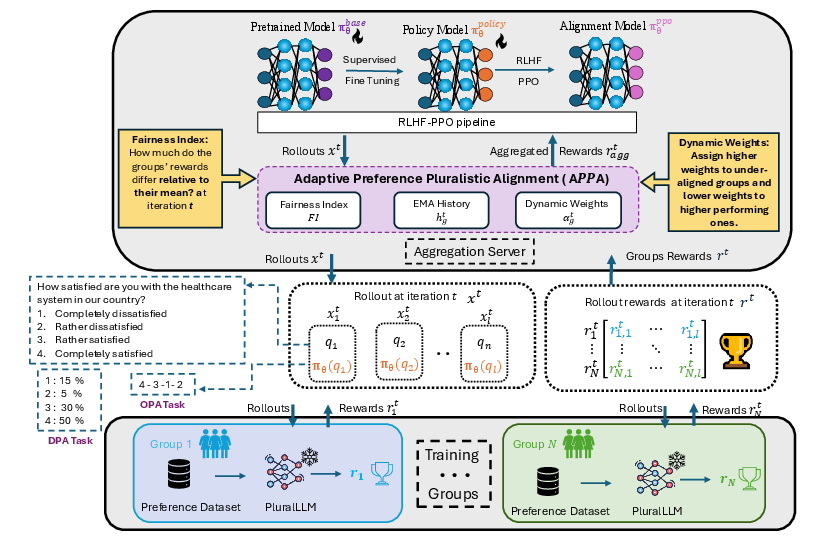
Figure 1: Overview of the PP framework: federated RLHF for pluralistic alignment of group preferences with adaptive dynamic reward aggregation.
The distinguishing algorithmic components are as follows:
- Dynamic group-specific weighting: For each PPO update, a reversed softmax over exponentially moving averaged historical group alignment scores hgt amplifies the weight of under-aligned groups while ensuring all groups (including well-aligned) retain non-zero influence. The temperature parameter T governs the sharpness of this ‘focusing’ dynamic.
- Fairness Index (FI) gating: When instantaneous reward dispersion across groups is highly uniform (FI≥τ), the aggregator collapses to a simple average for stability; otherwise, adaptive log-sum-exp reweighting is in force. This enables seamless transition as group alignment disparities shrink.
- Privacy preservation: Only group-level rewards are transmitted, never raw preferences or local contextual samples, preserving federated privacy guarantees.
The aggregation is formulated as:
Aggαt(rjt)={N1∑grg,jtif FI≥τ log(N1∑gexp(αgtrg,jt))otherwise
where αgt is computed via a reversed softmax of rg,j0, ensuring that underperforming groups are adaptively upweighted.
Empirical Results
Datasets, Tasks, and Models
Experiments span GLOBALQA (cross-national, nominal response distributions) and OQA (US demographic, ordinal response sets), each partitioned into federated groups (countries or demographic strata, respectively). Three instruction-tuned LLMs are evaluated: Gemma-2-2B, Llama-3.2-3B, and Qwen3-0.6B, representing a broad range of parameter capacities.
Fairness–Alignment Trade-off
The core evaluation concerns global (average) and worst-group (minimum) alignment scores, using per-question, per-group reward metrics defined above. All results are computed on held-out test sets.
Fairness–Alignment Pareto Visualization
Scatter analysis of the (\text{FI}, Min AS) plane demonstrates that PP consistently achieves near-Pareto-optimal joint fairness and worst-group alignment. Average aggregation strategies are displaced downward in Min AS, and Min aggregation, while occasionally matching FI, typically yields lower Avg AS.
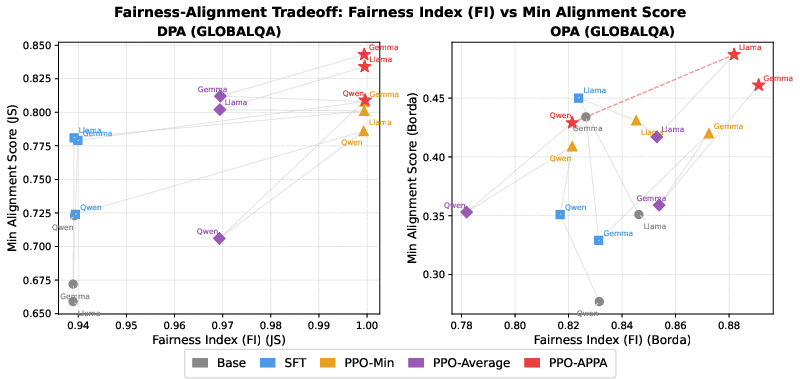
Figure 3: Pareto plot of Fairness Index vs. Minimum Alignment Score (GLOBALQA), showing PP (red stars) occupying the upper-right region for all model and aggregation combinations.
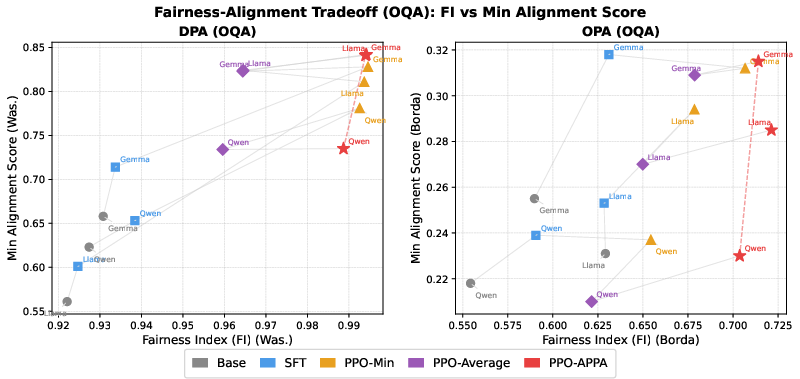
Figure 4: Fairness–Alignment Trade-off on OQA; PP remains near the Pareto frontier across capacity regimes.
Theoretical Properties
- The piecewise adaptive aggregation produces a valid, scalar reward signal that is compatible with the PPO objective and maintains trajectory- or batch-level differentiability as required for gradient ascent.
- The reversed softmax dynamic ensures self-correction: as an under-aligned group’s reward rises, the focus shifts smoothly to any remaining lagging groups. No group’s reward dominates permanently or is permanently suppressed.
Implications and Future Directions
This work demonstrates that strictly reward-level federated RLHF can achieve high-fidelity pluralistic alignment, without requiring sensitive raw data or centralized per-group labels. The adaptive reward aggregation paradigm introduces a new regime for balancing utility/fairness Pareto curves in LLM alignment, with direct applicability to other privacy-critical multi-stakeholder optimization domains. Notably:
- Practical significance: Ready integration with LLM training protocols, preservation of privacy, and computational efficiency render PP suitable for deployment in real-world multi-group dialogue, survey, and preference learning scenarios.
- Theoretical implications: The method establishes that neither hard minimax nor naive averaging are optimal for pluralistic RLHF in the federated setting; adaptive, history-aware weighting achieves superior fairness–utility trade-off.
- Extension opportunities: Future work includes extending adaptive aggregation to tasks with richer action and reward structures (e.g., long-form text generation, code, creative writing), where reward signal design and group-level consensus become harder. Design of aggregation rules for settings with partial group overlap, time-varying demography, or adversarial group dynamics remains open.
Conclusion
Adaptive Preference Pluralistic Alignment operationalizes the pluralistic alignment problem for LLMs in a privacy-sensitive federated RLHF setting. Its adaptive reward aggregation improves both global and worst-group alignment without sacrificing either, establishing a new strong baseline for fairness-aware, scalable LLM alignment protocols. As the space of societal uses for LLMs expands, aggregation mechanisms that are both fair and private will be critical; this work delineates a theoretically sound, empirically validated path forward.
For full details, see "APPA: Adaptive Preference Pluralistic Alignment for Fair Federated RLHF of LLMs" (2604.04261).