- The paper advances the Elo system by introducing a score-driven update that improves fairness and accommodates a wide range of game outcomes.
- It employs the gradient of the log-likelihood to update ratings, ensuring properties like zero-sum, monotonicity, and mean-reversion.
- The methodology extends to margin of victory, draws, and multi-player rankings, unifying various extensions under a single statistical framework.
Score-Driven Rating System: A Generalization of Elo for Sports
Introduction
The paper "Score-Driven Rating System for Sports" (2604.09143) presents a rigorous generalization of the Elo rating system using the gradient of the log-likelihood (hereafter, the "score") as the core update mechanism for player/team ratings. This framework decouples the update rule from the strong assumptions and limitations of the original Elo model, extending to diverse game outcomes—including win/loss, margin of victory, draws, and full multi-player rankings. The authors establish theoretical properties of score-driven updates (e.g., zero-sum, expectation zero) and demonstrate fairness, internal consistency, and adaptability to latent, time-varying skills. This framework unifies earlier disparate generalizations of Elo into a single, principled approach with immediate analytical and practical implications in sports analytics and beyond.
Classical Elo Rating Overview
The classical Elo system, originally designed for chess, is a sequential rating method where ratings of players increase or decrease based on actual results relative to expected outcome, the latter computed from rating differences via a logistic transform. While widely adopted, its domain is essentially restricted to binary outcomes and relies on a model where the probability of result is a unique function of current rating difference.
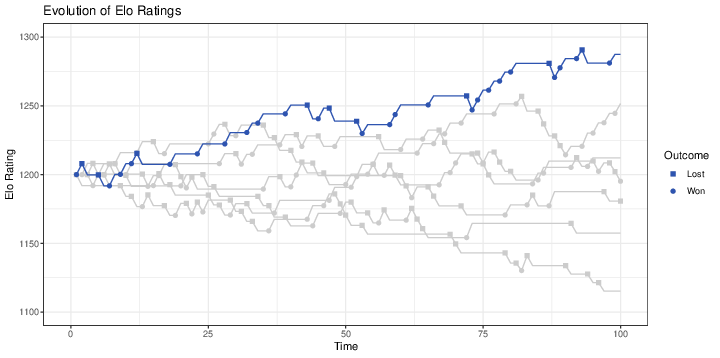
Figure 1: Simulated paths of Elo ratings for seven players, with one player highlighted.
Score-Driven Rating System Framework
The core innovation of this work is to replace the fixed difference-between-outcome-and-expectation update in Elo with the "score"—the derivative of the log-likelihood of the observed outcome with respect to player ratings. This permits construction of rating dynamics for essentially any outcome space representable as a random variable with a differentiable likelihood depending on ratings. The update rule is
rt+1(i)=rt(i)+K∇i(rt;yt),
where ∇i(rt;yt)=∂rt(i)∂lnf(yt∣rt).
Key assumptions are differentiable, strictly log-concave likelihoods dependent only on rating differences, ensuring desirable global properties.
Elo as a Special Case
A central analytical result is that the standard Elo system is a special case of the score-driven system if and only if the likelihood model uses a logistic link function for the outcome. The updating rule based on actual-minus-expected outcome aligns exactly with the gradient ascent on the (logistic) likelihood.
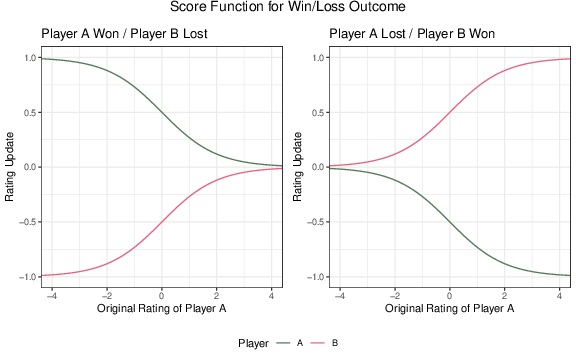
Figure 2: The score function for a win/loss game outcome, modeled by the Bernoulli likelihood.
Extensions: Margin of Victory, Draws, and Multi-Player Rankings
Margin of Victory
The framework naturally generalizes to update ratings for games where the outcome is a margin (e.g., point difference), using the Skellam or bivariate Poisson model for the result. The score update incorporates the deviation from expected margin, appropriately scaled. Importantly, the magnitude of the update reflects not only outcome but the model’s predicted expectation and variance for that match-up.
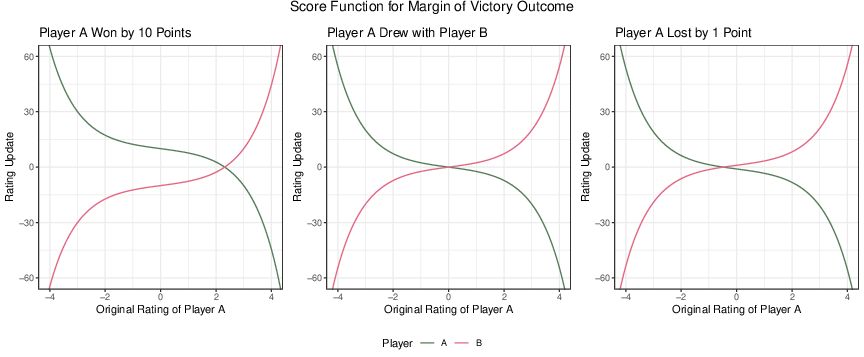
Figure 3: The score function for a margin of victory game outcome, showing gradient w.r.t. player A's rating.
Incorporation of Draws
Ordered categorical outcomes (win/draw/loss) are handled via ordered logit (or probit) models, allowing for a draw threshold parameter. The update for each result is computed through the score of the respective likelihood, ensuring the same fairness and zero-sum properties.
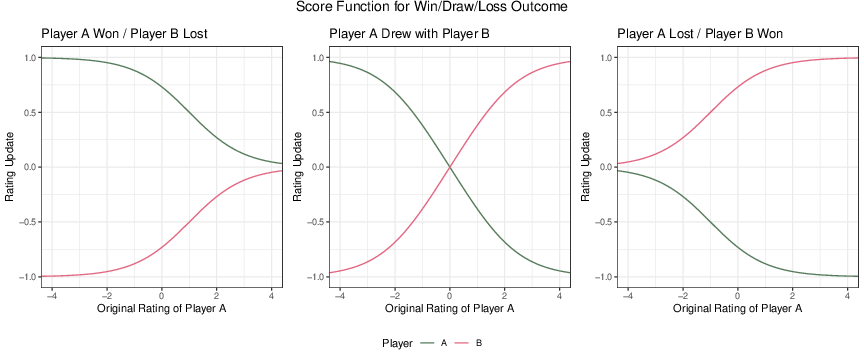
Figure 4: The score function for a win/draw/loss game outcome, including the effect of rating difference and draw threshold.
Complete Player Rankings
Multi-player events, common in athletics and races, are treated via the Plackett–Luce model for rankings. The score-driven update is computed for all participants based on their observed rank versus expected ranking probabilities under the current rating vector.
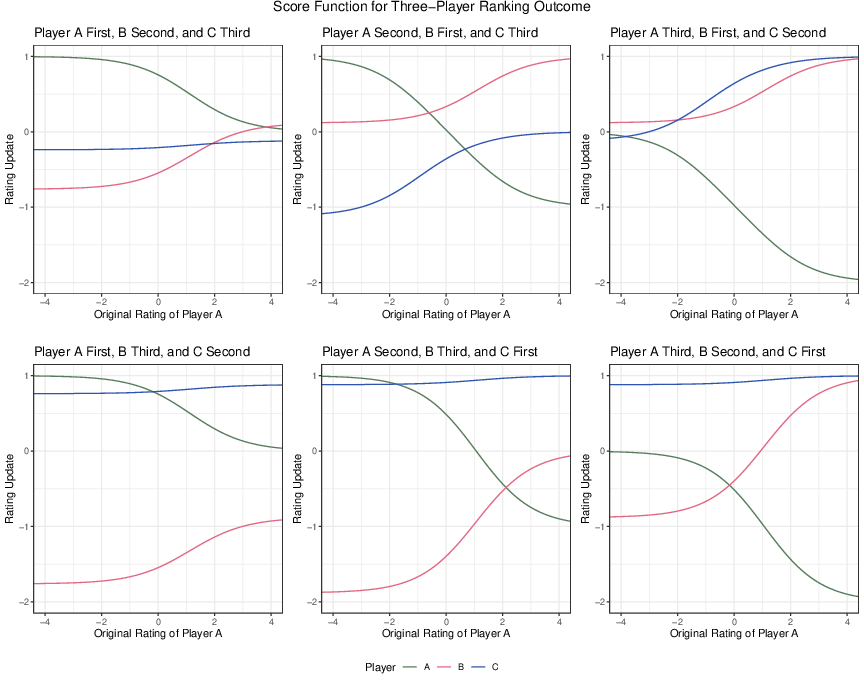
Figure 5: The score function for a ranking game outcome with three players, derived from the Plackett–Luce model.
Theoretical Properties and Fairness
The authors prove critical invariance and fairness properties of the score-driven update, provided the likelihood model meets the required conditions:
- Zero Expected Value: The expected rating update for a player, under the model, is zero, ensuring no player is favored.
- Zero Sum Over Players: After each game, the sum of all updates is zero; there is no inflation or deflation bias.
- Monotonicity: The score is strictly decreasing in a player's own rating—strong players lose more, gain less per outcome.
- Score-Driven Reversion: If a player's rating over- (under-)estimates their latent skill, the expected update is negative (positive) with respect to the true skill model. This creates a mean-reverting dynamic enabling tracking of time-varying ability.
Reversion Dynamics and Empirical Illustration
The score-driven system produces reversion dynamics, pushing ratings toward unobserved true skills over time even if the current ratings are far from those skills (e.g., due to initial uniform assignment). The rate and noisiness depend on the K-factor, outcome model and schedule of interactions.
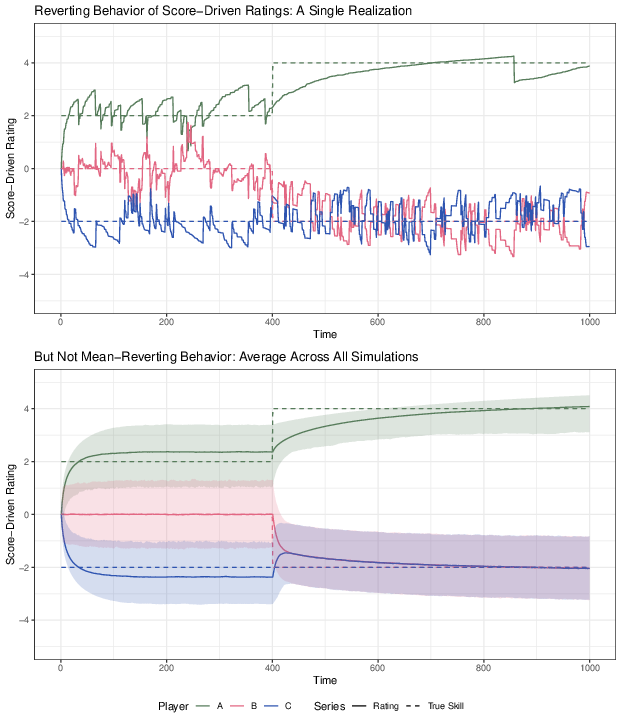
Figure 6: Simulated paths of score-driven ratings for three players, with illustration of both single-run realization and averaging across simulations (with 95% confidence bands).
Practical and Theoretical Implications
The unified score-driven framework delivers a robust method for constructing fair, internally-consistent rating systems for arbitrary sports or games, including those with multi-way, ranked, or high-cardinality outcome spaces. It rationalizes several earlier extensions of the Elo system under a single statistical principle and offers prescriptive guidance for building novel models for emerging sports or for applications outside sports (e.g., peer grading, reputation systems).
From a theoretical perspective, the framework clarifies the conditions under which rating systems possess desirable invariance properties, and exposes the limitations of mean-reverting or explanatory-variable-augmented dynamics when fairness is a primary concern. Questions on long-term convergence, and the precise relationship between rating process and latent skill trajectory under more complex interaction schedules, remain for future investigation.
Conclusion
The score-driven rating system represents a principled generalization of Elo, substituting the update with the likelihood score to achieve applicability across outcome types and sports domains while preserving crucial fairness and stability properties. Its foundation in likelihood theory and gradient ascent situates it as a compelling standard for designing rating dynamics, with both immediate and future significance for sports analytics, competitive systems, and statistical modeling more broadly.