- The paper presents a novel GPU-based pipeline that leverages delta-compressed CSR and HyperBall BFS approximation to overcome scalability bottlenecks in visibility graph analysis.
- It demonstrates high metric fidelity with a median error below 2% and speedups up to 239×, ensuring efficient and accurate urban spatial analysis.
- The approach scales to billions of edges and millions of nodes, enabling comprehensive city-wide analysis of visual integration and spatial configuration.
City-Scale Visibility Graph Analysis via GPU-Accelerated HyperBall
Introduction
"City-Scale Visibility Graph Analysis via GPU-Accelerated HyperBall" (2604.08374) introduces a computational pipeline that enables city-scale Visibility Graph Analysis (VGA), a fundamental space syntax approach for quantifying visual accessibility and configurational properties in urban spaces. Conventional VGA implementations are constrained to small study areas due to the O(N2) complexity of all-pairs BFS computations and the immense memory requirements for in-memory representation of large, dense visibility graphs. This work systematically removes these scalability bottlenecks via (1) delta-compressed CSR graph representation for both memory reduction and data streaming, (2) a HyperBall-based probabilistic BFS surrogate for O(D∣E∣2p) computation (where D is the graph diameter and p the HyperLogLog precision), and (3) a GPU-accelerated decode-union pipeline performing compressed traversal and register unions in CUDA kernels. The system is implemented with strict fidelity to the edge construction of the established tool depthmapX, enabling direct accuracy and performance comparisons.
Methodological Innovations
Delta-compressed CSR and Streaming Architecture
Dense visibility graphs present prohibitive memory footprints: for instance, a city-scale open-space grid at 3–5 m resolution and moderate radius yields hundreds of millions to billions of edges. The contribution of delta-encoded, LEB128-varint-applied CSR reduces raw index stream size by approximately 4×, enabling both in-memory and memory-mapped (mmapped) operation for graphs well beyond system RAM. Nodes are raster scan–ordered, resulting in mostly small index deltas, often 1–2 bytes (Figure 1).
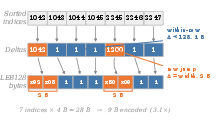
Figure 1: Delta-compressed CSR encoding leveraging small deltas from sorted neighbors and LEB128 provides memory efficiency and PCIe streamability for GPU operations.
This representation supports sequential streaming to GPUs for graphs too large to fit in VRAM, a property critical for the subsequent stages.
HyperBall Propagation for BFS Approximation
The all-pairs shortest-path computation required by VGA’s core metrics (e.g., mean depth, visual integration) is replaced by simultaneous neighborhood growth using HLL sketches per node (Figure 2). Iteratively, registers are max-merged and approximate neighborhood cardinalities ∣B(v,t)∣ are accumulated. The sum-of-distances is efficiently obtained without tracking explicit predecessor lists or distance matrices, and the operation count is proportional to the number of HyperBall iterations (equal to depth limit or diameter), not the network size.
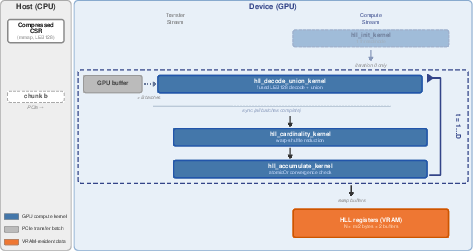
Figure 2: The GPU execution pipeline retains HLL registers in VRAM while compressed batches are streamed, decoded, and processed entirely on the device.
The fused decode-union kernel handles both LEB128 decoding and highly-parallel register union, and the architecture supports double-buffering, register packing, and device-level cardinality estimation.
Fidelity and Portability
To ensure accuracy is only affected by the HLL-approximate propagation (not visibility construction), the authors directly ported depthmapX's sparkSieve algorithm to parallel Rust, with exact edge set parity for benchmarking. Optional Hilbert reordering improves cache locality for unlimited-depth analysis, but for standard neighborhood scales (depth-3), working sets remain in GPU cache.
Experimental Results
Accuracy
HyperBall’s HLL-based distance estimates yield high-fidelity results. At p=10, Visual Mean Depth achieves Pearson r=0.999 and median relative error of 1.7% compared to exact BFS reference (depthmapX), across 20 varied configurations. Integration [HH] achieves Spearman ρ=0.893, improving to O(D∣E∣2p)0 at O(D∣E∣2p)1. Local metrics (connectivity, control, clustering) are computed exactly and are unaffected by the approximation. Errors in integration metrics are amplified mainly for extreme values due to nonlinear normalizations.
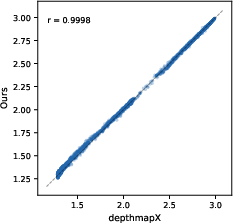
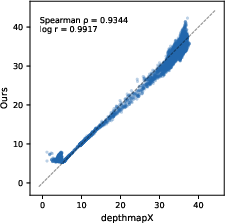
Figure 3: Scatter plot shows strong correspondence in Visual Mean Depth by HyperBall (O(D∣E∣2p)2) versus depthmapX.
The system delivers superlinear speedups as problem size increases: at O(D∣E∣2p)3 nodes, the end-to-end pipeline is O(D∣E∣2p)4 faster than depthmapX (7.25 s versus 1732 s for the largest configuration depthmapX could complete). BFS cost is proportional to the depth parameter: at standard depth-3, the BFS phase is O(D∣E∣2p)5 faster. The tool scales to O(D∣E∣2p)6 nodes and O(D∣E∣2p)7 billion in 137 s, with construction plus analysis of a full city grid (O(D∣E∣2p)8 million nodes, O(D∣E∣2p)9 billion edges) completing in 5.5 minutes (Figure 4, Figure 5).
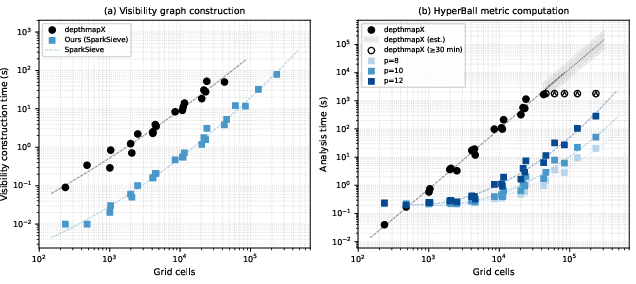
Figure 4: Log-log scaling by grid cells and HLL precision confirms near-quadratic scaling intrinsic to unlimited visibility radius but sub-quadratic with bounded radius.
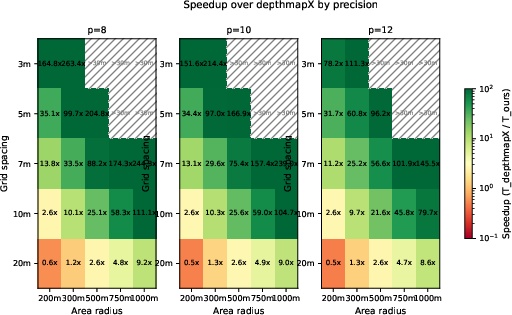
Figure 5: Speedup heatmap over depthmapX, reaching over D0 for city-scale instances.
Depth limiting is an intrinsic accelerator with HyperBall, in marked contrast to depthmapX where BFS time is largely invariant to the cutoff due to high graph connectivity and tiny diameter. The proportional iteration–cost alignment means that the most common analytical scale (depth-3) is also the computationally cheapest under this system.
Case Study: Valdivia
The system was exercised on the Valdivia, Chile city area at 5 m resolution and 400 m radius, producing a graph with 2.7 million nodes and 12.1 billion edges. The entire analysis, including grid and graph construction, compressing, and metric computation (at D1), was completed in 333 s on a consumer-grade laptop GPU. Spatial patterns of integration are consistent with prior studies, confirming practical utility at previously infeasible scales.
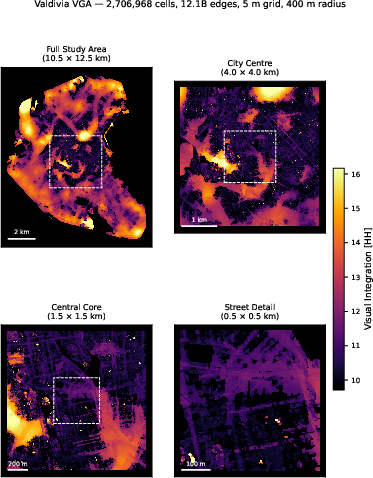
Figure 6: Visual Integration [HH] in Valdivia at 5 m resolution, showing both city-wide and street-level detail.
Discussion
The introduced paradigm demonstrates that city-scale VGA is feasible on off-the-shelf hardware. The error characteristics of the HLL approximation remain bounded and monotonic with precision; in practice, D2 is suitable for all but the most error-sensitive applications, given the sub-D3 median error. Local metrics remain exact. The alignment of HyperBall iteration count with analytical depth is a strong practical advantage for routine use.
Limitations include the current focus on planar (2D) visibility, absence of explicit terrain handling, and CUDA hardware requirement for optimal throughput. The batch streaming approach saturates near the highest edge densities, but practical urban analyses using bounded radius (which keeps average degree in check) are not affected. The system sidesteps the BFS ‘frontier plateau’ that plagues exact BFS algorithms on high-degree graphs. Scalability to larger scales will benefit from warp-cooperative decode, multi-GPU environments, and unified-memory GPU architectures.
Theoretical and Practical Implications
This system fundamentally changes the cost structure of VGA by exploiting the regularity and density of visibility graphs, the appropriateness of probabilistic neighborhood cardinality estimation, and the compute/memory characteristics of modern accelerators. By aligning algorithmic cost with analytical best practice (depth-limited analysis), routine city-wide VGA is now tractable, opening the path for robust resolution and sensitivity analyses. Given its high-fidelity reproduction of established metrics, this pipeline may serve as the new technical baseline for urban configurational studies requiring grid-based VGA.
Conclusion
The integration of delta-compressed CSR storage, HyperBall-accelerated BFS approximation, and GPU execution constitutes a paradigm shift in the practical limits of Visibility Graph Analysis. The system delivers orders-of-magnitude speedup without sacrificing metric fidelity for both local and global VGA measures. For practitioners, most standard analyses become computationally trivial, supporting not only one-off studies but systematic, multiresolution investigations. These contributions enlarge the methodological repertoire for quantitative urban morphology and spatial configuration research, with immediate implications for pedestrian modeling, social space studies, and city-scale design optimization.

