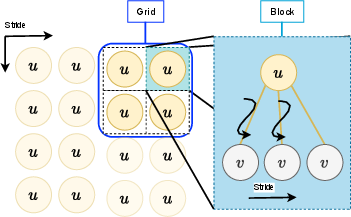
- The paper introduces DynLP, a GPU-parallel dynamic label propagation algorithm that updates only the affected subgraph to reduce redundant computation.
- It employs connected component-based initialization and block-strided CUDA kernels to deliver fast, scalable iteration on evolving graphs.
- Experimental results show linear scaling with graph size and significant speedup, while preserving prediction accuracy compared to traditional methods.
Parallel Dynamic Batch Update for Label Propagation in Semi-Supervised Learning
Introduction
Semi-supervised learning (SSL) is essential for data regimes where labeled samples are scarce and expensive to acquire, yet the volume of unlabeled data is substantial. Graph-based SSL (GSSL) has proven effective by leveraging structural relations, with label propagation (LP) as the core algorithm for inferring labels on graph nodes. Real-world settings commonly feature incremental data acquisition, requiring repeated batch updates to the graph and its labels. However, most LP methods are static, recomputing the solution from scratch for each batch—incurring redundant computation and poor scalability. The paper "DynLP: Parallel Dynamic Batch Update for Label Propagation in Semi-Supervised Learning" (2604.06596) introduces DynLP, a GPU-parallelized dynamic batched LP algorithm capable of efficiently updating node labels on sparse, evolving graphs with minimal redundant computation.
Methodology
Dynamic Iterative Label Propagation
DynLP formalizes the batch update problem for dynamic graphs, which include batched insertions and deletions of nodes. Traditional LP and streaming LP solutions require full graph Laplacian recomputation, leading to quadratic space and time complexity. DynLP circumvents this bottleneck with three principal innovations:
Kernel and Memory Design
To ensure practical scalability, DynLP designs specialized GPU kernels for sparsification and connected component finding and uses asynchronous host-to-device memory transfer to overlap computation and data movement. This enables efficient handling of batches in large, highly dynamic graphs.
Experimental Evaluation
Iteration and Execution Efficiency
DynLP was benchmarked against state-of-the-art static and streaming LP approaches, as well as recent GNN-based baselines, on both synthetic and real-world datasets scaling up to 50 million vertices. Required iteration counts and execution times exhibit nearly linear scaling in graph size, dramatically reducing overhead for batch updates compared to full recomputation.
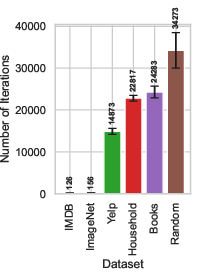
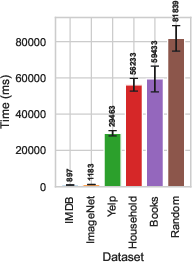
Figure 2: Required iterations scale moderately with graph size and batch composition.
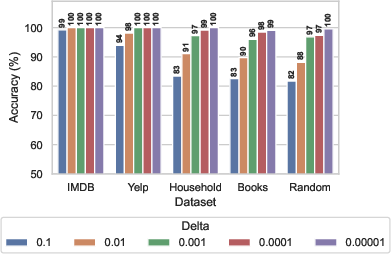
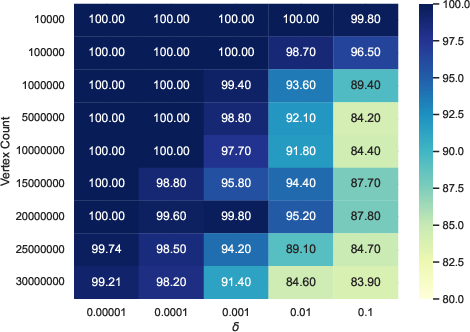
Figure 3: Accuracy variation across datasets demonstrates that DynLP fully preserves predictive quality for small δ.
DynLP achieves, on average, 13× and up to 102× speedup over standard iterative LP. The speedup is more pronounced for sparser graphs and larger batch sizes due to reduced redundant computation and memory optimizations.
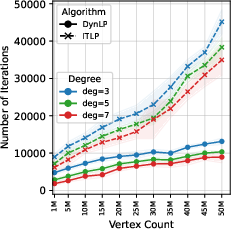
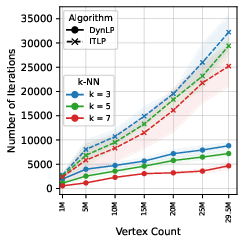
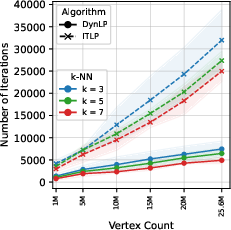
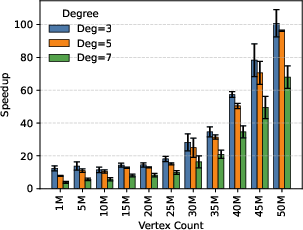
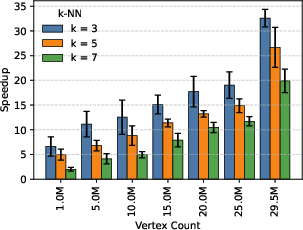
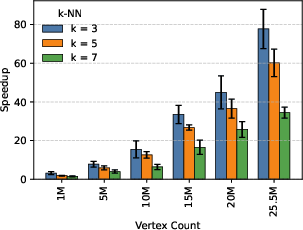
Figure 4: Iteration count for random graphs as batch size varies.
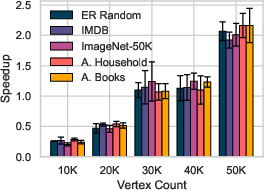
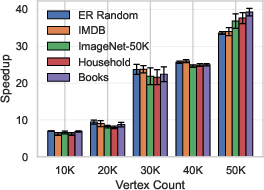
Figure 5: Speedup is measured considering only kernel execution on increasingly large vertex counts.
Comparison with Baselines
Against streaming LP (Wagner et al.'s method), DynLP dramatically outperforms both in kernel execution speed and when accounting for host-device memory transfer. The short-circuiting baseline is constrained by quadratic space complexity and fails to scale beyond 50K vertices, while DynLP operates efficiently at 50M scale.
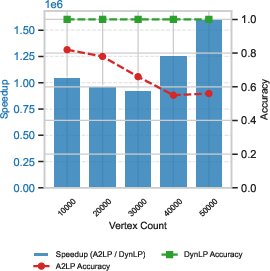
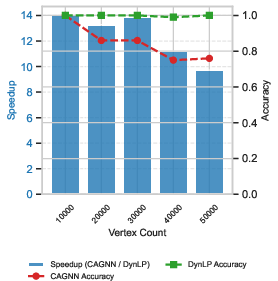
Figure 6: Comparison with A2LP on IMDB, demonstrating superior accuracy and speedup.
Machine learning-based approaches (A2LP, CAGNN) exhibit substantially higher execution times and lower accuracy in limited label regimes. DynLP and classical optimization-based methods maintain optimal accuracy, except for matrix approximation variants, which degrade in both precision and scalability.
Theoretical Guarantees
DynLP's update rule is shown to be equivalent to weighted neighborhood averaging, guaranteeing convergence to the unique harmonic solution for the updated graph. Strict convexity of the Dirichlet energy on the space of free variables substantiates convergence. This ensures that fast, local updates yield globally correct LP solutions over the evolving graph.
Implications and Future Directions
Practically, DynLP offers a scalable LP solution for real-time, dynamic settings in domains such as online recommendation, streaming annotation, sentiment analysis, and medical image categorization at industrial scale. Theoretically, the approach demonstrates that high-performance parallelism and connected component-based batching can preserve accuracy and minimize computation w.r.t. redundant LP calculation. The block-strided kernel and asynchronous memory design are generalizable to similar dynamic graph problems.
The restricted binary classification framework can be extended to multi-class scenarios; future research will need to generalize the connected component and initialization logic. DynLP's principles are applicable to other iterative graph inference algorithms (e.g., personalized PageRank, community detection), suggesting broader impact on scalable graph ML.
Conclusion
DynLP (2604.06596) establishes a high-performance, scalable framework for parallel dynamic label propagation with strict convergence guarantees. It addresses the primary limitations of both static and streaming LP in SSL, achieving substantial speedup and accuracy preservation on large sparse graphs with dynamic batch updates. The algorithm's architectural optimizations and theoretical foundations position it as a robust solution for real-world batch learning environments in graph-based SSL and beyond.