- The paper introduces a novel visibility-based concavity metric that uses the cumulative length of visibility edges to drive intersection-free convex decomposition.
- It leverages GPU acceleration with NVIDIA OptiX and CUDA to perform rotation-equivariant segmentation, effectively handling irregular mesh orientations.
- Experimental results demonstrate lower concavity values and fewer convex parts compared to state-of-the-art methods such as CoACD and V-HACD.
VisACD: Visibility-Based GPU-Accelerated Approximate Convex Decomposition
Motivation and Background
Efficient convex decomposition of 3D meshes is essential for physics-based simulation, collision detection, and robotics, providing a balance between computational tractability and geometric fidelity. Prior approaches, including exact convex decomposition, yield excessively fine-grained solutions impractical for simulation, while approximate convex decomposition (ACD) provides more feasible segmentations but often struggles with accuracy, efficiency, and sensitivity to mesh orientation. Established ACD algorithms frequently employ axis-aligned cutting planes and surface- or volumetric-based concavity metrics, yet these strategies exhibit limitations such as orientation sensitivity and intersection between convex hull parts, restricting their utility in complex, irregularly oriented or organic meshes.
Methodology
VisACD introduces a visibility-based, intersection-free, rotation-equivariant approach for approximate convex decomposition, optimized for parallel execution on GPUs via NVIDIA OptiX and CUDA. The method centers on a visibility-based concavity metric, using the cumulative length of visibility edges—segments between mesh vertices that lie outside and do not intersect the mesh—to quantify non-convexity. Unlike volume- or surface-based metrics, this formulation captures geometric intricacies efficiently and enables valuation of candidate cutting planes without physically partitioning the mesh, allowing for extensive sampling at each iteration.
Visibility edges are computed in parallel, leveraging ray-mesh intersection tests against a cage mesh slightly offset from the original geometry, filtering out insignificant near-surface connections. Cutting plane candidates are generated by sampling visibility edges and assigning orthogonal planes bisecting the edges, supplemented with planes aligned to prominent flat mesh surfaces. Each plane is evaluated using a value function based on the combined length of visibility edges it would sever, maximizing efficacy in removing concavity. Decomposition proceeds via a greedy algorithm, recursively partitioning the mesh by selecting the highest-value plane until a concavity threshold, part count, or completion criterion is reached. The strategy ensures intersection-free decomposition and rotation-equivariant performance, critical for practical simulation pipelines.
Results and Empirical Findings
VisACD demonstrates superior decomposition quality and efficiency relative to state-of-the-art algorithms such as CoACD and V-HACD, particularly on datasets with irregular geometry and orientation, including Objaverse and V-HACD benchmarks. Notably, VisACD achieves comparable or lower concavity values and substantially reduces the number of convex parts required to approximate complex meshes, with increased computational speed attributable to GPU-accelerated parallelism and visibility-based evaluation.
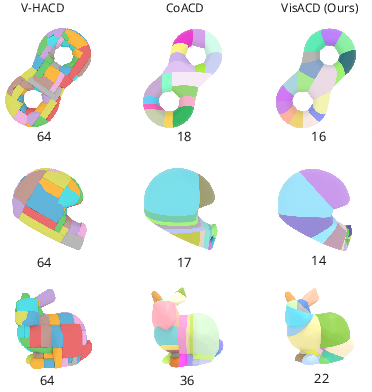
Figure 1: Qualitative Comparisons. VisACD is able to avoid axis-aligned limitations, producing accurate decompositions with fewer parts.
Qualitative analyses reveal that VisACD consistently avoids the deficiencies of axis-aligned plane methods, yielding decompositions that are both closer in shape to the input mesh and require fewer convex segments. Quantitative comparisons indicate that VisACD achieves lower or equivalent concavity values with reduced part counts across all evaluated datasets, with pronounced advantages for organically shaped or non-standardly oriented meshes. On the PartNet-Mobility dataset, results between VisACD and leading baselines are more closely matched due to the regularity of geometry; however, in diverse settings, VisACD's robustness to mesh orientation and topology is a substantial advantage.
Implications and Future Directions
VisACD's visibility-driven, rotation-equivariant approach enhances automatic collider generation and mesh processing in simulation, robotics, and game engines, mitigating manual hull fitting and improving both fidelity and efficiency. Its GPU-optimized architecture positions it well for deployment at scale in asset pipelines involving large and diverse mesh collections. Theoretical implications include an enriched understanding of visibility-based concavity as a practical surrogate for geometric complexity in decomposition tasks, and expansive plane sampling provides new possibilities for intersection-free ACD.
Despite favorable trade-offs, VisACD's greedy partitioning may produce sub-optimal global decompositions, and dependence on mesh topology necessitates remeshing for best performance. Future research may focus on integrating global optimization strategies, such as MCTS, retaining the computational advantages of visibility-driven methods. Extensions can explore adaptation to highly heterogeneous mesh structures and further acceleration using hardware-agnostic parallelization.
Conclusion
VisACD establishes a visibility-based, GPU-accelerated paradigm for approximate convex decomposition, efficiently producing intersection-free, rotation-equivariant decompositions with fewer and more accurate convex parts than predecessor methods. Its empirical superiority across diverse datasets exemplifies robust practical and theoretical contributions to simulation and mesh processing workflows. Further improvements may be achieved through global optimization and enhanced topology handling.

