- The paper introduces a novel operator-theoretic framework that uses graph Laplacians to recover intrinsic manifold diffusion operators from point-cloud data.
- It leverages the convergence of the discrete random walk Laplacian to the Laplace–Beltrami operator, ensuring statistically accurate exploration while mitigating off-manifold drifts.
- Experiments on synthetic and real datasets, such as hypersphere and Swiss roll scenarios, validate the approach's superior performance and low error accumulation compared to traditional methods.
Diffusion Processes on Implicit Manifolds: An Expert Summary
Introduction and Motivation
The paper "Diffusion Processes on Implicit Manifolds" (2604.07213) introduces a rigorous operator-theoretic framework for constructing stochastic differential equations (SDEs) that realize intrinsic manifold-valued diffusions using only access to point-cloud data in ambient space. This is motivated by the prevalent scenario in machine learning and scientific computing where high-dimensional data concentrations adhere to unknown, low-dimensional manifolds, but analytic geometric primitives—such as local charts, retractions, or explicit projections—are not accessible. The work proposes a fully data-driven method that recovers intrinsic manifold diffusion operators and simulates corresponding stochastic processes in path space, directly addressing critical gaps in the modeling, sampling, and exploration of data manifolds based on the manifold hypothesis.
Operator-Theoretic Construction and Theoretical Guarantees
The central technical contribution is the formulation of Implicit Manifold-valued Diffusions (IMDs). This involves estimation of the infinitesimal generator L—a second-order differential operator characterized by local drift and tangential noise structure—from proximity graphs over data points. The key ingredient is the use of the random walk graph Laplacian as a discrete generator, which, under appropriate scaling and vanishing neighborhood radii, converges to the Laplace–Beltrami operator ΔM of the underlying manifold as the sample size increases.
The carré-du-champ (CDC) operator, fundamental in diffusion geometry, is estimated from the data-induced discrete generator and encodes local Riemannian metric information. Notably, the authors establish that, when endowed with these graph-based differential operators and CDCs, the resulting data-driven Markov process converges in law to the true path-space measure of the smooth manifold diffusion process—a strong and nontrivial result enabling analysis and simulation without explicit manifold coordinate access.
Simulations are accomplished via a numerically consistent Euler–Maruyama scheme, justified by convergence arguments. The practical discretization is further enhanced with an optional denoising Riemannian gradient descent (DRGD) correction step, leveraging pretrained score-based models for numerical stability and improved geometric fidelity at larger step sizes.
Numerical Experiments: Statistical and Geometric Fidelity
The paper substantiates the efficacy of IMDs through experiments on both synthetic and real datasets.
First, for diffusion on the hypersphere, the endpoint statistics of IMD-simulated Langevin processes recover the analytic law of the von Mises–Fisher distribution, with close agreement between empirical and theoretical densities.
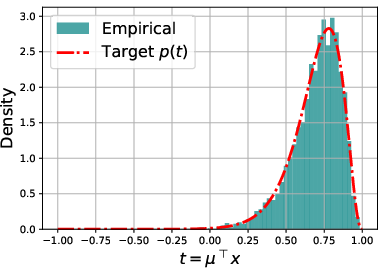
Figure 1: Histogram of the endpoint statistic t=⟨μ,YT⟩ under Langevin dynamics computed with IMDs, closely matching the von Mises–Fisher law.
Furthermore, geometric fidelity is quantified through radial error metrics: IMDs yield low mean and maximal deviation from the manifold, with the DRGD correction enabling use of larger integration steps in higher-dimensional cases.
Experiments on the Swiss roll demonstrate that the nearest-neighbor-based generator estimation prevents off-manifold drift and enables statistically coherent exploration even on manifolds with significant curvature and boundaries.
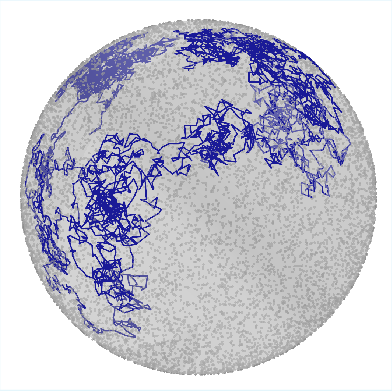
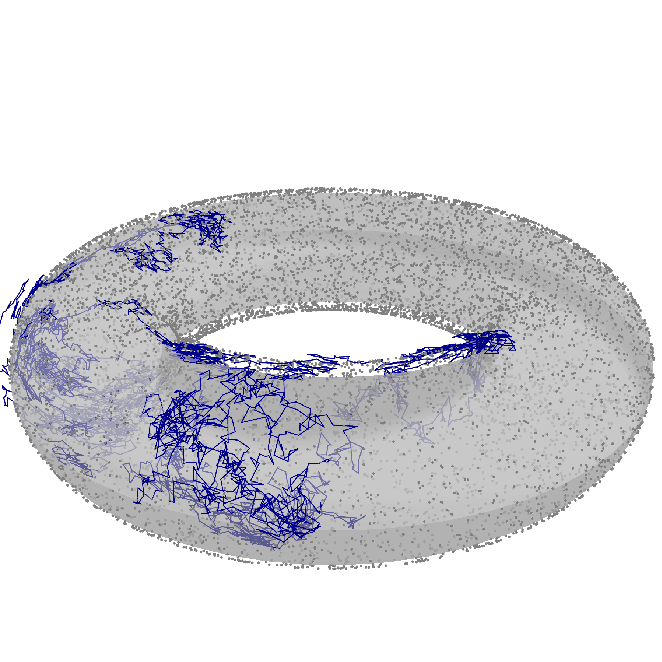
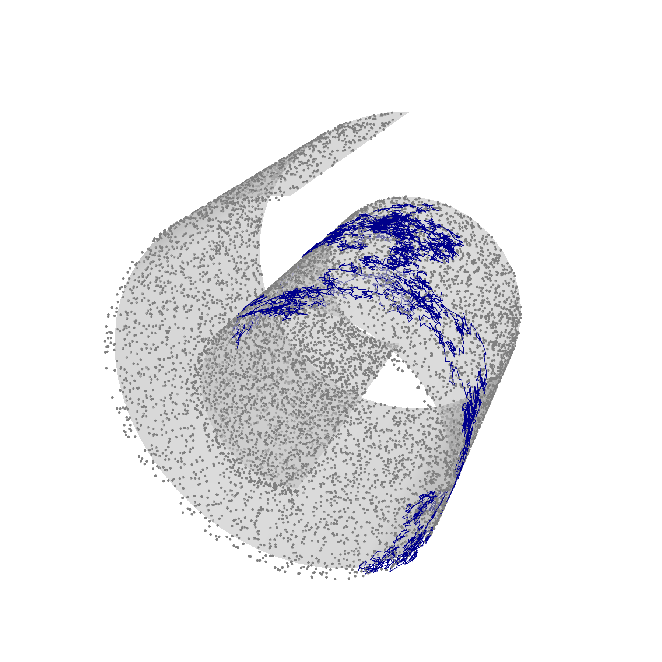
Figure 2: IMDs' discretized sample paths remain concentrated on the Swiss roll, mitigating off-manifold excursions due to nearest-neighbor Laplacian construction.
A direct comparison with alternative strategies (e.g., CDC-only or naive score-based projections) on the sphere and Swiss roll shows that IMDs uniquely achieve non-accumulative error behavior and maintain locality, while others exhibit error drift or discontinuous jumps in latent space.
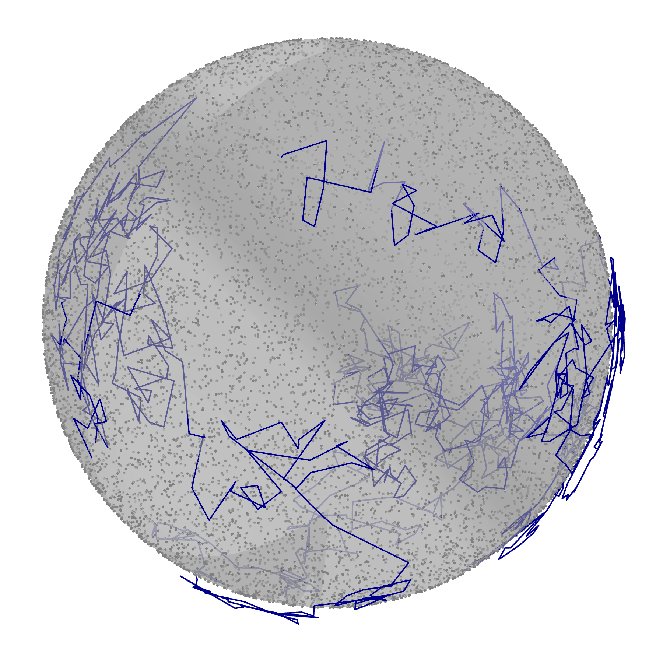
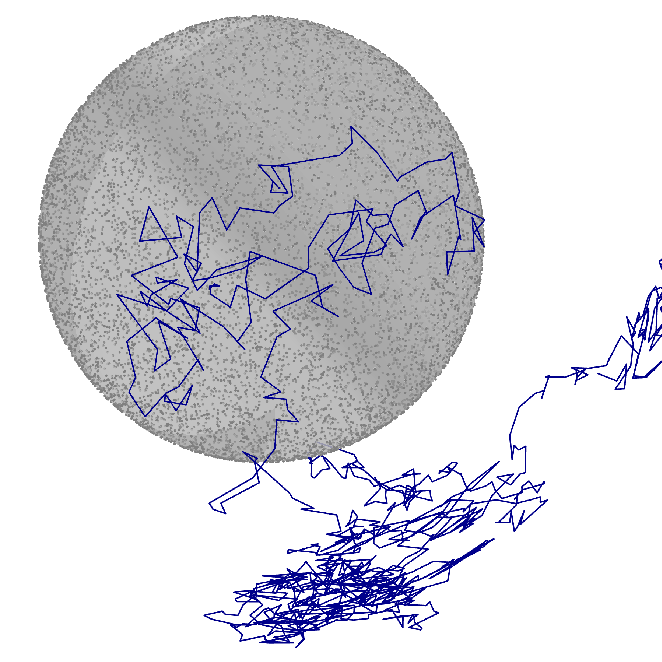
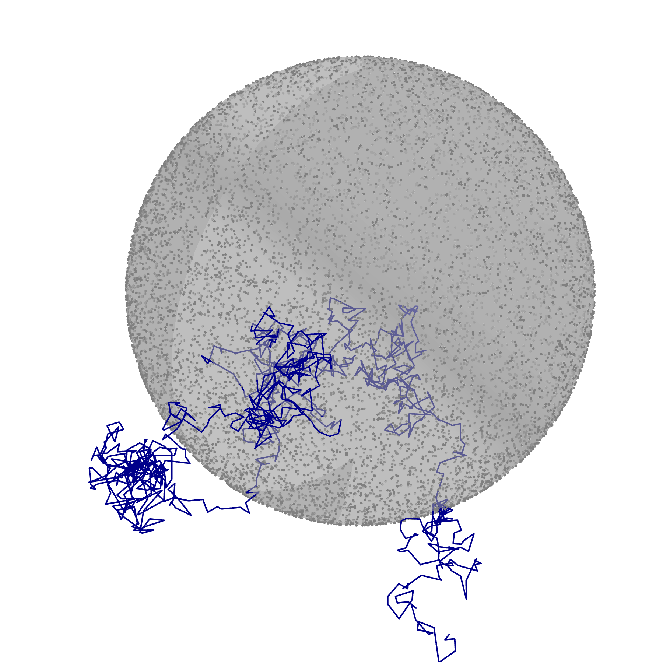
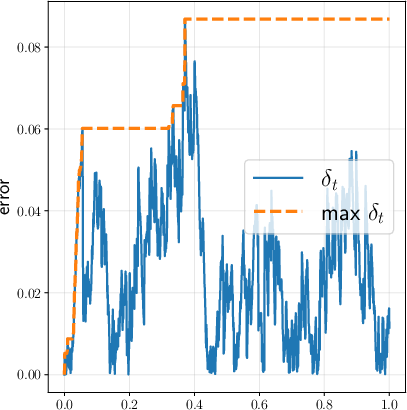
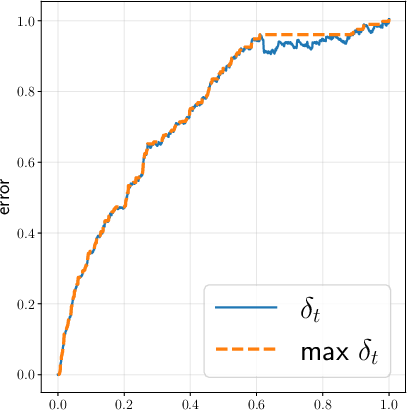
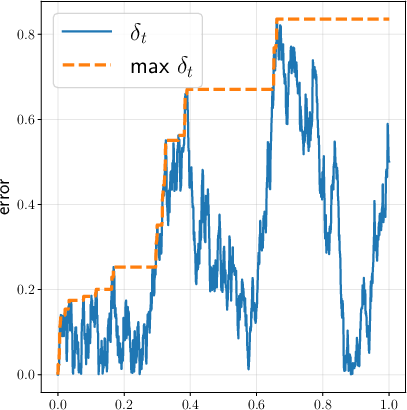
Figure 3: Diffusion trajectories (top) and radial errors (bottom) comparing IMDs and baseline methods. IMDs suppress error accumulation, unlike CDC+DRGD.
Latent Connectivity and Interpolation: Manifold-awareness in Generative Tasks
A particularly compelling application is interpolation between widely-separated states on a real-world manifold (MNIST digit submanifold). Here, IMDs produce a continuous, smooth transition between two distant data samples, unlike standard score-based retraction methods, which tend to generate artifacts or remain stuck in proximity to initialization due to lack of intrinsic dynamics.




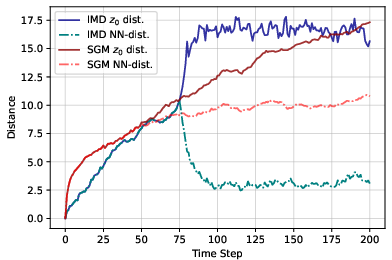
Figure 4: IMDs facilitate smooth transitions in pixel space between dissimilar MNIST digits, inaccessible to baseline generative models.
Nearest-neighbor analyses confirm that intermediate samples traverse structured interior regions of the data distribution, not simply nearest-neighbor or memorized points, demonstrating genuine exploration along the data manifold's intrinsic geometry.
Theoretical and Practical Implications
The construction developed represents a significant unification of diffusion geometry, graph-based manifold learning, and stochastic process theory, yielding a method with robust theoretical guarantees on path-space convergence. Notably, the work:
- Enables statistically correct sampling and exploration on high-complexity data manifolds using only point clouds.
- Bridges gaps between score-based generative modeling and intrinsic geometry, permitting tangential stochastic dynamics beyond nearest-neighbor interpolation or local memorization.
- Supports extensions to generative modeling scenarios conditioned on manifold structure or in the presence of noise, with implications for algorithms requiring manifold-aware stochastic sampling, e.g., in scientific simulation, robotics, or molecular modeling.
Limitations include computational challenges due to the curse of dimensionality in the graph Laplacian for high ambient dimensions, although neural surrogates for the CDC operator are proposed as a scalable direction. Finite-sample convergence bounds and adaptation to broader kernel types are posited as avenues for theoretical refinement.
Future Directions and Research Outlook
Prospective developments include neural estimation of geometric operators for scalability to massive datasets, integration of robust out-of-sample and noisy-data handling, and adaptation of IMDs for endpoint-conditioned processes such as Schrödinger bridges. Further, the fusion of tangential and normal dynamics may elucidate inductive biases in generative modeling, facilitating geometric regularization and improved mode connectivity under the manifold hypothesis.
Conclusion
The framework of Implicit Manifold-valued Diffusions advances data-driven stochastic calculus on unknown manifolds, with strong path-space convergence guarantees and demonstrated superiority over local-projection-based alternatives in maintaining intrinsic geometric fidelity. Its deployment provides critical capabilities for manifold-aware learning, sampling, and exploration, enriching the modern stochastic modeling toolkit in high-dimensional data regimes.

