- The paper presents a novel framework that structures conversational context into unit, structure, and pattern levels for non-linear, mixed-initiative interactions.
- It demonstrates that explicit, manipulable context enables users to branch, edit, and negotiate context boundaries, improving collaborative workflows.
- Empirical findings reveal that adaptive AI initiative paired with customizable context control enhances task efficiency while balancing cognitive load.
Mixed-Initiative Context: Explicit, Structured Context in Human-AI Collaboration
Introduction and Motivation
Context is foundational in human-AI collaboration, serving as the substrate for grounding, shared understanding, and continuity. Contemporary LLM systems invariably represent context as a linear transcript—a single, chronologically stacked sequence spanning all prior interaction. This approach ignores the intrinsic dynamism, heterogeneous lifecycle, and structural diversity of contextual elements generated in multi-turn collaborative tasks.
The paper "Mixed-Initiative Context: Structuring and Managing Context for Human-AI Collaboration" (2604.07121) interrogates the limitations of such flattened context models:
- Users cannot directly inspect, reorganize, or isolate portions of context; corrections are only possible via additional prompts that are neither explicit nor verifiable.
- The lack of explicit, manipulable context impedes non-linear, exploratory, multi-path workflows characteristic of ideation, comparison, backtracking, and selective foraging.
- Existing systems offer negligible or opaque affordances for collaborative context structuring—users lack control, and AI cannot explicitly propose or negotiate context boundaries.
This motivates a paradigm shift: treating context as an explicit, structured, and manipulable interactive object, forming the basis of the Mixed-Initiative Context (MIC) framework.
Mixed-Initiative Context: Conceptual Framework
The MIC framework reconceptualizes context, decomposing it into three explicit layers:
- Unit Level: Fundamental, independently addressable context units (user or AI turns), each with independently controllable participation state and lifecycle. Units can be activated, deactivated, or edited at any time.
- Structure Level: Context units are interconnected in directed, non-linear topologies (mainlines, branches, subpaths), supporting parallel, parent-child, and semantic relationships. Information locality is enforced both vertically (descendant-only propagation) and horizontally (branch isolation).
- Pattern Level: Arbitrary aggregations of context units form semantically meaningful patterns, supporting extraction, re-use, and cross-session reference as reasoning procedures, SOPs, or context summaries. These patterns constitute a higher-order, transferable knowledge layer.
Bidirectional mixed-initiative operates across these levels: humans act via direct manipulation or natural-language delegation; AI analyzes and proactively proposes branch points, returns, and pattern extractions, subject to user acceptance.
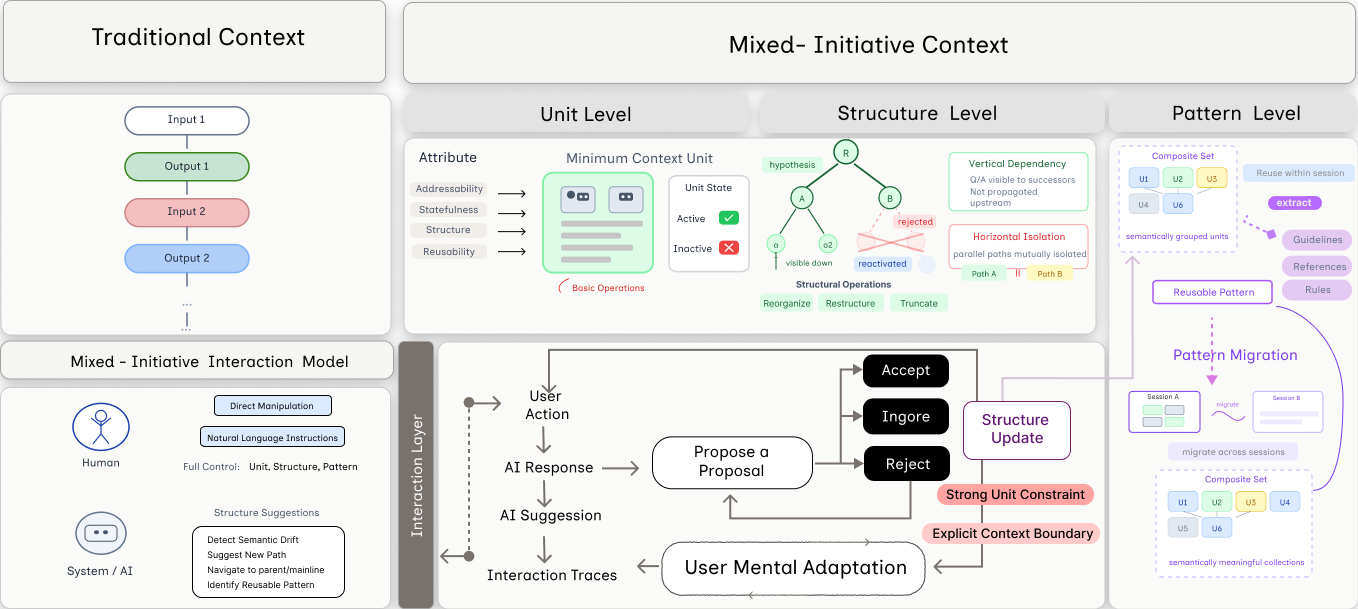
Figure 1: The Mixed-Initiative Context framework. Left: Traditional vs. proposed interaction model. Right: Context hierarchy (Unit, Structure, Pattern) with the interaction layer driving continuous update and adaptation.
This framework aims to eliminate context pollution, cross-thread interference, and fading instructions typical of flat linear stacks, and enable collaboration that reflects the structured, non-linear organization of real user workflows.
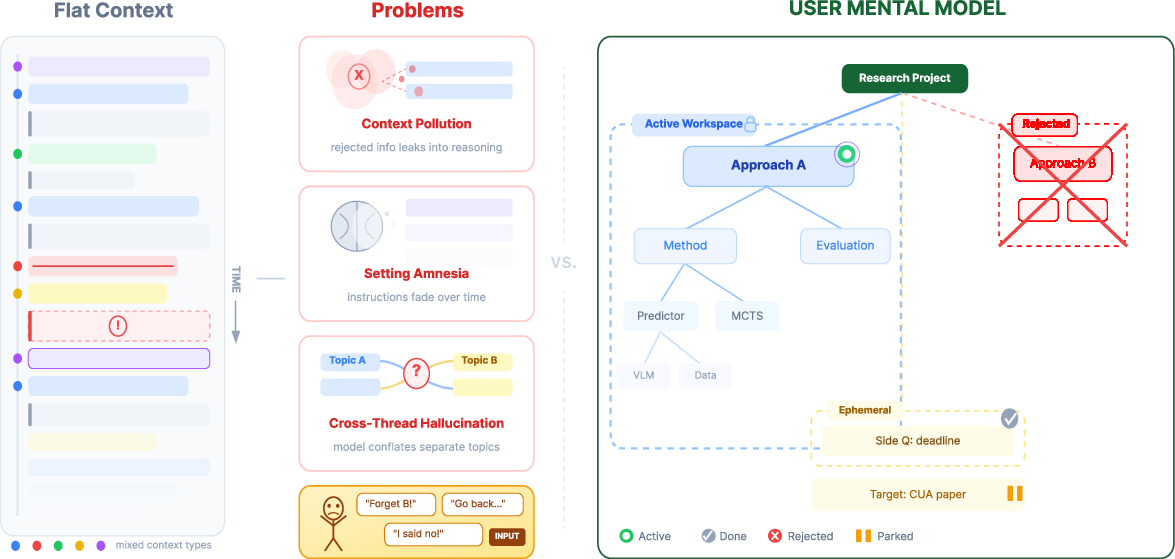
Figure 2: Flat conversational context collapses heterogeneous task elements into a single transcript, resulting in mismatches with user mental organization and context pollution.
System Instantiation: Contextify
To operationalize the MIC concept, the authors present Contextify—a minimal probe system with explicit, node-based context management. Its interface comprises:
- Conversational System: A central chat interface, rendering inputs and outputs as atomic, interactive units.
- Context Map: A synchronized, collapsible, node-based canvas visualizing the hierarchical and parallel structure of the conversation, permitting direct operations (activation, branching, editing, batch include/exclude, rearrangement).
- Pattern Capsule Bar: Mechanism for pattern extraction and cross-session reuse, with human-in-the-loop review.
Background agents (Conversation, Structure, Memory, User Model) support the MIC operations: generating responses, making structure suggestions, summarizing completed paths, and adapting to inferred user structural preferences.
This unmediated design abstains from interpretive or abstracted UI metaphors, allowing direct correspondence between observable data structure and user actions, and enabling organic surface of interaction tensions and preferences.
User Study: Methodology and Empirical Findings
A within-subjects user study (N=6) probed comparative use between baseline linear-chat systems and the Contextify instantiation. Open-ended product-design tasks were selected to naturally elicit branching, comparison, and non-linear workflows.
Key findings:
- Context Management Needs Surface with Task Complexity: All participants—regardless of prior experience—engaged in explicit context structuring and boundary negotiation when enabled by the system.
- Behavioral patterns included: branching for parallel exploration and isolation, batch selection for boundary enforcement, editing/merging for context repair, and rollback for error recovery.
- Diverse User Organizational Models: Users demonstrated distinct management styles (mainline curation, parallel exploration, delegation to AI), with differing preferred granularity and intervention frequency.
- AI Initiative Reception is Highly Contextual: AI's structural suggestions were positively regarded when they supported externalizing organization and offloading mechanical operations but were unwanted if mistimed or overbearing during focused execution. Preferences regarding initiative timing, intensity, and negotiation mechanism varied widely.
- Operability Transforms Collaboration and Control: Making context visible and manipulable—rather than only allowing input-level control—shifted users' mental model of AI from a text generator to a systemic, collaboratively organizing agent, significantly impacting perceived workflow efficiency and control.
- Cognitive Overhead vs. Benefit Tradeoff: Direct manipulation supports were valued in complex, multi-path scenarios but incurred unnecessary cost for simple, linear or low-complexity tasks.
Design Space and Theoretical Implications
The work surfaces four major, non-trivial design tensions for MIC systems:
- Context Unit Granularity and Lifecycle: Granularity must be task- and user-sensitive; coarse units inhibit control, fine granularity increases overhead. Lifecycle management demands richer state (active, inactive, frozen, archived) than naïve include/exclude.
- Legibility and Provenance: Users require both machine-traceable and human-meaningful representations; dual-layer approaches (machine structure + user annotations) may be necessary. Actionable provenance and accountability are essential for trustworthy collaboration.
- Personalized, Phase-aware Mixed Initiative: Initiative should be adaptive to task phase, user working style, and organizational preferences. Rigid policies or binary negotiation mechanisms (accept/reject) are insufficient—richer, gradated negotiation is needed to preserve agency and avoid cognitive displacement.
- Personalization and Governance: The system's capacity to adapt to users' individual structuring preferences via behavioral signal learning must be balanced with robust transparency and privacy boundaries.
Theoretical implications include:
- Reframing context as an explicit collaborative object aligns with distributed cognition and situated action perspectives, decoupling collaborative process from linear, input-centric control [10.1207/S15327051HCI16234_09] [10.1007/s00779-003-0253-8].
- MIC enables new research directions in multi-agent system orchestration, collaborative knowledge building, fine-grained context persistence, and provenance-aware human-AI workflows.
Practical Implications and Future Directions
The MIC paradigm operationalized by Contextify indicates that manipulating context, rather than just inputs or outputs, is central to effective human-AI collaboration in open-ended, exploratory tasks. Future developments may target:
- Generalizing to multimodal settings (code, images, mixed media) with richer context unit semantics.
- Multi-user, collaborative context structuring and initiative negotiation policies.
- Integrating behavioral trace learning into context-aware model architectures, moving beyond prompt-based adaptation toward fine-tuned personalization.
- Systematic evaluation of alternative interface representations and their effects on fluency, mental model acquisition, and cognitive load.
- Extending provenance and explainability mechanisms into the context structuring layer for robust transparency.
Conclusion
The MIC framework and Contextify prototype radically extend the locus of control in human-AI interactions from input-level steering to full context-layer structuring. Explicit, manipulable, and collaboratively organized context supports non-linear, exploratory, and user-aligned workflows, overcoming the pathologies of flat context windows in conventional LLM systems. The empirical evidence supports a reorientation away from input-bound interaction models toward richer, negotiation-based, hybrid initiative paradigms—laying the groundwork for fundamentally new classes of interactive, context-aware, human-centered AI systems.
References:
"Mixed-Initiative Context: Structuring and Managing Context for Human-AI Collaboration" (2604.07121)