Quantum coherent transceivers toward Holevo-limited communications
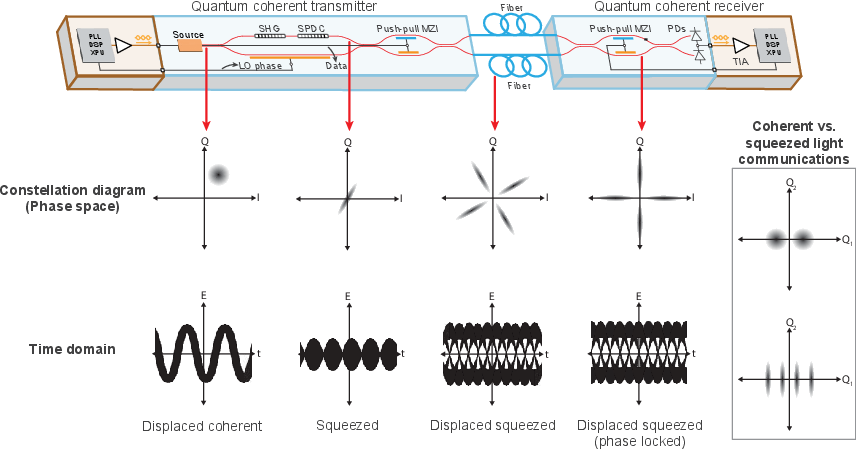
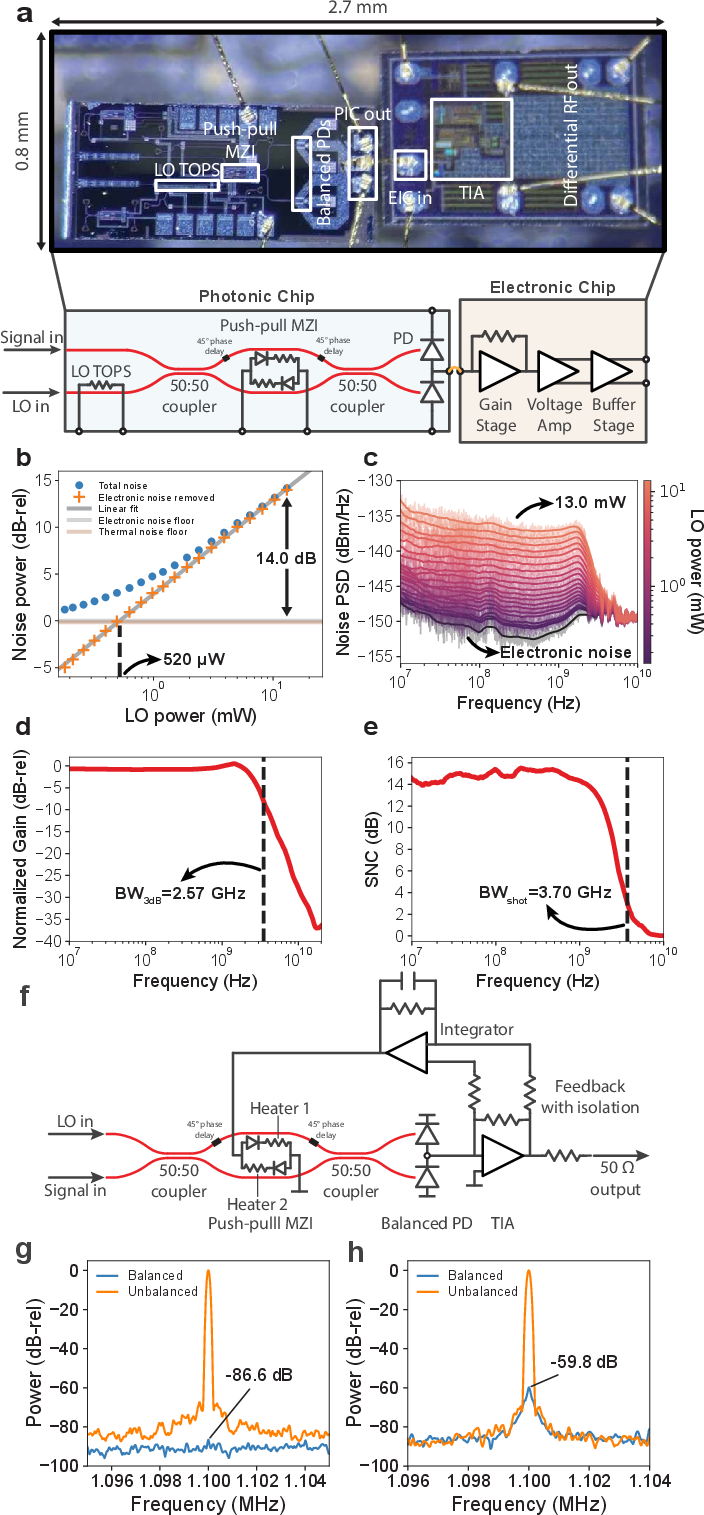
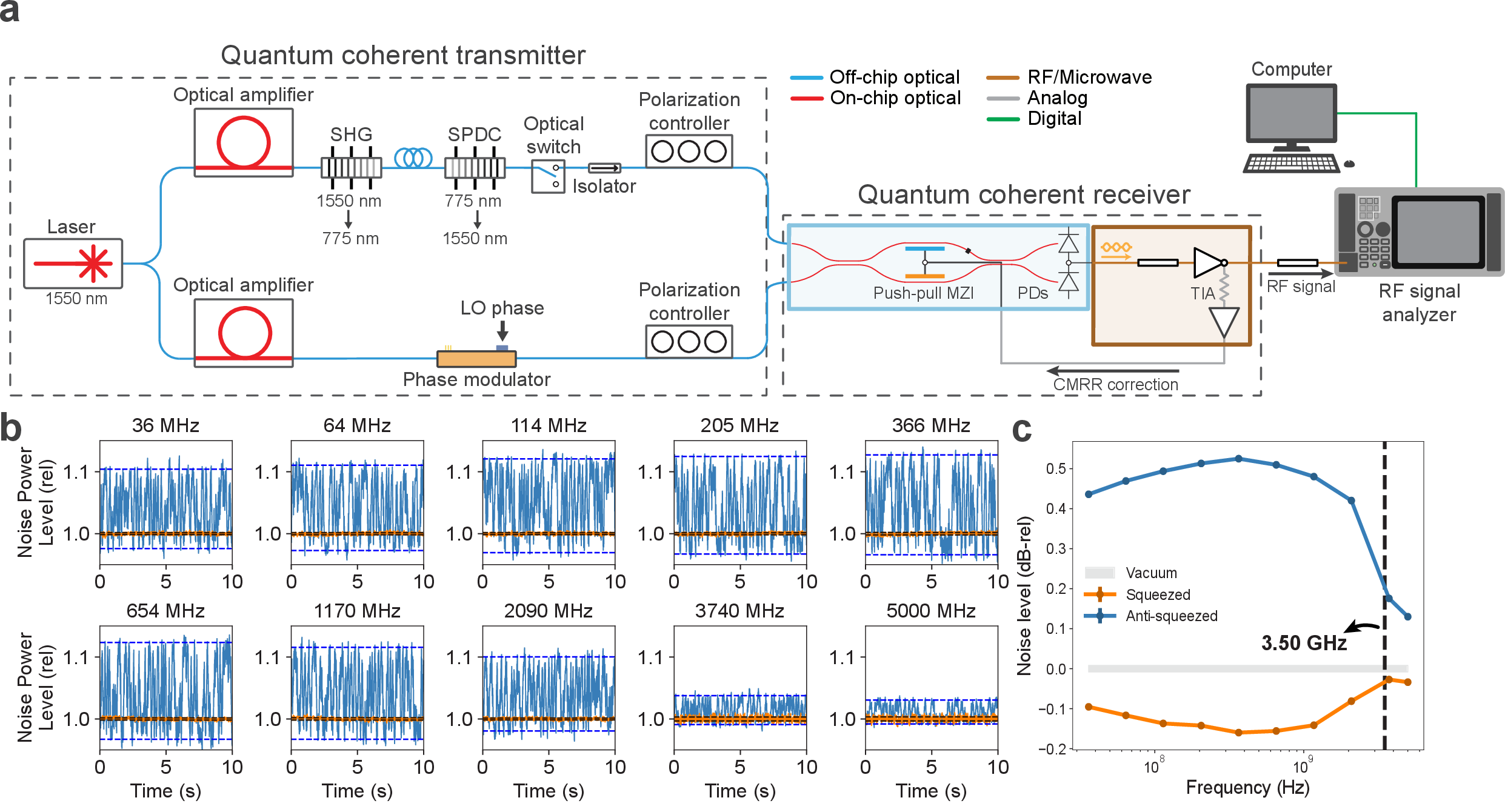
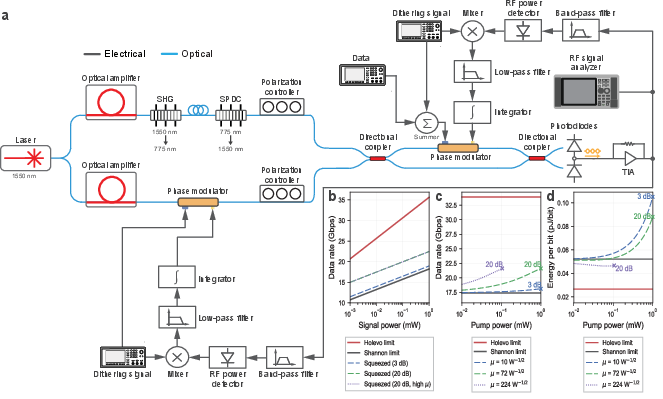
Abstract: The Holevo limit bounds the channel capacity of a communication channel in which information is encoded in quantum states in a Hilbert space at the transmitter and decoded using quantum measurements at the receiver. Saturating the Holevo limit requires quantum-limited transceivers that either generate quantum states of light or employ quantum-limited measurements. Here, we demonstrate an integrated photonic-electronic quantum-limited coherent receiver (QRX) achieving 14.0 dB shot noise clearance (SNC), 520 $μ$W knee power, 2.57 GHz 3-dB bandwidth, 3.50 GHz shot-noise-limited bandwidth, and 90.2 dB common-mode rejection ratio ($\mathrm{CMRR}$). We scale this design to a 32-channel QRX array with median 26.6 dB $\mathrm{SNC}$, and automatic $\mathrm{CMRR}$ correction yielding a median 76.8 dB $\mathrm{CMRR}$ at minimum. Using the integrated QRX and fiber-optic transmitter, we measure $0.15\pm0.01$ dB of squeezing below the shot noise limit, limited by off-chip losses. We propose a squeezed light communication scheme that can surpass the Shannon limit, with a path toward the Holevo limit.
Paper Prompts
Sign up for free to create and run prompts on this paper using GPT-5.
Top Community Prompts
Explain it Like I'm 14
What this paper is about
This paper is about building and testing tiny “quantum‑aware” devices that can send and receive very faint, special kinds of light to move information more efficiently. The big goal is to approach the “Holevo limit,” which is the ultimate theoretical maximum for how much information you can send using light when you take quantum physics into account. The authors show a new chip that can detect quantum features of light at high speeds and across many channels, and they explain how this can boost data rates beyond the usual “Shannon limit” that applies to ordinary (classical) communication.
The big questions the researchers asked
- Can we build a compact, integrated receiver (on a chip) that is quiet enough to “hear” the tiny, quantum‑level fluctuations of light?
- Can we scale that receiver design to many channels at once without losing performance?
- Can this receiver reliably detect “squeezed light,” a special kind of light with reduced noise along one direction?
- Can using squeezed light help push communication capacity beyond the usual classical limit (the Shannon limit) toward the Holevo limit?
How they did it (in everyday terms)
Think of sending messages with light as drawing points on a map, where the map has two directions (like east–west and north–south). Noise (random fluctuations) makes those points blur into fluffy circles, which can make similar symbols hard to tell apart. In “squeezed light,” you can “press” that noise so it gets smaller in one direction (say, east–west) while getting larger in the other (north–south). If you line up your measurements with the quieter direction, you can tell points apart more easily with the same amount of light.
Here’s what they built and tested:
- An integrated coherent receiver (QRX): This chip mixes the incoming signal with a very clean “local oscillator” (a bright reference laser) and compares two photodiodes like two perfectly balanced ears. This “balanced” trick cancels common noise and reveals the tiny differences that carry the data.
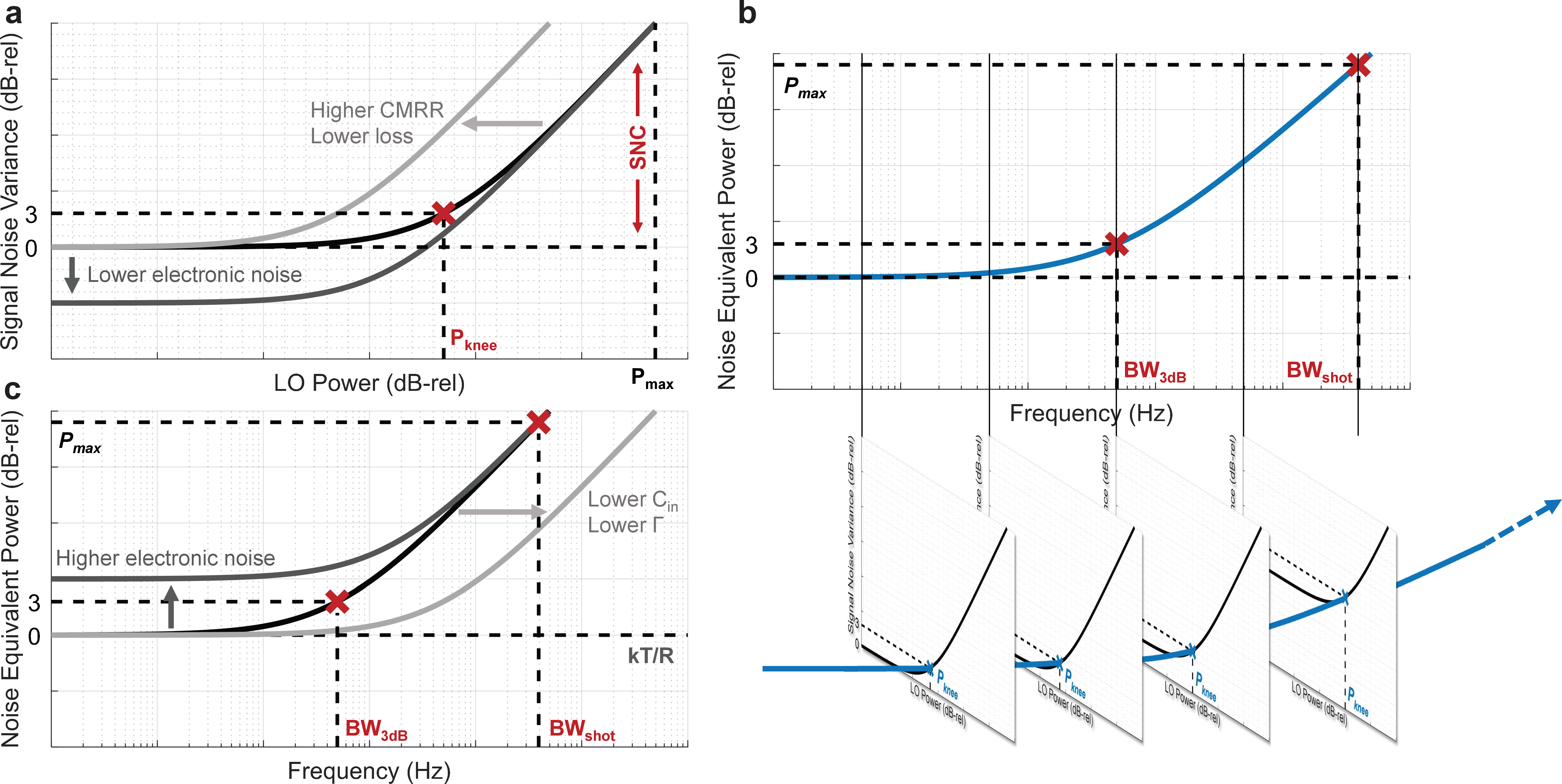
- A design guide: They model how light power, electronic noise, and balancing quality affect performance, and define clear metrics for designers to target.
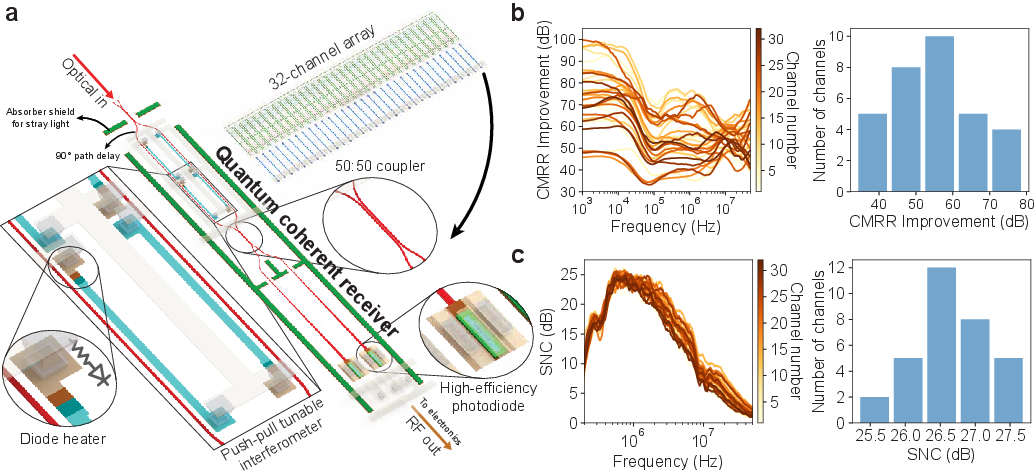
- A 32‑channel array: They replicate the receiver many times on the same chip, adding an automatic balancing loop so each channel can stay perfectly tuned.
- A squeezed‑light test: Using a fiber‑optic transmitter, they create squeezed light (by converting laser light up to a higher color and then down again to produce squeezing) and send it to the chip to see if the receiver can measure its reduced noise.
Helpful analogies for key parts:
- Local oscillator (LO): like a metronome or tuning fork that helps you measure tiny timing and phase differences in the signal.
- Balanced photodiodes: like two matched microphones listening on both sides; subtracting them removes shared background hum.
- “Squeezing” noise: like squeezing a water balloon—one side gets thinner (less noise in one direction), the other side gets fatter (more noise in the perpendicular direction).
What they found and why it matters
The authors report several important performance numbers and demonstrations:
- Single‑channel receiver performance:
- Shot noise clearance (how much above the electronics noise floor the unavoidable quantum “shot noise” is): 14.0 dB
- Knee power (the LO power where shot noise starts to dominate): 520 µW
- 3‑dB bandwidth (classical speed range): 2.57 GHz
- Shot‑noise‑limited bandwidth (quantum‑useful speed range): 3.50 GHz
- Common‑mode rejection ratio (how well shared noise is canceled): 90.2 dB
- 32‑channel array:
- Median shot noise clearance across channels: 26.6 dB
- Automatic balancing significantly boosts the common‑mode rejection across the array, keeping channels uniform and stable
- Squeezed light detection:
- They measured squeezing of about 0.15 ± 0.01 dB below the shot‑noise level (the fundamental noise floor), limited mostly by losses in fiber and benchtop components after the light leaves the chip.
- The on‑chip losses are low enough that, with better off‑chip components, the same receiver could see much deeper squeezing (meaning even better sensitivity).
Why this matters:
- Seeing, and using, sub‑shot‑noise fluctuations means the receiver can tell symbols apart more easily with the same light. That can increase the data rate or reduce the power needed for the same performance.
- The multi‑channel, high‑speed operation shows this approach can scale for practical systems.
What this could lead to
- Toward the Holevo limit: Using squeezed light and quantum‑quiet receivers can push capacity beyond the classical Shannon limit, moving closer to the best possible rates allowed by quantum physics.
- More bits per joule: For low‑power links (like future data centers or chip‑to‑chip connections), this can lower the energy per bit—meaning faster and greener communication.
- Enabling quantum tech: The same receivers help with quantum key distribution (secure communication), quantum random number generation, and other continuous‑variable quantum tasks.
- Scalable hardware: Putting photonics and electronics together on chips is compact and manufacturable, which is crucial for building large, practical systems.
Key terms explained simply
- Shannon limit: The usual ceiling on how much information you can send over a noisy channel using classical measurements.
- Holevo limit: A higher, ultimate ceiling that applies when you use the full power of quantum measurements at the receiver.
- Squeezed light: Light with noise reduced in one measurement direction and increased in the perpendicular one, like squeezing a balloon.
- Coherent receiver: A detector that mixes a signal with a clean reference laser (LO) to read both “directions” (quadratures) of the light wave.
- Local oscillator (LO): A bright, stable laser used as a reference to make precise measurements of the signal’s phase and amplitude.
- Shot noise: The unavoidable “graininess” of light due to its photon nature; the fundamental noise floor.
- Shot noise clearance (SNC): How far above the electronics noise floor the shot noise sits; higher is better for quantum‑sensitive measurements.
- Knee power: The LO power where shot noise starts to dominate over electronics noise, marking the start of quantum‑useful operation.
- Common‑mode rejection ratio (CMRR): How well the receiver cancels noise that appears equally on both photodiodes; higher is better.
- Bandwidth: The frequency range over which the receiver works well; higher bandwidth means faster data.
Takeaway
The team built and tested a chip‑scale, quantum‑level sensitive receiver that works at multi‑gigahertz speeds and across many channels, and showed it can detect squeezed light. This is a concrete step toward communication systems that beat classical limits, moving closer to the quantum‑optimal Holevo limit. In short: smaller, faster, quieter receivers + squeezed light = more information with less power.
Knowledge Gaps
Below is a concise, actionable list of knowledge gaps, limitations, and open questions that remain unresolved by the paper. Each item is phrased to guide future investigation and experimental validation.
- End-to-end link demonstration missing: No experimental transmission with displaced squeezed states (e.g., QPSK) and no measured BER/AIR; demonstrate a full link that surpasses the appropriate Shannon bound and quantify gains under realistic losses and noise.
- Clarify the benchmark “Shannon limit” being surpassed: Explicitly compare against both one-quadrature (homodyne) and two-quadrature (heterodyne) Shannon capacities under measured r and η to verify whether gains exceed C_S1 only or also approach/exceed C_S2.
- High-bandwidth LO phase locking not shown: Replace the 1 Hz phase ramp with a robust phase-locked loop (MHz–GHz bandwidth), quantify phase-error tolerance for squeezed-quadrature alignment, and measure performance degradation vs residual phase noise.
- Large off-chip/system loss dominates squeezing measurement: The measured η ≈ 4.6% (≈13.3 dB system loss) limited squeezing to 0.15 dB below SNL; provide a loss budget (fiber components, interferometers, mode-mismatch, connectors) and demonstrate strategies to reach multi-dB squeezing across GHz.
- On-chip squeezer integration not realized: Squeezed-light generation is off-chip; integrate SHG/SPDC (or alternative χ(2)/χ(3) platforms) with the QRX to reduce loss and validate on-chip squeezing levels and stability.
- Energy efficiency accounting incomplete: Eb analyses do not include pump power for squeezing (SHG/SPDC), LO distribution power, or control electronics; provide end-to-end energy budgets and identify regimes where squeezing yields a net Eb reduction vs classical links.
- Quantitative design thresholds for μ and η: The paper identifies the parametric gain coefficient μ and end-to-end detection efficiency η as key, but lacks explicit inequality thresholds/contours (r vs η, Eb vs μ) defining when squeezed links outperform classical baselines.
- NEP(f) measurement absent: The design guide describes NEP vs frequency and bandwidth definitions (BW_3dB, BW_shot), but no measured NEP(f) curves are provided; supply empirical NEP(f) to validate bandwidth claims and receiver noise models.
- CMRR correction bandwidth is limited: The automatic CMRR correction degrades between 10–100 kHz, likely due to the integrator op-amp; develop higher-bandwidth, on-chip balancing loops and report CMRR vs frequency, LO power, and temperature.
- Long-term stability and environmental robustness uncharacterized: No data on drift, re-lock dynamics, or robustness to temperature and vibration for single and array receivers; characterize stability timescales and required re-calibration overhead.
- Scaling claims for thousands of channels not validated: Provide modeling and experiments for LO power distribution (losses, TPA ceilings in silicon), thermal effects, phase-noise accumulation, and inter-channel crosstalk to establish a realistic maximum channel count.
- Array variability and early saturation: One array element saturates early, setting per-channel LO limits; perform a statistical yield/variability analysis and implement per-channel trimming/AGC to maximize usable LO across the array.
- Frequency-dependent squeezing performance not analyzed: Maximum squeezing occurs around 366 MHz; identify sources of reduced/high-frequency excess noise (electronics, PD capacitance, residual RIN/phase noise) and implement mitigation to flatten/extend the squeezing spectrum.
- Receiver impairment modeling is incomplete: Extend the receiver model to include LO RIN after imperfect CMRR, LO phase noise, PD excess noise (including 1/f corner), frequency-dependent coupler imbalance, and finite photodiode QE; validate against measurements.
- Impact of finite shot-noise clearance on η across band: Provide η_SNC(f) and guidelines for setting s_LO in arrays under power/thermal/TPA constraints, quantifying the capacity loss due to finite SNC vs frequency.
- Operation with modulated signals not verified: Demonstrate shot-noise-limited performance and linearity under strong displacement and high-rate modulation, assessing saturation, intermodulation, and decoherence from technical noise.
- Polarization and mode management not addressed: Characterize polarization sensitivity and implement polarization diversity/control (and mode matching) to reduce coupling loss and improve η in fiber-to-chip operation.
- Joint detection pathway to Holevo limit not detailed: Outline concrete structured receivers combining squeezed-state encoding with collective/joint measurements, and estimate achievable capacity gap to Holevo under realistic η and r.
- Thermal management and photonics–electronics co-design: Quantify parasitic capacitances, heating from LO distribution, and their effects on bandwidth/noise; provide design rules for further scaling without degrading SNC and BW.
- Comparison to state-of-the-art missing: Benchmark the QRX (SNC, BW, NEP, power) against best-in-class coherent receivers to identify the most impactful improvements needed for application-grade systems.
- Pump noise transfer not characterized: Analyze and measure how pump amplitude/phase noise in the squeezer maps onto the transmitted squeezed state and the detected quadrature; develop filtering/lock strategies to suppress pump-induced excess noise.
Practical Applications
Immediate Applications
The demonstrated quantum-limited coherent receiver (QRX), 32-channel array, and the accompanying design/measurement framework enable several deployable use cases today. Below are actionable applications, linked to sectors, and the key assumptions/dependencies that govern feasibility.
- Quantum-limited balanced homodyne/heterodyne detection modules for labs
- Sectors: academia, test & measurement, quantum optics/metrology
- Use: Drop-in replacement for discrete balanced detectors to measure shot noise, characterize squeezed states, and calibrate laser RIN using the provided SNC, CMRR, and knee-power methodology.
- Tools/products/workflows: Compact PIC+EIC QRX modules (single- and 32-channel), self-balancing MZI with automatic CMRR correction, factory test based on LO-sweep slopes and Pknee.
- Assumptions/dependencies: Availability of a low-RIN LO or high CMRR; stable packaging with low on-chip/off-chip loss; PD QE consistent with specs; prevention of two-photon absorption and carrier screening at allowed LO powers.
- High-throughput continuous-variable quantum random number generators (CV-QRNGs)
- Sectors: cybersecurity, finance, cloud services, telecom
- Use: Exploit vacuum/shot-noise fluctuations measured by high-SNC, GHz-bandwidth QRX for multi-Gb/s entropy generation.
- Tools/products/workflows: 32-channel parallel homodyne QRNG appliances; on-chip automatic CMRR for stability; real-time health tests and entropy estimation informed by the noise models in the paper.
- Assumptions/dependencies: Accurate system calibration; robust statistical post-processing; secure hardware design against side-channel leakage; maintained shot-noise dominance across the operating bandwidth.
- Prototyping and scaling of continuous-variable QKD (CV-QKD) receivers with higher key rates
- Sectors: telecom/carrier networks, data centers, defense, finance
- Use: Use the QRX’s >GHz shot-noise-limited bandwidth and high CMRR for higher symbol rates and improved excess-noise budgeting in CV-QKD.
- Tools/products/workflows: CV-QKD receiver front-ends leveraging the QRX array; local-LO architectures; DSP stacks for phase tracking and reconciliation; automated CMRR tuning loops.
- Assumptions/dependencies: Link loss compatible with η targets; compliant security models (local LO, Trojan-horse protections); phase/frequency locking; environmental stabilization.
- Low-OSNR coherent sensing and spectroscopy front-ends
- Sectors: industrial sensing, scientific instruments
- Use: Improve SNR in heterodyne interferometry/spectroscopy via shot-noise-limited detection and 90 dB-class CMRR, reducing LO-induced decoherence.
- Tools/products/workflows: QRX modules integrated into coherent spectrometers and interferometers; in-situ calibration of SNC and NEP over frequency.
- Assumptions/dependencies: Optical source RIN manageable via CMRR; stable LO phase; sufficient optical power within PD/electronics linear range.
- Improved balanced detection for OCT and coherent LiDAR receivers
- Sectors: healthcare (OCT), robotics/automotive (LiDAR), industrial metrology
- Use: Replace discrete balanced detectors to reduce electronic noise and LO RIN contributions; enable lower optical power operation without SNR loss.
- Tools/products/workflows: Integrated receiver heads with self-calibrating MZI; firmware for CMRR maintenance under environmental drift.
- Assumptions/dependencies: Compatibility with existing front optics; spectral matching (e.g., 1.3 µm OCT variants may need process-porting); system-level approvals and safety constraints.
- Multi-channel, phase-stable coherent readout for photonic experiments
- Sectors: academia, quantum information science
- Use: Parallel homodyne arrays for tomography of multimode quantum states, cluster states, and continuous-variable quantum circuits.
- Tools/products/workflows: 32-channel QRX arrays with shared LO distribution; automated CMRR loops per channel; synchronized data acquisition.
- Assumptions/dependencies: LO power distribution without saturating any element; maintained uniformity across channels; thermal and phase stabilization.
- Design and verification methodology for quantum/coherent receivers
- Sectors: EDA for photonics, semiconductor/IP vendors, R&D labs
- Use: Adopt the paper’s metrics and models (SNC, Pknee, BW3dB, BWshot, ηopt×ηSNC) as standard sign-off criteria and as compact models for PIC/EIC co-design.
- Tools/products/workflows: Verification suites incorporating LO-sweep and frequency-dependent SNC/NEP tests; automated CMRR calibration blocks as reusable IP.
- Assumptions/dependencies: Access to calibrated test LOs and metrology; model validation across process corners; reproducible packaging.
- Shot-noise metrology and calibration services
- Sectors: photonics manufacturing, component OEMs
- Use: Use shot-noise slopes and knee-power extraction to qualify PDs, TIAs, and couplers; create factory acceptance tests for balanced detectors.
- Tools/products/workflows: Production test fixtures built around the QRX; automated scripts to extract SNC/CMRR/BWshot.
- Assumptions/dependencies: Traceable references; stable supply and packaging yields.
Long-Term Applications
These applications require further research, integration (e.g., on-chip squeezing), scaling, or maturing of supply chains and standards. They align with the paper’s proposal for squeezed-light communications and paths toward Holevo-limited performance.
- Squeezed-light coherent communications beyond the Shannon limit
- Sectors: telecom, data center interconnects, satellite/FSO links
- Use: Deploy squeezed carriers with LO phase-locked to the squeezed quadrature to raise effective SNR/bit density at fixed photon budgets.
- Tools/products/workflows: Integrated QTX+QRX transceivers with on-chip SHG/SPDC squeezers, displacement modulators, phase locks; DSP for squeezed-constellation demodulation.
- Assumptions/dependencies: High detection efficiency η (optical + SNC) and high parametric gain μ; low total link loss; robust LO phase-locking; secure and stable squeezed sources; component nonlinearity/TPA kept below limits.
- Massively parallel low-photon interconnects approaching Holevo energy efficiency
- Sectors: data centers/HPC, co-packaged optics, on-chip interposers
- Use: Thousands of low-photon channels operated in parallel with quantum-limited receivers to minimize energy/bit; possible future joint-detection receivers to approach Holevo.
- Tools/products/workflows: High-density QRX arrays with shared LO networks; on-package photonics; thermal management and LO power budgeting; eventual joint-detection modules.
- Assumptions/dependencies: Packaging with ultra-low loss and crosstalk; scalable LO distribution without excess RIN; maturing of joint-detection receiver technologies; standards for quantum-enhanced links.
- Fully integrated quantum coherent transceivers (transmit + receive on a chip)
- Sectors: integrated photonics, telecom equipment, quantum networking
- Use: Monolithic QTX (SHG+SPDC squeezing, displacement, modulation) co-packaged with QRX arrays for compact, alignment-free quantum links.
- Tools/products/workflows: Hybrid platforms (e.g., Si/SiN/LN/AlN) for nonlinear optics; wafer-level testing of squeezing; co-integration of PIC/EIC with auto-CMRR and phase locks.
- Assumptions/dependencies: Foundry-grade nonlinear processes; robust pump suppression and isolation; yield and uniformity for large arrays.
- Quantum-enhanced coherent LiDAR and imaging at ultra-low optical power
- Sectors: robotics/automotive, aerospace, defense, scientific imaging
- Use: Leverage quadrature-squeezed illumination and quantum-limited receivers to boost range/contrast or reduce transmit power within eye-safety limits.
- Tools/products/workflows: Squeezed-light transmitters with FMCW or pulsed formats; phase-locked QRX arrays; signal processing tuned to squeezed-noise statistics.
- Assumptions/dependencies: Bright squeezed sources at applicable wavelengths; ruggedization against vibration/temperature; handling of target-induced phase noise and atmospheric turbulence.
- Scalable CV quantum information processing and photonic computing readout
- Sectors: quantum computing, advanced R&D
- Use: High-channel-count homodyne arrays for measurement-based CV quantum computing (cluster states) and error syndrome extraction.
- Tools/products/workflows: Integrated detectors synchronized with squeezed-state sources; low-latency electronics; control of optical loss and phase across many modes.
- Assumptions/dependencies: On-chip generation of large, low-loss cluster states; precise phase control; cryo or room-temperature stability depending on platform.
- Standards and policy frameworks for quantum-enhanced networks
- Sectors: standards bodies, regulators, national infrastructure
- Use: Define performance/interop metrics (e.g., SNC, η, BWshot) for quantum-enhanced receivers; certification pathways for CV-QKD and quantum RNGs; spectrum and safety guidelines for squeezed-light carriers.
- Tools/products/workflows: Compliance test suites based on receiver models and measurement procedures; reference implementations for auto-CMRR and LO security (local LO).
- Assumptions/dependencies: Industry consensus; validation against security proofs; coordination with telecom and cybersecurity standards.
- Co-design toolchains for quantum photonic–electronic systems
- Sectors: EDA/software, semiconductor ecosystem
- Use: CAD models that incorporate quantum-aware figures of merit (SNC, Pknee, ηopt×ηSNC) and automate LO distribution, PD sizing, and CMRR loops.
- Tools/products/workflows: PDKs with quantum device models; simulation libraries for squeezed-state link budgets; automated test/trim procedures at wafer/package level.
- Assumptions/dependencies: Foundry PDK support for nonlinear elements; validated compact models; integration with existing PIC/EIC EDA flows.
- Secure, low-power quantum links for satellites and free-space optics
- Sectors: space, defense, remote infrastructure
- Use: Use squeezed-light communications and high-SNC coherent receivers to extend range or reduce power in FSO channels, with potential CV-QKD.
- Tools/products/workflows: Radiation-tolerant PIC/EIC; acquisition/pointing systems; adaptive optics for phase stabilization; polarization/phase management in turbulence.
- Assumptions/dependencies: Robust environmental resilience; link budgets that preserve η; scalable, space-qualified squeezed sources.
Across these applications, the key dependencies repeatedly emphasized by the paper are:
- Detection efficiency η = ηopt × ηSNC (optical loss + LO-power-limited SNC), which directly controls observable squeezing and capacity gains.
- Parametric gain coefficient μ of the nonlinear waveguide to generate sufficient squeezing at practical pump powers.
- High CMRR to suppress LO-induced decoherence and RIN coupling, especially under multi-channel LO distribution.
- LO phase locking to align with the squeezed quadrature and maintain sub-shot-noise operation.
- Avoiding saturation/TPA and maintaining linearity across the intended LO/signal power range.
- Stable, low-loss packaging and scalable photonic–electronic co-integration to maintain performance at array scale.
Glossary
- annihilation-creation operator: The pair of operators () that lower/raise photon number in a quantized field, central to quantum optics. "the complete quantum treatment with the annihilation-creation operator is required"
- antisqueezing: The increase of quantum noise along the quadrature orthogonal to the squeezed one. "a maximum antisqueezing level of \unit{dB} above the SNL"
- balanced photodiode pair: Two matched photodiodes used in differential (balanced) detection to suppress common-mode noise. "onto a balanced photodiode pair."
- bosonic entropy function: The function g(N) giving the entropy of a thermal bosonic mode, used in the Holevo capacity. "where is the bosonic entropy function"
- bosonic mode: A single quantized electromagnetic field mode obeying bosonic commutation relations. "The complex amplitude of a bosonic mode is "
- carrier screening effect: Nonlinear reduction of photodiode response at high photocurrent due to space-charge effects. "carrier screening effect in photodiodes"
- coherent detection: Interferometric detection using a phase-referenced local oscillator to measure field quadratures. "Coherent detection resolves both quadratures of the optical field"
- coherent states: Minimum-uncertainty quantum states of light resembling classical fields. "Coherent states can saturate this bound"
- common-mode rejection ratio (CMRR): The suppression of signals common to both detector arms in a balanced receiver. "common-mode rejection ratio ()"
- constellation diagram: A phase-space representation of modulation symbols showing amplitude and phase. "Constellation diagram (phase space)"
- end-to-end detection efficiency (η): Overall efficiency accounting for optical loss and finite shot-noise clearance. "and the end-to-end detection efficiency as the two key parameters"
- heterodyne detection: Detection that measures both quadratures by mixing with an LO at a different frequency. "When both quadratures are used with heterodyne detection"
- Hilbert space: The abstract vector space in which quantum states are represented. "quantum states in a Hilbert space"
- Holevo limit: The ultimate upper bound on classical information per channel use with quantum measurements. "The Holevo limit bounds the channel capacity"
- joint detection receivers: Receivers performing collective measurements over multiple modes/symbols to exploit superadditivity. "used with joint detection receivers"
- knee power: The LO power at which the receiver transitions from electronic-noise-limited to shot-noise-limited operation. "520~W knee power"
- local oscillator (LO): A strong, phase-referenced optical field used to interfere with the signal for coherent detection. "local oscillator (LO)"
- Mach–Zehnder interferometer (MZI): An interferometric device for splitting and recombining light with controllable phase. "on-chip tunable MZI"
- mean photon number: The expectation value of photons in a mode, determining signal energy. "where is the mean photon number of the mode."
- noise equivalent power (NEP): The input optical power needed to achieve SNR of 1 in a 1 Hz bandwidth. "Normalized noise equivalent power (NEP) in \unit{dB} as a function of frequency."
- non-classical light: States of light exhibiting properties that require quantization of the field (e.g., squeezing). "Non-classical light encompasses states of light with properties that can be explained only with the quantization of the electromagnetic field."
- parametric gain coefficient (μ): A parameter characterizing nonlinear interaction strength in a waveguide for squeezing generation. "we identify the parametric gain coefficient of the nonlinear waveguide"
- phase space: The plane defined by the two conjugate quadratures used to represent quantum states and modulation symbols. "In phase space, this displacement preserves the anisotropic noise ellipse"
- photodiode quantum efficiency: The fraction of incident photons converted to carriers in a photodiode. "photodiode quantum efficiency"
- photonic integrated circuit (PIC): A chip integrating optical components for routing, modulation, and detection. "photonic integrated circuit (PIC)"
- power spectral density (PSD): Distribution of signal or noise power per unit frequency. "Noise power spectral densities (PSDs) measured at different LO powers."
- quadrature: One of two conjugate components (in-phase and quadrature-phase) of the optical field. "redistributing quantum noise between conjugate quadratures"
- quadrature phase shift keying (QPSK): A modulation with four phase states encoding two bits per symbol. "quadrature phase shift keying (QPSK)"
- relative intensity noise (RIN): Spectral density of fractional intensity fluctuations of a laser. "RIN is the relative intensity noise spectral density"
- second harmonic generation (SHG): A χ(2) nonlinear process converting photons at frequency ω into 2ω. "second harmonic generation (SHG)"
- second quantization: The formalism treating fields as quantized operators with creation/annihilation operators. "including the second quantization of the electromagnetic field"
- shot noise clearance (SNC): The ratio between total noise at maximum LO and the electronic noise floor, indicating shot-noise dominance. "shot noise clearance ()"
- shot-noise-limited bandwidth: The frequency range over which the receiver noise is dominated by optical shot noise. "3.50~GHz shot-noise-limited bandwidth"
- spontaneous parametric downconversion (SPDC): A χ(2) nonlinear process splitting a pump photon into two lower-energy photons, used for squeezing. "spontaneous parametric downconversion (SPDC)"
- squeezed light: Light with reduced quantum noise in one quadrature below the shot-noise limit at the expense of the other. "squeezed light can improve communication performance"
- squeezed vacuum: A zero-mean quantum state with unequal quadrature variances produced by squeezing. "squeezed vacuum state"
- squeezing parameter (r): A parameter quantifying the amount of noise reduction (and increase) in the squeezed (anti-squeezed) quadrature. "For a squeezed state with squeezing parameter "
- sub-shot-noise fluctuations: Noise levels below the shot-noise limit in a measured quadrature. "including the sub-shot-noise fluctuations of a squeezed state."
- superadditive coding gain: The increase in capacity by collective (joint) measurements across multiple symbols/modes. "The gap between the Shannon and Holevo limits arises from superadditive coding gain."
- transimpedance amplifier (TIA): An amplifier converting photodiode current to voltage, used in optical receivers. "32-channel transimpedance amplifier (TIA) array"
- two-photon absorption: A nonlinear loss process where two photons are simultaneously absorbed, limiting high-power operation. "two-photon absorption in the waveguides"
- unitary transformation: A norm-preserving linear operation describing lossless couplers/interferometers in quantum optics. "A lossless coupler with the unitary, U="
- vacuum noise level: The baseline quantum noise corresponding to the variance of the vacuum state. "referenced to the vacuum noise level"
Collections
Sign up for free to add this paper to one or more collections.

