- The paper demonstrates that audience segmentation can effectively restore heterogeneity in LLM social simulations by controlling identifier granularity and parsimony.
- The paper employs rigorous empirical evaluation using US survey data and multiple fidelity metrics to reveal challenges like over-regularization.
- The paper finds that theory-driven, data-driven, and instrument-based segmentation logics yield distinct trade-offs between distributional, structural, and predictive fidelity.
Restoring Heterogeneity in LLM-Based Social Simulation via Audience Segmentation
LLM-based social simulation has gained prominence as a scalable alternative to traditional human data collection, but there is a persistent bottleneck: the collapse of heterogeneity into an "average persona." This phenomenon is underpinned by LLMs’ training objectives (e.g., MLE) and further amplified by methodological practices that fail to explicitly encode subgroup diversity. The erasure of heterogeneity—termed “heterogeneity masking”—is shown to be not merely a technical artifact but a consequence of epistemological typological thinking, contrasting with the population-thinking necessary for nuanced social simulation. Ensuring that simulated data reflects authentic, structured population variance is critical for valid inference and downstream modeling.
Audience Segmentation: Conceptual and Empirical Foundations
The paper proposes formalizing audience segmentation as a core methodological device to restore heterogeneity. Drawing from communication and marketing sciences, segmentation identifies theoretically and empirically meaningful subgroups via combinations of demographic, psychographic, and behavioral identifiers. The utility of this approach hinges not on perfect replication of real-world subgroup distributions, but on recovering theoretically salient, empirically discriminable structures.
Segmentation operates through three methodological axes:
- Granularity: The depth and multidimensionality of identifier specification.
- Parsimony: The trade-off between comprehensive versus compact identifier sets.
- Selection Logic: Justification of identifier inclusion, which may be theory-driven, data-driven, or instrument-based.
Experimental Design and Evaluation Framework
Empirical analysis leverages US climate-opinion survey data (594 human respondents, stratified for representativeness), with "silicon samples" generated using Llama 3.1-70B and Mixtral 8x22B. Six segmentation configurations are evaluated, reflecting different levels of granularity, parsimony, and identifier selection logic (Classic Demo, Theory-augmented at two scales, Data-driven, Instrument-based at two scales). Persona conditioning in prompts is standardized, and output attitudinal responses are direct (Likert-scale integers), facilitating rigorous metric comparison.
A three-dimensional fidelity framework structures evaluation:
- Distributional fidelity: Alignment of generated and empirical response distributions (MAE, KLD, weighted F1, etc.).
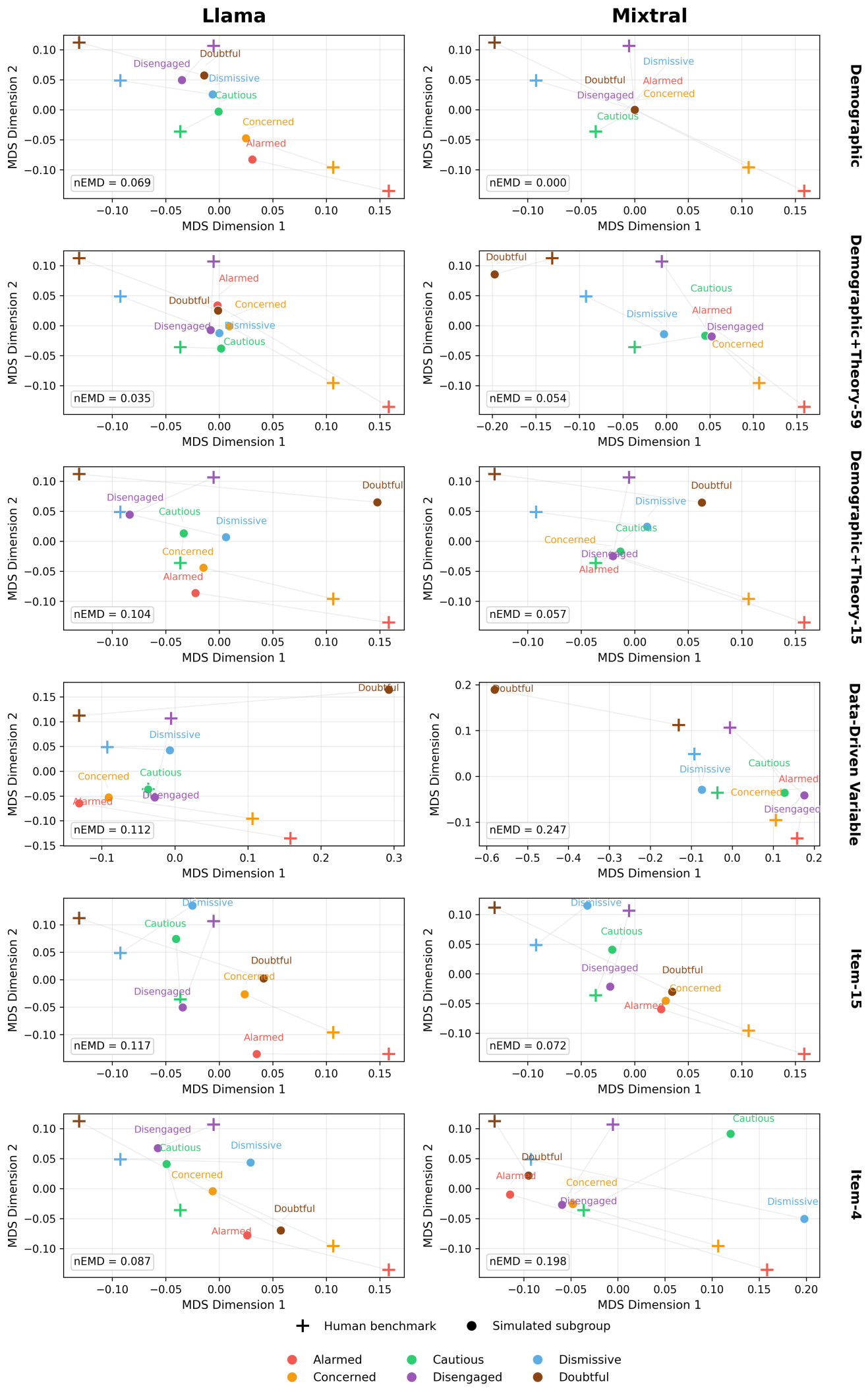
- Structural fidelity: Preservation of within-group variance (SD, CV) and between-group differentiation (nEMD, MDS mapping, Procrustes distance).
- Predictive fidelity: Replication of relational associations between identifiers and outcomes (Cramér’s V).
Key Findings
Granularity Does Not Guarantee Improved Fidelity
Moving from demographic-only (Demo) to moderately enriched (Demo+Theory-15) segmentation improves simulation accuracy, especially in distributional metrics (e.g., KLD decreases, F1 increases), but further expansion to highly granular (Demo+Theory-59) configurations yields inconsistent or adverse effects, particularly on structural and predictive fidelity.

Figure 1: Comparison of distributional fidelity metrics across segmentation configurations and LLMs.

Figure 2: Comparison of structural fidelity metrics across segmentation configurations and LLMs.
The empirical evidence highlights that excessive identifier granularity can trigger over-regularization and mask subgroup differentiation—contrary to prevailing assumptions about "more detailed personas” leading to richer simulation outputs.
Across both theory-driven and instrument-based comparisons, succinct sets of discriminative identifiers (e.g., Theory-15 versus Theory-59, Item-4 versus Item-15) frequently match or outperform comprehensive variants in preserving between-group and predictive relationships. Particularly, compact configurations are associated with better alignment in Cramér’s V with human benchmarks, quantifying the preservation of empirical association strengths.
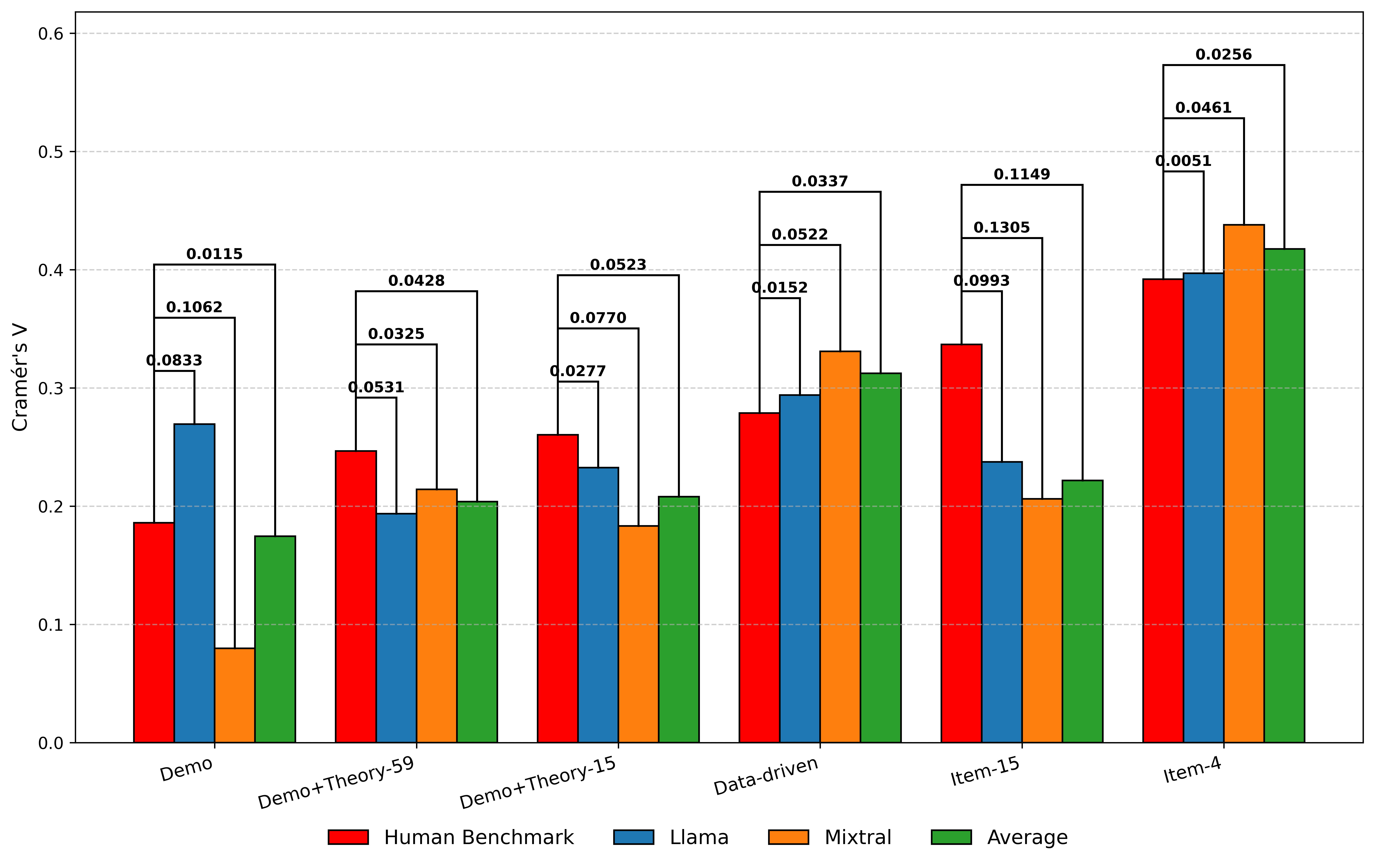
Figure 3: Comparison of Cramér's V across segmentation configurations and LLMs. Brackets and numbers indicate the differences from the human benchmark.
Notably, parsimonious configurations retain, and occasionally enhance, structural variance, indicating that thoughtful identifier selection (rather than mere volume) best fosters subgroup differentiation.
No single configuration simultaneously optimizes distributional, structural, and predictive fidelity. Instead:
Performance gains in one fidelity dimension are observed to sometimes coincide with drawbacks in another, emphasizing the importance of aligning segmentation configuration with specific research priorities.
Residual Over-Regularization Remains
Despite best practices in segmentation, all tested LLMs demonstrate over-regularization relative to human empirical data—i.e., simulated subgroup differences remain systematically compressed. The implication is that even optimized prompt engineering and identifier design cannot completely overcome model-intrinsic variance suppression.
Implications for Social Simulation and AI Research
These findings have significant implications for both the practice and theory of LLM-based social simulation:
- Methodological specification and reporting: Clearly documenting segmentation logic and parsimony thresholds is vital for reproducibility and interpretability in simulation studies.
- Heterogeneity-aware evaluation: Adopting distributional, structural, and predictive fidelity metrics, rather than only aggregate-level comparisons, is indispensable for rigorous validation of simulated social data.
- Model selection and development: Persistent over-regularization underscores the need for future research into modeling techniques and alignment protocols that maintain or even amplify core axes of population variance during both pre-training and fine-tuning.
Substantively, the study demonstrates that the restoration of heterogeneity in LLM-driven "silicon samples" is not solely a question of technical capability but of deliberate methodological design grounded in population-thinking. As simulation increasingly supplements or replaces survey-based social research, these practices will become central to the validity of AI-enabled social science.
Conclusion
Audience segmentation, when informed by theory, empirical discriminability, and selection logic, provides an effective pathway to mitigating the average persona effect in LLM-based social simulation. However, gains are conditional and dimension-specific: indiscriminate increases in identifier granularity do not guarantee better simulation performance, and parsimony, when aligned with task-relevant information, can outperform comprehensive conditioning. Persistent over-regularization across models flags unresolved challenges in preserving authentic subgroup structure and variance, warranting future innovation in architecture and alignment. Ultimately, this research establishes segmentation design, not mere prompt engineering, as foundational to high-fidelity simulation of social heterogeneity.