- The paper introduces a critic-in-the-loop (CITL) pipeline that uses vision-language feedback to iteratively refine frontend code outputs.
- Its methodology integrates an LLM-based generator with a visual critic and LoRA fine-tuning, achieving up to 17.8% improvement in visual fidelity.
- Empirical results on the WebDev Arena dataset demonstrate that multimodal critiques significantly enhance visual design while exposing trade-offs in code-level optimizations.
Vision-Guided Iterative Refinement for Frontend Code Generation
Introduction
"Vision-Guided Iterative Refinement for Frontend Code Generation" (2604.05839) proposes an automated, multimodal approach to enhancing code generation for frontend web development—a domain where solution quality is inherently visual and extends beyond code correctness. The paper introduces a critic-in-the-loop (CITL) pipeline, leveraging a vision-LLM (VLM) as a structured visual critic to provide iterative, targeted feedback after rendering code-generated webpages. This system eliminates the need for costly human-in-the-loop refinement, achieving measurable gains in solution quality. Furthermore, parameter-efficient LoRA fine-tuning is explored to internalize visual critique within the backbone code-generating LLM for increased efficiency.
Methodology
The CITL system integrates multiple actors within the pipeline for natural language-prompted frontend code generation: an LLM-based code generator, a VLM visual critic, a code critic, and an improver LLM, coordinated in a sequential critique-refine-evaluate schema.
The pipeline operates as follows: Given a user task, the generator LLM produces an initial code sample, which is rendered and evaluated by the VLM critic for visual fidelity, aesthetics, and requirement adherence. The visual critique is combined with code-level analysis via the code critic, producing actionable suggestions for code improvements. Each refined solution is re-rendered and scored, with the process iterated for a fixed number of cycles.
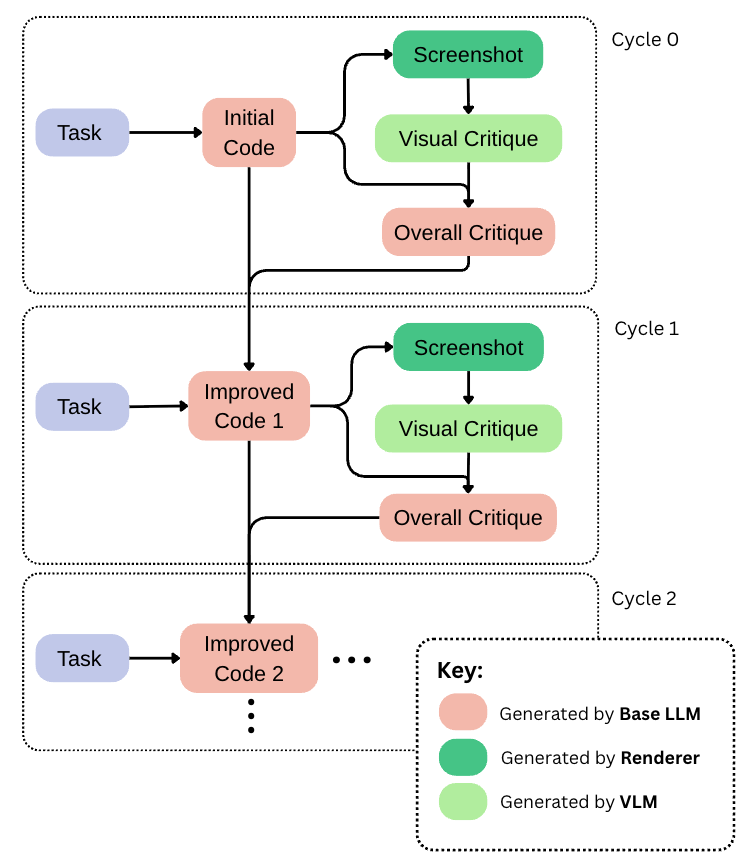
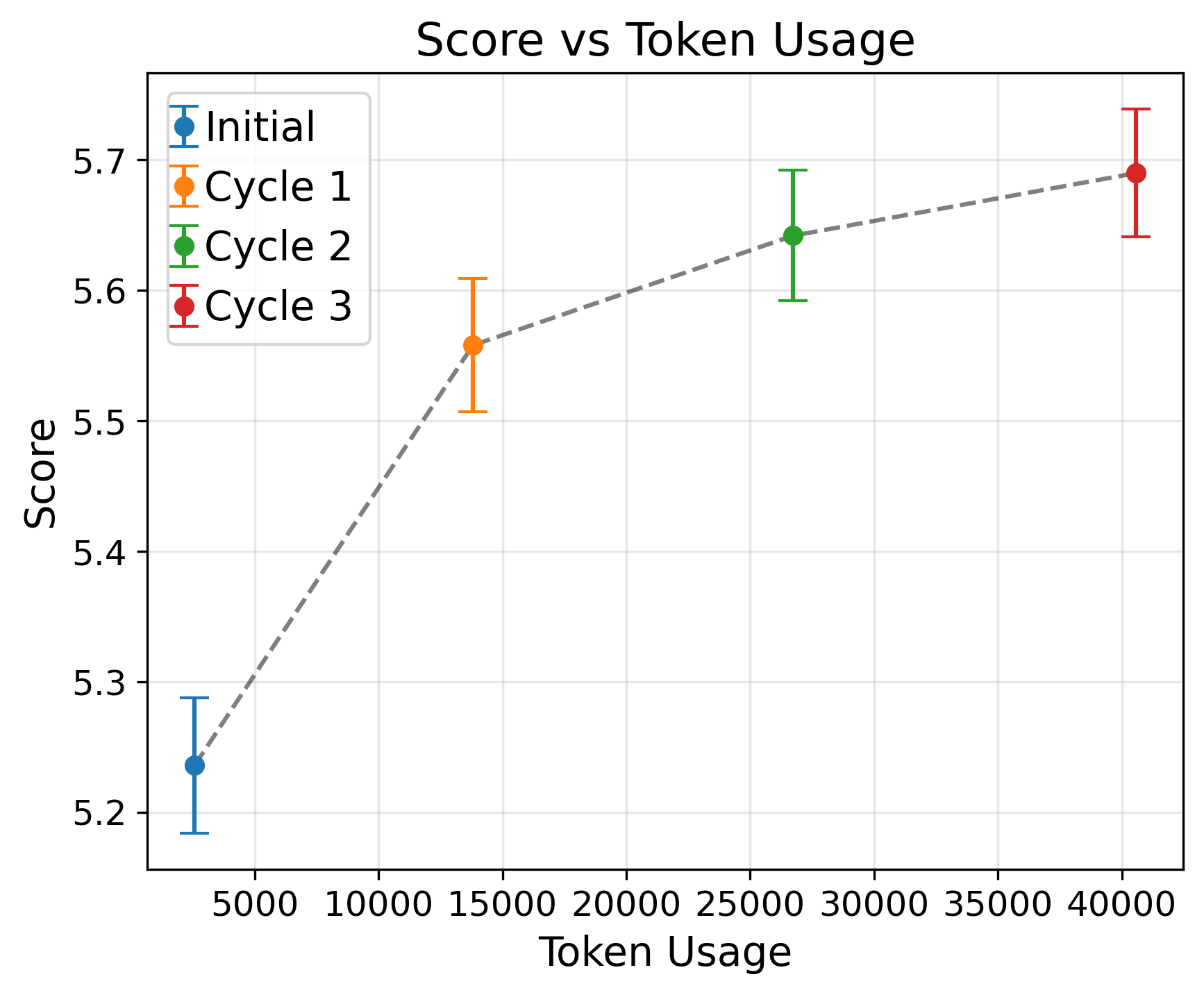
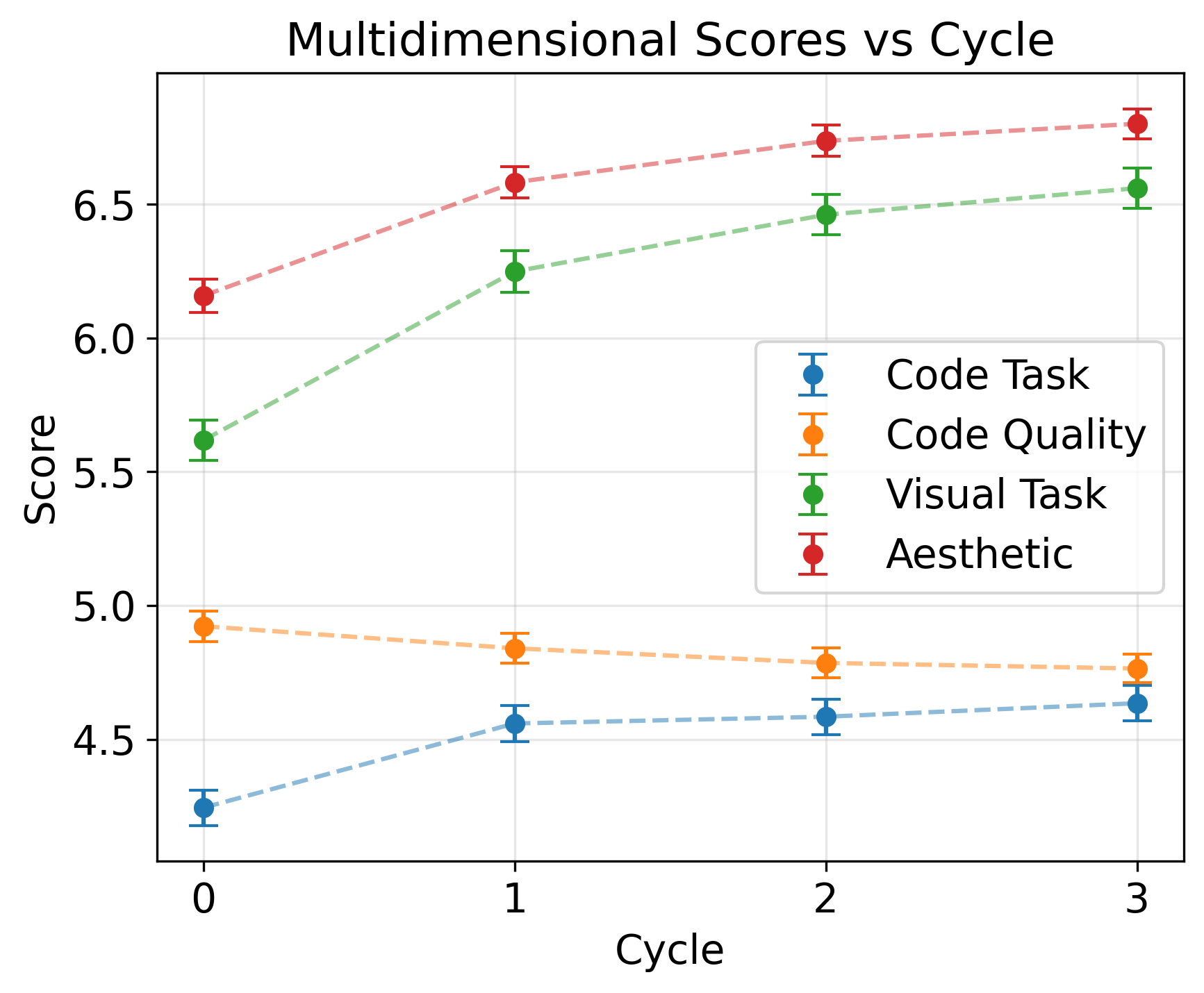
Figure 1: The workflow of the critic-in-the-loop pipeline (left), and empirical illustrations of the quality–efficiency trade-off and multi-dimensional evaluation scores (right).
The methodology adopts a modular evaluation framework (“VLM-as-a-Judge”), scoring each solution on visual task accomplishment, aesthetic quality, code task accomplishment, and code quality, using validated correlation with human preferences. For model efficiency, the CITL process is parallelized using Ray, and LoRA is employed to distill the iterative feedback into the code generator via fine-tuning, converting the multi-round pipeline into a single-step generation process.
Experimental Results
Experiments are structured around the WebDev Arena dataset, utilizing real-world web design prompts and comparing several code generator architectures (Distill-Qwen-14B, Claude 4.5 Haiku, and Claude 4.5 Sonnet). The VLM critic is fixed as Claude 4.5 Sonnet for stability.
The main empirical outcomes are:
- CITL yields strong, iterative quality improvements: For Distill-Qwen-14B, up to 17.8% average score increase is observed over initial generations, with substantial gains in visual metrics. Claude models demonstrate similarly robust gains, particularly in self-improvement regimes.
- Token usage grows with cycles: Each refinement cycle incurs increasing computational cost, highlighting the trade-off between solution quality and efficiency.
- LoRA fine-tuning recovers a nontrivial fraction of CITL’s gains: Fine-tuned code generators capture ~25% of the total CITL improvement while operating at comparable token counts to non-refined baselines.
Breakdown analyses reveal that visual task accomplishment and aesthetics receive the largest boosts, supporting the vital role of vision-grounded feedback. Code quality either stagnates or marginally regresses with iterative refinement, indicating a focus on perceptual amendments at the expense of code-level optimality.
The critical ablation—refinement without a visual/code critic—shows negligible improvement (1–2%), verifying that the advantage is rooted in structured, multimodal critique.
Critique Analysis
A large-scale analysis of generated critique content highlights categorical focus areas: a majority of citl critiques center on visual design polish, completeness of elements, and implementation gaps. Functional aspects such as interactivity and responsiveness are also present but less frequent. This underscores the necessity for multimodal capabilities in robust Web UI code generation, where both visual and code understanding are required for substantive improvements.
Evaluation Framework
The VLM-as-a-Judge evaluation framework is rigorously validated, achieving over 69% agreement with human preferences—significantly surpassing single-dimensional or coarser-grained automated judges. The multi-dimensional, modality-segregated approach proves more discriminative and better aligned with human evaluators, thus supporting its adoption for further research and benchmarking in visually-grounded code generation tasks.
Practical and Theoretical Implications
The presented CITL system demonstrates that iterative, vision-guided critique can substantially improve LLM-based code generation for visually complex domains. While distilled models improve inference efficiency, some refinement gains remain irreducible through distillation, especially in fine-grained visual accomplishment. These findings advocate for the persistent use of multimodal, iterative pipelines or hybrid infrastructures in production web development agents.
Theoretically, the work advances the understanding of multimodal knowledge distillation: only a subset of procedural improvements provided by iterative feedback can be internalized by compact student models, revealing both the promise and limits of “distilled” models for highly multimodal tasks.
Future research directions include leveraging richer intermediate critic signals for distillation (e.g., visual critique trajectories or edit-log sequences) and tightening the loop with human experts, potentially closing the gap to maximum achievable quality.
Conclusion
The paper establishes the efficacy of vision-guided, automated critic-in-the-loop frameworks for frontend code generation, verifying that iterative, structured, multimodal feedback engenders marked improvements in both visual and functional code quality. While distillation via LoRA fine-tuning internalizes partial critic knowledge for efficient inference, best-in-class performance still necessitates full CITL cycles. These insights inform the development of future AI systems for code generation in domains fundamentally grounded in visual outputs.