- The paper introduces a dual-connectivity architecture that boosts entanglement rates by 19.5–37% over single-connectivity in FSO quantum networks.
- It formulates a mixed-integer nonlinear program addressing heterogeneous fidelity, rate, and capacity constraints, solved via an alternating optimization method.
- Simulations confirm near-optimal performance with a 5–19% optimality gap, underscoring significant practical benefits for advanced quantum communications.
Entanglement Rate Maximization in Dual-Connectivity Wireless Quantum Networks
Introduction
This paper addresses the problem of maximizing entanglement generation rates in free-space optics (FSO)-based quantum networks employing a dual-connectivity (DC) architecture. In contrast to conventionally studied single-connectivity (SC) schemes where each quantum user (QU) is connected to a single quantum base station (QBS), the DC arrangement allows each QU to associate with up to two QBSs. This architectural extension is motivated by the need to overcome entanglement resource bottlenecks imposed by QBS generation capacities and the physical impairments intrinsic to terrestrial FSO links. The network model accommodates heterogeneous QU fidelity requirements, entanglement rate demands, and incorporates atmospheric impairments along with quantum memory decoherence.
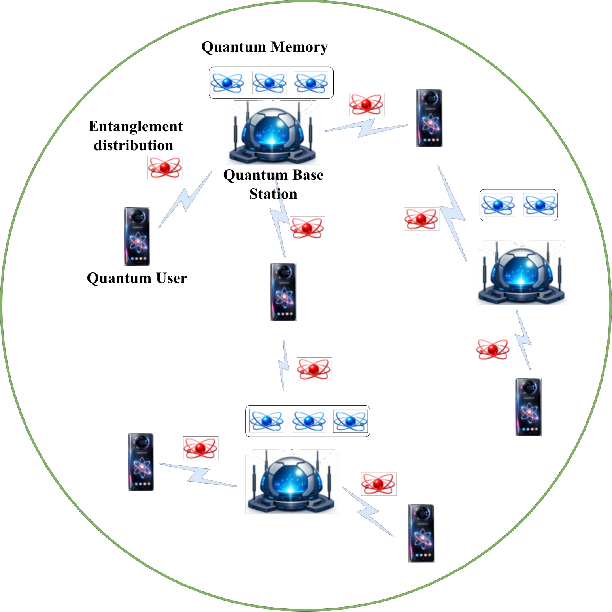
Figure 1: A schematic view of the considered quantum network model with multiple QBSs providing dual connectivity via FSO channels to multiple QUs.
System Model and Channel Impairments
The network comprises N QBSs and U QUs, spatially distributed over a 2D region. Each QBS generates Bell pairs, storing one qubit locally and transmitting the other via an FSO channel. FSO channel quality is determined by atmospheric loss, pointing error, and atmospheric turbulence—each modeled with parameterized statistical distributions. Link quality directly impacts the success probability sn,j of entanglement distribution from QBS n to QU j. Link fidelity further degrades with transmission distance and quantum memory decoherence, modeled via an exponential decay function reflecting practical system constraints.
Entanglement generation capacity at each QBS is bounded (Rnmax), while entanglement rate and minimum fidelity requirements at each QU are heterogeneous. These heterogeneities exemplify realistic quantum communication contexts where application-level demands (e.g., for quantum key distribution or distributed quantum computation) may differ dramatically from user to user. The DC association constraint restricts each QU to a maximum of two QBSs—facilitating spatial link diversity without the complexity of full multi-point connections.
The optimization goal is to maximize the total entanglement rate delivered across the network subject to several practical, non-convex constraints: (i) user-level minimum entanglement rate requirements, (ii) link-level fidelity requirements, (iii) per-QBS generation capacity limits, (iv) DC association limit (at most two QBSs per QU), and (v) integrality constraints for association variables. The full problem is cast as a mixed-integer nonlinear program (MINLP), jointly over association variables xn,j∈{0,1} and continuous entanglement generation rates rn,j.
Solution Method: Alternating Optimization Framework
Given the MINLP structure and strong coupling between discrete association and continuous rate allocation variables, the paper implements an alternating optimization (AO) procedure. The approach decomposes the original problem into two subproblems:
- Rate allocation subproblem: Given fixed associations, find optimal entanglement rates via linear programming.
- Association subproblem: Given fixed rates, find near-optimal association variables by relaxing the integer constraint through a penalized difference-of-convex programming approximation, efficiently solved using the majorization–minimization (MM) technique and linear programming solvers.
The efficacy and convergence of the AO procedure is empirically verified.
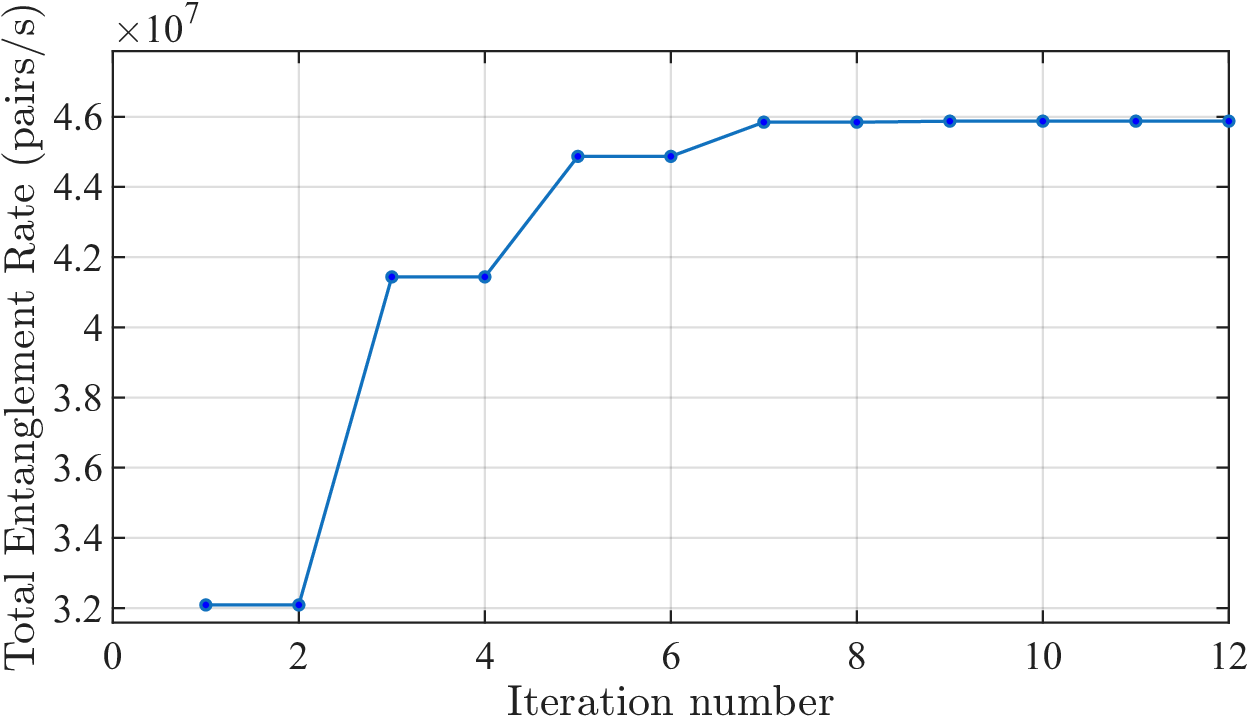
Figure 2: The AO algorithm demonstrates rapid convergence, requiring only 8 iterations for network settings with N=10 QBSs and U=20 QUs.
Numerical Results
Extensive simulations over randomly generated network configurations validate the practical performance of the proposed DC architecture and AO solution. The DC configuration yields a 19.5%–37% increase in total entanglement rate relative to SC baselines under all tested conditions. The performance gap widens particularly as network load increases (i.e., as the number of QUs approaches QBS capacity). The proposed AO approach achieves near-optimality, with an average optimality gap of 5%–19% when compared to exact Gurobi-based solutions, but at significantly reduced computational cost.
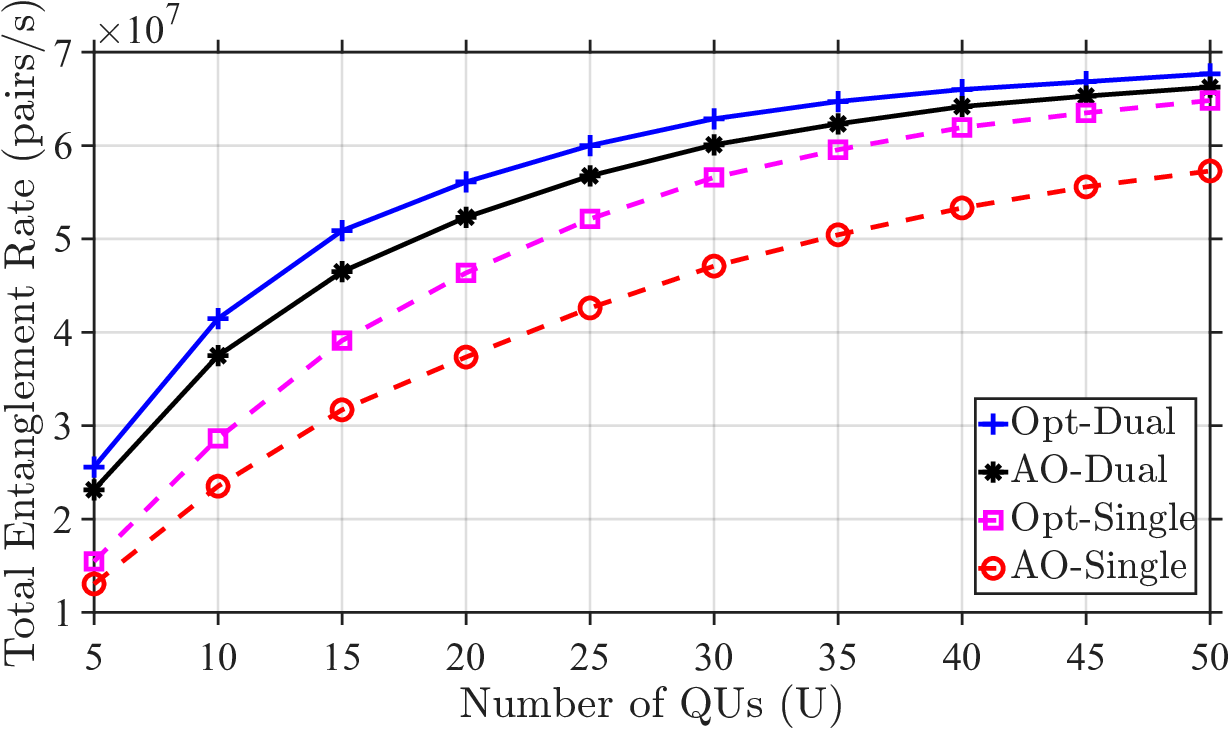
Figure 3: As the number of QUs increases (with U0 fixed), the total entanglement rate rises, and the DC architecture consistently outperforms its SC counterpart.
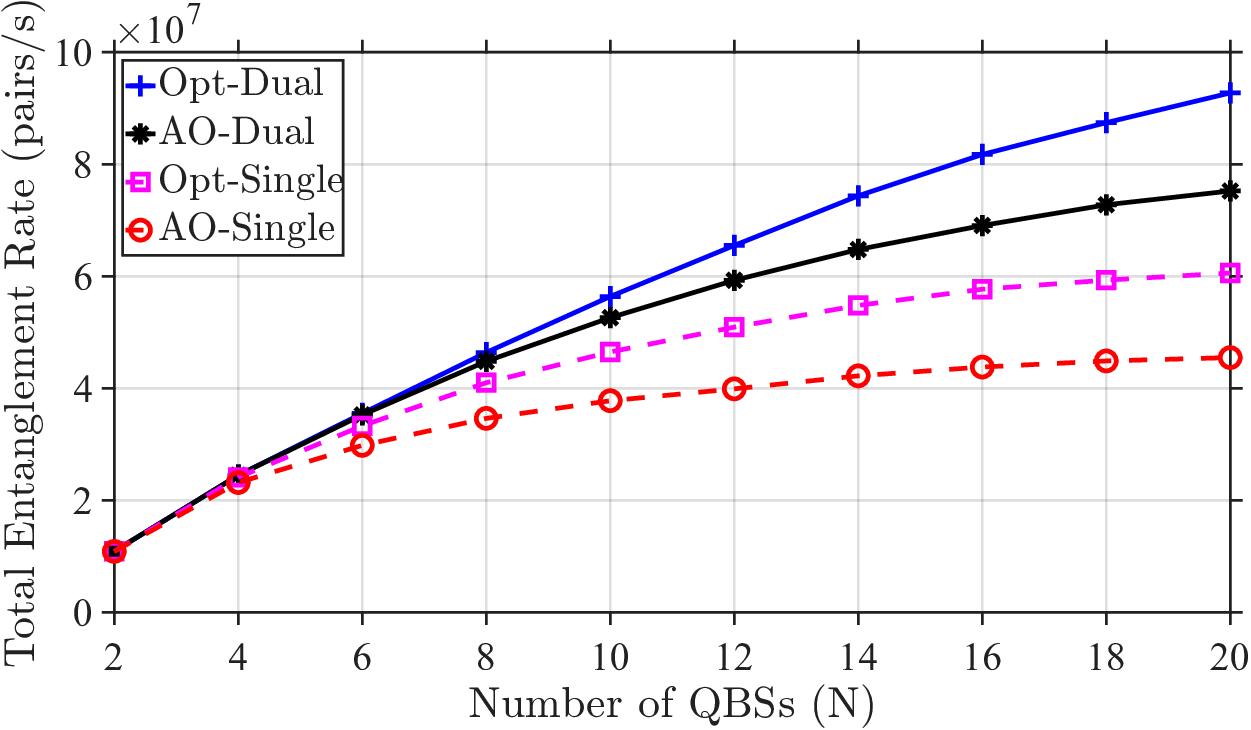
Figure 4: With increasing QBSs (U1 fixed), total entanglement rate improves; the performance advantage of DC over SC architecture is especially pronounced as available QBS capacity grows.
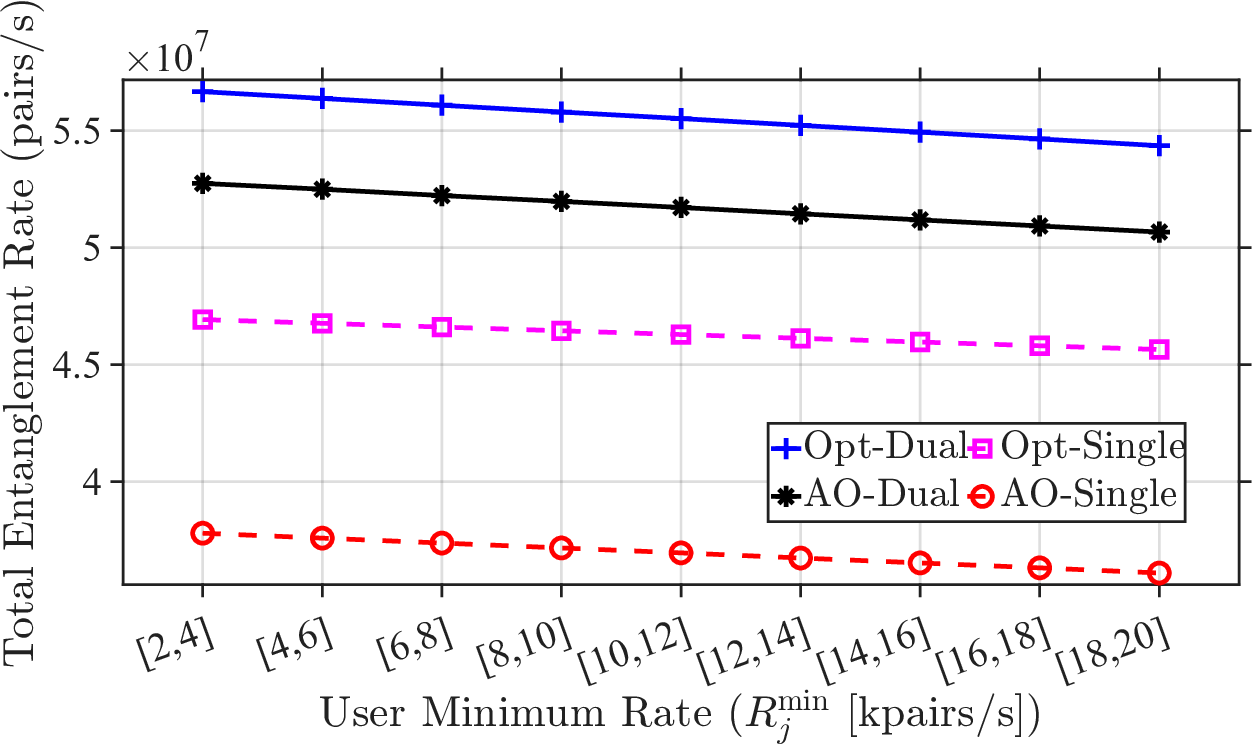
Figure 5: Higher user minimum entanglement rate requirements lead to lower achievable total entanglement rates, yet DC always exhibits superior performance to SC under varying requirements.
Implications and Future Directions
The results strongly support the practical adoption of DC architectures in terrestrial FSO-based quantum networks, particularly in settings where entanglement generation at QBSs is the limiting factor and spatial channel impairments are severe. Dual-connectivity not only improves aggregate throughput but also enables satisfaction of heterogeneous and stringent quality-of-service constraints imposed by advanced quantum applications.
On the algorithmic side, the adoption of penalty-based difference-of-convex programming and MM in the AO framework affirms the viability of scalable resource allocation under high-dimensional, non-convex constraint sets generated by heterogeneous quantum network models.
From a theoretical perspective, the modeling approach reconciles physical layer impairments (e.g., atmospheric turbulence, pointing error) with application-layer requirements (entanglement rate, fidelity), producing a holistic network optimization framework. Extensions to scenarios with dynamic traffic, mobility, or integrated quantum-classical control could further exploit the flexibility of DC schemes.
Conclusion
This work rigorously establishes the superiority of dual-connectivity architectures for maximizing entanglement rates in FSO quantum networks with heterogeneous application demands and practical channel impairments. The AO framework, combining linear programming with MM-based difference-of-convex programming for association variable optimization, achieves near-optimal performance with manageable complexity. The architectural and algorithmic contributions provide a solid foundation for future FSO-based quantum network resource management, particularly as quantum networking infrastructure scales in density and functional sophistication.