- The paper introduces a Lie algebra truncation method that reinterprets expressivity through the effective dimension and Fubini–Study metric spectrum.
- It establishes a geometric capacity–plateau principle that controls gradient variance, thereby enabling provable polynomial trainability in quantum neural networks.
- Experiments on quantum classification and VQE tasks confirm that structured Lie truncation preserves both key generator span and optimization stability.
LieTrunc-QNN: Lie Algebra Truncation and Geometric Control of Quantum Neural Network Trainability
Algebraic–Geometric Framework for Quantum Neural Networks
LieTrunc-QNN introduces a rigorous algebraic–geometric paradigm for designing parameterized quantum circuits (PQCs) by leveraging the structure of Lie algebras and the geometry of the reachable quantum state manifold. Traditional PQC design maximizes parameter count and circuit depth to enhance expressivity, but this invariably worsens trainability due to the onset of barren plateaus—exponential suppression of gradient variance. The LieTrunc-QNN framework instead models PQCs as Lie subalgebras of u(2n), focusing on the induced Riemannian geometry of the set of reachable quantum states.
Expressivity is reinterpreted as the intrinsic (effective) dimension and the Fubini–Study (FS) metric spectrum of the resultant manifold M⊂CP2n−1, not as a function of only parameter count. Crucially, efficient QNN training requires controlling not only representational capacity but also the geometric features that fundamentally govern trainability.
Capacity–Plateau Principle and Geometric Regularization
The work posits a geometric capacity–plateau principle: as the effective dimension of the state manifold increases—thus expanding expressivity—randomly initialized gradients experience exponential decay due to measure concentration, the central cause of barren plateaus. Conversely, contraction of the manifold via structured restriction of the Lie algebra (LieTrunc) constraints the effective dimension, preserving polynomially bounded gradient variance and enabling trainable optimization dynamics.
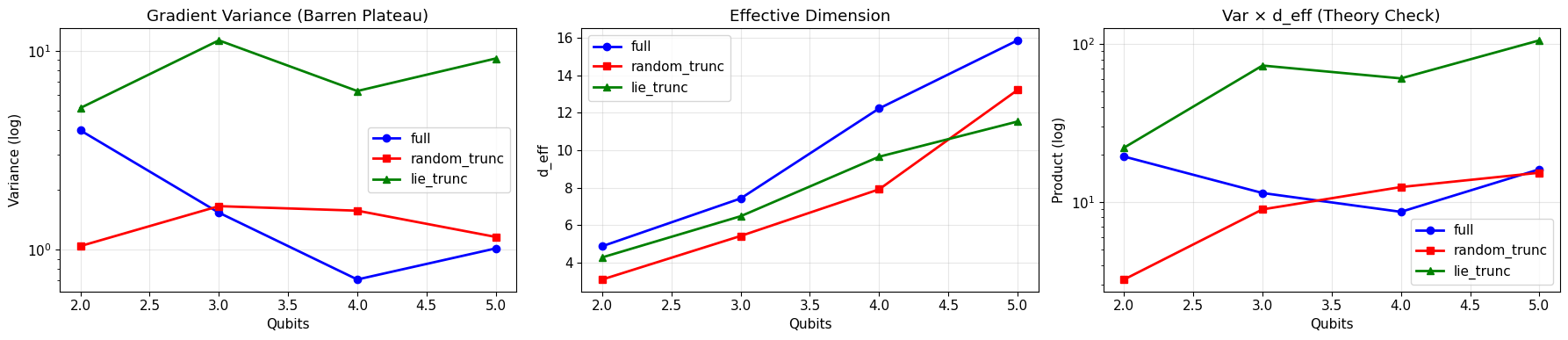
Figure 2: Left panel shows the exponential vanishing of gradient variance in full models; LieTrunc-QNN maintains polynomial decay, while RandomTrunc collapses variance and dimension; the middle and right panels show effective dimension deff and the empirical geometric scaling law Var⋅deff≈constant, validating the geometric theory.
Mathematically, the framework establishes that gradient variance obeys a law of the form
Var(∇θL)∼O(κ(g)deff1)
where κ(g) is the FS metric condition number and deff is its trace-based effective dimension. This gives a direct link between the geometry of the generator-induced manifold (through the metric spectrum and volume) and trainability.
Structured Lie Algebra Truncation: Theory and Guarantees
LieTrunc-QNN advances beyond previous heuristics by selecting Lie subalgebras with controlled adjoint spectrum, ensuring the contraction of the reachable manifold is algebraically structured and does not indiscriminately destroy expressive power. The generator span is maintained, preserving key tangent directions, and the corresponding manifold reduction regularizes the tangent bundle, guaranteeing numerically stable gradients.
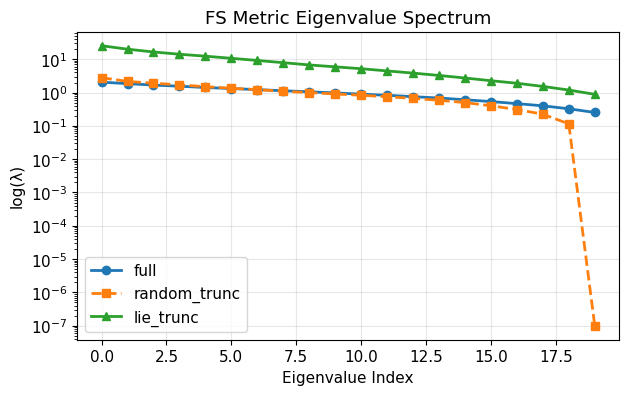
Figure 1: Fubini–Study metric eigenvalue spectra across PQC architectures; RandomTrunc induces severe spectral collapse, destroying expressivity, whereas LieTrunc maintains the full, structured spectrum of the generator span.
The central theoretical results include:
- Barren Plateaus as a Geometric Inevitable: Exponential vanishing of gradient variance emerges as a necessary consequence of high effective dimension, regardless of heuristic circuit details.
- Provable Polynomial Trainability Regime: If the LieTrunc reduction confines deff=O(poly(n)), gradient variance is Ω(n−k), a polynomially decaying and thus trainable regime.
- Functional Dimension from Generator Span: The expressivity and geometric rank are lower-bounded by the dimension of the Lie algebra generated by Hamiltonian terms, not by the raw parameter count. This sharply differentiates LieTrunc from RandomTrunc architectures, which collapse the metric rank and effective dimension, producing functionally trivial models.
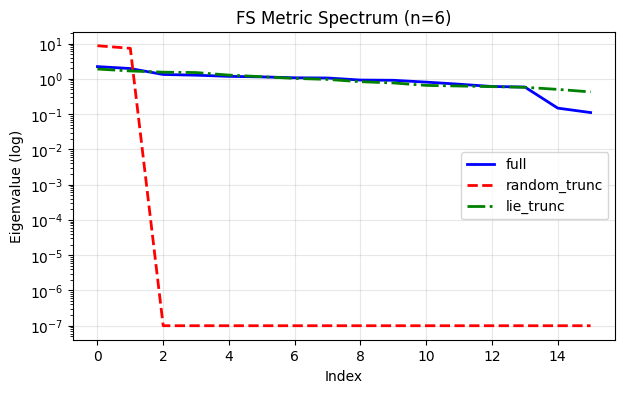
Figure 3: At n=6 qubits, the FS spectrum under RandomTrunc collapses to rank 2, while LieTrunc maintains full rank (M⊂CP2n−10), corroborating that only structured algebraic preservation avoids functional collapse without sacrificing trainability.
Empirically, for M⊂CP2n−11 qubits, LieTrunc-QNN and Full models retain high effective dimension and metric rank, whereas RandomTrunc collapses to M⊂CP2n−12, with a catastrophic drop in expressivity.
Experimental Validation
Extensive simulations on quantum classification and VQE tasks for M⊂CP2n−13–6 qubits confirm the theoretical principles. LieTrunc-QNN consistently:
- Maintains stable, non-vanishing gradients across system sizes, avoiding the exponential suppression encountered by Full PQCs.
- Preserves effective dimension and the full generator-induced metric spectrum, contrasting with the spectral collapse of random truncation.
- Achieves competitive or superior optimization losses.
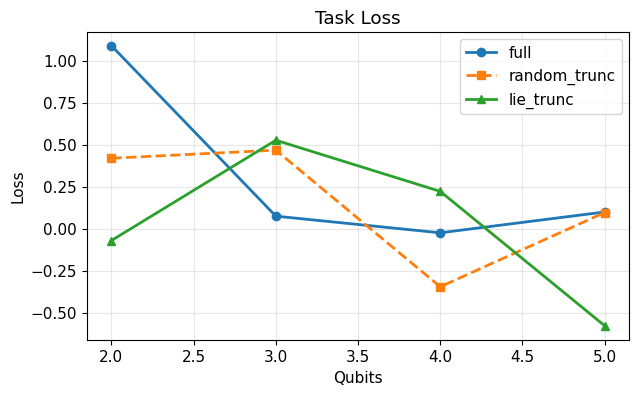
Figure 5: Across all qubit counts, LieTrunc-QNN achieves stable task loss and competitive final accuracy, outperforming unstructured pruning that sacrifices expressiveness for barren plateau avoidance.
The empirical signature M⊂CP2n−14 is observed across architectures, validating the geometric scaling law and theory–practice correspondence.
Generator Span Controls Functional Expressivity
A critical implication is the independence of model expressivity from parameter count—only the algebraic span of the generator set governs the rank of the FS metric and the dimensionality of the optimization landscape:
Implications and Future Directions
LieTrunc-QNN establishes an explicit, theoretically sound geometric design framework for QNNs, bridging quantum Lie algebra, Riemannian geometry, and learning theory. Practically, this enables hardware-tailored PQC architectures that are resilient to noise and decoherence, as compact Lie subalgebra restriction yields bounded quantum evolution and robust gradient landscapes. Theoretically, it repositions quantum ML optimization as a geometric control problem, shifting architectural principles away from heuristic circuit engineering toward rigorous Lie–geometric regularization.
Potential future research trajectories motivated by this framework include:
- Hardware-aware compilation of LiETrunc-restricted PQCs for NISQ processors, optimizing for both expressivity and robustness.
- Spectral analysis of the FS metric for large-scale and hybrid quantum–classical systems.
- Extending the geometric regularization paradigm to quantum error mitigation protocols and robust variational algorithms.
Conclusion
LieTrunc-QNN presents a unifying theoretical and empirical approach for scalable, trainable quantum neural networks by controlling the expressivity–trainability trade-off through structured Lie algebra reduction. By elucidating the geometric mechanisms behind barren plateaus and prescribing algebraically principled circuit architectures with provable polynomial trainability, this work refines both the foundational understanding and practical toolkit of quantum machine learning. LieTrunc-QNN signals a transition toward geometry-aware quantum model design, offering scalable expressivity with inherent robustness suitable for the NISQ era and beyond.